
Best Farm Accounting Software in 2026: 8 Tools Compared

Key facts8 tools compared: Traction Ag, Ambrook, FarmBooks, QuickBooks Online Plus, EasyFarm, Figured…
- 8 tools compared: Traction Ag, Ambrook, FarmBooks, QuickBooks Online Plus, EasyFarm, Figured, Wave, Xero
- Traction Ag (best for: Row-crop farms wanting field-to-finance): ~$100-$500+/mo
- Ambrook (best for: Modern small/mid farms and ranches): $29-$49/mo per entity
- FarmBooks (best for: Offline, security-first bookkeeping): $395 one-time + $85/yr
- QuickBooks Online Plus (best for: Farms with an existing accountant): $115/mo
Most accounting software treats a farm like a coffee shop with bigger trucks. It assumes you sell a product on a calendar month, book the revenue, and move on. Farming does not work like that. You buy seed in March, spray in June, and might not see a dollar of revenue until you sell grain the following January. A herd is inventory that breeds. A combine depreciates over years. And every spring you owe the IRS a Schedule F, not a generic profit-and-loss.
That mismatch is why so many farmers run QuickBooks with a wall of custom categories and a frustrated accountant, or worse, a shoebox of receipts. The good news: a handful of tools now handle crop-year accounting, livestock inventory, and per-field profitability without making you fight the software.
I spent time comparing the main options and reading their actual pricing pages. If you want the short version: Traction Ag is the strongest purpose-built pick for row-crop operations that want field data tied to the books, and Ambrook is the one I'd hand to a small or mid-size farm that wants modern, clean software without a steep learning curve. This guide is for working farmers and ranchers, plus the bookkeepers who support them.
Quick comparison
| Tool | Best for | Price | Standout |
|---|---|---|---|
| Traction Ag | Row-crop farms wanting field-to-finance | ~$100-$500+/mo | Breakeven per acre and bushel |
| Ambrook | Modern small/mid farms and ranches | $29-$49/mo per entity | Built-in banking and bill pay |
| FarmBooks | Offline, security-first bookkeeping | $395 one-time + $85/yr | Enterprise and Schedule F reports |
| QuickBooks Online Plus | Farms with an existing accountant | $115/mo | Ecosystem and accountant familiarity |
| EasyFarm | Multi-enterprise farms, no subscription | $650-$1,450 one-time | Detailed cost-center tracking |
| Figured | Forecasting on top of Xero/QBO | $90/mo + fields | Budgeting and scenario planning |
| Wave | Tiny or startup farms | Free (Pro $16/mo) | Genuinely free core accounting |
| Xero | Tech-forward farms and advisors | $20-$80/mo | Clean ledger plus Figured pairing |
Traction Ag
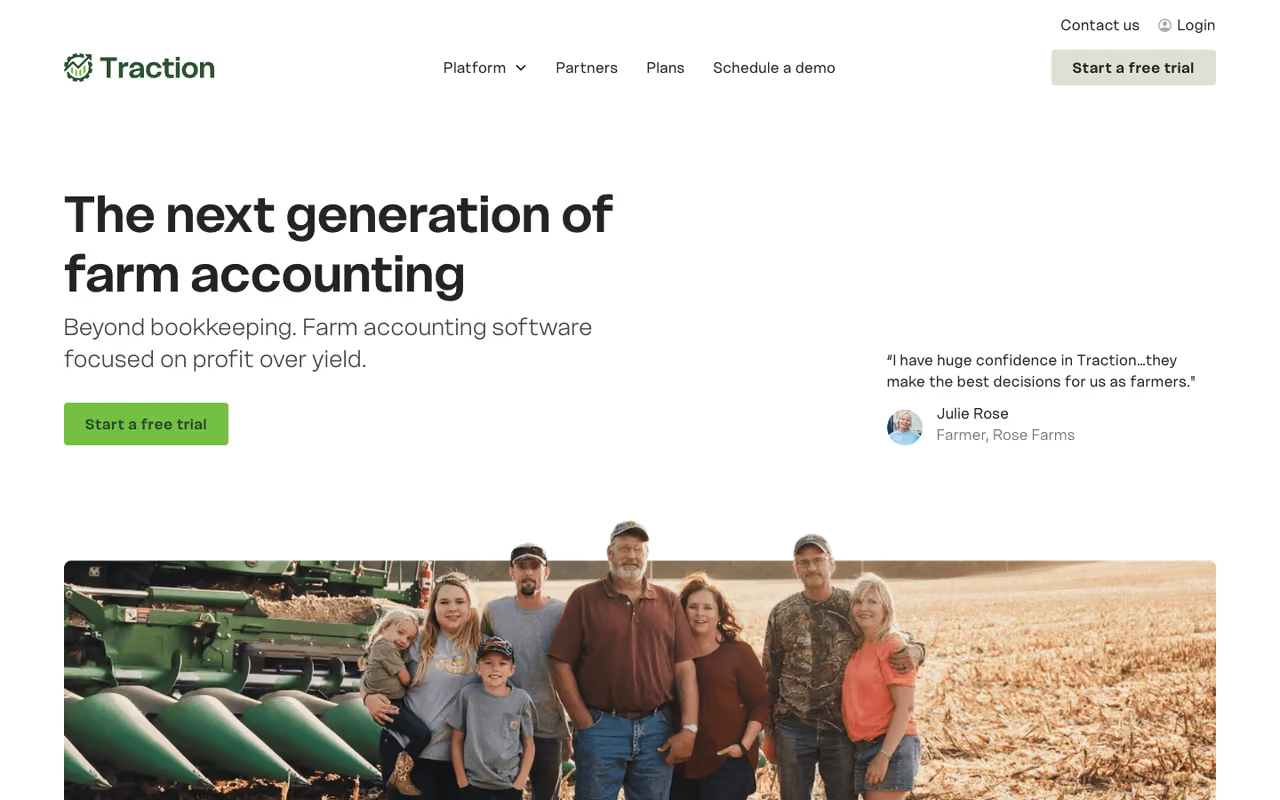
Traction Ag is the closest thing to software written by someone who has actually farmed. It is a cloud accounting platform built around crop-year logic instead of the calendar, and after it acquired Conservis in 2023, it folded field-level farm management into the same system. That connection is the whole point: your agronomic data feeds your financials, so you can see breakeven per acre and per bushel rather than one lump number at year-end.
Who it's best for: row-crop operations, especially corn and soybean farms running a few hundred to several thousand acres, that want to know which field or which crop actually made money.
Pick Traction Ag if you run a row-crop operation, corn and soybeans especially, and want breakeven per acre and per bushel from agronomic data feeding your books. It is built for crop farms first, and the price climbs fast once you add entities and payroll.
Pricing is quote-based and lands roughly in the $100 to $500-plus per month range depending on entities, acreage, and add-ons like payroll. Traction recently added monthly billing alongside the old annual-only model, which helps if you'd rather match the payment to your cash flow. Their integrated payroll for up to five employees starts around $1,400 per year.
The standout is reporting. You get real-time cash and accrual views, tax-ready Schedule F output, and inventory tracking that understands grain in the bin versus grain sold.
The catch: it is built for crop farms first. If you run a diversified vegetable operation selling at farmers markets, or a small cattle outfit, a lot of the field-record machinery is overkill you're still paying for. The price also climbs fast once you add entities and payroll.
Ambrook
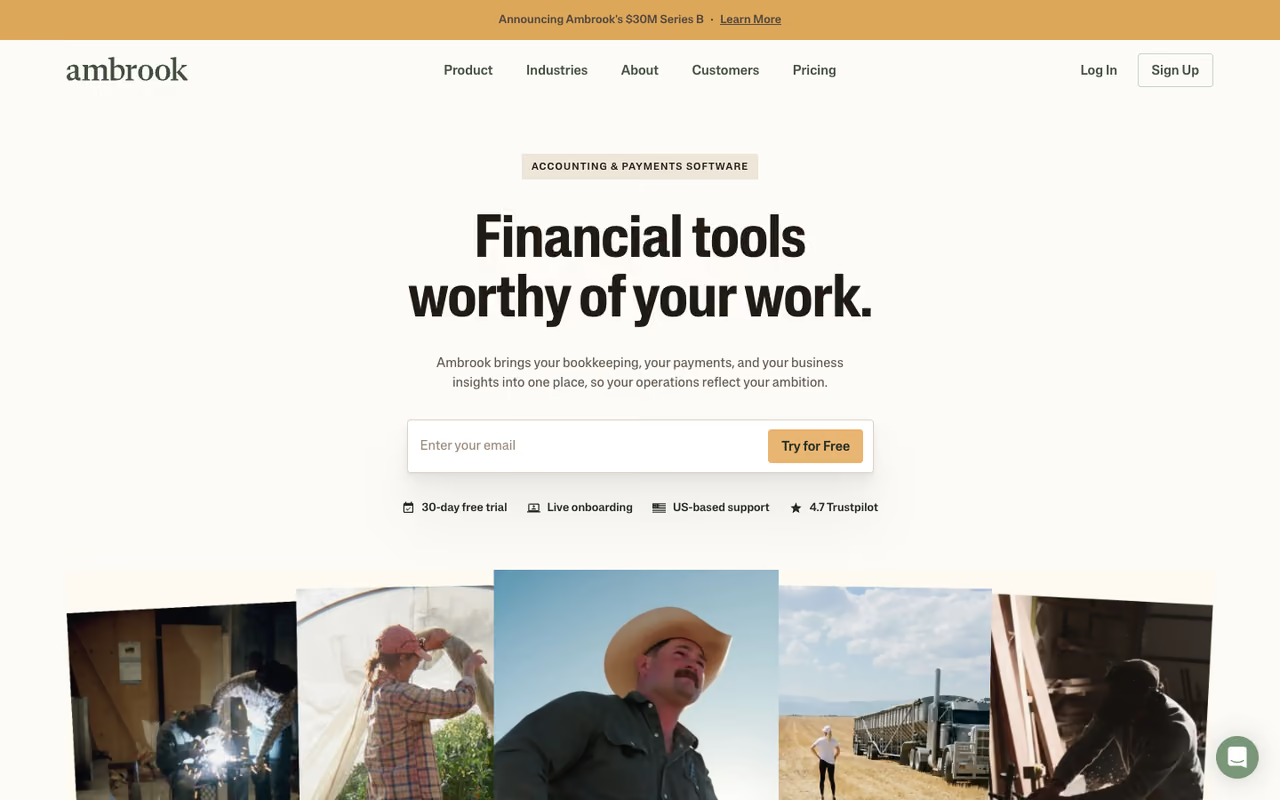
Ambrook earned the nickname "QuickBooks for cowboys," and it fits. It is the most modern-feeling tool here, combining bookkeeping, bill pay, expense tracking, and an actual business bank account (the Ambrook Wallet) in one place. Transactions get auto-categorized and mapped to Schedule F, and you can split costs and tag profitability by location, project, crop, or herd.
Who it's best for: small to mid-size farms and ranches that want clean, fast software and like the idea of banking and books living together.
A modern, clearly priced choice for small to mid-size farms and ranches that like banking and books together, from $29 per month per entity. Per-entity pricing adds up across several legal entities, and it leans toward US farmers.
Pricing is refreshingly clear. Per the Ambrook pricing page, the Build plan is $29 per month per entity (3 users, standard ACH), and Pro is $49 per month per entity with unlimited users, cost-of-production tracking, accounting-integrated inventory, and profitability by location or project. A Full Service tier with hands-on monthly reconciliation is custom-priced.
The standout is how little friction there is. Receipt scanning is unlimited, bill forwarding works, and the Schedule F alignment means tax prep isn't a frantic January reconstruction.
Where it falls short: the per-entity pricing adds up if you run several legal entities, and the banking-first design means you get the most value when you actually move money through Ambrook. It also leans toward US farmers, so the tax fit is weaker if you're abroad.
FarmBooks
FarmBooks is the desktop holdout, and for some farms that is exactly the appeal. Built by Sanders Software Consulting specifically for agriculture, it runs on your own Windows machine with no subscription and no dependency on a cloud login working when you're standing in a barn with bad signal.
Who it's best for: farmers who prefer on-premise software, want predictable one-time cost, and care about deep Schedule F and enterprise reporting.
The desktop holdout for farmers who want a $395 one-time cost, no cloud dependency and deep Schedule F reporting. It is Windows-only with a dated interface and no real mobile access, so it is not for entering expenses from the field.
Pricing is a $395 one-time fee for a single farm, which includes the first year of license and maintenance, then $85 per year after that. A second farm runs $200, and a third or more is $150 each. There's a 30-day free trial. Compared to a $49-per-month cloud tool, you break even in well under a year.
The standout is its reporting depth for the price. It tracks crops, livestock, inputs, and activity-level costs, and produces clean Schedule F-ready output that accountants like.
The catch: it's desktop-only and Windows-only, the interface looks like software from a decade ago, and there's no real mobile or live cloud collaboration. If you want to enter expenses from your phone in the field, this isn't it.
QuickBooks Online Plus
QuickBooks isn't built for farming, and I'll say that plainly. But it's also the system your accountant already knows, integrates with nearly everything, and can be bent into farm shape. When you set up the company file as agriculture, ranching, or farming, QuickBooks generates a chart of accounts that roughly maps to Schedule F categories. You still do manual setup to track inputs back to the tax form.
Who it's best for: farms that already work with an accountant on QuickBooks, or operations that want a general ledger plus a giant app ecosystem.
QuickBooks Online Plus is $115 per month, which is the tier most farms need for class and location tracking (the closest stand-in for enterprise tracking).
The standout is the ecosystem. If you need payroll, inventory add-ons, or a specific bank feed, something connects to QuickBooks.
A general ledger bent into farm shape, sensible if your accountant already lives in QuickBooks and you want its huge app ecosystem. At $115 per month for Plus, you still do the farm-specific work yourself, with no crop-year accounting or per-acre profitability.
Where it falls short: no native crop-year accounting, no livestock-as-inventory logic, and no per-acre profitability without bolt-ons like Figured. You're paying for a generic tool and doing the farm-specific work yourself. For a deeper general comparison, see our guide to the best accounting software for small business.
EasyFarm
EasyFarm is the other no-subscription veteran. It's a static desktop program (it literally ships on a flash drive) aimed at farms that want detailed operational and cost-center tracking without recurring fees.
Who it's best for: multi-enterprise farms (think a grain operation plus cattle plus custom work) that want to track costs separately per enterprise and own the software outright.
Choose EasyFarm if you run several enterprises, such as grain plus cattle plus custom work, and want to own the software outright and slice costs by field, crop, herd or job. The real features sit in higher tiers, so the $650 starting price misleads.
Pricing is one-time, ranging from $650 for the Lite edition up to $1,450 for Platinum, with several tiers in between (Plus at $750, Premier at $1,250). That's a bigger upfront hit than FarmBooks, but again, no monthly bill.
The standout is enterprise-level cost tracking. You can slice costs by field, crop, herd, or job, which is genuinely useful if you run several distinct operations.
The catch: like FarmBooks, it's dated desktop software with a learning curve, limited cloud or mobile access, and a look that won't win any design awards. The higher price tiers are where the real features live, so the "starts at $650" number can be misleading.
Figured
Figured isn't standalone accounting. It's a planning and forecasting layer that sits on top of Xero or QuickBooks Online and adds serious agricultural budgeting, production tracking, and scenario modeling. Think of it as the financial-planning brain bolted onto your ledger.
Who it's best for: farms (and farm advisors) that already use Xero or QBO and want real budgeting, cash-flow forecasting, and "what if cattle prices drop 15%" scenario planning.
Per the Figured pricing page, Farm Manager is $90 per month for a single farm and includes 25 fields, with additional fields billed in 50-field bundles at $90. Advisors get a Farm Reporter tier at $40 per month. Remember this stacks on top of your Xero or QuickBooks subscription.
The standout is forward-looking planning. Most tools here tell you what happened. Figured helps you model what's about to.
Where it falls short: it's not a complete solution on its own, so you're paying two subscriptions. And it's overkill if you just want clean books and a Schedule F, rather than multi-year projections.
A planning layer for farms and advisors already on Xero or QuickBooks, strong on budgeting, cash-flow forecasting and scenario modeling. It is not standalone, so you pay for two subscriptions, and it is overkill if you just want clean books and a Schedule F.
If you'd rather start with the underlying ledger, our roundup of the best bookkeeping software covers Xero and the alternatives in depth.
Wave
Wave is the budget answer, and it's a legitimate one for the right farm. The core accounting and invoicing are genuinely free, with no trial clock, no feature throttling on the basics, and unlimited invoices.
Who it's best for: very small or startup farms, market gardeners, and side operations that need to track income, expenses, and send a few invoices without paying for software they'll barely use.
The budget answer for very small farms, market gardeners and side operations, with free core accounting and unlimited invoices. It has zero farm-specific features, so expect to outgrow it once the operation gets complex.
Pricing: the Starter plan is free. A Pro plan runs $16 per month (or $170 per year) and adds things like auto-import of bank transactions and unlimited receipt scanning. Payroll is a separate add-on starting at $40 per month plus $6 per employee. The real cost shows up in payment processing if customers pay invoices online (2.9% plus $0.60 per card transaction).
The standout is the price-to-capability ratio. For a farm clearing five figures, free accounting that does the job is hard to argue with.
The catch: zero farm-specific features. No Schedule F mapping, no livestock inventory, no per-field tracking. It's general small-business accounting that happens to be free, so you'll outgrow it the moment your operation gets complex.
Xero
Xero deserves a mention on its own, not just as Figured's host. It's a clean, modern cloud ledger that tech-forward farms and their advisors like, with strong bank reconciliation and an open API.
Who it's best for: farms that value a tidy general ledger and plan to pair it with Figured (or a farm-savvy bookkeeper) for the ag-specific layer.
Xero's US plans run roughly $20 per month for Early up to about $80 for Established, with the mid Growing tier being where most small businesses land. It's competitive with QuickBooks and often friendlier to use.
The standout is the platform. The combination of Xero plus Figured is arguably the most flexible setup here for a planning-heavy operation.
Where it falls short: same core issue as QuickBooks. Out of the box it knows nothing about crop years or livestock. You're building the farm layer yourself or paying for Figured on top.
A tidy, modern ledger for tech-forward farms and their advisors, best paired with Figured for the ag layer. On its own it knows nothing about crop years or livestock, so you build the farm layer yourself or pay for Figured on top.
How to choose
Don't start with features. Start with two questions.
First, is your farm crop-heavy with real acreage and a need to know profit per field? Then a purpose-built tool earns its price. Traction Ag if you want field data wired into the books, Ambrook if you want clean modern software and don't need deep agronomic records.
Second, do you already have an accountant and a system they trust? If your bookkeeper lives in QuickBooks or Xero, fighting them is rarely worth it. Keep the ledger they know and add Figured if you need planning, or add a farm-savvy bookkeeper who can configure Schedule F categories.
If budget is the hard constraint: Wave is free and fine for a small operation, FarmBooks is the cheapest farm-specific tool over a few years at $395 plus $85 annually, and EasyFarm makes sense only if you want to own multi-enterprise desktop software outright.
A quick gut check: cloud tools win on access (phone in the field, your accountant logging in remotely, automatic bank feeds). Desktop tools win on one-time cost and working offline. Pick the trade-off that matches how you actually run the place.
Whatever you land on, the same discipline applies to every software stack on the farm, from accounting to agronomy to marketing. If you want to keep up with the tools shaping AI and software (the stuff that quietly cuts hours off your week), Dupple X is a fast way to stay current without the noise. You can also browse our running list of top tools across categories.
FAQ
What is the best farm accounting software in 2026?
For most row-crop farms, Traction Ag is the strongest purpose-built option because it ties field and agronomic data directly to financials and reports breakeven per acre and bushel. For small to mid-size farms and ranches that want clean, modern software, Ambrook is the better fit. If you already work in QuickBooks with an accountant, it's often easier to keep it and configure Schedule F categories than to switch.
Does QuickBooks work for farm accounting?
Yes, with setup work. QuickBooks Online has no native farm features, but if you set up the company as agriculture or farming, it generates a chart of accounts that roughly maps to Schedule F. You'll manually configure categories to track inputs back to the tax form, and you won't get crop-year accounting or livestock inventory without add-ons like Figured. Plus is $115 per month.
What's the cheapest farm accounting software?
Wave is free for core accounting and invoicing, which makes it the cheapest option for tiny or startup farms, though it has no farm-specific features. Among purpose-built tools, FarmBooks is the most affordable over time at a $395 one-time fee plus $85 per year, since it has no monthly subscription.
Is there farm accounting software with Schedule F support?
Yes. Traction Ag, Ambrook, FarmBooks, and EasyFarm all produce Schedule F-aligned output built for US farmers. Ambrook and Traction auto-map transactions to Schedule F categories in the cloud, while FarmBooks and EasyFarm handle it in desktop software. QuickBooks can be configured for Schedule F but doesn't do it automatically.
Cloud or desktop farm accounting: which is better?
Cloud tools (Traction Ag, Ambrook, Xero, QuickBooks Online, Wave) win on remote access, automatic bank feeds, phone entry in the field, and letting your accountant log in. Desktop tools (FarmBooks, EasyFarm) win on one-time cost, offline reliability, and on-premise data control. If you have decent connectivity and want collaboration, go cloud. If you're security-first or have spotty internet, desktop still makes sense.
How much should I budget for farm accounting software?
For a small farm, expect anywhere from free (Wave) to about $50 per month (Ambrook Pro). Crop operations using Traction Ag typically land between $100 and $500-plus per month depending on acreage, entities, and payroll. Desktop buyers pay $395 to $1,450 once, plus small annual maintenance. Budget more if you add payroll, multiple entities, or a forecasting layer like Figured.
Related guides
Some offers on this page may be paid placements or contain affiliate links.
Across our whole catalogue the median is $24 a month and 33% of tools advertise a free tier. Figures are the lowest recurring monthly price quoted in our own review of each tool, read on 2026-08-19. Full method and every category.
