
Best AI Data Labeling Tools (2026)

Key facts8 tools compared: Label Studio, Roboflow, Encord, V7, Snorkel AI, SuperAnnotate, Scale AI, CVAT
- 8 tools compared: Label Studio, Roboflow, Encord, V7, Snorkel AI, SuperAnnotate, Scale AI, CVAT
- Label Studio (best for: Self-hosting technical teams): Free (OSS) / $50+/mo cloud
- Roboflow (best for: Computer vision teams): Free / $79+/mo
- Encord (best for: Multimodal & GenAI at scale): Custom (trial available)
- V7 (best for: Medical, document, complex CV): Custom
Your model is only as good as the data you feed it. That truism gets repeated until it stops meaning anything, but anyone who has shipped a model knows where the time actually goes: not the training run, the labeling. Bad annotations leak into every prediction, and at scale they get expensive to find and fix.
The good news is that labeling in 2026 looks nothing like the spreadsheet-and-bounding-box grind of a few years ago. Pre-labeling with foundation models, text-prompt segmentation (SAM 3 shipped this year), programmatic labeling functions, and model-in-the-loop review have cut timelines by a wide margin. The catch is that the tool you pick depends heavily on what you're building: a hobby computer vision project, an enterprise LLM fine-tune, or a medical imaging dataset all want different things.
I compared most of the platforms below on how they handle images, text, and chat-style data for fine-tuning. If you want one answer: start with Label Studio if you're technical and self-hosting, or Roboflow if you're doing computer vision and want AI assist out of the box. This guide is for ML engineers, founders, and ops people who need to turn raw data into a usable training set without burning a quarter on it.
Quick comparison
| Tool | Best for | Price | Standout |
|---|---|---|---|
| Label Studio | Self-hosting technical teams | Free (OSS) / $50+/mo cloud | Every data type in one open tool |
| Roboflow | Computer vision teams | Free / $79+/mo | Auto Label + model training in one loop |
| Encord | Multimodal & GenAI at scale | Custom (trial available) | Full data ops, not just labeling |
| V7 | Medical, document, complex CV | Custom | SAM 3 auto-annotate, DICOM support |
| Snorkel AI | Programmatic text labeling | Custom (enterprise) | Labeling functions, 10-100x faster |
| SuperAnnotate | Enterprise LLM/RLHF data | Custom | Customizable multimodal editor |
| Scale AI | High-stakes, AV, defense | Custom ($50k+ min) | Managed workforce + QA |
| CVAT | Open-source CV annotation | Free (OSS) / $23+/mo | 200k+ users, video tracking |

Label Studio: the open-source default
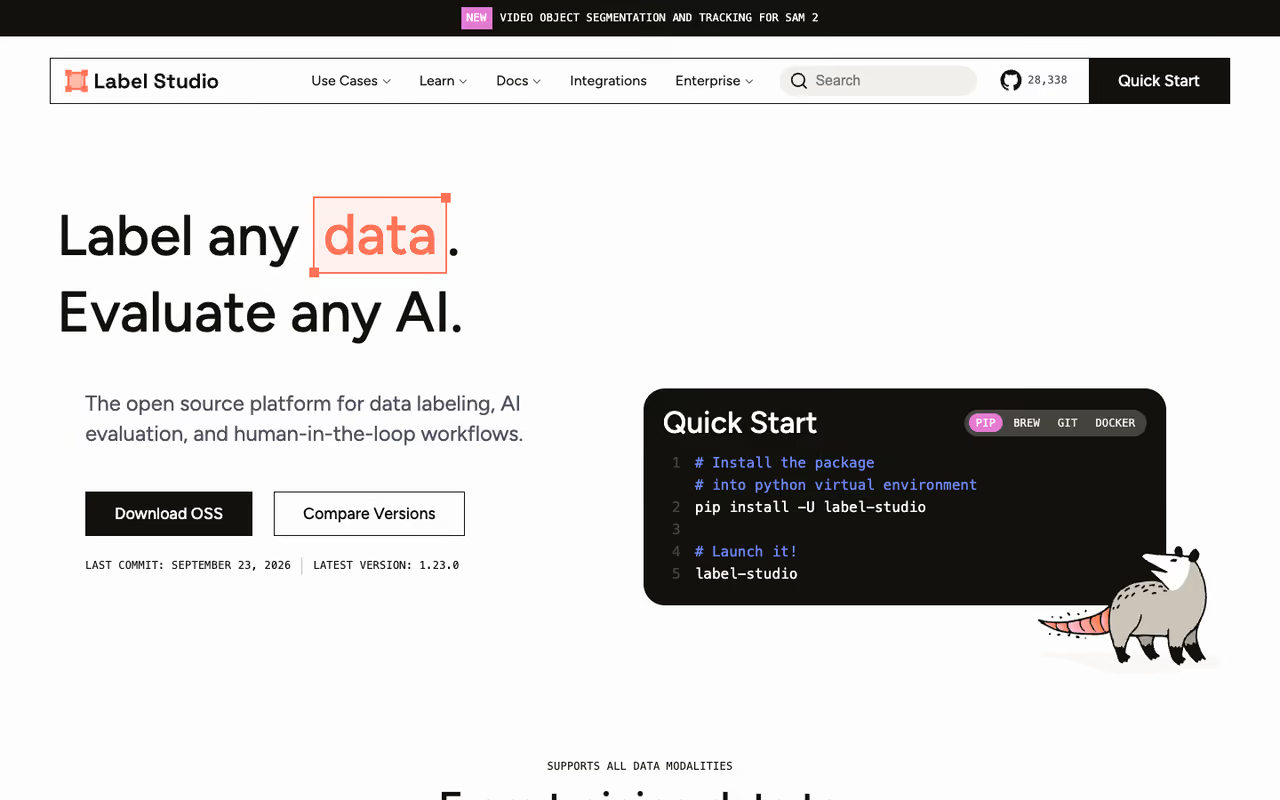
Label Studio, maintained by HumanSignal, is the closest thing the field has to a universal labeling tool. It handles images, text, audio, video, time series, PDFs, and multimodal combinations like dialogue rating, all from one interface. That breadth is rare. Most tools pick a lane (vision or text) and stay there.
Who it's best for: technical teams that want to self-host, control their data, and customize the labeling interface with config templates. If you have a GPU box and someone comfortable with Docker, this is your starting point.
The open-source default for technical teams that want to self-host and control their data. It handles images, text, audio, video and more from one interface, but consensus scoring, advanced QA and role-based access sit behind the Enterprise tier.
the community edition is free and open source, and HumanSignal has committed to keeping it that way. The hosted Starter plan runs $50/month, and Enterprise is custom-quoted based on team size and deployment model, per the HumanSignal pricing page.
The standout: pre-labeling with your own model. You connect an ML backend, it pre-annotates, and your team corrects instead of labeling from scratch. Active learning loops mean the model improves as you go, so later batches need less manual work.
The catch: the open-source version gives you the editor, not the management layer. Consensus scoring, advanced QA, role-based access, and analytics live behind the Enterprise tier. Self-hosting also means you own the infrastructure, the upgrades, and the 2am Docker debugging.

Roboflow: computer vision, labeling to deployment
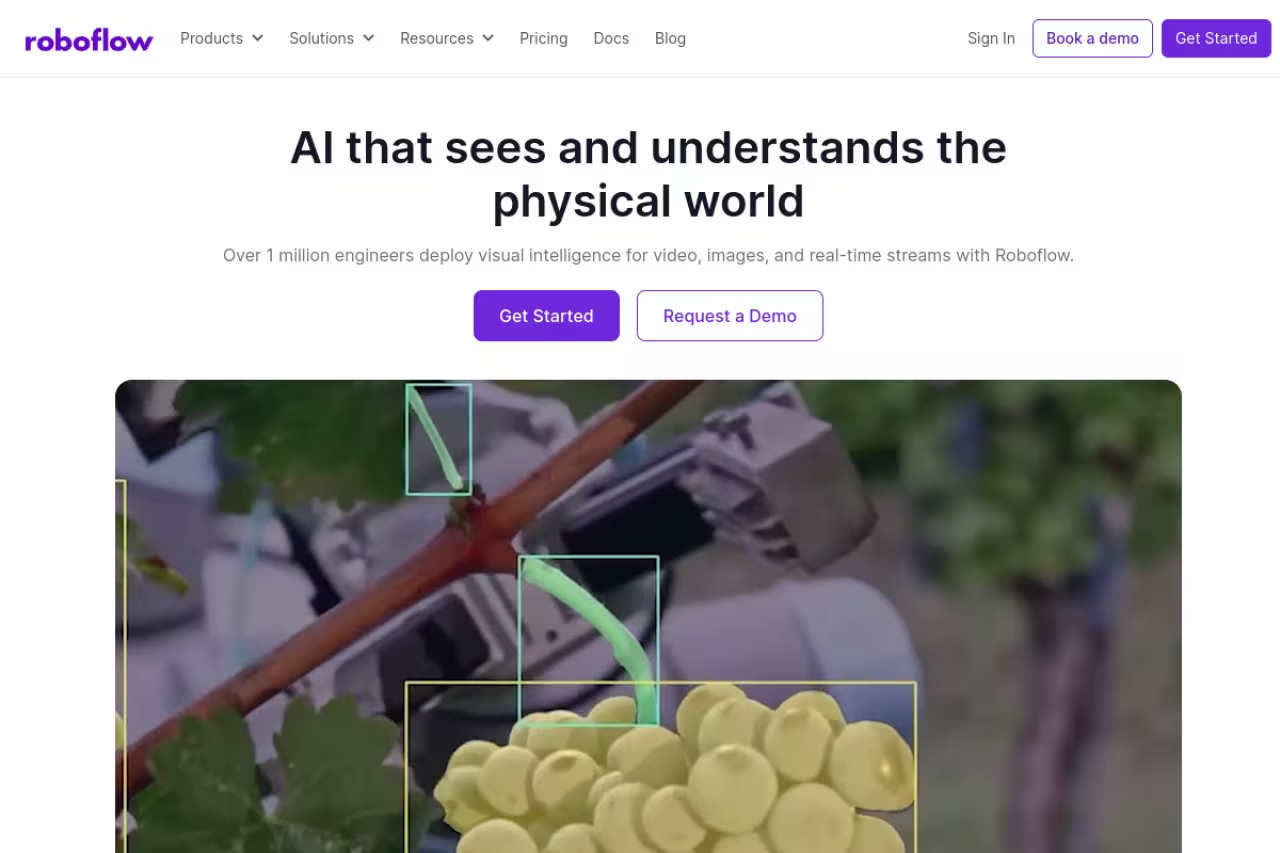
Roboflow is built for one thing and does it well: getting a computer vision model from raw images to a deployed endpoint. Labeling, augmentation, training, and hosting all live in the same place, which removes a lot of the glue code CV projects usually need.
Who it's best for: startups and small teams shipping object detection or segmentation models who want AI-assisted labeling without standing up infrastructure.
A strong pick for startups and small teams shipping object detection or segmentation models, with labeling, training and hosting in one place. It is computer vision only, and credit-based pricing gets harder to predict at volume.
the Public (free) plan gives you $60/month in credits, 2 users, and works on open datasets through Roboflow Universe. The Core plan is $79/month on annual billing ($99 monthly) with private data and 3 users, confirmed on the Roboflow pricing page. Enterprise is custom.
The standout: Label Assist, Smart Polygon, and Auto Label. You can prompt a model to pre-annotate a whole dataset, then spot-check instead of drawing every box by hand. On a clean dataset this turns a week of clicking into an afternoon of review.
The catch: it's computer vision and nothing else. No text, no audio, no LLM fine-tuning data. The credit-based pricing also gets harder to predict once you're training and inferring at volume, so model your usage before you commit to a tier.

Encord: data operations, not just a labeling tool
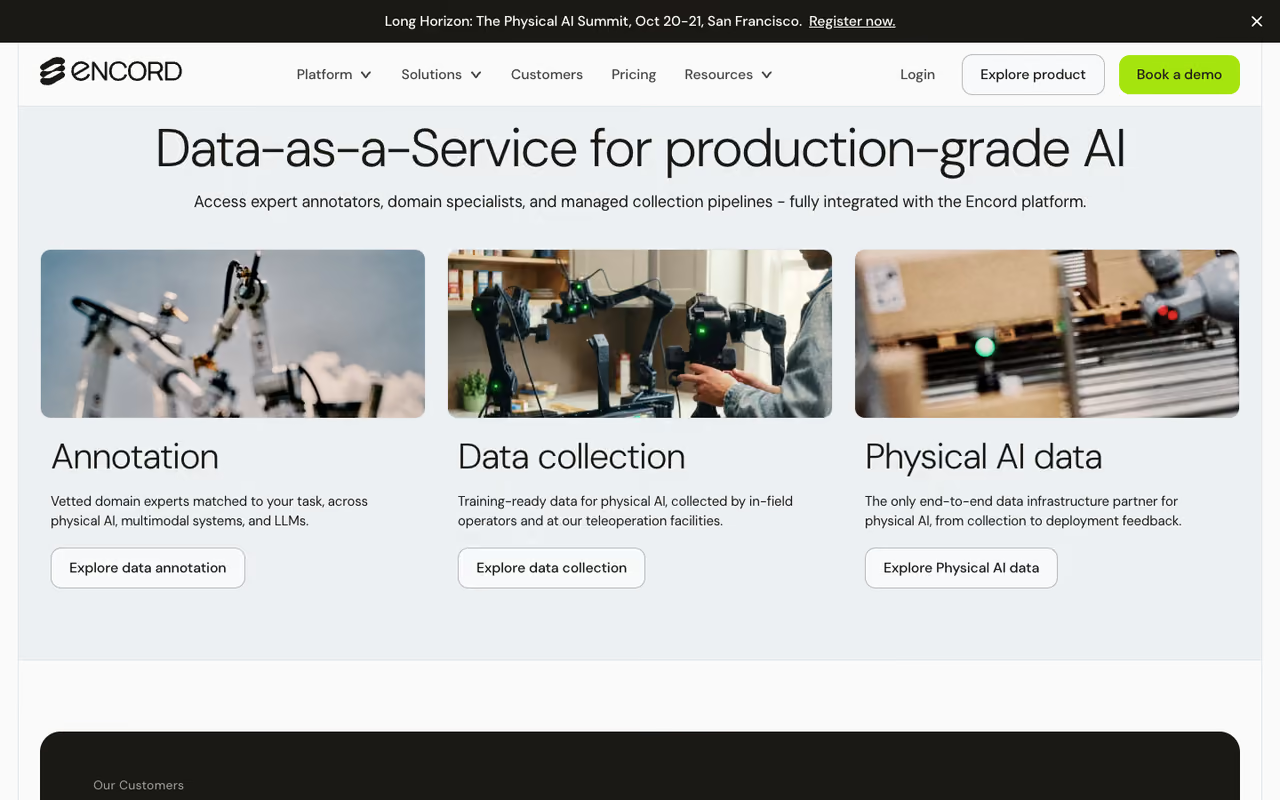
Encord treats labeling as one stage in a larger pipeline. The platform covers annotation, dataset curation, quality evaluation, and model-output review, which is why it shows up at the top of most 2026 generative-AI labeling roundups. If your problem is "we have a million unlabeled assets and no idea which ones matter," Encord's curation and active learning are built for that.
Who it's best for: teams building multimodal or generative AI who need to manage data quality across the whole lifecycle, not just push annotations out the door.
Choose Encord when labeling is one stage in a bigger pipeline for multimodal or generative AI, thanks to embeddings-based curation and active learning. It is overkill for small projects, and custom pricing means booking a demo before you can try it.
custom, with a trial available. Encord doesn't publish flat per-seat numbers, so you'll talk to sales. Expect enterprise-grade pricing aimed at funded teams rather than solo builders.
The standout: the data curation layer. Embeddings-based search lets you find edge cases, dedupe near-identical frames, and prioritize what to label next, which matters more than raw labeling speed once your dataset is large.
The catch: it's overkill for a small project. If you have 5,000 images and a deadline, the platform's depth becomes friction. The custom pricing also means no quick self-serve start: you're booking a demo before you can try the full thing.
If you're piecing together an AI stack and want the labeling layer to slot into the rest of your tooling, our Dupple X breakdown covers how the pieces fit, and our best AI agents roundup is worth a look if you're automating the review step.
V7: the specialist's choice for hard domains
V7 (V7 Darwin) goes where general tools struggle: medical imaging, documents, and pixel-perfect segmentation. It reads 50+ formats including DICOM and SVS for medical, handles video with auto-tracking, and shipped SAM 3 in February 2026 for text-prompt-based automatic detection.
Who it's best for: enterprises in healthcare, insurance, finance, or any field where the data is complex and compliance is non-negotiable (V7 carries SOC 2 Type II and HIPAA).
The specialist for hard domains like medical imaging, documents and pixel-perfect segmentation, with SOC 2 Type II and HIPAA compliance. It is a demo-gated purchase, and more platform than you need for straightforward bounding-box work.
custom, demo-gated. No public per-seat number, which is standard for this tier.
The standout: Auto-Annotate with SAM for semantic masks plus multi-stage review workflows with conditional logic and consensus. V7 Go also automates document-heavy work using foundation models from OpenAI, Anthropic, and Google.
The catch: the price and the demo wall. This is a tool you buy after a sales conversation, not something you spin up on a Friday. For straightforward bounding-box work it's more platform than you need.

Snorkel AI: label with code, not clicks
Snorkel AI flips the model. Instead of annotating examples one by one, you write labeling functions: rules, heuristics, and weak signals that label data subsets programmatically. Snorkel claims 10-100x faster development for suitable projects, and the approach has serious research behind it from the Stanford team that started it.
Who it's best for: enterprises with large, structured text datasets where domain experts can encode their knowledge as rules instead of labeling thousands of rows by hand.
Skip clicking and write labeling functions instead, which suits enterprises with large, structured text datasets and domain experts who can encode rules. It falls short on image, audio and video, and bad labeling functions quietly poison your dataset.
enterprise, custom. Snorkel raised a $100M Series D in May 2025 at a $1.3B valuation, and the product is aimed squarely at large organizations.
The standout: programmatic labeling and Expert Data-as-a-Service, which pairs the platform with vetted domain experts to build specialized datasets for frontier models.
The catch: the automation works best on structured text. For complex or multimodal data (image recognition, audio, video) the labeling-function approach falls short, and you're back to manual tools. There's also a learning curve: writing good labeling functions is a skill, and bad ones quietly poison your dataset.

SuperAnnotate: enterprise LLM and RLHF data
SuperAnnotate has positioned itself as the platform for building large-scale multimodal datasets, with a heavy focus on LLM fine-tuning and RLHF. Its customizable editor lets teams build templates for chat rating, model comparison, code SFT validation, and other GenAI workflows.
Who it's best for: enterprises building or fine-tuning LLMs that need RLHF pipelines and access to a vetted annotation workforce.
An enterprise platform for building LLM fine-tuning and RLHF datasets, with a customizable editor and a marketplace of vetted annotation teams. The custom-quote model makes it a poor fit for solo developers or small teams.
custom, based on volume and features. No public flat rate.
The standout: the model-in-the-loop RLHF setup, which blends human feedback with model insights in real time, plus a marketplace of vetted annotation teams if you don't want to staff this internally.
The catch: it's enterprise-shaped through and through. The custom-quote model and the marketplace make it a poor fit for a solo developer or a small team labeling a few thousand examples. You're buying a workflow, not a quick utility.

Scale AI: the heavyweight for high-stakes data
Scale AI dominates the top end: autonomous vehicles, defense, and projects where accuracy below 95% is a non-starter. The pull is the combination of a managed workforce and proprietary QA, so you're outsourcing both the labor and the quality control rather than just renting a tool.
Who it's best for: well-funded teams with large, mission-critical datasets and the budget to match.
The heavyweight for mission-critical datasets where you outsource both labor and quality control to a managed workforce. Contracts reportedly start at $50,000+, and you give up direct control and iteration speed, so most startups should look elsewhere.
custom enterprise, typically with $50,000+ minimum contracts per multiple 2026 market reports. This is not a self-serve product.
The standout: the managed service. You hand Scale your data and requirements, and a trained workforce plus QA layer returns labeled data at accuracy rates above 95% for most project types.
The catch: the minimums and the loss of direct control. You're not labeling in-house, so iteration is slower and you're dependent on a vendor's queue. For most startups this is the wrong tool, full stop, until the data volume and stakes justify the spend.

CVAT: the open-source CV workhorse
CVAT, originally built at Intel and now run by CVAT.ai, is the most widely adopted open-source annotation tool for computer vision, with over 200,000 users. The self-hosted version is free under the MIT license and handles bounding boxes, polygons, semantic segmentation, keypoints, and video tracking.
Who it's best for: CV teams that want a battle-tested open-source labeler and have the infrastructure to host it, or solo users who want a cheap cloud option.
A battle-tested open-source labeler for computer vision teams that can host it themselves, or solo users who want a cheap cloud option. It is vision-only, the UI feels utilitarian, and analytics and team management push you to paid tiers.
self-hosted is free. CVAT Cloud has a free tier with limits, a Solo plan at $23/month annual, Team from $46/month annual, and Enterprise around $12,000/year per current public listings.
The standout: maturity and AI-assisted labeling in an open package. It's been hardened by years of community use, so the core annotation experience is reliable and fast.
The catch: it's vision-only and the UI feels more utilitarian than the polished commercial tools. Advanced analytics and team management push you toward the paid Cloud or Enterprise tiers.
How to choose
Skip the feature matrices and answer three questions.
What data are you labeling? Vision only? Roboflow or CVAT. Text and LLM data? Snorkel or SuperAnnotate. Everything, including audio and time series? Label Studio. Medical or documents? V7.
Who's doing the labeling? In-house team that wants control: self-host Label Studio or CVAT. No labeling staff and a budget: managed services from Scale AI or SuperAnnotate's marketplace.
How big is the dataset and the budget? Small project, tight budget: start free with Label Studio, CVAT, or Roboflow's free tier. Large, high-stakes, funded: Encord, Scale AI, or V7.
A practical move: start free, prove the workflow, then upgrade only when QA, consensus, or workforce becomes the bottleneck. Most teams overbuy on day one and underuse the platform for months.
FAQ
What is the best AI data labeling tool in 2026?
There's no single best tool, but the strongest starting points are Label Studio for technical teams that want an open, all-data-type platform, and Roboflow for computer vision teams that want AI-assisted labeling and model training in one place. For enterprise multimodal and generative AI work, Encord and SuperAnnotate lead.
Are there free data labeling tools?
Yes. Label Studio and CVAT are both fully open source and free to self-host. Roboflow has a free Public plan with $60/month in credits, and CVAT Cloud offers a free tier with usage limits. These cover most small to mid-size projects before you need to pay.
What is AI-assisted or automated data labeling?
It's using a model to pre-label your data so humans review and correct instead of labeling from scratch. Examples include Roboflow's Auto Label, V7's SAM 3 auto-annotate, and Label Studio's pre-labeling via a connected ML backend. Snorkel goes further with programmatic labeling functions that label data with code.
How much does data labeling software cost?
It ranges from free (open-source Label Studio, CVAT) to roughly $50-$99/month for hosted starter plans (Label Studio cloud, Roboflow Core), up to custom enterprise pricing. Managed services like Scale AI often carry $50,000+ minimum contracts, so cost depends heavily on whether you label in-house or outsource.
Which data labeling tool is best for LLM fine-tuning and RLHF?
SuperAnnotate and Snorkel AI are the strongest for LLM and RLHF data. SuperAnnotate offers a customizable multimodal editor with model-in-the-loop RLHF, while Snorkel uses programmatic labeling for large structured-text datasets. Label Studio also handles chat-rating and ranking tasks for fine-tuning workflows.
Should I self-host or use a managed labeling service?
Self-host (Label Studio, CVAT) if you have technical staff, want full data control, and are cost-sensitive. Use a managed service (Scale AI, SuperAnnotate) if you lack labeling staff, have a budget, and need a vetted workforce plus QA at scale. Many teams self-host early and switch to managed once volume becomes the bottleneck.
If you're building an AI product and want the rest of your stack to keep up with your labeling pipeline, Dupple X bundles the tools worth paying for, and our top tools directory is a good place to compare what else is out there.
Related guides
Some offers on this page may be paid placements or contain affiliate links.
