
Best Referral Marketing Software in 2026: 8 Tools I'd Actually Pay For


Key facts8 tools compared: Rewardful, FirstPromoter, ReferralCandy, Tolt, Cello, GrowSurf, Viral Loops…
- 8 tools compared: Rewardful, FirstPromoter, ReferralCandy, Tolt, Cello, GrowSurf, Viral Loops, Friendbuy
- Rewardful (best for: SaaS on Stripe): $49/mo
- FirstPromoter (best for: SaaS scaling affiliates): $49/mo
- ReferralCandy (best for: Shopify ecommerce): $39/mo + fee
- Tolt (best for: Bootstrapped SaaS): $69/mo
Referral software is one of those categories where the demo always looks great and the bill always looks different. Every vendor promises "viral growth." What they don't tell you is that half of them charge a success fee that eats into the channel you're trying to build, and the other half were designed for a business model that isn't yours.
The single biggest mistake teams make is picking a tool before you've decided who your advocates actually are. A customer earning a $20 store credit needs a completely different system than a creator earning a 30% recurring commission. Get that wrong and you'll be fighting your own software for months.
So here's the short version for skimmers. If you run a SaaS or subscription product and you want clean Stripe-native affiliate tracking, Rewardful is the one I reach for first. If you're an ecommerce brand on Shopify, ReferralCandy is the path of least resistance. Below I break down eight tools I'd genuinely consider in 2026, what each is best at, and where each one quietly costs you more than the sticker price.
Quick comparison
| Tool | Best for | Starting price | Standout |
|---|---|---|---|
| Rewardful | SaaS on Stripe | $49/mo | Zero transaction fees, dead-simple Stripe sync |
| FirstPromoter | SaaS scaling affiliates | $49/mo | Deep fraud detection + multi-tier commissions |
| ReferralCandy | Shopify ecommerce | $39/mo + fee | Fastest setup for DTC brands |
| Tolt | Bootstrapped SaaS | $69/mo | Modern UI, crypto/Wise payouts |
| Cello | B2B SaaS in-app | Free / $200/mo | In-product referral widget, ARR-based pricing |
| GrowSurf | Newsletters & waitlists | ~$179/mo | Milestone "refer 3 friends" mechanics |
| Viral Loops | Campaigns & launches | $35/mo | Pre-built viral templates |
| Friendbuy | Mid-market DTC | ~$249/mo | Referral + loyalty in one, no success fee |
Rewardful: the default for Stripe-based SaaS
Rewardful does one thing and does it well: it sits on top of Stripe and turns your subscription billing into an affiliate and referral engine. You connect Stripe, drop a script on your site, and commissions get calculated automatically from real subscription events. No manual reconciliation, no spreadsheet of who owes what.
Who it's best for: SaaS and subscription founders who already bill through Stripe and want affiliates live this week, not next quarter.
The default for SaaS and subscription founders already billing through Stripe who want affiliates live this week. The integration is the cleanest here and there is a 0% transaction fee, but it is tied to Stripe and Paddle and reporting is basic.
The Starter plan is $49/month and covers up to $7,500/month in affiliate-driven revenue with one campaign. Growth at $99/month bumps that to $15,000/month with unlimited campaigns and a branded affiliate portal on your own domain. Enterprise starts at $149/month for anything above that. Crucially, Rewardful takes a 0% transaction fee, so the price you see is the price you pay. Annual billing gets you two months free.
The standout: The Stripe integration is the cleanest in this category. Recurring commissions, free-trial handling, refunds clawed back automatically. It just tracks correctly.
The catch: It's tied to Stripe (and Paddle). If you bill through anything else, or you run an ecommerce store with one-time purchases, this isn't your tool. The reporting is also fairly basic compared to FirstPromoter, so power users running large affiliate teams sometimes outgrow it.
FirstPromoter: when affiliates become a real channel
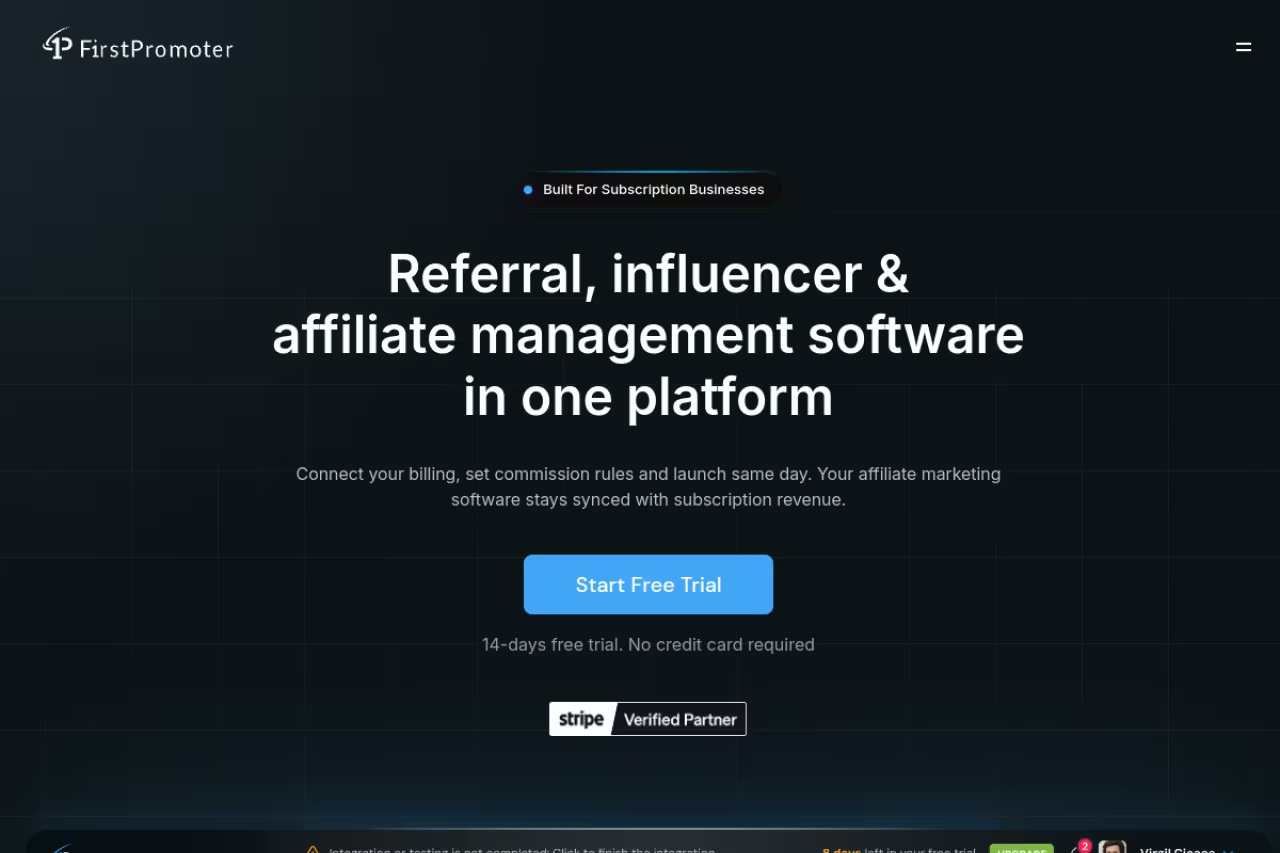
FirstPromoter is what you graduate to when affiliates stop being a side experiment and start being a line item your CFO cares about. It handles multi-tier commissions, recurring payouts, custom commission rules, and the kind of fraud detection that actually matters once real money is moving.
Who it's best for: SaaS teams running serious affiliate or partner programs who need granular control over commission structures and self-referral protection.
Graduate to FirstPromoter when affiliates become a real channel and you need granular commission control and self-referral protection. Fraud and analytics depth beat Rewardful's, but setup takes longer than advertised and solo founders get more machine than they need.
Starter is $49/month for up to $5,000/month in affiliate revenue, three campaigns, and 1,000 affiliates. Business at $99/month unlocks unlimited campaigns and affiliates up to $15,000/month in tracked revenue. Enterprise starts at $149/month. There's a 14-day trial with no card required.
The standout: The fraud and analytics depth. You can set up tiered commissions, bonus rules, and cohort-level reporting that Rewardful doesn't touch. It integrates with Stripe, Paddle, Chargebee, and Recurly, so you're not locked to one billing stack.
The catch: The interface feels engineered rather than designed. There's a learning curve, and the initial setup takes longer than the "five minutes" the marketing implies. For a solo founder who just wants links out the door, it's more machine than you need.

ReferralCandy: the Shopify shortcut
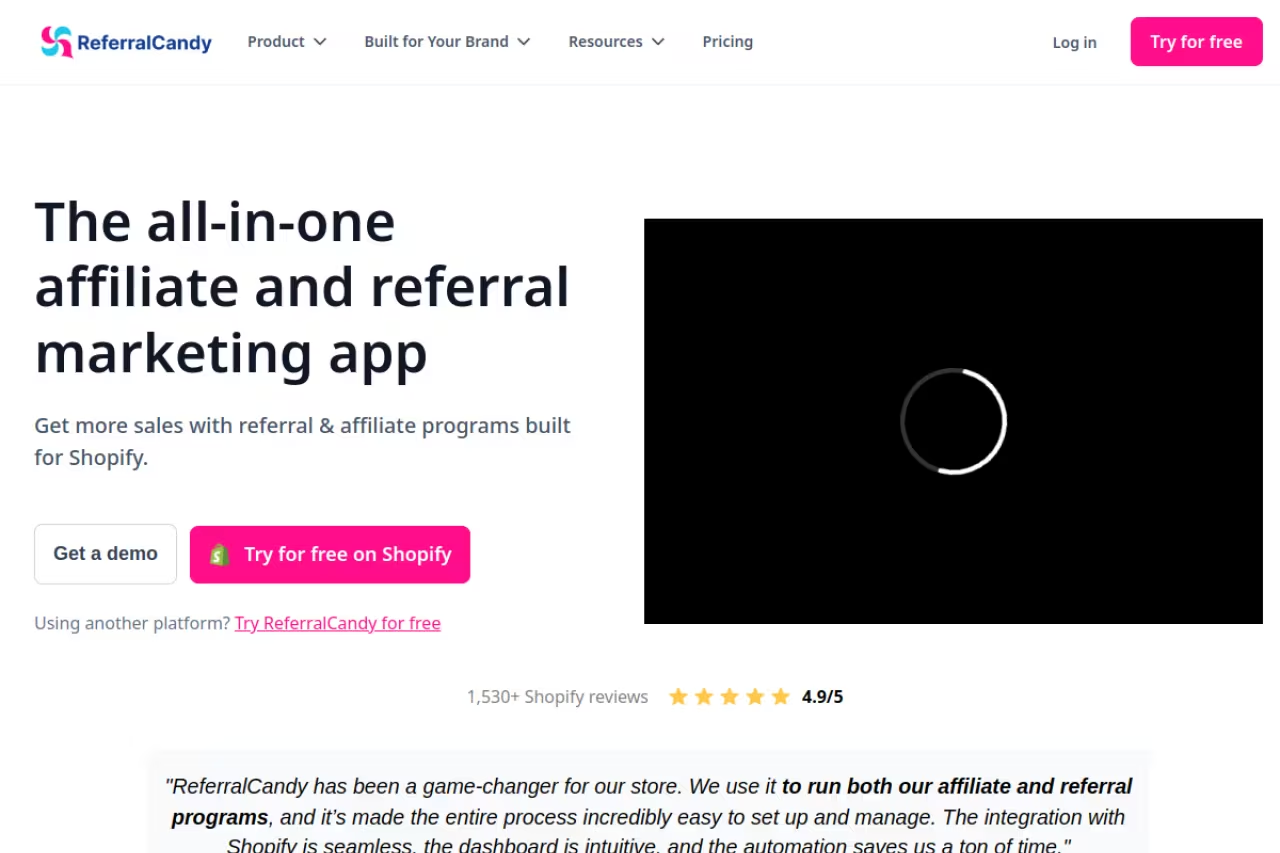
If you sell physical products on Shopify, ReferralCandy is the fastest way to launch a customer referral program that doesn't look like a 2014 popup. It plugs straight into Shopify, WooCommerce, and BigCommerce, automates the reward emails, and handles the "give $10, get $10" mechanics out of the box.
Who it's best for: DTC and ecommerce brands that want post-purchase referrals running without engineering help.
The fastest way for DTC and ecommerce brands to launch post-purchase referrals without engineering help. Read the fine print: the success fee starts at 10.5% on the cheapest plan, so you share the revenue the channel captures.
This is where you read the fine print. Plans are $39/month (Basic), $79/month (Grow), $249/month (Scale), and $799/month (Enterprise), and each carries a success fee on referred sales: 10.5%, 3.5%, 1.5%, and 0.25% respectively. The fee applies to a referred customer's first three orders. On the cheapest plan, a 10.5% cut on referred revenue is steep, so most active stores end up on Grow or higher just to lower the fee.
The standout: Time to launch. You can have a working referral program live in an afternoon with branded emails and a customer-facing portal.
The catch: The success fee model. Once referrals scale, you're paying ReferralCandy a percentage of the exact revenue you built the channel to capture. Run the math at your expected volume before committing, because a flat-fee competitor can be cheaper past a certain point.
Tolt: the modern bootstrapper's pick
Tolt showed up a couple of years ago and quickly became the cool kid of SaaS affiliate tools. The product is genuinely nice to use, the dashboards are clean, and it supports modern payout rails like Wise and crypto alongside PayPal. It's aimed squarely at indie and bootstrapped SaaS founders.
Who it's best for: Early-stage SaaS teams who want a good-looking affiliate program and care about the partner experience.
A polished pick for early-stage and bootstrapped SaaS teams that care about the partner experience, with Wise and crypto payouts. Auto-payouts start on the $99 Growth plan, and repeated price hikes have weakened the value story.
Basic is $69/month for up to $10,000/month in affiliate revenue with manual payouts. Growth at $99/month adds automatic payouts and tax-form collection up to $20,000/month. Pro at $199/month removes most limits. Note that Tolt removed its free plan and has raised prices several times since 2023, so it's pricier than it once was.
The standout: Auto-payouts via Wise and crypto are a real differentiator for international affiliate networks, and the UI is the best-looking in this list.
The catch: Auto-payouts only kick in on the $99 Growth plan and up. The repeated price hikes also mean the value-for-money story isn't as strong as it was in 2024, and some of its earliest fans have started shopping around.
Cello: referrals built into your product
Cello takes a different angle. Instead of a separate affiliate portal, it drops a referral widget directly inside your app so users can refer friends without ever leaving the product. For B2B SaaS where your best advocates are active power users, that in-product placement matters a lot.
Who it's best for: Product-led B2B SaaS that wants customer referrals triggered at the moment of value, inside the app.
A strong fit for product-led B2B SaaS that wants referrals triggered inside the app at the moment of value. ARR-based pricing is fair at first but can turn into a tax as you scale, and it is a poor match for standalone affiliate programs.
Cello prices by referral ARR rather than seats. There's a free tier with unlimited referrals, then Grow at $200/month (covering up to $50K in referral ARR) and Scale at $750/month (up to $100K), with Enterprise custom. There's a separate Partner Referrals track for partner programs starting at $200/month.
The standout: The in-app widget and the performance-aligned pricing. You're paying in proportion to the revenue the channel actually generates, which is a fairer model than flat tiers for many teams.
The catch: That ARR-based pricing can flip from a feature to a tax once you scale. A program generating real money fast pushes you up the tiers quickly. It's also narrowly focused on in-product referrals, so it's not the right fit if you want a traditional standalone affiliate program.
If you're building a product-led growth motion, your referral tool is only one piece. Our Dupple X plan bundles the growth tooling we use internally, and our top tools directory is worth a scan before you commit to any single platform.

GrowSurf: built for newsletters and waitlists
GrowSurf is the tool I think of for milestone referral campaigns, the "refer 3 friends, unlock early access" mechanic that newsletters and waitlists run. It's developer-friendly with a solid REST API and webhooks, and it handles the leaderboard-and-reward loop well.
Who it's best for: Newsletter operators, waitlist launches, and startups running milestone-based referral campaigns.
Pick GrowSurf for newsletters, waitlist launches and startups running milestone-based referral campaigns, backed by good developer tooling. It costs more than participant-based rivals at entry level, and the entry tier cap fills fast for a large newsletter.
GrowSurf runs roughly $179/month for the Startup tier and around $449/month for Business, with a 30% discount on annual billing and a 14-day free trial that includes all paid features. Pricing scales with participant count rather than revenue.
The standout: Milestone and tiered-reward mechanics, plus genuinely good developer tooling. If you want a custom referral page wired into your own app, GrowSurf gives you the hooks to build it.
The catch: It's more expensive than the participant-based competitors at the entry level, and the entry tier participant cap fills up fast for a large newsletter. The flip side of being developer-friendly is that getting the most out of it usually means writing some code.

Viral Loops: campaigns, not always-on programs
Viral Loops leans into pre-built templates: pre-launch waitlists, sweepstakes, milestone referrals, ambassador campaigns. If you're launching something and want a time-boxed viral campaign rather than an evergreen affiliate program, the template approach saves real time.
Who it's best for: Marketers running launch campaigns, contests, or short-term viral pushes.
Built for marketers running launch campaigns, contests or short-term viral pushes, with templates that save real time. It is optimized for campaigns rather than durable always-on programs, and pricing can climb as a campaign goes viral.
Plans start at $35/month and scale up to around $279/month based on participant count, with a 14-day trial (limited to 10 participants) and 30% off annual billing.
The standout: The template library. You can stand up a Robinhood-style waitlist or a Harry's-style milestone campaign without designing the mechanics from scratch.
The catch: It's optimized for campaigns, not durable always-on programs. Teams running long-term affiliate or customer referral systems sometimes find it less flexible than a purpose-built tool, and the participant-based pricing can climb as a campaign goes viral (which is, ironically, the point).

Friendbuy: referral plus loyalty for mid-market DTC
Friendbuy is the enterprise-leaning pick for established DTC brands that want referral and loyalty in one platform without paying a success fee on every referred order. It has the integrations, the A/B testing, and the analytics that bigger marketing teams expect.
Who it's best for: Mid-market and larger ecommerce brands that want a flat-fee model and plan to run loyalty alongside referrals.
The flat-fee option for mid-market and larger ecommerce brands that want referral and loyalty together without a success fee. Pricing is opaque and annual contracts are common, so it is too broad if you only want a simple referral program.
Friendbuy uses custom pricing, with entry plans reported around $249/month and scaling to enterprise contracts. There's no success fee, which is the whole pitch versus ReferralCandy at higher volumes.
The standout: No percentage cut of referred revenue, plus built-in A/B testing and a loyalty module. At high referral volume, the flat fee beats success-fee tools handily.
The catch: Pricing is opaque and annual contracts are common, so it's a bigger commitment. If you only want a simple referral program and don't care about loyalty, you're paying for a platform broader than you need.
How to choose without overthinking it
Start with one question: are your advocates customers or partners?
If they're customers earning store credit or discounts, you want a customer-referral tool. For ecommerce, that's ReferralCandy (fast, success-fee model) or Friendbuy (flat fee, better at scale). For in-app B2B referrals, it's Cello.
If they're partners, affiliates, or creators earning cash commissions, you want affiliate software. For Stripe SaaS, that's Rewardful (simple) or FirstPromoter (powerful). For a modern indie experience, Tolt.
Then check the pricing model against your volume. A success fee feels cheap at $0 in referrals and expensive at $50K. A flat fee is the reverse. Do the math at your realistic six-month volume, not your launch-week volume. Finally, confirm the billing integration. If a tool doesn't connect cleanly to your payment stack, every other feature is irrelevant.
For a wider view of the stack around your referral channel, our guides on the best AI marketing tools and the best email marketing software pair naturally with whatever you pick here, and the full top tools list covers adjacent categories.
FAQ
What is the best referral marketing software in 2026?
There's no single winner because it depends on your model. For SaaS billing through Stripe, Rewardful is the cleanest starting point. For Shopify ecommerce, ReferralCandy launches fastest. For serious affiliate programs, FirstPromoter offers the most control. Match the tool to whether your advocates earn discounts or cash commissions.
How much does referral software cost?
Entry plans typically run $35 to $69 per month for participant-based tools (Viral Loops, Tolt) and $49 to $200 per month for revenue-based ones (Rewardful, Cello). Watch for success fees: ReferralCandy adds 0.25% to 10.5% of referred sales on top of the base price, which changes the total cost a lot at higher volume.
Is referral software worth it for a small SaaS startup?
Yes, if you have product-market fit and happy users. A tool like Rewardful or Tolt at around $49 to $69 a month replaces hours of manual commission tracking and reduces payout errors. If you're pre-revenue or still hunting for fit, hold off. Referrals amplify an existing growth motion, they don't create one.
What's the difference between referral software and affiliate software?
Referral software is built for your customers referring friends, usually for discounts or credits, with simple sharing flows (ReferralCandy, Friendbuy, Cello). Affiliate software is built for partners and creators earning cash commissions, with payout rails, tax forms, and multi-tier rules (Rewardful, FirstPromoter, Tolt). Some platforms do both, but most lean one way.
Do I need referral software if I use Stripe?
Stripe handles billing, not referral tracking. You still need a layer that attributes a sale to the right advocate, calculates the commission, and manages payouts. Rewardful and FirstPromoter both sit directly on Stripe to do exactly that, which is why they're the common pick for Stripe-based SaaS.
If your growth motion is solid and you want the same tooling and playbooks we use to run it, Dupple X is worth a look. Pick the referral tool that fits your model, run the pricing math honestly, and launch small before you scale.
Related guides
Some offers on this page may be paid placements or contain affiliate links.
