
The Best CRM for Healthcare in 2026 (Compared)

Key facts8 tools compared: Zoho CRM, Salesforce Health Cloud, Keragon, HubSpot, LeadSquared, Tebra…
- 8 tools compared: Zoho CRM, Salesforce Health Cloud, Keragon, HubSpot, LeadSquared, Tebra, Keap, Pipedrive
- Zoho CRM (best for: Small to mid practices): $14 to $52/user/mo
- Salesforce Health Cloud (best for: Hospitals, enterprise): From $325/user/mo
- Keragon (best for: Connecting healthcare tools): Custom (paid plans incl. BAA)
- HubSpot (best for: Patient marketing teams): From $3,600/mo (Enterprise)
Most "best healthcare CRM" lists skip the one question that actually decides the purchase: will the vendor sign a Business Associate Agreement, and which features does that BAA actually cover? Because here's the trap nobody warns you about. You can buy a HIPAA-eligible CRM, sign the paperwork, and still violate HIPAA the moment you turn on an AI feature or pipe patient data into Google Ads. The signature is the easy part.
I spent a few weeks digging through pricing pages, BAA terms, and real implementation costs to figure out which platforms hold up for clinics, digital health startups, and hospital networks. The answer depends heavily on your size and whether protected health information (PHI) lives inside the CRM or stays in a separate system.
If you want the short version: Zoho CRM is the best value for small and mid-sized practices because it offers BAA coverage without forcing you onto a five-figure enterprise plan. Salesforce Health Cloud is the pick for hospital systems and anyone who needs clinical data unified at scale. And if your stack is a patchwork of EHRs and booking tools, Keragon is the HIPAA-compliant glue that connects them. Here's how they all compare.
Quick comparison
| Tool | Best for | Price (annual) | Standout |
|---|---|---|---|
| Zoho CRM | Small to mid practices | $14 to $52/user/mo | BAA on affordable tiers |
| Salesforce Health Cloud | Hospitals, enterprise | From $325/user/mo | Clinical + operational data in one place |
| Keragon | Connecting healthcare tools | Custom (paid plans incl. BAA) | No-code HIPAA automation |
| HubSpot | Patient marketing teams | From $3,600/mo (Enterprise) | Marketing automation with BAA |
| LeadSquared | High-volume patient intake | $25 to $50/user/mo | Intake and engagement workflows |
| Tebra | Independent medical practices | Custom (~$200 to $700/provider/mo) | EHR + billing + CRM in one |
| Keap | Solo clinics, wellness | From $299/mo | Full automation, all-in-one |
| Pipedrive | Sales-style patient pipelines | $14 to $79/seat/mo | Visual pipeline (no BAA) |
Zoho CRM: the best value for most practices
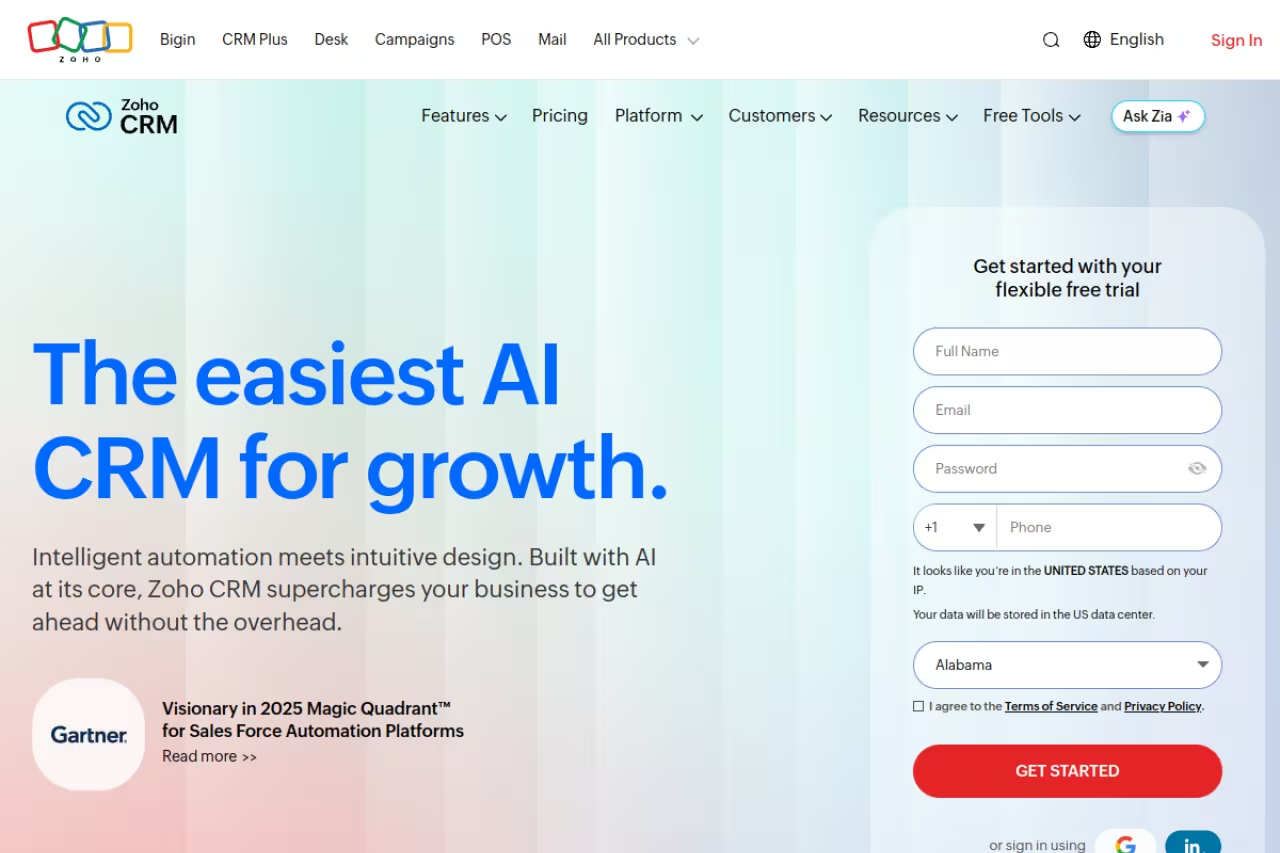
Zoho CRM is where I'd start if you run a clinic, a multi-location practice, or a growing digital health company and you don't want to spend enterprise money to get compliant. The reason it tops most realistic shortlists is simple: Zoho will sign a BAA without pushing you onto a plan that costs more than your rent.
Who it's best for: Small and mid-sized healthcare teams that need contact management, appointment workflows, multichannel messaging, and reporting without an enterprise budget or a six-month implementation.
The practical starting point for small and mid-sized healthcare teams, since a BAA is available across multiple tiers without enterprise pricing. The trade-offs are that Zia sits outside BAA protection and you configure patient workflows yourself.
Standard is $14/user/month, Professional $23, Enterprise $40, and Ultimate $52, all billed annually (Zoho CRM pricing). Monthly billing runs roughly 20% higher. For a 10-person team, the three-year total cost of ownership can land near $18,000, the lowest of any platform I looked at, according to Improvado's 2026 CRM comparison.
The standout: Affordable BAA coverage across multiple tiers. Most big vendors gate BAAs behind their priciest plan. Zoho doesn't, which is why it punches above its weight for smaller healthcare organizations.
The catch: Zia, Zoho's AI assistant, sits outside standard BAA protection, so you can't feed it PHI without checking the scope first. The platform is also broad rather than healthcare-native, which means you're configuring patient workflows yourself rather than getting them prebuilt. Budget time for setup.
Salesforce Health Cloud: built for enterprise scale
Salesforce Health Cloud is the platform hospital systems and large payers reach for when they need to unify clinical and operational data into a single patient record. It's overkill for a three-doctor clinic. For a 50-provider network juggling care coordination, referrals, and patient outreach, it's in a different league.
Who it's best for: Hospitals, health systems, and large provider groups that need a true patient-360 view, deep EHR integration, and the resources to run a serious implementation.
The platform for hospitals, health systems and large provider groups that need a true patient-360 view and deep EHR integration. The cost is brutal below enterprise scale, Einstein AI falls outside BAA coverage, and implementation is a serious commitment.
Health Cloud Enterprise starts at $325 to $350/user/month, Unlimited runs $500 to $525, and the Agentforce editions for sales and service reach $750/user/month, all billed annually (ITQlick pricing breakdown). Three-year TCO for a 10-user setup is around $180,000 once you add implementation and integration, per Improvado.
The standout: Nothing else consolidates clinical data, care plans, and engagement at this depth. The newer Agentforce tier adds AI agents that can handle routine patient service tasks, which is genuinely useful at hospital volume.
The catch: The cost is brutal for anyone under enterprise scale, and Einstein AI analytics fall outside standard BAA coverage, so your data team has to be careful about what touches the AI layer. Implementation alone can run $15,000 to $80,000. This is a commitment, not a quick win.
If your team is evaluating AI tooling more broadly alongside your CRM, our roundup of the best AI agents covers where autonomous agents actually earn their keep right now.
Keragon: the HIPAA-compliant automation layer
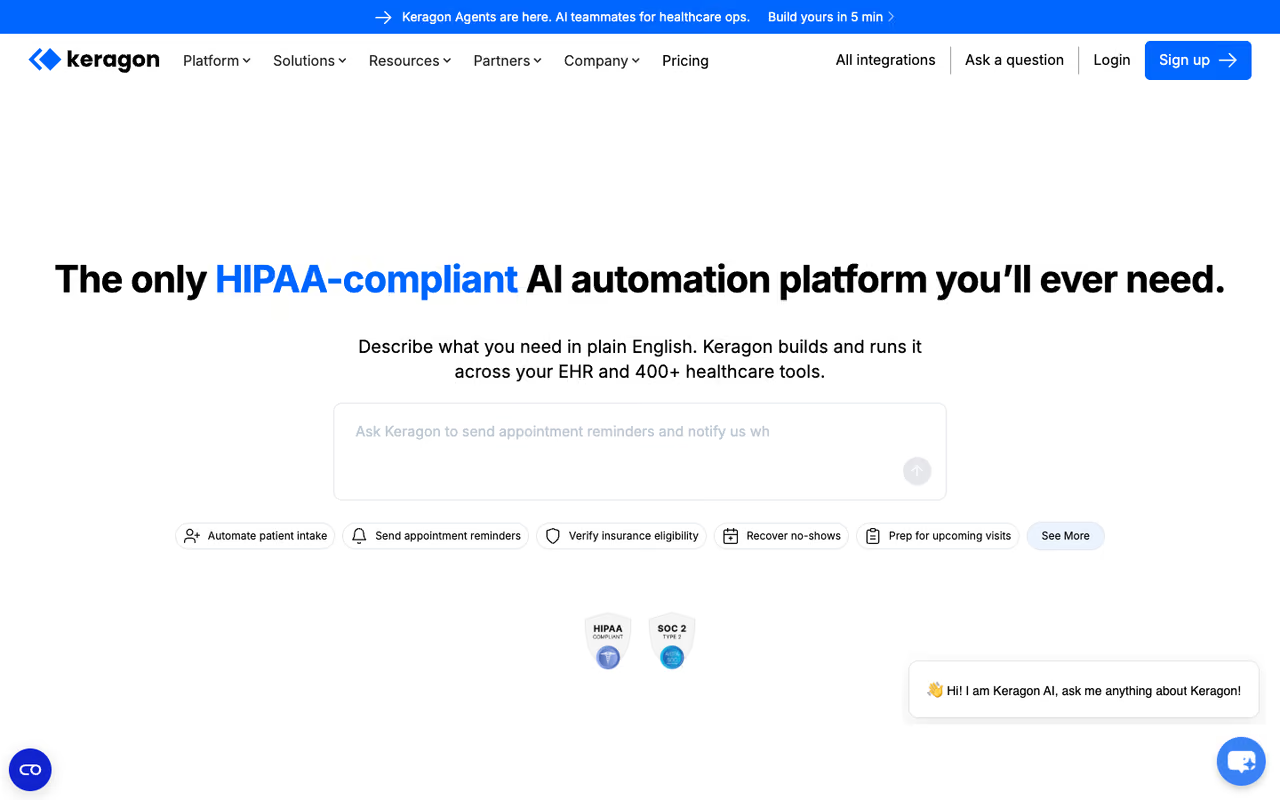
Keragon isn't a CRM in the classic sense, and that's exactly why it earns a top-three spot. It's a no-code automation platform built specifically for healthcare, and it solves the problem that breaks most "compliant" setups: the integrations between your tools.
You might have a CRM, an EHR like Tebra, a booking system, and a payment processor. The CRM signs a BAA. The booking tool signs a BAA. But the Zapier flow connecting them? No BAA. That gap is where PHI leaks. Keragon closes it.
Who it's best for: Digital health startups and clinics with a multi-tool stack who need automated patient follow-ups, intake routing, and reminders that stay compliant end to end.
Not a CRM, but the compliant plumbing for digital health startups and clinics with a multi-tool stack that need follow-ups and intake routing to stay HIPAA-safe. You still need a real CRM, and pricing is custom and above general automation tools.
Keragon uses custom pricing, but every paid plan includes HIPAA compliance and a signed BAA, with SOC 2 Type 2 practices, role-based access, and audit logs. It's pricier than general automation tools, which reflects the compliance overhead.
The standout: It connects 300+ tools with signed BAAs in the loop, using a visual workflow editor. If your problem is "my tools are compliant but the wiring between them isn't," this is the fix.
The catch: It's a connector, not a system of record. You still need an actual CRM for contact management and reporting. Think of Keragon as the compliant plumbing, not the house.
If you're piecing together a healthcare stack from scratch, our guide to the top AI tools is a good place to see what plays well together.
HubSpot: patient marketing without the compliance gaps
HubSpot became a legitimate healthcare option once it started signing BAAs, and it's the strongest pick if your priority is patient acquisition and marketing rather than clinical operations. The email, landing pages, forms, and automation are best-in-class.
Who it's best for: Marketing-led healthcare organizations and patient-acquisition teams who want polished campaigns with compliance backing.
The strongest pick for marketing-led healthcare organizations and patient-acquisition teams that want polished campaigns with compliance backing. HIPAA support requires the expensive Enterprise tier, and several integrations and reporting features fall outside the BAA.
HIPAA support requires Marketing Hub Enterprise, which starts at $3,600/month for 10 seats and 10,000 contacts, per Patient Protect's 2026 breakdown. As of February 2026, HubSpot's BAA explicitly covers the updated MFA requirements under the HIPAA Security Rule.
The standout: The marketing automation is genuinely excellent, and the BAA covers email, landing pages, forms, and automation when configured correctly.
The catch: Native connections to Google Ads, Meta, and LinkedIn are not covered by the BAA, and neither are several reporting features like Custom Report Builder. You also have to manually enable sensitive-data settings and flag yourself as a covered entity, or the protection never activates.
LeadSquared: built for patient intake at volume
LeadSquared is purpose-built for healthcare organizations that move a lot of patients through acquisition, intake, and engagement. If your bottleneck is converting inquiries into booked appointments at scale, this is where it shines.
Who it's best for: Hospital networks, clinic chains, and telehealth companies with high inbound volume that need to automate intake and follow-up.
Built for hospital networks, clinic chains and telehealth companies with high inbound volume that need intake and follow-up automated. HIPAA compliance is out of the box, but it is heavier than a small wellness practice needs and the interface is more functional than elegant.
The Sales Pro plan is $25/user/month and Sales Super is $50/user/month (LeadSquared on Capterra). A healthcare deployment option ships HIPAA-compliant out of the box.
The standout: Out-of-the-box HIPAA compliance plus genuinely strong intake automation: HIPAA-compliant SMS, email, WhatsApp, chatbots, and calls all run from one hub, with EHR integration.
The catch: It's optimized for high-throughput sales-style operations, so a small wellness practice would find it heavier than needed. The interface is more functional than elegant.

Tebra: the all-in-one for independent practices
Tebra (the 2021 merger of Kareo and PatientPop) bundles EHR, billing, scheduling, and patient engagement into one platform aimed at small and mid-sized medical groups. The CRM-style features live in the Tebra Engage module.
Who it's best for: Independent practices that want clinical, billing, and patient communication under one roof instead of stitching three vendors together.
An all-in-one for independent practices that want clinical, billing and patient communication under one roof rather than three vendors. Pricing is opaque, so expect a sales call, and bundling locks you into Tebra's ecosystem.
No public pricing. Tebra sells by module (Clinical, Billing, Engage) on a per-provider basis, and most cloud EHR platforms in this category run $200 to $700 per provider per month (Pabau's Tebra pricing analysis). Expect a sales call.
The standout: Engage handles two-way SMS, broadcast messaging, digital intake with e-signatures, and automated reminders, all tied to the clinical record.
The catch: The opaque pricing is a real friction point. You can't estimate total cost without a demo, and bundling everything means you're somewhat locked into Tebra's ecosystem.
Keap: automation for solo clinics and wellness
Keap is a strong fit for solo practitioners, wellness businesses, and small cash-pay clinics that want CRM, email, automation, and payments in one tool. Every plan includes the full platform.
Who it's best for: Small practices and wellness operators who value automation and want one tool instead of five.
A good fit for solo practitioners, wellness businesses and small cash-pay clinics that want CRM, email, automation and payments in one tool with no feature gating. It is HIPAA-compatible, not compliant out of the box, so confirm the paperwork before storing PHI.
Starts at $299/month for 1,500 contacts and 2 users (Encharge's Keap review). All paid plans can support HIPAA controls.
The standout: No feature-gating. The full CRM, email, automation, and payment stack is in every tier, which is rare.
The catch: Keap is HIPAA-compatible, not compliant out of the box. You enable the security controls and follow proper procedures yourself, and BAA handling isn't as automatic as Zoho's or Keragon's. Confirm the paperwork before storing PHI.
How to choose
Skip the feature checklists and answer three questions instead.
Does PHI live inside the CRM, or stays elsewhere? If patient data never enters the CRM (you keep it in your EHR and only track non-PHI contacts), even a tool without a BAA like Pipedrive can work, paired with Keragon for the compliant flows. If PHI lives in the CRM, you need a signed BAA, full stop.
What's your scale? Solo to mid-sized practice: Zoho or Keap. High-volume intake: LeadSquared. Hospital or health system: Salesforce Health Cloud. All-in-one with billing: Tebra.
Where do your tools break? If your individual tools are compliant but the integrations between them aren't, the missing piece is Keragon, not another CRM.
One warning that applies to every option here: a signed BAA does not make your whole setup compliant. AI features, ad-platform connectors, and third-party integrations are routinely excluded. Read what your BAA actually covers before you turn anything on.
If you're building out the rest of your tech stack, Dupple X curates the AI tools worth your time, so you spend less of it wading through review sites like this one.
FAQ
What is the best CRM for a small healthcare practice?
For most small and mid-sized practices, Zoho CRM is the best balance of price and compliance. It signs a BAA on affordable tiers ($14 to $52/user/month) instead of forcing you onto an enterprise plan, and it covers the core needs: contacts, appointment workflows, and multichannel messaging. Keap is a solid alternative for solo or wellness practices that want heavier automation.
Is HubSpot HIPAA compliant?
HubSpot is HIPAA-eligible, but only on Marketing Hub Enterprise (and equivalent Enterprise tiers) with a signed BAA, and only after you enable sensitive-data settings and identify as a covered entity. The BAA covers email, landing pages, forms, and automation. It does not cover native Google Ads, Meta, or LinkedIn integrations, or several reporting features, so those can't touch PHI.
Do all healthcare CRMs sign a Business Associate Agreement?
No, and this is the biggest gotcha. Pipedrive, for example, does not sign a BAA and is not HIPAA compliant on its own. Salesforce Health Cloud, Zoho, HubSpot Enterprise, LeadSquared, and Keragon all offer BAAs. Always confirm the BAA in writing and check which specific features it excludes before storing any patient data.
How much does a healthcare CRM cost in 2026?
It ranges enormously. Zoho starts at $14/user/month and Pipedrive at $14/seat/month. LeadSquared runs $25 to $50/user/month. HubSpot Enterprise starts at $3,600/month, and Salesforce Health Cloud starts around $325/user/month. Factor in implementation ($15,000 to $80,000 for enterprise) and security audits when you compare three-year totals, not just sticker prices.
Can I use a regular CRM and still be HIPAA compliant?
Sometimes. If protected health information never enters the CRM and stays in your EHR or a separate compliant system, a standard CRM can be fine for tracking non-PHI contacts. To run compliant automations across tools, route the sensitive flows through a healthcare-specific platform like Keragon, which keeps the integrations under a BAA end to end.
Ready to cut the research time? Start a Dupple X trial and get the shortlist of tools that actually fit your stack.
Related guides
Some offers on this page may be paid placements or contain affiliate links.
Across our whole catalogue the median is $24 a month and 33% of tools advertise a free tier. Figures are the lowest recurring monthly price quoted in our own review of each tool, read on 2026-08-19. Full method and every category.
