
The Best CRM for Call Centers in 2026 (Compared and Ranked)

Key facts8 tools compared: Zoho CRM, HubSpot, JustCall, CloudTalk, Freshdesk, Salesforce Service Cloud…
- 8 tools compared: Zoho CRM, HubSpot, JustCall, CloudTalk, Freshdesk, Salesforce Service Cloud, Five9, Talkdesk
- Zoho CRM (best for: Best overall value): $14 Standard to $52 Ultimate
- HubSpot (best for: Easiest to use): Free, then $20 Service Hub Starter
- JustCall (best for: Voice-first sales teams): $19 Essentials to $89 Business
- CloudTalk (best for: Mid-market call ops): $25 Lite to $50 Expert
Most "call center CRM" lists are written by people who have never sat through a four-hour shift watching agents fumble between a dialer in one tab and a contact record in another. I have. The gap between a CRM that logs calls and a CRM that actually makes agents faster is huge, and pricing pages do a great job of hiding it.
The core problem: a call center lives or dies on context. An agent picks up, and they need the caller's history, their open tickets, their last three interactions, and a place to take notes, all before the customer finishes their first sentence. A CRM that forces an agent to alt-tab during a live call costs you average handle time on every single conversation. Multiply that across thousands of calls a day and you are bleeding money.
So I looked at this from two angles: CRMs that bolt calling onto a strong contact database, and contact-center platforms that put the phone first. If you want my short answer, Zoho CRM is the best value for most teams, HubSpot is the easiest to live with day to day, and if you run a high-volume outbound floor, a voice-first tool like JustCall or Five9 will serve you better than a generic CRM. Here is the full breakdown.
Quick comparison
| Tool | Best for | Price (per user/mo, billed annually) | Standout |
|---|---|---|---|
| Zoho CRM | Best overall value | $14 Standard to $52 Ultimate | Full sales + service suite for cheap |
| HubSpot | Easiest to use | Free, then $20 Service Hub Starter | Unified contact timeline |
| JustCall | Voice-first sales teams | $19 Essentials to $89 Business | Calling as the core product |
| CloudTalk | Mid-market call ops | $25 Lite to $50 Expert | Power dialer + call analytics |
| Freshdesk | Support-led centers | $19 to $89 (Email & Ticketing) | Ticketing depth |
| Salesforce Service Cloud | Enterprise complexity | $25 Starter to $165 Enterprise | Endless customization |
| Five9 | High-volume outbound | ~$159/seat, 50-seat min | Predictive dialer + WFM |
| Talkdesk | Modern enterprise CX | $85 to $165/seat (3-yr term) | AI routing, fast setup |
Zoho CRM: best value for most call centers
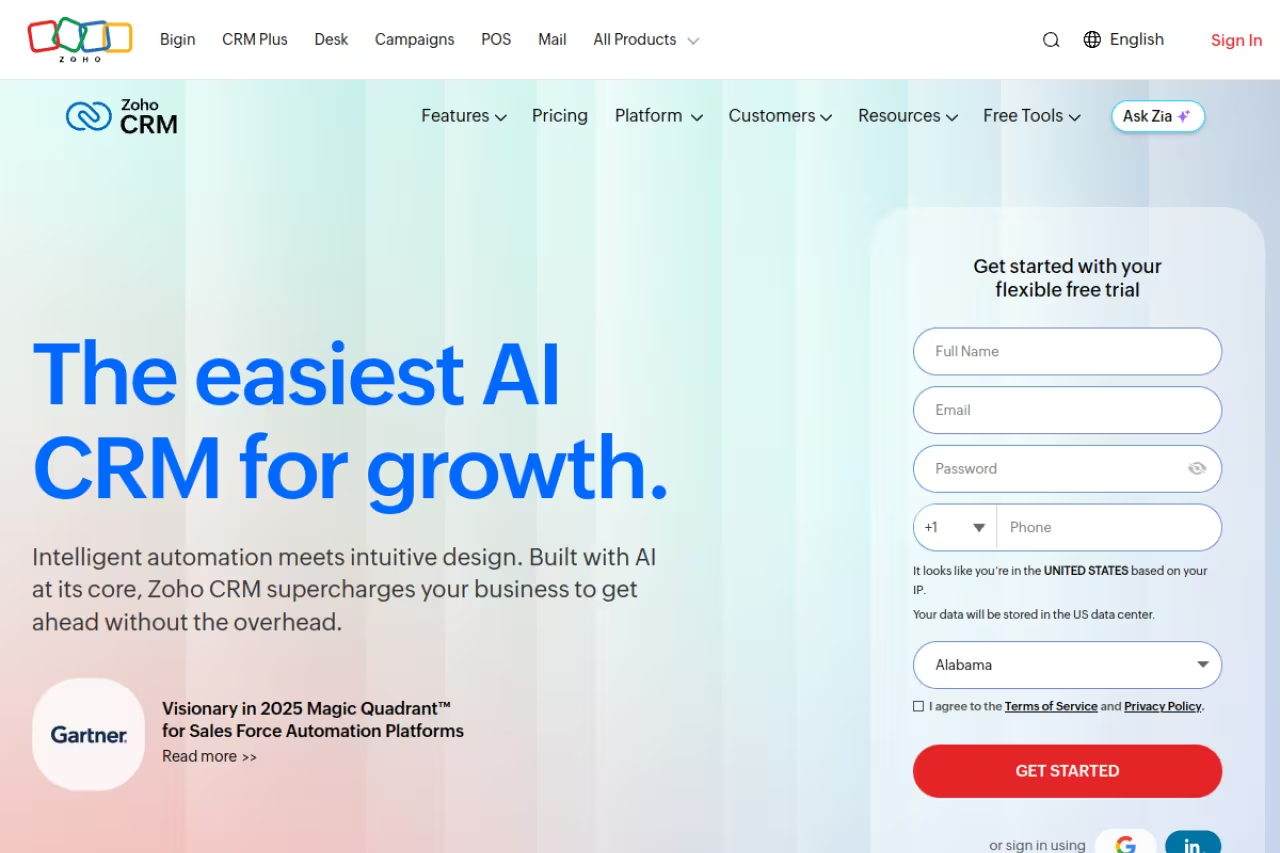
Zoho CRM is what I recommend to most teams that ask me where to start. It does the unglamorous thing well: it gives you a full sales, service, and marketing CRM at a price that does not require finance approval. Its built-in telephony layer (Zoho's PhoneBridge) connects to dozens of providers, so you click to dial inside the record and the call logs itself.
Who it's best for: small to mid-size operations that want one system for the whole customer lifecycle, not a phone tool stapled to a database.
The best value for small to mid-size operations wanting one system for the whole customer lifecycle, with click-to-dial and self-logging calls. Expect a busy interface and real configuration time, and telephony quality depends on the provider you connect.
Pricing is the headline. Standard runs $14 per user per month billed annually, Professional $23, Enterprise $40, and Ultimate $52, per Zoho's pricing page. There is a free tier for up to 3 users. Enterprise is where the workflow automation and the AI assistant (Zia) start to earn their keep for a contact center.
The standout is breadth for the dollar. You get sales pipelines, a help desk via Zoho Desk, and marketing automation that most rivals charge triple for.
The catch: Zoho's interface feels busy, and you will spend real time configuring it. The telephony is provider-dependent, so call quality and dialer features hinge on whoever you connect, not Zoho itself. If you want a polished, ready-out-of-the-box dialer, this is not it.

HubSpot: the easiest to live with
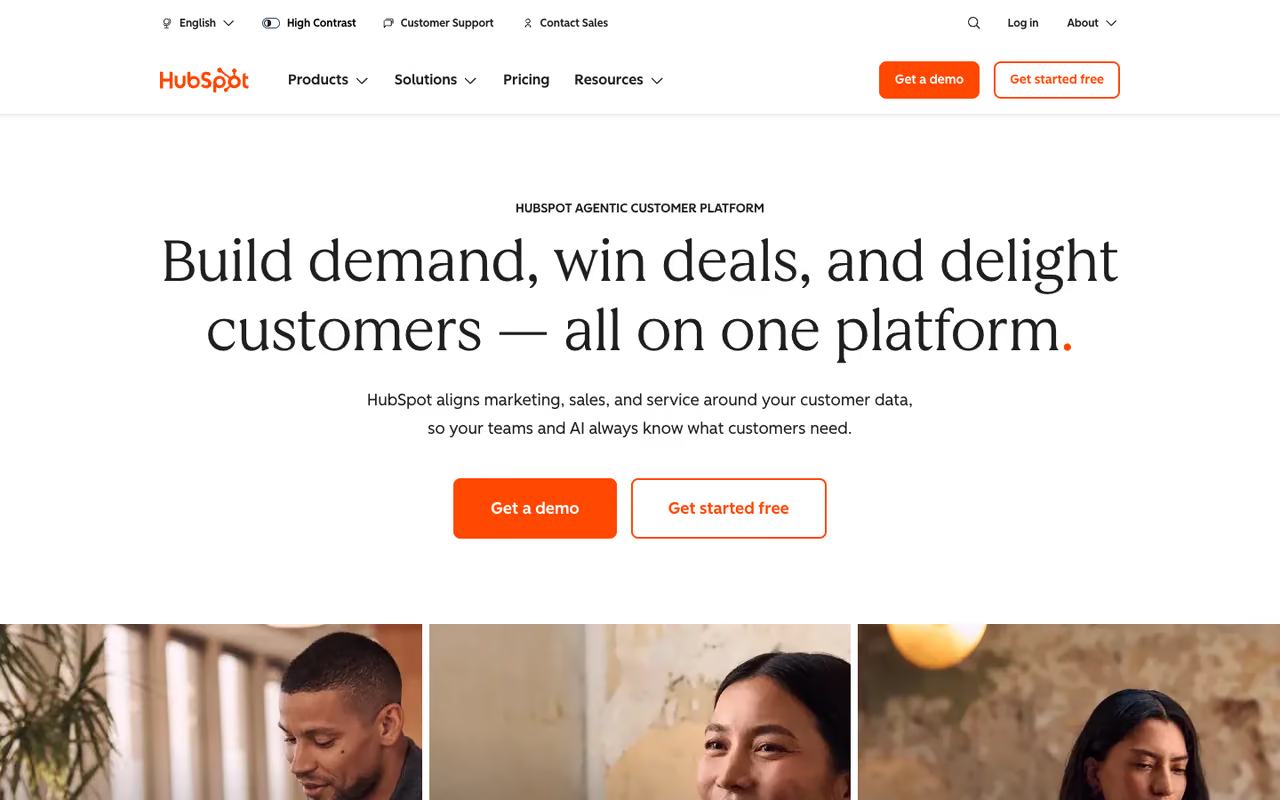
HubSpot wins on the thing nobody puts on a feature matrix: agents actually like using it. Every call, email, chat, and ticket lands on one contact timeline, so an agent sees the full story without clicking around. For centers that handle phone plus email and chat, that single view changes how fast people resolve issues.
Who it's best for: SMB and mid-market teams that want omnichannel context and a short onboarding ramp.
HubSpot's CRM is free to start. The calling tools and ticketing live in Service Hub, which begins at $20 per seat per month for Starter and jumps to roughly $100 per seat per month at Professional, according to HubSpot's pricing. Built-in calling minutes are capped, so heavy phone teams usually connect a dedicated voice provider.
The standout is the unified timeline and how little training agents need. New hires are productive in days, not weeks.
Where it falls short: cost scales fast. The jump from Starter to Professional is steep, and the features call centers actually want (custom reporting, advanced automation, call transcription) sit in the higher tiers. HubSpot is a CRM with a phone, not a contact-center platform, so very high call volumes will outgrow it.
Pick it for SMB and mid-market teams that want omnichannel context and a short onboarding ramp, since agents actually enjoy using it. It is a CRM with a phone, so very high call volumes will outgrow it and costs scale fast.
If your team is drowning in tools and you want one place to run the whole customer relationship, that consolidation is worth a Dupple X yearly trial to plan the migration properly.

JustCall: voice-first for sales floors
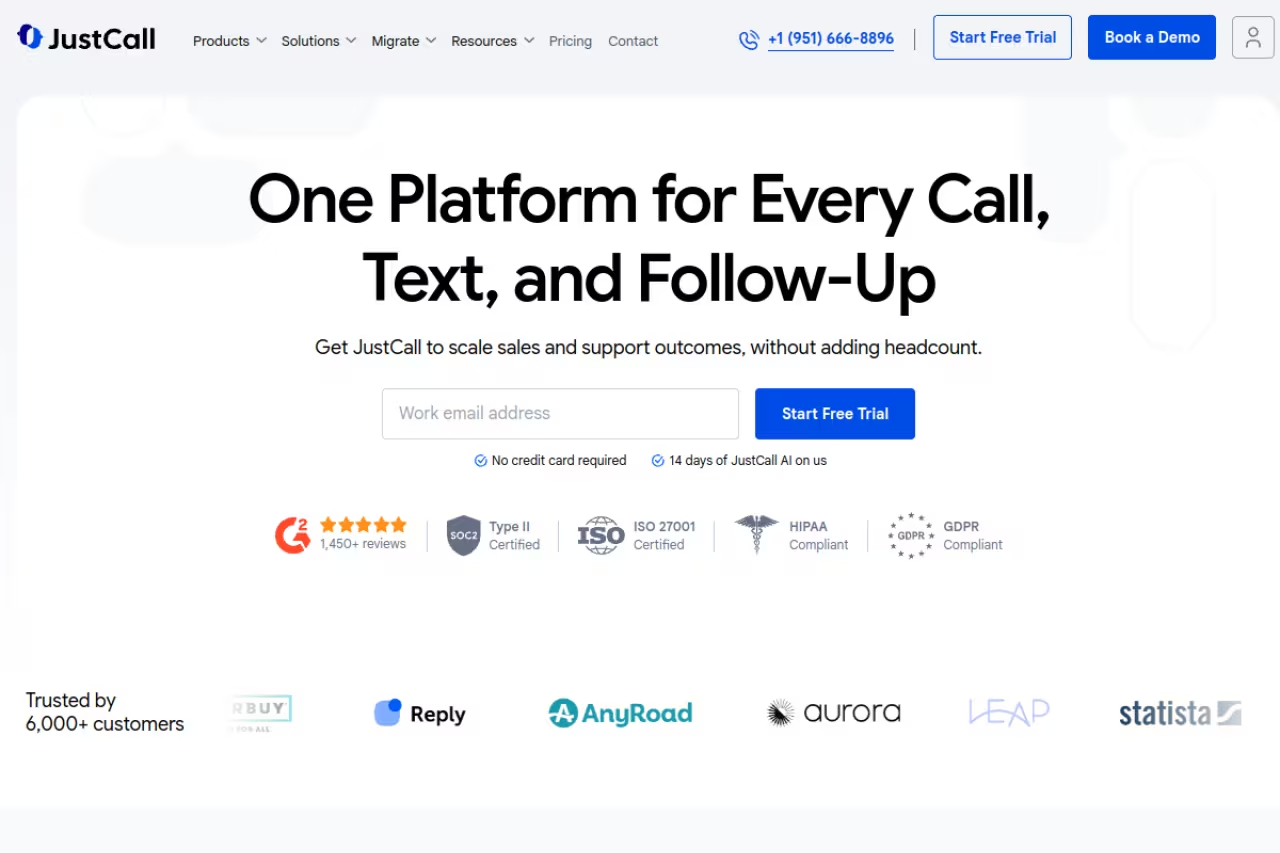
JustCall flips the model. Instead of a CRM that calls, it is a calling platform that syncs to your CRM. For outbound sales teams that grind through call lists all day, that priority order matters. You get a sales dialer, SMS, call recording, and AI call scoring, and it pushes everything into Salesforce, HubSpot, or Zoho.
Who it's best for: outbound and inside-sales teams where the phone is the job, not a feature.
A voice-first layer for outbound sales floors where the phone is the job, with a dialer and AI call scoring. It is not a system of record, so you still need a real CRM, and the 2-user minimum and add-ons raise the bill.
Pricing starts at $19 per user per month for Essentials billed annually, Team at $29, Pro at $49, and Business at $89, per JustCall's pricing. Watch the fine print: most plans carry a 2-user minimum, so real entry cost doubles, and phone numbers, SMS credits, and AI add-ons stack on top.
The standout is the dialer experience and the AI coaching layer. Sales Dialer plus AI scoring on every call gives managers a feedback loop that generic CRMs cannot match.
The catch: JustCall is not a system of record. You still need a real CRM behind it for pipeline and customer data, so this is a layer, not a replacement. Number provisioning and per-minute charges can make the bill less predictable than the headline rate suggests.

CloudTalk: mid-market call operations
CloudTalk sits in a useful middle. It is a proper cloud call center with IVR, smart routing, a power dialer, and call analytics, and it integrates with the major CRMs rather than trying to be one. Supervisors get the real-time dashboards (handle time, queue stats, agent status) that a busy floor needs.
Who it's best for: growing call operations that have a CRM already and need serious telephony on top.
Plans run from $25 per user per month (Lite, billed annually) up through Essential at $29 and Expert at $50, per CloudTalk's pricing. The Expert tier, which carries the power dialer and conversation intelligence, requires a minimum of 3 licenses.
The standout is the analytics and the call-quality reputation. International numbers in 160-plus countries also help if you run support across regions.
Where it falls short: like JustCall, it is telephony, not a CRM, so budget for both. The power dialer and the better automation are gated behind Expert, so the cheap plans feel thin once you are running at scale.
A solid cloud call center for growing operations that already have a CRM and need serious telephony on top. Budget for both, and note the power dialer and better automation are gated behind the Expert tier.
Freshdesk: support-led centers
Freshdesk (from Freshworks) is built for ticket-driven support more than sales. If your call center is fundamentally a help desk that also answers phones, its ticketing model is deeper than what a sales CRM gives you. Freshcaller, the voice product, plugs in for inbound and outbound calls tied to those tickets.
Who it's best for: customer-support operations where every call should become a tracked ticket.
Freshdesk's Email and Ticketing tiers run $19, $55, and $89 per agent per month billed annually for Growth, Pro, and Enterprise; the omnichannel "Freshdesk Omni" bundle runs $29 to $119, per Freshworks' pricing. The Freddy AI copilot is a roughly $29 per agent per month add-on, so factor that in if you want AI assist.
The standout is ticketing maturity: SLAs, automations, knowledge base, and reporting that support leaders actually use.
The catch: as a sales CRM it is weak, and the voice features are an add-on rather than the heart of the product. The AI tooling now sits behind consumption-based session packs, which makes the real cost harder to predict than the per-agent rate implies.
Go with Freshdesk if your call center is really a help desk that answers phones and every call should become a tracked ticket. It is weak as a sales CRM, and AI add-ons make real costs harder to predict.
Salesforce Service Cloud: enterprise muscle
Salesforce Service Cloud is the option you reach for when no off-the-shelf tool can model your process. It will do anything, which is both the pitch and the warning. With Service Cloud Voice, telephony lives natively inside the agent console alongside AI-driven case routing.
Who it's best for: large enterprises with dedicated admins and genuinely complex, multi-team workflows.
List pricing starts at $25 per user per month for Starter Suite, $100 for Pro Suite, $165 for Enterprise, and $330 for Unlimited, per Salesforce. Service Cloud Voice is a separate add-on that runs $50 to $200 per user per month, so effective per-agent cost routinely lands north of $300.
The standout is customization and the ecosystem. Anything you can imagine, a Salesforce partner has built.
Where it falls short: cost and complexity. Salesforce raised most Enterprise and Unlimited prices roughly 6% in late 2025, and the add-on stack (Voice, Digital Engagement, Einstein) inflates the bill fast. For a small or mid-size center, this is overkill, full stop. You need admin headcount just to keep it tuned.
The enterprise option when nothing off the shelf can model your process, with voice built into the agent console. For small or mid-size centers it is overkill, and the add-on stack plus admin headcount inflate the bill fast.

Five9: high-volume outbound
Five9 is a true CCaaS platform built for floors running thousands of calls. Its predictive dialer, workforce management, and omnichannel routing are mature in a way newer tools are not. It is not your CRM; it connects to Salesforce, Zendesk, and others and acts as the contact-center engine.
Who it's best for: large outbound and blended operations that need predictive dialing and real WFM.
A true CCaaS platform for large outbound and blended floors that need predictive dialing and real workforce management. The 50-seat minimum and implementation project rule out small teams entirely.
Pricing starts around $159 per seat per month with a 50-seat minimum, which puts it firmly in enterprise territory. That number sits well above mid-market tools, so it only makes sense at scale.
The standout is dialer sophistication and reliability under heavy load. When you are pacing thousands of outbound calls, this is where Five9 earns its price.
The catch: the seat minimum and pricing rule out small teams entirely, and implementation is a project, not a signup. You are buying a platform and a deployment, not a quick install.

Talkdesk: modern enterprise CX
Talkdesk is the newer-feeling enterprise option, leaning hard into AI routing, self-service bots, and faster time-to-value than the legacy CCaaS crowd. For an enterprise that wants contact-center power without a six-month rollout, it is the friendlier pick.
Who it's best for: enterprises that want AI-first CX and a quicker deployment than Genesys or Five9.
Talkdesk's plans run CX Cloud Digital Essentials at $85 per seat per month, Voice Essentials at $105, and CX Cloud Elite at $165, typically on a three-year commitment. That commitment is the trade-off for the lower-than-rival entry point.
The standout is the AI tooling and a cleaner admin experience. Routing and virtual agents are strong out of the box.
Where it falls short: the multi-year contracts reduce flexibility, and like the other CCaaS tools, it still needs a CRM behind it for customer records. Pricing transparency is thin until you talk to sales.
The friendlier enterprise pick for AI-first CX and quicker deployment than Genesys or Five9. The trade-off is multi-year contracts, thin pricing transparency until you talk to sales, and still needing a CRM behind it.
How to choose
Skip the feature-matrix paralysis. Answer three questions in order.
First, is your center sales-led or support-led? Sales-led with heavy outbound points you at a voice-first tool (JustCall, CloudTalk, Five9). Support-led points you at ticketing-strong systems (Freshdesk, HubSpot Service Hub).
Second, do you already have a CRM? If yes, you likely want a calling layer (JustCall, CloudTalk) rather than a second CRM. If you are starting fresh and want one system, Zoho or HubSpot covers the most ground.
Third, what is your seat count? Under 50 seats, the CCaaS platforms (Five9, Genesys, Talkdesk) are not for you. Over a few hundred seats with real compliance and WFM needs, the cheaper CRMs will buckle and the enterprise platforms start to make sense.
My default recommendation: most teams should start with Zoho CRM for value or HubSpot for ease, then add a dedicated dialer only if call volume justifies it. Buy the platform your process needs today, not the one you might need at 10x scale.
If you are still mapping the wider stack, our guides to the best call-center CRM software, best CRM analytics tools, and best AI customer support tools go deeper on adjacent pieces. You can also browse vetted picks on our top tools page.
FAQ
What is the best CRM for a small call center?
For most small call centers, Zoho CRM offers the best balance of price and capability, starting at $14 per user per month with click-to-dial telephony built in. If you handle a lot of email and chat alongside calls, HubSpot's free tier plus Service Hub Starter ($20 per seat) is the easier on-ramp. Both avoid the heavy seat minimums of enterprise CCaaS tools.
What is the difference between a CRM and call center software?
A CRM stores your customer data: contacts, history, deals, and tickets. Call center software (CCaaS) handles the phone layer: dialers, IVR, routing, and queue management. Many teams run both, connecting a tool like CloudTalk or JustCall to a CRM like Zoho or Salesforce. Some CRMs (HubSpot, Zoho) include basic calling, but high-volume floors need dedicated telephony.
How much does call center CRM software cost?
Entry CRM plans with calling start around $14 to $25 per user per month (Zoho, CloudTalk, JustCall). Mid-market support suites like Freshdesk run $19 to $89 per agent. Enterprise CCaaS platforms (Five9, Talkdesk, Genesys) start at $85 to $159 per seat and often carry seat minimums. Budget for add-ons too: phone numbers, AI assist, and voice modules stack on top of the base rate.
Do I need a separate dialer if my CRM has calling?
It depends on volume. HubSpot and Zoho include click-to-dial that works fine for low-to-moderate outbound. Once you are running predictive or power dialing across long call lists, a dedicated dialer (JustCall, CloudTalk, Five9) pays for itself in connect rates and agent talk time. The built-in calling in most CRMs is for convenience, not for grinding through thousands of calls a day.
Which call center CRM is best for outbound sales?
For outbound, prioritize the dialer. JustCall is the strongest value for sales teams that live on the phone, with a sales dialer and AI call scoring. CloudTalk's power dialer suits mid-market outbound. At enterprise scale, Five9's predictive dialer is the standard. Pair any of them with a CRM (Zoho, HubSpot, Salesforce) so your pipeline and call activity stay in one record.
Related guides
Some offers on this page may be paid placements or contain affiliate links.
Across our whole catalogue the median is $24 a month and 33% of tools advertise a free tier. Figures are the lowest recurring monthly price quoted in our own review of each tool, read on 2026-08-19. Full method and every category.
