
Best AI Healthcare Tools in 2026

Key facts8 tools compared: Abridge, Heidi, Freed, Suki, Dragon Copilot, Aidoc, Docus, Ada
- 8 tools compared: Abridge, Heidi, Freed, Suki, Dragon Copilot, Aidoc, Docus, Ada
- Abridge (best for: Epic health systems): Enterprise, ~$2,500/clinician/yr
- Heidi (best for: Independent clinicians): Free; Clinician $150/mo
- Freed (best for: Solo and small practice): $99/mo ($90 annual)
- Suki (best for: Voice-command workflows): ~$299-$399/mo
Most clinicians I talk to do not want another dashboard. They want their evenings back. The average doctor spends close to two hours on documentation for every hour of patient care, and that gap is exactly where AI has moved fastest in healthcare. Over 40% of US physicians used some form of AI documentation tool in 2025, and the number kept climbing through 2026.
The catch is that "AI in healthcare" covers wildly different jobs. An ambient scribe that writes your notes has almost nothing in common with a radiology triage model that flags a stroke on a CT scan, which has nothing in common with a symptom checker your patients use at home. Lumping them into one ranking is how people end up buying the wrong thing.
So I split this by job. If you are a clinician who just wants notes written for you, start with Abridge for health systems on Epic, or Heidi if you are independent and want to start free today. Below I walk through eight tools across scribing, diagnosis, decision support, and patient-facing care, with real pricing and the honest downsides nobody puts on their landing page.
Quick comparison
| Tool | Best for | Price | Standout |
|---|---|---|---|
| Abridge | Epic health systems | Enterprise, ~$2,500/clinician/yr | Best in KLAS Ambient AI, 2 years running |
| Heidi | Independent clinicians | Free; Clinician $150/mo | Genuinely usable free tier |
| Freed | Solo and small practice | $99/mo ($90 annual) | Simple, fast, no enterprise sales |
| Suki | Voice-command workflows | ~$299-$399/mo | Talk to your EHR, not just transcribe |
| Dragon Copilot | Large enterprises | ~$500-$830+/mo | Deepest legacy EHR integration |
| Aidoc | Radiology and ER triage | Enterprise quote | FDA-cleared multi-condition CT triage |
| Docus | Lab interpretation and second opinions | Free; from ~$6/mo | Doctor-ready reports from raw labs |
| Ada | Patient symptom checking | Free | 13M+ users, peer-reviewed |
Abridge: the enterprise scribe that won KLAS twice
Abridge is an ambient AI scribe built for hospitals and large groups running Epic. It listens to the patient conversation, drafts a structured note, and pushes it into the chart with the kind of revenue-cycle and coding intelligence that billing teams actually care about.
The enterprise pick for health systems running Epic. Two straight Best in KLAS wins for ambient AI and strong coding intelligence make it hard to beat there, but pricing is enterprise-only and gated behind a sales call, so independent clinicians should look elsewhere.
Abridge was named Best in KLAS for Ambient AI in both 2025 and 2026, the only vendor to hold that title two years straight, and that reputation is doing a lot of the selling at the enterprise level. If your organization lives in Epic, the integration depth here is hard to match.
Pricing is enterprise-only and gated behind a sales call. Public estimates put it around $2,500 per clinician per year, with some health-system contracts landing in the $600 to $800 per provider per month range depending on volume and modules. There is no self-serve plan.
The catch: there is no path in for an independent clinician or a two-person clinic. You need a health-system contract, a procurement process, and patience. If that is not you, skip to Heidi or Freed.
Heidi: the free tier that actually works
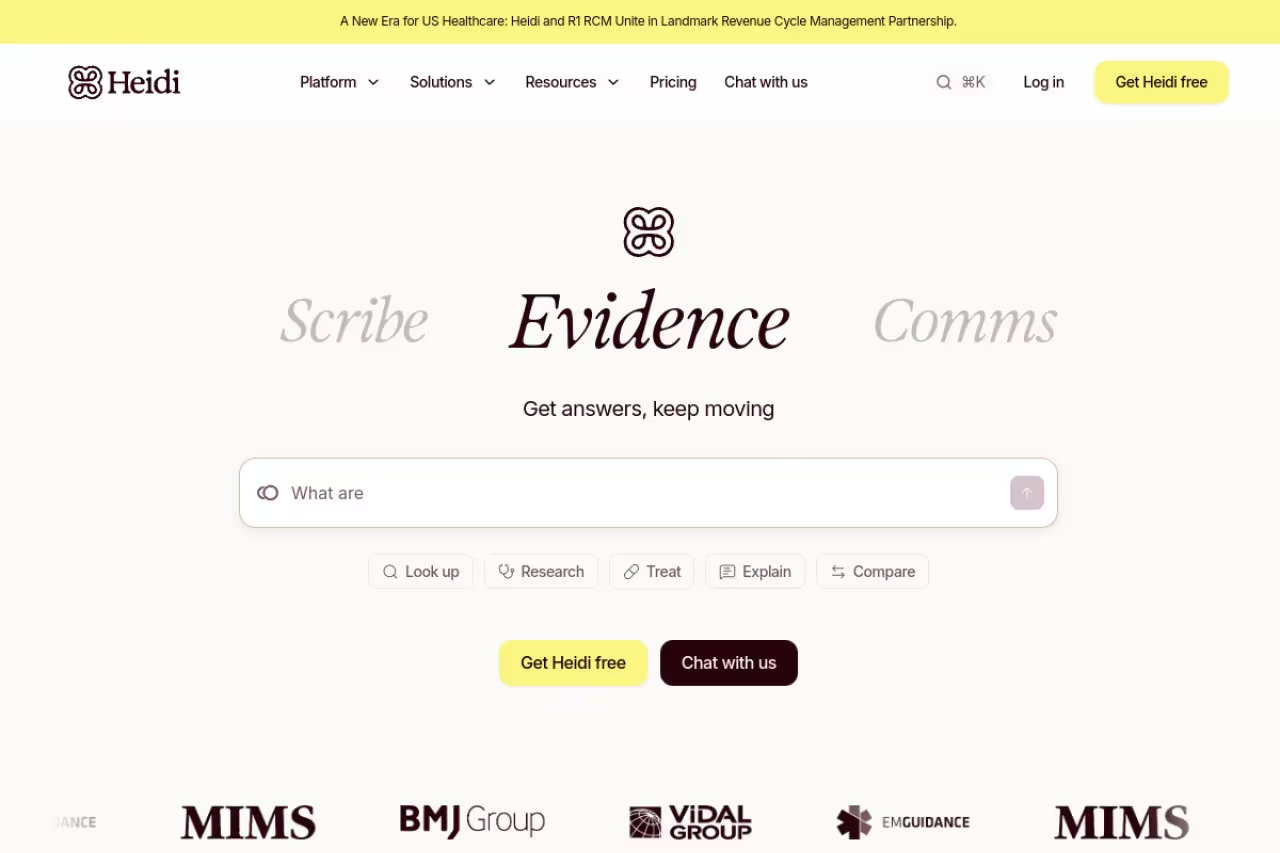
Heidi is the scribe I point independent clinicians to first, because you can start without a credit card and find out in an afternoon whether ambient documentation fits your workflow. It transcribes the visit, generates notes from a large template library, and has an "Ask Heidi" feature for quick clinical lookups.
Where I'd start if you're a solo practitioner, locum, or small clinic who wants to evaluate before committing. The free plan lets you test properly without a credit card, but it has no Business Associate Agreement, so US clinicians handling protected health information must upgrade.
The Free plan gives you unlimited transcription with standard templates and a capped number of "actions" per month, which is enough to test it properly rather than a 50-word demo.
Heidi rebranded its tiers in early 2026. The paid Clinician plan runs $150 per user per month and unlocks unlimited advanced templates plus the full Ask Heidi feature set, with a 14-day trial. There is also a cheaper Evidence Plus add-on around $40 per user per month for the citation and CME-tracking side, and a custom-quoted Practice tier with EHR integration.
The catch: the free plan does not include a Business Associate Agreement, so US clinicians handling protected health information cannot use it compliantly until they upgrade. Treat free as a test drive, not a forever plan.

Freed: the no-nonsense scribe for small practices
Freed became one of the most recognizable scribes among independent physicians for a simple reason: it does one thing, sets it up in minutes, and never asks you to sit through an enterprise demo. You record the visit, you get a clean SOAP note, you edit and sign.
A lightweight scribe for solo and small outpatient practices that want results today without any procurement. Public pricing at $99 per month and minutes of setup are the draw, but it stays deliberately simple and a growing group will eventually outgrow it.
The product is opinionated and lightweight rather than a full platform, which is exactly why busy clinicians like it.
Pricing is refreshingly public. Freed is $99 per month per clinician, dropping to about $90 per month on annual billing, with a 7-day free trial. EHR write-back now sits in a Premier tier at roughly $119 per month monthly or $104 annual.
The catch: it stays deliberately simple. There is no real multi-provider management layer and no deep two-way EHR navigation, so a growing group will eventually outgrow it and look at Suki or an enterprise option.

Suki: when you want to talk to your EHR
Suki has been in clinical use since 2017, which makes it one of the longest-running ambient tools here, and it goes beyond transcription. Suki lets you use voice commands to pull lab results, place orders, and navigate the chart, with two-way integration into Epic, Oracle Health, athenahealth, and MEDITECH.
Pick Suki if you want a voice assistant for your EHR, not just a note generator, with two-way integration into Epic and others. At roughly triple Freed's price, it only pays off if you actually use that depth, and a small practice that only needs notes should skip it.
If you find yourself narrating actions and wishing the EHR would just do them, this is the closest thing to that.
Suki uses a per-provider model: Suki Compose lands around $299 per provider per month for ambient notes and dictation, while Suki Assistant runs closer to $399 for the voice-command EHR navigation and order entry. Enterprise pricing flexes with user count and integration depth.
The catch: the per-provider price is roughly triple Freed's, and the voice-command magic depends heavily on how deep your specific EHR integration goes. A small practice that only needs notes is paying for capability it will not touch.
Dragon Copilot: the incumbent with the deepest roots
Dragon Copilot is Microsoft's merged product, formed in March 2025 when Nuance combined DAX Copilot with Dragon Medical One. The underlying Dragon dictation engine is trusted by more than 550,000 physicians, and the ambient layer plugs into the biggest enterprise EHRs.
The safe enterprise choice for large organizations already deep in the Microsoft and Nuance ecosystem that want documentation backed by human quality assurance. It is heavy, involved to set up and expensive, so smaller clinics will find newer tools faster to deploy and cheaper to run.
The Epic and Meditech integration is about as mature as it gets in this market.
Budget roughly $500 to $830 or more per provider per month depending on configuration and contract. This is enterprise software with enterprise procurement attached.
The catch: it is heavy. The combined product carries years of legacy decisions, the setup is involved, and the price reflects an enterprise sales motion. Smaller clinics will find newer tools faster to deploy and cheaper to run.

Aidoc: AI that reads the scan before the radiologist does
Aidoc is a different category entirely. It is FDA-cleared clinical AI that analyzes CT and other imaging in real time to triage acute findings, flagging things like stroke, pulmonary embolism, and intracranial hemorrhage so the urgent cases jump the queue. Its aiOS platform has analyzed more than 100 million patient cases and runs in over 1,600 hospitals.
A different category, aimed at radiology departments and emergency settings drowning in imaging volume. FDA-cleared triage across 14 acute indications is impressive, but it is infrastructure needing PACS integration and a health-system budget, and it augments radiologists rather than replacing the read.
In January 2026 the FDA cleared Aidoc's first complete multi-condition triage solution, bringing 14 acute indications into a single CT workflow powered by its CARE foundation model. That is a meaningful step up from the one-condition-per-algorithm model that defined this space.
Pricing is enterprise and quote-based, sold to health systems rather than individuals.
The catch: this is infrastructure, not an app you download. It requires integration with your PACS and imaging workflow, governance sign-off, and a health-system budget. It also augments radiologists rather than replacing the read, so the value depends on your case volume and how well you act on the triage signal.
Docus: turning raw labs into a doctor-ready report
Docus sits between the clinician tools and the consumer apps. Upload lab results and it produces an interpreted report with biomarker explanations, a differential diagnosis, suggested follow-ups, and a clinical plan, the kind of synthesis that saves time reviewing results before a visit.
A handy first pass on lab data for clinicians and engaged patients who want to understand their own numbers. The lab interpretation is the useful part, but treat it as a starting point, and the human second opinion costs extra on top of the subscription.
The lab-interpretation layer is the genuinely useful part.
There is a freemium tier, with paid plans starting around $6 per month and annual options at $300, $600, and $1,200 for higher usage. Human medical second opinions from specialists are sold separately at roughly $490 per consultation, so do not assume that is bundled.
The catch: AI interpretation is a starting point, not a verdict. Docus is explicit that its output supports rather than replaces clinical judgment, and the genuinely valuable human second opinion is a per-consult upcharge on top of the subscription.
Ada: the symptom checker patients actually trust
Ada is the patient-facing pick. It is a conversational symptom checker that asks structured follow-up questions and suggests possible causes and next steps. With more than 13 million users and validation in several peer-reviewed studies, it is one of the most credible consumer health AIs out there.
The patient-facing pick for engagement and triage, free for consumers or embedded by health systems and insurers. With more than 13 million users it is one of the most credible consumer health AIs, but it is a triage and reassurance layer, not a diagnosis.
The consumer app is completely free with no ads and no in-app purchases. Ada makes its money from B2B partnerships, where enterprise deployments are custom-priced based on volume and integration scope.
The catch: a symptom checker is not a diagnosis, and Ada says so plainly. It is a triage and reassurance layer, useful for steering patients to the right level of care, but it does not replace a clinical assessment.
How to choose
Start with the job, not the brand. The single most common mistake is comparing an enterprise scribe to a solo-clinician app as if they compete.
- You want notes written and you run a small or solo practice. Try Heidi free this week, then compare against Freed at $99. One of those two fits most independent clinicians.
- You are a health system on Epic. Abridge and Dragon Copilot are the serious contenders. Abridge has the KLAS momentum; Dragon Copilot has the deepest legacy roots. Run both in a pilot before signing.
- You want a voice assistant, not just transcription. Suki is the one built around voice commands and EHR actions.
- Your bottleneck is imaging, not notes. That is Aidoc territory, and it is an integration project, not a subscription.
- You want to help patients before or after the visit. Ada for symptom triage, Docus for lab interpretation.
One more practical filter for US clinicians: confirm the vendor will sign a Business Associate Agreement on the plan you are buying. Several "free" tiers, Heidi's included, do not include one, which rules them out for compliant use with protected health information.
If you are evaluating a stack of AI tools across your whole operation, not just clinical ones, a single subscription like Dupple X can be a cheaper way to trial several before you commit budget to any one.
FAQ
What is the best AI medical scribe in 2026?
For health systems on Epic, Abridge is the strongest pick, having won Best in KLAS for Ambient AI in both 2025 and 2026. For independent clinicians, Heidi (free to start) and Freed ($99 per month) are the most practical. The "best" one depends entirely on whether you are buying for a hospital or a solo practice. For a broader view, see our roundup of the best AI agents and our top AI tools directory.
Are AI healthcare tools HIPAA compliant?
The serious clinical tools sign a Business Associate Agreement, which is the document that makes HIPAA-compliant use possible. The important catch is that many free tiers do not include a BAA. Heidi's free plan, for example, excludes one, so US clinicians handling protected health information have to upgrade to a paid plan before using it for real patient data. Always confirm the BAA before you enter any patient information.
How much does an AI medical scribe cost?
As of 2026, pricing ranges from about $50 per month for budget tools up to $99 for Freed, roughly $150 for Heidi's Clinician plan, and $299 to $399 for Suki. Enterprise platforms like Abridge and Dragon Copilot run from several hundred to over $800 per provider per month and are quoted through sales. Most vendors offer a free trial, so the real cost to evaluate is your time.
Can AI diagnose medical conditions?
Not on its own, and no responsible tool claims to. FDA-cleared systems like Aidoc triage and flag acute findings on imaging to help clinicians prioritize, but a radiologist still confirms the read. Symptom checkers like Ada suggest possible causes and next steps, not diagnoses. The legitimate tools position themselves as decision support that augments a clinician, not a replacement for one.
Which AI tool helps patients understand their lab results?
Docus is built for this. You upload lab results and it returns an interpreted report with biomarker explanations, a possible differential, and suggested follow-ups. It has a free tier with paid plans starting around $6 per month. Just remember the AI interpretation is a starting point, and the human specialist second opinion is a separate paid consultation.
Do I need a different tool for documentation versus diagnosis?
Yes. Ambient scribes (Abridge, Heidi, Freed, Suki, Dragon Copilot) write your notes from the patient conversation. Diagnostic and triage AI (Aidoc) reads images and flags acute findings. Patient-facing tools (Ada, Docus) handle symptom checking and lab interpretation. These are genuinely separate products solving separate problems, which is why this list is organized by job rather than by ranking. For more on building an AI toolkit, see our guide to the best AI tools.
Related guides
Some offers on this page may be paid placements or contain affiliate links.
