
The Best Compliance Management Software in 2026

Key facts8 tools compared: Vanta, Drata, Secureframe, Sprinto, Scrut, Thoropass, Hyperproof, OneTrust
- 8 tools compared: Vanta, Drata, Secureframe, Sprinto, Scrut, Thoropass, Hyperproof, OneTrust
- Vanta (best for: Most startups + mid-market): ~$10K to $12K start
- Drata (best for: Engineering-led teams): ~$7.5K start (+ onboarding)
- Secureframe (best for: Budget-conscious buyers): ~$7.5K start
- Sprinto (best for: Lean startups, fast SOC 2): ~$4K to $8K start
Getting SOC 2 used to mean six months, a consultant, and a spreadsheet you hated by week two. That's the problem compliance software was built to kill: connect your stack, let the platform pull evidence automatically, and walk into your audit with the proof already collected.
The catch is that "compliance management software" now covers two very different things. There are the audit-automation platforms a 30-person SaaS company needs to land enterprise deals (SOC 2, ISO 27001, HIPAA). And there are the heavyweight GRC suites a regulated enterprise uses to run privacy, vendor risk, and dozens of frameworks at once. Buying the wrong category wastes either your money or your runway.
If you want one answer: Vanta is still the safest default for most startups and mid-market teams, with the biggest integration catalog and auditor network. But it isn't the cheapest, and a few newer players genuinely beat it on price and automation depth. I've spent the last few weeks pulling current pricing, reading audit reports, and comparing onboarding flows. Here's what actually holds up in 2026, and where each tool falls short. If you want the broader picture beyond compliance, our top tools hub maps the wider stack.
Quick comparison
| Tool | Best for | Price (annual) | Standout |
|---|---|---|---|
| Vanta | Most startups + mid-market | ~$10K to $12K start | Largest integration + auditor network |
| Drata | Engineering-led teams | ~$7.5K start (+ onboarding) | Deep CI/CD automation |
| Secureframe | Budget-conscious buyers | ~$7.5K start | Aggressive pricing, AI remediation |
| Sprinto | Lean startups, fast SOC 2 | ~$4K to $8K start | Lightweight, lowest entry price |
| Scrut | Multi-framework programs | ~$10K to $15K start | 60+ frameworks, control reuse |
| Thoropass | Software + audit in one | ~$12K to $18K | Bundled auditor services |
| Hyperproof | Enterprise multi-framework | ~$25K start | Risk + compliance at scale |
| OneTrust | Privacy-heavy enterprises | ~$50K+ start | Broadest GRC + privacy suite |

Vanta: the default that's hard to argue with
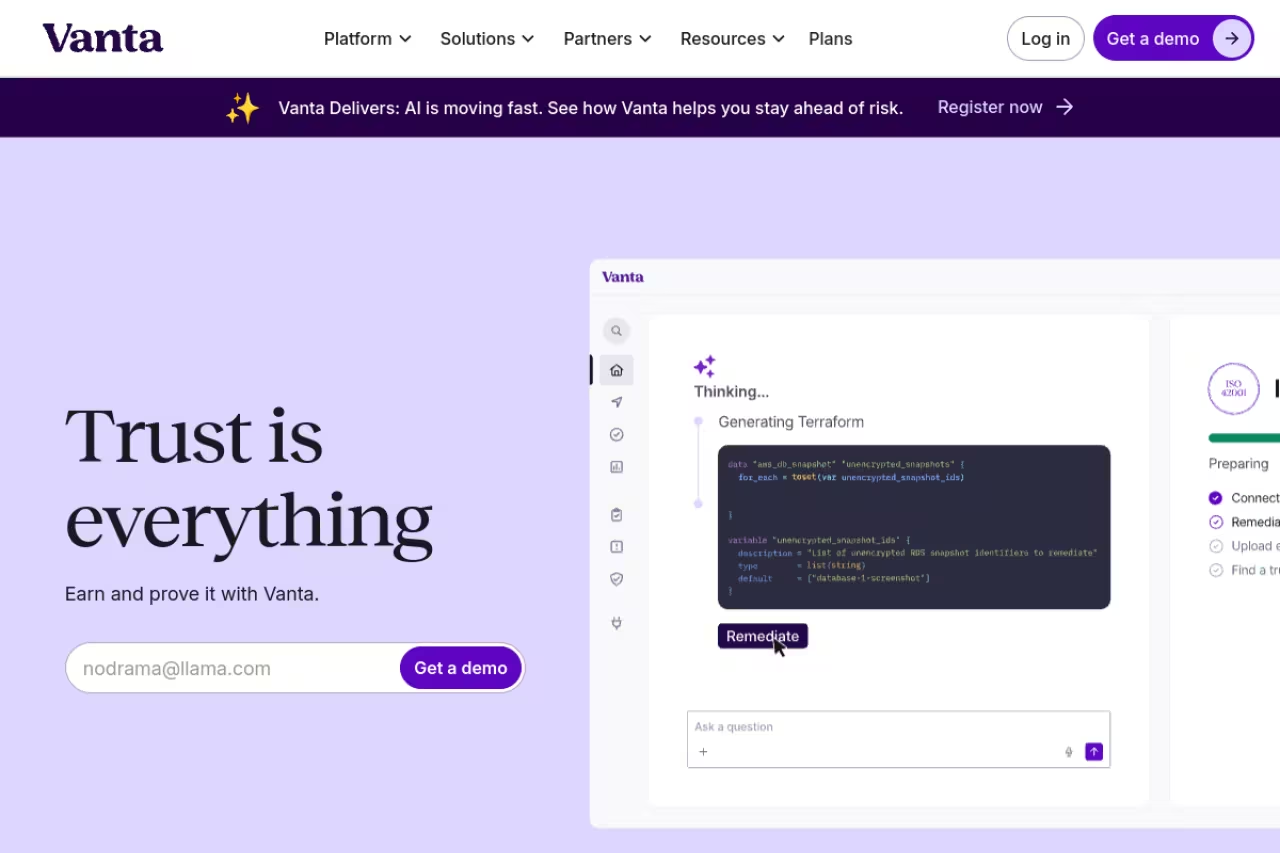
Vanta is the platform most auditors have seen a hundred times, and that matters more than founders expect. It connects to your cloud, identity, and endpoint tools, runs continuous monitoring tests, and collects evidence on a schedule so you're not scrambling the week before your audit window closes.
Who it's best for: SaaS companies that need SOC 2 or ISO 27001 to unblock deals and want the path of least resistance. Vanta claims its automation cuts framework time by 82%, with 1,200+ automated tests and 400+ integrations across 35+ frameworks.
Real pricing: typically starts around $10K to $12K per year for a small team on a single framework, climbing to $25K to $55K in the mid-market and past $50K at enterprise, per a 2026 platform pricing breakdown. Additional frameworks cost more.
The standout is the auditor network. When your auditor already lives inside Vanta daily, evidence review goes faster and you argue less.
The catch: you pay for that polish. Vanta is rarely the cheapest quote on the table, and several buyers told me they used a Secureframe or Sprinto number to negotiate Vanta down 20-30%. Do that.
The path of least resistance for SaaS companies needing SOC 2 or ISO 27001, helped by an auditor network most auditors already know. You pay for the polish, so use a rival quote to negotiate it down 20 to 30%.

Drata: for teams that live in the terminal
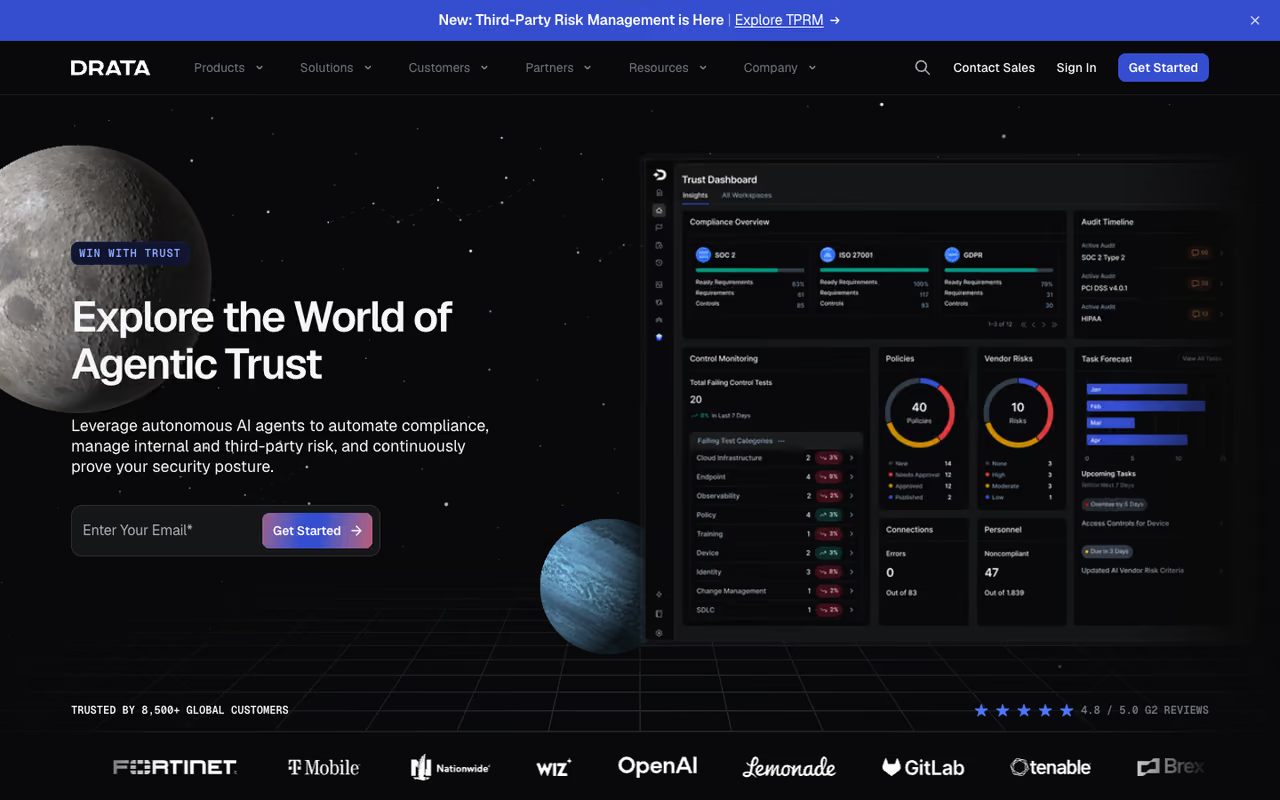
Drata competes head-to-head with Vanta and wins with engineering-heavy orgs. Its automation goes deeper into CI/CD and infrastructure, with daily automated control testing and a prebuilt control library that maps cleanly to common frameworks.
Who it's best for: DevOps-first teams that want compliance wired into their pipeline rather than bolted on top. If your engineers will actually use the tool instead of routing everything through a security lead, Drata rewards that.
Real pricing: the license starts around $7.5K to $15K per year with unlimited users, which sounds great until you hit the onboarding fee. Drata charges $10K to $25K for implementation separately, so a realistic year-one all-in often lands at $25K to $50K. Budget for it.
The standout is automation breadth combined with a strong risk register and issue management, so you're not buying a second tool for risk tracking.
Where it falls short: that onboarding cost catches people off guard, and the interface has more surface area than a tiny team needs. For a five-person startup chasing its first SOC 2, Drata can be overkill.
Pick Drata if you are a DevOps-first team that wants compliance wired into the pipeline. Watch the $10K to $25K onboarding fee, and note it can be overkill for a five-person startup chasing a first SOC 2.

Secureframe: the price aggressor
Secureframe has spent the last year undercutting the incumbents on price, and it's working. It does the core job well: automated evidence collection, continuous monitoring with alerting, a versioned policy library, and AI-assisted remediation guidance that tells you how to fix failing controls instead of just flagging them.
Who it's best for: companies where budget is the hard constraint but you still want a credible, audit-ready platform. Quotes for startups have run as low as $5K to $7K, with entry pricing around $7.5K per year and roughly $7.5K per additional framework.
The standout is the remediation guidance. A lot of platforms tell you a control failed. Secureframe is better at telling you the specific next step, which saves real hours when your team doesn't have a dedicated compliance hire.
The catch: it has a smaller integration catalog and auditor network than Vanta, so if you use a niche tool in your stack you may end up collecting some evidence manually. Worth checking your integrations list before signing.
A credible, audit-ready choice when budget is the hard constraint, with remediation guidance that names the specific next step. It has a smaller integration catalog and auditor network than Vanta, so check your stack first.
If your team is still piecing together a security stack alongside compliance, our roundup of the best AI cybersecurity tools pairs well with whatever platform you pick here. (And if tracking tool launches and price moves is your job, Dupple X does that part for you.)

Sprinto: lightest weight, lowest entry
Sprinto is the lean option. It supports SOC 2, ISO 27001, HIPAA, GDPR, PCI DSS and more, but the whole product is built to be lighter and faster to stand up than the bigger platforms.
Who it's best for: early-stage startups that need a clean SOC 2 quickly without a heavy implementation. Onboarding is genuinely fast, and the day-to-day UI doesn't drown a non-specialist.
Real pricing: this is where Sprinto wins. Entry pricing runs $4K to $8K per year, with startup discounts reportedly reaching 60%. SOC 2 packages commonly land in the $8K to $10K range once integrations and policies are included.
The standout is time-to-value. If you need to show a prospect you're "in process" on SOC 2 within days, Sprinto gets you there.
Where it falls short: renewals. Multiple buyers report renewal increases up to 40% after that first discounted year, so model year two before you celebrate year one. The lightweight design also means less depth for complex, multi-entity programs.
The lean option for early-stage startups that need a clean SOC 2 fast, with entry pricing of $4K to $8K per year. Model year two carefully, because renewal increases of up to 40% are reported and depth is limited for complex programs.

Scrut: built for multiple frameworks at once
Scrut is an AI-powered GRC platform covering 60+ frameworks, the widest catalog among the automation-first tools. Its Unified Control Framework lets you collect a piece of evidence once and reuse it across multiple certifications, which is the entire point if you're chasing SOC 2 and ISO 27001 and HIPAA together.
Who it's best for: growth-stage companies and teams that know they'll stack several frameworks and don't want to redo evidence collection each time.
Real pricing: a single framework typically starts around $10K to $15K per year, in line with the market. Scrut's pricing has a reputation for being more stable on multi-year contracts, which matters given how aggressively others raise renewals.
The standout is control reuse across 60+ frameworks plus AI "Teammates" that handle parts of the execution and questionnaire responses.
The catch: the breadth means a steeper learning curve than a single-framework tool like Sprinto. If you only ever need one framework, you're paying for range you won't use.
Built for growth-stage teams stacking several frameworks, reusing evidence across 60+ of them. The breadth means a steeper learning curve than Sprinto, so a single-framework buyer pays for range they won't use.
For mapping where compliance overlaps with broader risk, our guide to the best AI risk management tools covers the adjacent layer.

Thoropass: software plus real auditors
Thoropass (formerly Laika) takes a different angle: it bundles the compliance platform with managed audit services, so the software and the human auditors come from the same place. Its First Pass AI pre-screens evidence before auditors review it, and auditor collaboration is built into the workflow from day one.
Who it's best for: teams that would rather buy one thing than coordinate a platform vendor and a separate audit firm. If you don't have a compliance lead and don't want to manage two relationships, the bundle is genuinely useful.
Real pricing: roughly $12K to $18K per year for small teams, with platform and audit costs combined rather than quoted separately.
The standout is the integrated audit. Most platforms hand you off to a third-party auditor; Thoropass keeps it under one roof, which removes a lot of back-and-forth.
Where it falls short: bundling means less flexibility if you already have an auditor you trust or want to shop the audit separately. You're buying the package, not just the software.
Choose Thoropass if you would rather buy one package than coordinate a platform vendor and a separate audit firm, from roughly $12K to $18K per year. The bundle trades away flexibility if you already have an auditor you trust.

Hyperproof: when one program isn't enough
Hyperproof is where you graduate when audit-automation tools start to feel small. It's built for enterprise multi-framework programs, supporting SOC 2, ISO 27001, NIST 800-53, and custom compliance programs, with strong risk management and the ability to run many frameworks in parallel without the evidence chaos.
Who it's best for: larger organizations with a dedicated GRC function juggling several frameworks and a real risk register.
Real pricing: custom, generally starting around $25K per year, scaling to $40K to $75K in the mid-market and past $75K at enterprise, per the same 2026 pricing comparison.
The standout is depth. Hyperproof treats compliance as an ongoing operations program rather than a one-time certification sprint, which is exactly what a 500-person company needs.
The catch: it's too much for a startup. If you're chasing your first SOC 2, the price and complexity are wasted on you. Come back when you have a GRC team.
Where you graduate when audit-automation tools feel small: enterprise multi-framework programs with a real risk register. It is too much for a startup chasing its first SOC 2, so come back when you have a GRC team.

OneTrust: the privacy-first enterprise GRC
OneTrust is the broadest suite on this list, spanning privacy, risk, vendor management, and compliance. It supports 50+ pre-mapped frameworks plus 100+ global privacy regulations like GDPR, CCPA, and LGPD across 300+ jurisdictions, which no audit-automation tool comes close to matching.
Who it's best for: enterprises consolidating privacy and GRC into one platform, especially if you operate across multiple regions with serious data-protection obligations.
Real pricing: this is enterprise territory. Single modules start around $50K per year, with multi-module deployments reaching $250K+, and licensing roughly $15K per module per vendor pricing data.
The standout is privacy and jurisdiction coverage. If your compliance problem is fundamentally about data protection across borders, OneTrust is in a different league.
Where it falls short: for SOC 2, it's the wrong tool. OneTrust is overkill and overpriced for a startup that just needs a security certification. It earns its cost only when privacy and multi-module governance are the core problem.
The broadest suite here for enterprises consolidating privacy and GRC across borders, with 100+ global privacy regulations covered. For SOC 2 it is the wrong tool, overkill and overpriced for a startup.
How to choose
Skip the feature matrices and answer three questions.
What's your real goal? If it's landing enterprise deals via SOC 2 or ISO 27001, you want an audit-automation tool: Vanta, Drata, Secureframe, or Sprinto. If it's running an ongoing privacy and risk program across regulations, you want a GRC suite: Hyperproof or OneTrust. Buying up a tier "to be safe" just burns money.
How many frameworks, and when? One framework now, maybe another later: Vanta or Sprinto. Three or more from the start: Scrut, for the control reuse. Don't pay for 60 frameworks if you'll only ever touch one.
Do you have a compliance person? No one to own it: Thoropass (bundled auditors) or Secureframe (strong remediation guidance) carry more of the load. A dedicated security or GRC lead: Drata or Hyperproof reward the depth. If your main need is AI-driven evidence and monitoring specifically, our list of the best AI compliance tools goes deeper on that angle.
One more thing that's easy to forget: every quote here is negotiable. Get two or three, and use the lower number to pull the others down. That tactic worked consistently through early 2026 and still does.
If you want to keep up with how this category and the broader AI tooling stack keeps shifting, Dupple X tracks the tools and pricing changes so you're not re-researching this every renewal cycle.
FAQ
What is compliance management software?
It's a platform that automates the work of proving you meet a security or regulatory standard. Instead of tracking controls in spreadsheets, the software connects to your cloud and SaaS tools, monitors controls continuously, gathers evidence on a schedule, and hands it to your auditor. For SOC 2 and ISO 27001 it can cut a months-long project down to weeks.
How much does compliance management software cost in 2026?
For audit-automation tools the entry point runs roughly $4K to $15K per year for a single framework, with Sprinto and Secureframe at the low end and Vanta and Drata higher. Watch for separate onboarding fees (Drata charges $10K to $25K) and renewal increases. Enterprise GRC suites like Hyperproof and OneTrust start at $25K to $50K+ and scale into six figures.
Which compliance software is best for a startup getting SOC 2 for the first time?
Sprinto, Secureframe, or Vanta. Sprinto has the lowest entry price and fastest setup, Secureframe undercuts on cost with good remediation guidance, and Vanta is the safest default thanks to its auditor network. For a first SOC 2, avoid enterprise GRC platforms like OneTrust and Hyperproof. They're built for a problem you don't have yet.
What's the difference between compliance automation and a GRC platform?
Compliance automation tools (Vanta, Drata, Sprinto) focus on getting you certified for specific frameworks fast, with heavy automation around evidence collection. GRC suites (OneTrust, Hyperproof) are broader operating systems for governance, risk, and compliance across many frameworks, privacy regulations, and vendor risk. Startups want the former; regulated enterprises want the latter.
Can these tools handle more than one framework?
Yes, but coverage varies. Vanta supports 35+ frameworks, Drata and Secureframe around 30, and Scrut leads the automation tools with 60+. If you know you'll stack SOC 2, ISO 27001, and HIPAA, pick a platform with strong control reuse so you collect each piece of evidence once and apply it everywhere. Scrut and Vanta both do this well.
Is it worth paying for compliance software instead of doing it manually?
For almost any company that needs recurring certifications, yes. Manual SOC 2 work eats hundreds of hours per cycle and breaks the moment your stack changes. Since certification is rarely one-and-done, the software pays for itself in saved time and faster audits. The real decision isn't whether to buy, it's which tier matches your stage.
Related guides
Some offers on this page may be paid placements or contain affiliate links.
