
The Best B2B Sales Software in 2026 (Compared and Ranked)

Key facts8 tools compared: Apollo.io, Clay, HubSpot Sales Hub, Cognism, Gong, Salesloft, Instantly…
- 8 tools compared: Apollo.io, Clay, HubSpot Sales Hub, Cognism, Gong, Salesloft, Instantly, LinkedIn Sales Navigator
- Apollo.io (best for: All-in-one for small teams): Free; paid from $49/user/mo
- Clay (best for: GTM engineers, custom workflows): Free; paid from $185/mo
- HubSpot Sales Hub (best for: Teams already on HubSpot CRM): Free; paid from $100/seat/mo
- Cognism (best for: European outbound, cold calling): Custom (~$15k+/yr)
Most "best B2B sales software" lists read like they were written by someone who has never sent a cold email. They rank 20 tools, give every one a glowing paragraph, and quietly skip the part where you actually have to pay for it. I compared most of these platforms on pricing, features, and public user reviews, so this one is different.
Here is the tension nobody admits: there is no single best tool. A sales stack has layers. You need data (who to contact), engagement (how to reach them), and intelligence (whether any of it is working). The mistake teams make is buying one expensive all-in-one platform when they needed three cheaper specialists, or vice versa. Wrong layer, wrong budget, wrong outcome.
If you want the short answer: for most small and mid-sized teams, Apollo.io is the best starting point because it bundles a decent contact database with sequencing for a price you can actually afford. If your motion is more technical and you want to build custom enrichment workflows, Clay is the one worth the learning curve. This guide is for founders, SDR leaders, and operators picking a stack in 2026, not enterprise buyers with a six-figure budget and a procurement team.
Quick comparison
| Tool | Best for | Price | Standout |
|---|---|---|---|
| Apollo.io | All-in-one for small teams | Free; paid from $49/user/mo | Database + sequencing in one |
| Clay | GTM engineers, custom workflows | Free; paid from $185/mo | 150+ data sources, AI enrichment |
| HubSpot Sales Hub | Teams already on HubSpot CRM | Free; paid from $100/seat/mo | Native CRM and reporting |
| Cognism | European outbound, cold calling | Custom (~$15k+/yr) | GDPR-compliant EU mobile data |
| Gong | Coaching and call review | Custom (annual) | Best-in-class conversation AI |
| Salesloft | High-volume cadence execution | ~$140/user/mo and up | Forecasting after Clari merger |
| Instantly | Cold email at scale | From $30/mo flat | Inbox rotation, big warmup pool |
| LinkedIn Sales Navigator | Social selling, account research | From ~$99/mo | Direct LinkedIn graph access |

Apollo.io: the best all-in-one for most teams
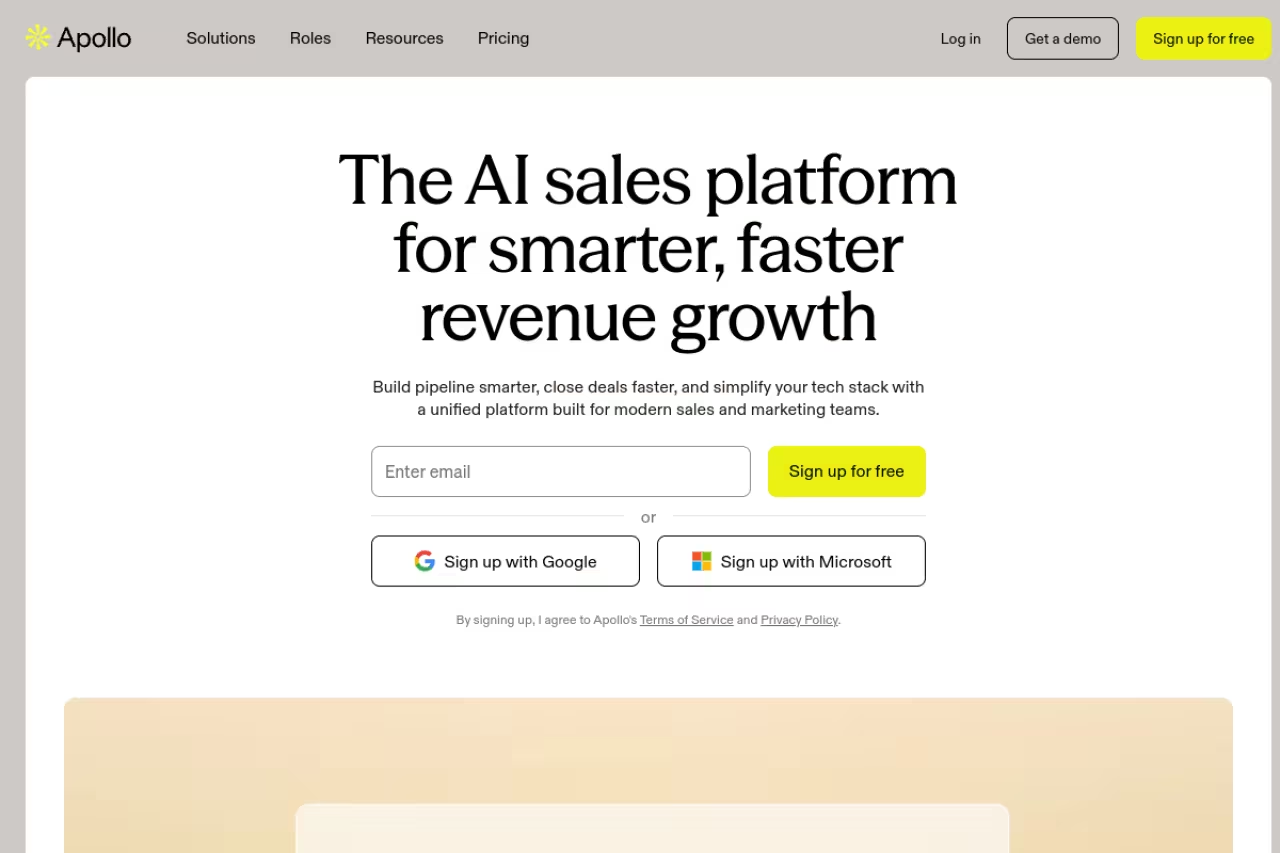
Apollo is what I recommend to almost every founder-led team that asks me where to start. It rolls a B2B contact database, email sequencing, a dialer, and meeting scheduling into one product, so you are not stitching together four subscriptions before you have sent a single email.
The place to start for founder-led and small to mid-market teams that want one bill and one login for data, sequencing and dialing. Accuracy is good, not great, and credit limits arrive faster than marketed, so use Cognism for EU mobiles.
Solo founders doing their own outbound get the most value, because the free Starter plan gives you a real taste of the database before you commit a dollar.
Pricing is public and reasonable, which is rarer than it should be in this category. Paid plans run $49/user/month for Basic, $79 for Professional, and $119 for Organization on annual billing, per Apollo's pricing page. Everything runs on a credit system: an email lookup costs 1 credit, a phone number costs 8, and overage credits are $0.20 each.
The standout is integration. Because the data and the sequencer live in the same place, your enriched contacts flow straight into a cadence without a manual export. For a two-person team that saves real hours every week.
The catch: data accuracy is good, not great. Direct dials in particular can be stale, and you will hit credit limits faster than the marketing implies once you start pulling phone numbers. If your whole motion is cold calling EU mobiles, look at Cognism instead.
Clay: the power tool for GTM engineers
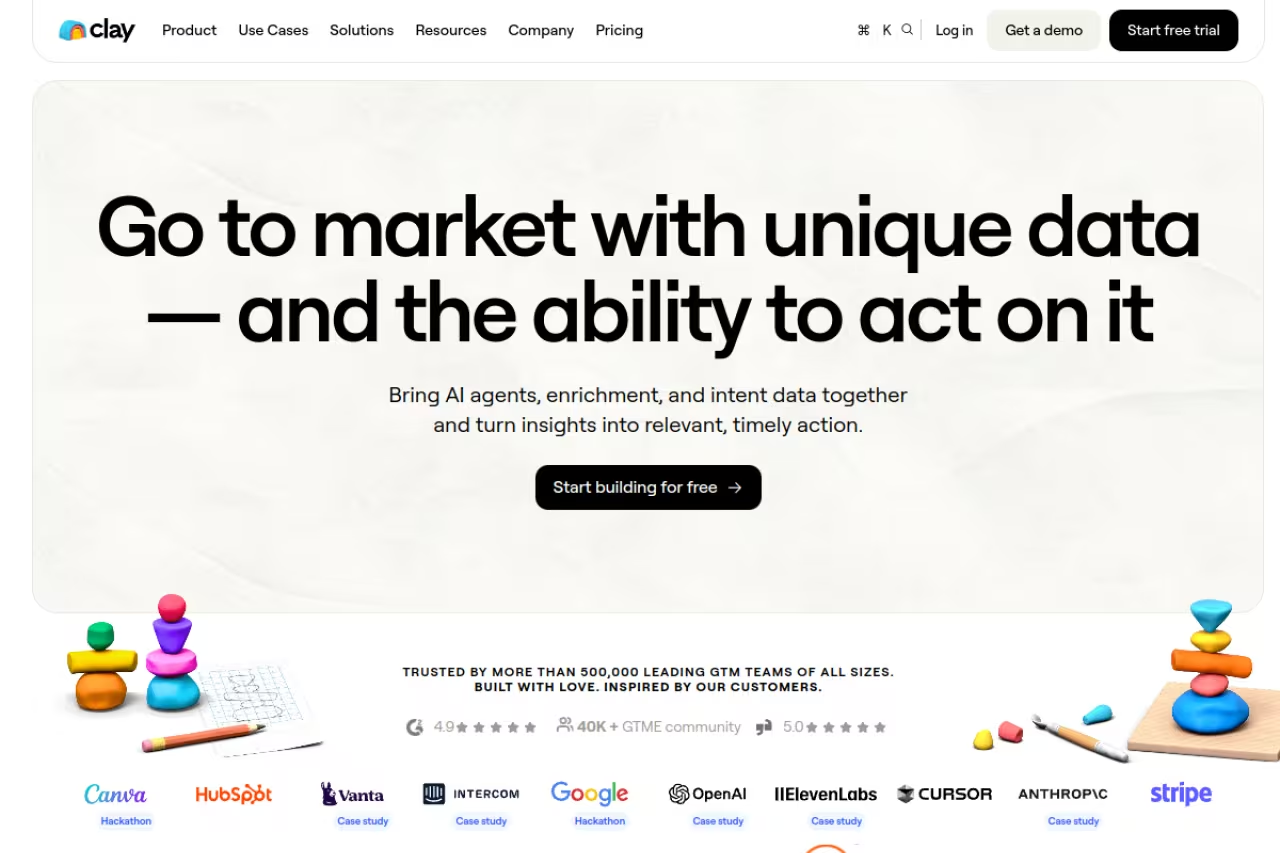
Clay is the tool that made "GTM engineering" a job title. Instead of a fixed database, it pulls from 150+ data sources and lets you build enrichment and outreach workflows in a spreadsheet-like canvas, then layer AI agents on top to research prospects automatically.
Clay is the power tool for technical operators and RevOps people who want custom waterfall enrichment and AI research in a spreadsheet-like canvas. The learning curve is steep and credits burn unpredictably, so it is infrastructure, not a turnkey app.
If "I want to combine three data sources and trigger outreach when a condition is met" sounds like your idea of fun, this is your tool.
After a March 2026 pricing overhaul, Clay runs a free plan with 100 credits a month, a Launch plan at $185/month (2,500 data credits, 15,000 actions), and Growth at $495/month, according to coverage of Clay's 2026 pricing change. Data marketplace costs also dropped sharply, which makes the waterfall approach much cheaper than it was.
The standout is flexibility. Nothing else lets you orchestrate this many sources and act on the result in one place. When it clicks, it replaces several tools at once.
Where it falls short: the learning curve is steep and the credit math gets confusing fast. A complex table can burn through credits in ways you did not predict, and non-technical reps will not touch it without training. This is infrastructure, not a turnkey app.
HubSpot Sales Hub: best if you live in HubSpot
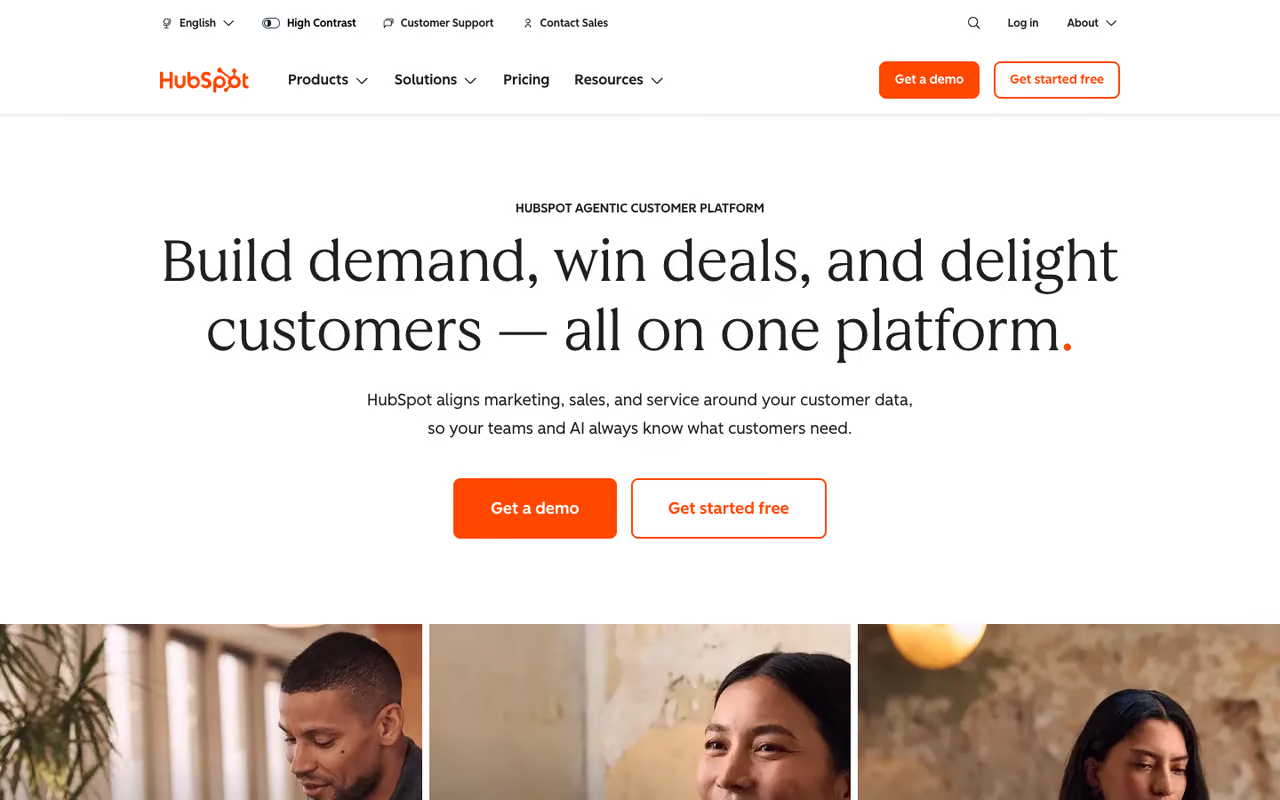
If your company already runs marketing and support on HubSpot, HubSpot Sales Hub is the obvious pick. Sequences, call tracking, meeting links, and forecasting all sit natively on top of the CRM, so your reps work where your data already lives. No sync to break.
It is best for teams that value one source of truth over best-in-class point tools. The reporting is genuinely strong, and handing a manager a clean pipeline dashboard without building it from scratch is worth a lot.
The obvious pick if your company already runs marketing and support on HubSpot, with a unified record and strong reporting. Pricing climbs quickly, including a $1,500 onboarding fee on Professional, and you still need a prospecting database.
Pricing climbs quickly. The free tier is usable, Starter is $15/seat/month, but Professional jumps to $100/seat/month and Enterprise to $150, with a mandatory $1,500 onboarding fee on Professional, per HubSpot's sales pricing. That onboarding charge surprises a lot of buyers.
The standout is the unified record. Every email, call, and deal stage attaches to one contact, and your whole org sees the same history.
The catch: it is a CRM with sales features bolted on, not a prospecting database. You still need Apollo, Clay, or ZoomInfo to find the contacts in the first place. And the price-per-seat math gets painful past a handful of reps.
If you are still assembling the rest of your growth stack around this, our roundup of the best AI tools for sales pairs well with whichever CRM you land on.

Cognism: for European outbound and cold calling
Cognism earns its spot for one reason: it has the best European B2B data of any provider on this list, especially mobile numbers. Most US-first databases legally cannot sell EU mobiles. Cognism can, and its phone-verified Diamond Data set hits a 98% verification rate that translates into noticeably higher connect rates on the dialer.
Cognism is the choice for high-volume cold calling into the UK, DACH or Nordics, with compliance built in and strong European mobile data. It is pricey and annual-only, and Apollo or ZoomInfo gives more for less on US prospects.
Pricing is custom and not cheap. Cognism does not publish numbers, but reporting puts the Platinum tier around $15,000/year and Diamond closer to $20,000 to $25,000, plus per-user fees, according to Salesmotion's pricing breakdown. Annual contracts only.
The standout is compliance baked in: do-not-call checking, consent tracking, and data processing agreements that satisfy European regulators.
Where it falls short: the price locks out small teams, and US coverage, while fine, is not its strength. If you are calling US prospects all day, Apollo or ZoomInfo gives you more for less.

Gong: for coaching and deal review
Gong records every call and meeting, transcribes it, and runs AI over the result to surface talk-to-listen ratios, competitor mentions, pricing objections, and whether reps actually followed the methodology. It is still the best conversation intelligence on the market in 2026.
Gong suits sales leaders who coach, managing five or more reps and reviewing real calls instead of trusting reports. Pricing is opaque and runs to tens of thousands a year, so a two-rep team with no coaching cadence is paying for transcription.
If you manage five or more reps and want to review real calls instead of relying on what reps tell you happened, Gong pays for itself in ramp time alone.
Pricing is custom, annual, and opaque. There is a platform fee plus per-seat licenses, and smaller teams pay a steep per-user platform fee before any seats, per comparison reporting. Expect tens of thousands a year minimum.
The standout is coaching depth. The call library and AI insights genuinely change how reps sell, not just how they report.
The catch: it is overkill for a two-rep team with no coaching cadence. If nobody is going to review the calls, you are paying enterprise money for an expensive transcription service.
Salesloft: for cadence execution at scale
Salesloft is a pure execution layer: cadences, dialing, conversation intelligence, and deal management built for reps running high outbound volume. After merging with Clari in 2025, it now bundles forecasting too, which closes a gap it used to have against Gong.
Salesloft is an execution layer for established sales orgs that have outgrown a lightweight sequencer, now with forecasting after merging with Clari. It has no contact database, and the seat minimum prices out small teams entirely.
Pricing is roughly $140/user/month for Essentials and around $180 for Advanced, with Premier at custom rates and a typical 10 to 15 user minimum, based on third-party pricing data.
The standout is workflow discipline. It standardizes how every rep runs outbound, which matters once you have a team big enough that consistency beats individual flair.
Where it falls short: it has no contact database, so you pair it with Apollo, Cognism, or ZoomInfo. And the seat minimum prices out small teams entirely.

Instantly: for cold email volume
Instantly is the tool for teams whose motion is high-volume cold email. Its edge is deliverability infrastructure: inbox rotation across many mailboxes and a warmup pool of roughly 200,000 real inboxes, which keeps you out of the spam folder at scale.
Pick Instantly if your motion is high-volume cold email and you need warmup and inbox rotation, with flat pricing from $30/month. It will not rescue bad domain setup or a spammy pitch, since deliverability depends on both.
Pricing is refreshingly flat. The Growth plan starts at $30/month with unlimited email accounts, and a 50-mailbox agency lands around $97/month on Hypergrowth, per cold email pricing comparisons. It scales by features, not per user.
The standout is the warmup network. A larger pool means more realistic engagement signals, which is the difference between landing in the inbox and the promotions tab.
The catch: deliverability still depends far more on your domain setup and copy than on any tool. Instantly will not save bad infrastructure or a spammy pitch.
LinkedIn Sales Navigator: for account research
LinkedIn Sales Navigator is the one tool here almost everyone ends up using regardless of the rest of their stack. It gives you direct access to LinkedIn's graph: advanced search filters, account and lead tracking, and warm-intro paths you cannot get anywhere else.
The research tool nearly everyone ends up using for relationship-driven selling and account research, with data nobody else has. It is not a bulk-export database, and LinkedIn limits scraping, so do not expect clean CSVs of contacts.
Pricing starts around $99/month for the Core seat, with Advanced tiers higher. It is per-user and adds up across a team, but the single-seat cost is easy to justify.
The standout is data nobody else has. Job changes, mutual connections, and real-time role updates come straight from the source.
The catch: it is research and outreach, not a database you can export in bulk. LinkedIn actively limits scraping, so do not buy it expecting clean CSVs of contacts.
How to choose
Stop shopping for "the best tool" and start mapping layers. Answer three questions in order.
First, where is your contact data coming from? If you sell into Europe and cold call, Cognism. If you want public pricing and an all-in-one, Apollo. If you want to build custom enrichment, Clay. Pick exactly one database. You do not need three.
Second, how do you reach people? Email-heavy at volume points to Instantly. Mixed cadences for a real team point to Salesloft. Already on HubSpot CRM means HubSpot Sales Hub. If Apollo is your database, its built-in sequencer may cover this layer entirely and save you a tool.
Third, do you coach calls? Only buy Gong if someone will actually review the recordings. If not, skip it until you have a coaching cadence worth the spend.
Match budget to stage. A pre-revenue founder should live on Apollo's free tier plus a Sales Navigator seat and nothing else. A 10-rep team can justify Salesloft plus a database plus Gong. Buying enterprise tools too early is the most common way I see startups waste money. For more on stitching AI into this workflow, our guide to the best AI agents covers where automation actually helps versus where it is hype, and Dupple X is how thousands of operators keep up with new tools as they ship.
Want a broader view before you commit? Our top AI tools directory tracks what is gaining traction across sales and the rest of the GTM stack.
FAQ
What is the best B2B sales software for a small startup?
For most small startups, Apollo.io is the best starting point. Its free tier gives you a real contact database, and paid plans start at $49/user/month with sequencing included, so you avoid paying for separate data and outreach tools. Add a LinkedIn Sales Navigator seat for research and you have a complete starter stack for well under $200/month.
Do I need a separate sales database and sales engagement tool?
Not always. All-in-one platforms like Apollo and HubSpot Sales Hub combine a contact database (or CRM) with sequencing in one product, which is enough for most small teams. You only need separate specialist tools, like Cognism for EU data plus Salesloft for cadences, once your volume or data-quality needs outgrow what a bundled tool delivers.
How much does B2B sales software cost in 2026?
It ranges widely. Self-serve tools like Apollo ($49/user/month and up) and Instantly ($30/month flat) are accessible to any budget. Mid-tier platforms like HubSpot Sales Hub run $100/seat/month. Enterprise data and intelligence tools like Cognism and Gong are custom-quoted and typically start in the tens of thousands per year on annual contracts.
Is Apollo or ZoomInfo better for B2B prospecting?
Apollo wins on price and accessibility with public pricing, a free tier, and an all-in-one design that suits small and mid-market teams. ZoomInfo has deeper data with 600+ million contacts and more attributes per record, but it typically costs $15,000+/year and is built for larger organizations. Most startups should start with Apollo and only move to ZoomInfo if data depth becomes a real constraint.
What sales software is best for European GTM teams?
Cognism is the strongest pick for European outbound. It legally sells GDPR-compliant EU mobile numbers that most US-first databases cannot, and its Diamond Data set has a 98% phone verification rate. For UK, DACH, and Nordic markets where compliance and call connect rates matter, it outperforms the US-centric alternatives.
Can AI replace sales engagement tools?
Not yet, but it is changing how they work. AI now handles research, enrichment, and first-draft personalization inside tools like Clay and Apollo, which removes hours of manual work. It does not replace the underlying database, deliverability infrastructure, or human judgment on positioning and timing. Think of AI as a layer that makes these tools faster, not a substitute for them.
Related guides
Some offers on this page may be paid placements or contain affiliate links.
Across our whole catalogue the median is $24 a month and 33% of tools advertise a free tier. Figures are the lowest recurring monthly price quoted in our own review of each tool, read on 2026-08-19. Full method and every category.
