
Best Application Monitoring Tools (2026)

Key facts8 tools compared: Datadog, Dynatrace, New Relic, Sentry, Grafana Cloud, Honeycomb, Better…
- 8 tools compared: Datadog, Dynatrace, New Relic, Sentry, Grafana Cloud, Honeycomb, Better Stack, Prometheus + Grafana
- Datadog (best for: All-in-one, fast setup): $15/host infra, $31/host APM
- Dynatrace (best for: Large, complex multicloud): ~$0.08/host/hour full-stack
- New Relic (best for: Mid-size teams, generous free tier): 100 GB free, then $0.40/GB
- Sentry (best for: Developers shipping fast): Free, then $26/mo
The first time a production API fell over on my watch, I found out from a customer email, not a dashboard. That gap between "something broke" and "we know it broke" is exactly what application monitoring is supposed to close. The problem is that the category has bloated into a confusing mess of overlapping terms: APM, observability, RUM, tracing, error tracking. Half the vendors price by host, half by data volume, and the bill at the end of the quarter rarely matches the demo.
Based on pricing pages, documentation, and public user reports, a few of these tools are known to balloon into five-figure monthly invoices for what should have been simple trace data. So this is the honest version. If you want the short answer: Datadog is still the platform most teams should default to because it covers everything in one place and the integrations are unmatched. But it gets expensive fast, and for a lot of teams there's a better fit.
This guide is for engineers, founders, and operators who actually have to pick one of these and live with the bill. I'll cover what each tool is genuinely good at, what it costs in 2026, and where it falls down. If your stack runs on LLMs, the rules shift a bit, and our best LLM observability tools guide covers that corner separately.
Quick comparison
| Tool | Best for | Price | Standout |
|---|---|---|---|
| Datadog | All-in-one, fast setup | $15/host infra, $31/host APM | 900+ integrations |
| Dynatrace | Large, complex multicloud | ~$0.08/host/hour full-stack | Davis AI root cause |
| New Relic | Mid-size teams, generous free tier | 100 GB free, then $0.40/GB | Usage-based, not per-host |
| Sentry | Developers shipping fast | Free, then $26/mo | Best-in-class error grouping |
| Grafana Cloud | OpenTelemetry-native teams | Free, Pro from $19/mo | Open LGTM stack |
| Honeycomb | Debugging distributed systems | Free 20M events, Pro $130/mo | High-cardinality queries |
| Better Stack | Uptime + logs on a budget | Free, paid from $24/mo | Modular, pay per product |
| Prometheus + Grafana | Self-hosted, full control | Free (your infra) | Zero vendor lock-in |

Datadog: the default for most teams
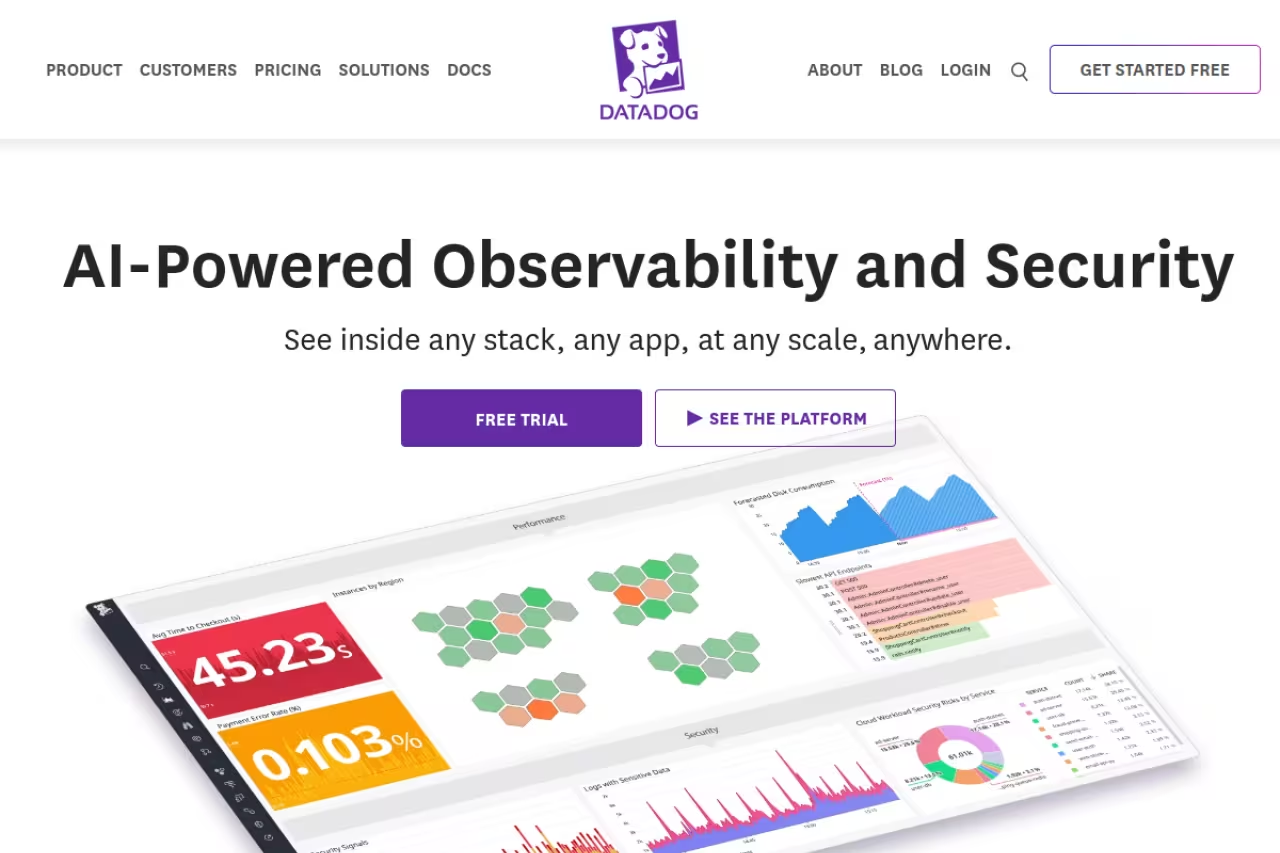
Datadog is the tool I recommend when someone says "we just need monitoring and we don't want to think about it too hard." It pulls metrics, traces, logs, real user monitoring, and synthetics into one platform, and it talks to roughly 900 integrations out of the box. You install the agent, point it at your stack, and within an hour you have dashboards that would take days to wire up elsewhere.
The default for teams that want breadth and speed over cost control, with one pane of glass across a mix of cloud services. The integration catalog is superb, but separate charges per product mean the bill can spiral without retention and sampling limits.
Pricing in 2026: Infrastructure monitoring is $15 per host per month on the annual Pro plan, and APM adds $31 per host per month when bundled with infrastructure. There's a free tier covering up to 5 hosts with one-day metric retention, which is fine for a side project but not much else.
The standout is the integration catalog and how little glue code you write. Everything just connects.
The catch: the bill. Datadog charges separately for nearly every product (logs, APM, RUM, synthetics, security), and ingestion-based charges for logs and custom metrics can spiral without warning. I've seen teams open their invoice and find the logs line alone dwarfed their compute spend. If you turn it all on without setting retention and sampling limits, you will overpay. Budget time to configure quotas before you scale up, and if monitoring spend is part of a bigger cloud bill problem, our AI cloud cost optimization tools guide is worth a read.

Dynatrace: best for big, messy estates
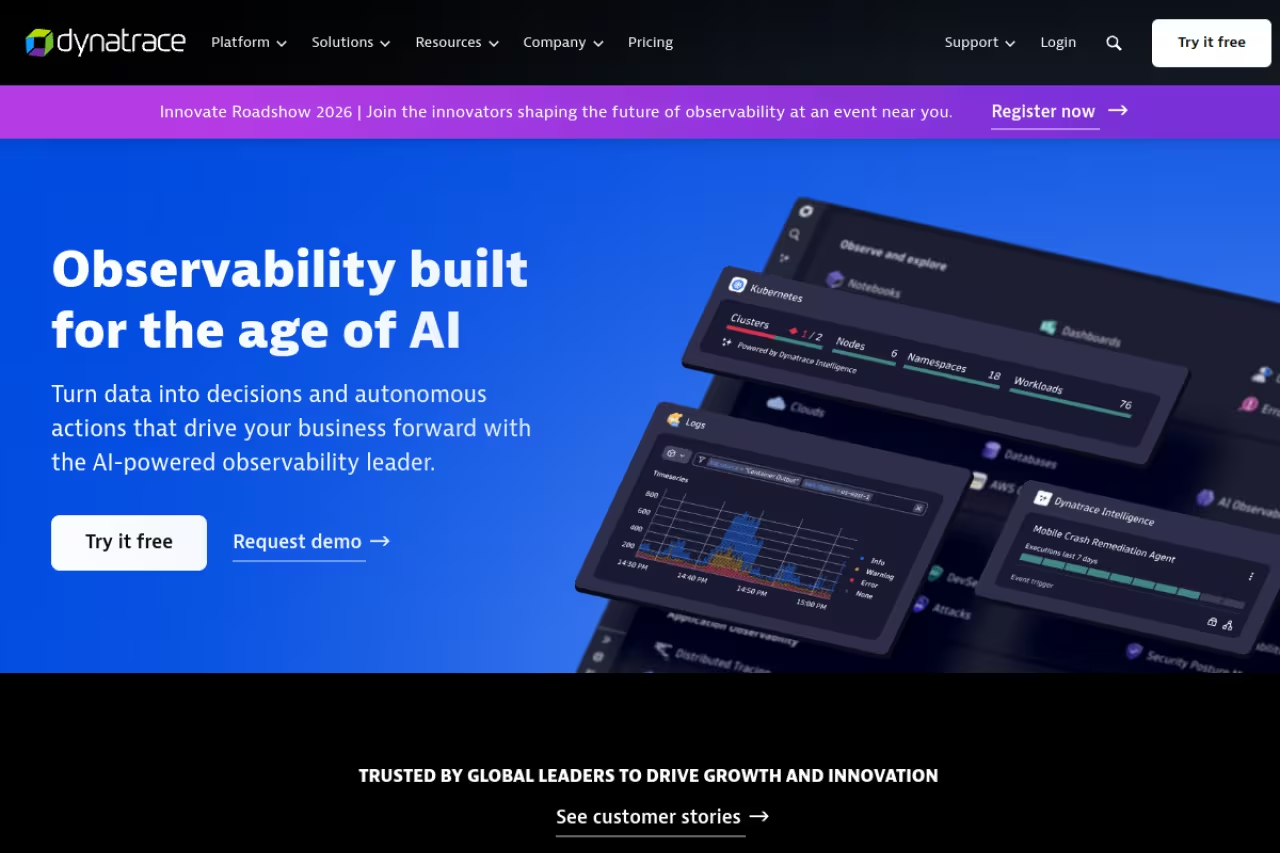
Dynatrace is what you reach for when your environment is too large for a human to reason about. Its OneAgent auto-instruments your whole stack with one install, and the Davis AI engine builds a live dependency map and tells you the probable root cause of an incident instead of just throwing 40 red graphs at you. For enterprises drowning in microservices, that causal analysis is the real selling point.
Dynatrace is for large organizations with sprawling multicloud or Kubernetes estates where manual instrumentation is unrealistic, and its Davis AI root cause analysis saves real on-call hours. Pricing is hard to predict and it is overkill for small teams.
Pricing in 2026: Dynatrace moved to its consumption-based Platform Subscription model. Full-stack monitoring runs around $0.08 per hour for an 8 GiB host, billed at roughly $0.01 per memory-GiB-hour with a minimum per host. That works out to a meaningful per-host cost once you do the math, and Davis AI is included in full-stack at no extra charge.
The standout is genuine AI-driven root cause. When Dynatrace says "this is the broken service," it's usually right, and that saves real on-call hours.
Where it falls short: the pricing model is hard to predict, the UI has a steeper learning curve than Datadog, and it's overkill for small teams. If you're running a handful of services, you're paying for capability you'll never touch.

New Relic: the most generous free tier
New Relic rebuilt its whole pricing model around data ingest plus users instead of per-host fees, and the free tier is the most generous in the market: 100 GB of data ingest per month and one full platform user, free forever. For a small team or an early-stage startup, you can run real production monitoring without paying a cent for a while.
A strong fit for budget-conscious startups and mid-size teams consolidating tools, thanks to 100 GB of free ingest each month. The catch is user pricing: $349 full-platform seats add up fast in a large engineering org.
Pricing in 2026: after the free 100 GB, data ingest is $0.40 per GB. Full platform users are $349 each per year on the Pro edition, with cheaper core users at $49/month and unlimited basic users included. Because billing tracks data volume rather than host count, autoscaling doesn't automatically inflate your bill the way per-host pricing can.
The standout is that all-in-one functionality (APM, infrastructure, logs, browser, mobile) sits behind a single usage meter, so you're not juggling separate product SKUs.
The catch: the user pricing bites if you have a large engineering org. Those $349 full-platform seats add up quickly, and teams often end up rationing who gets full access. Watch your ingest too, because verbose logging can blow past 100 GB faster than you'd expect.

Sentry: error tracking developers actually like
Sentry started as error tracking and stayed obsessed with it, which is why its error grouping is regarded as the best in the category. It clusters thousands of stack traces into a handful of real issues, ties them to the exact release and commit that introduced them, and surfaces the line of code at fault. It has since added tracing, session replay, and profiling, but the core reason to use it is still: a developer pushes a bug, and Sentry tells them precisely what broke and where.
Best for: product engineering teams shipping fast who care more about catching exceptions in their own code than monitoring infrastructure.
Pick Sentry if your product engineers care more about catching exceptions in their own code than monitoring infrastructure. Its error grouping and commit-level traceability are excellent, but it is not full observability, so many teams run it alongside Datadog or Grafana.
Pricing in 2026: the Developer tier is free with one user, 5,000 errors, 5 million spans, and 50 replays per month. The Team plan is $26/month billed annually with unlimited users and 50,000 errors, and Business is $80/month with unlimited dashboards and anomaly detection. Pay-as-you-go covers overages.
The standout is how directly it connects an error to a person and a commit. It fits into a developer's workflow instead of sitting in a separate ops silo.
Where it falls short: Sentry is not a full observability platform. It won't replace infrastructure monitoring or give you the host-level metrics an SRE wants. Plenty of teams run Sentry alongside Datadog or Grafana rather than instead of them.
If you're assembling a developer stack, it pairs naturally with the picks in our best AI DevOps tools guide.
Grafana Cloud: OpenTelemetry-native and open
Grafana Cloud is the managed version of the open LGTM stack: Loki for logs, Grafana for dashboards, Tempo for traces, and Mimir for metrics. Every component is open source and speaks OpenTelemetry, which means your instrumentation isn't locked to a vendor. If you later want to self-host, you can, with no rewrite.
The choice for teams already committed to OpenTelemetry who want vendor-neutral instrumentation with a managed backend. You keep portability, but you must wire Loki, Tempo and Mimir together, which takes more patience than a one-agent install.
Pricing in 2026: the free tier covers 10,000 metrics series, 50 GB of logs, 50 GB of traces, and 3 users with 14-day retention. The Pro plan starts at $19/month platform fee plus usage, with metrics at $6.50 per 1,000 series beyond the included amount and $8 per additional user. It's one of the few pricing pages where you can actually estimate your bill ahead of time.
The standout is that you get a polished managed experience without surrendering the portability of open standards.
The catch: Grafana Cloud is powerful but assembled from parts. Wiring Loki, Tempo, and Mimir together with sensible defaults takes more thought than Datadog's one-agent install, and you'll want someone comfortable with the OTel collector. It rewards teams with the patience to configure it.
Honeycomb: for debugging the weird stuff
Honeycomb takes a different angle. Instead of pre-built dashboards, it lets you slice high-cardinality event data across any dimension on the fly. When a bug only happens for one customer, on one API version, in one region, traditional dashboards won't find it. Honeycomb's exploratory querying will. It pioneered this approach and it's still the sharpest tool for debugging distributed systems where the cause isn't obvious.
A precision instrument for engineering teams debugging complex distributed systems and intermittent production mysteries, with BubbleUp pointing at what differs in failing requests. It is not a full infrastructure monitor and asks your team to think query-first.
Pricing in 2026: the free plan is genuinely usable at 20 million events per month with full tracing and BubbleUp. The Pro plan starts at $130/month and scales to 1.5 billion events, and pricing is roughly $0.10 per GB of telemetry with unlimited seats across every tier.
The standout is BubbleUp, which automatically tells you what's different about the slow or failing requests versus the healthy ones. It feels like cheating during an incident.
Where it falls short: Honeycomb focuses on events and traces, not full infrastructure monitoring. You won't get the host metrics, uptime checks, and integration breadth of a Datadog. It's a precision instrument, not the whole toolbox, and it asks your team to learn a query-first way of thinking.

Better Stack: uptime and logs without the enterprise bill
Better Stack is the practical pick for smaller teams that mostly need to know "is the site up?" and "what do the logs say?" without committing to a heavyweight platform. It bundles uptime monitoring, a status page, incident management, and log management, and prices each piece separately so you only pay for what you turn on.
The practical pick for startups and small teams that mostly need uptime, alerting and logs on a tight budget, with a loaded free tier and modular pricing. It is not a deep APM, so you may outgrow it as systems get complex.
Pricing in 2026: the free tier is unusually loaded, with 10 monitors, 10 heartbeats, a status page, 3 GB of logs, and 30 GB of metrics. Paid plans start at $24/month for logs and $29/month for uptime and incident management, with higher tiers stepping up volume and retention.
The standout is the modular pricing. You're not forced into an all-in-one bundle, so the bill stays small and predictable.
The catch: it's not a deep APM. You get uptime, logs, and incident response, but not the distributed tracing depth or code-level profiling of the bigger platforms. As your system grows more complex, you may outgrow it.
Prometheus + Grafana + OpenTelemetry: the free, self-hosted route
If you have the operational muscle, the open-source combination of Prometheus for metrics, Grafana for dashboards, and OpenTelemetry for instrumentation gives you a capable monitoring stack with zero license cost and zero vendor lock-in. According to Grafana Labs' 2026 observability survey, a majority of organizations are already on OpenTelemetry or migrating to it, so this path is increasingly mainstream rather than fringe.
The free, self-hosted route for teams with platform or SRE engineers, or anyone needing full data ownership for compliance. You get total control and no surprise bills, but running it at scale is a real ongoing job that can cost more than a paid vendor.
Pricing in 2026: free, in the sense of software licenses. You pay for the infrastructure to run it and the engineering hours to operate it.
The standout is total control. Your data stays on your infrastructure, you tune retention exactly how you want, and you'll never get a surprise ingestion bill.
Where it falls short: "free" is misleading. Running Prometheus at scale, managing storage, handling high availability, and keeping the OTel collector healthy is a real ongoing job. For a small team, the engineering time often costs more than just paying for Grafana Cloud or New Relic would have.
How to choose
Skip the feature matrices. In 2026 the big four have converged, and almost everyone supports OpenTelemetry, so instrumentation lock-in barely matters anymore. Decide on three questions instead.
First, what's your team's center of gravity? If developers own monitoring and care about catching their own bugs, start with Sentry. If an ops or SRE team owns it and needs infrastructure-wide visibility, look at Datadog, Dynatrace, or Grafana.
Second, how do you want to be billed? Per-host pricing (Datadog, Dynatrace) is predictable until you autoscale, then it isn't. Usage-based pricing (New Relic, Grafana, Honeycomb) tracks data volume, which rewards disciplined logging and punishes verbose debug output left on in production.
Third, how much complexity can you operate? Datadog and New Relic get you running in an afternoon. Grafana Cloud and the self-hosted stack reward teams willing to configure and tune. Dynatrace is built for scale you may not have yet.
My honest default: small team, start with New Relic's free tier or Sentry. Growing fast and want one platform, pay for Datadog and set quotas on day one. Large and complex, evaluate Dynatrace. Want control and have the people, self-host with Prometheus and Grafana. If security monitoring sits next to this on your roadmap, our AI cloud security tools guide pairs well here.
Whatever you pick, the tools are only half the job. If you're building out a broader engineering toolkit, the Dupple X bundle and our top tools directory are worth a look for the rest of your stack.
FAQ
What is the difference between application monitoring and observability?
Monitoring tells you whether known things are working: is the server up, is latency within range, is the error rate normal. Observability is broader. It's the ability to ask new questions about your system's behavior without shipping new code, usually by querying high-cardinality traces and events. In practice most modern platforms blend both, but tools like Honeycomb lean hard into observability while uptime tools like Better Stack lean toward classic monitoring.
Which application monitoring tool is best for a small startup?
For most small startups, New Relic's free tier (100 GB of ingest a month) or Sentry's free developer plan covers real production needs at zero cost. Better Stack is a strong free option if you mostly need uptime monitoring and logs. The point is to avoid Datadog or Dynatrace early, since their power comes with cost and configuration overhead you don't need yet.
How much does Datadog actually cost?
Datadog's headline prices are $15 per host per month for infrastructure and $31 per host for APM on annual plans. But the real bill is usually higher because logs, RUM, synthetics, and security are billed separately, and log ingestion charges scale with volume. Teams routinely pay several times their host-based estimate once those add-ons are running, so set retention and sampling limits before you scale.
Do I still need a paid monitoring tool if I use OpenTelemetry?
No, but you'll trade money for time. OpenTelemetry handles instrumentation in a vendor-neutral way, and you can send that data to a free self-hosted stack like Prometheus and Grafana. The catch is that operating that stack at scale is a real engineering job. Paid backends like Grafana Cloud, New Relic, or Honeycomb take that work off your plate, and since they all ingest OTel data, you're not locked in if you switch later.
What's the best tool for tracking errors in my code specifically?
Sentry, by a clear margin. Its error grouping clusters noisy stack traces into a handful of actionable issues, ties each one to the release and commit that caused it, and points to the exact line of code. It's purpose-built for developers, integrates into your deploy workflow, and has a free tier covering 5,000 errors a month. Most teams run it alongside a broader monitoring platform rather than instead of one.
Related guides
Some offers on this page may be paid placements or contain affiliate links.
