
Best AI Cloud Security Tools in 2026

Key facts8 tools compared: Wiz, Orca Security, Sysdig, Prisma/Cortex Cloud, CrowdStrike Falcon…
- 8 tools compared: Wiz, Orca Security, Sysdig, Prisma/Cortex Cloud, CrowdStrike Falcon, Microsoft Defender, Aikido Security, Lacework FortiCNAPP
- Wiz (best for: Multi-cloud enterprises): ~$24K/yr for 100 workloads
- Orca Security (best for: Fast agentless rollout): Custom (~$36K+/yr), free tier
- Sysdig (best for: Runtime + Kubernetes depth): Custom, per-host
- Prisma/Cortex Cloud (best for: Broadest CNAPP coverage): Credit-based (~$45K+/yr)
Your cloud got more complicated this year, and so did the people attacking it. Misconfigured S3 buckets, over-permissioned IAM roles, a forgotten container running an old CVE, and now a swarm of AI agents spinning up resources nobody is watching. The old way of triaging alerts one by one stopped scaling around the time your environment hit a few thousand resources.
That is the gap AI cloud security tools are filling. The good ones do not just flag problems. They correlate identity, network exposure, and vulnerabilities into a single attack path, then tell you the two fixes that actually matter instead of the 4,000 that technically exist. I spent the past few weeks digging through these platforms, their pricing pages, and their AI feature claims to figure out which ones earn the hype.
If you want the short version: Wiz is still the platform most teams should evaluate first, because its Security Graph plus AI posture management is the most complete package for multi-cloud shops with budget. If you are a smaller team or a developer who wants results today without a sales call, Aikido Security is the one I keep recommending. Below is the full breakdown.
Quick comparison
| Tool | Best for | Price | Standout |
|---|---|---|---|
| Wiz | Multi-cloud enterprises | ~$24K/yr for 100 workloads | Security Graph + AI-SPM |
| Orca Security | Fast agentless rollout | Custom (~$36K+/yr), free tier | SideScanning, low false positives |
| Sysdig | Runtime + Kubernetes depth | Custom, per-host | Sysdig Sage AI analyst, free |
| Prisma/Cortex Cloud | Broadest CNAPP coverage | Credit-based (~$45K+/yr) | Code-to-cloud in one license |
| CrowdStrike Falcon | Endpoint + cloud in one | Custom, per-resource | Charlotte AI agentic triage |
| Microsoft Defender | Azure-heavy stacks | Pay-as-you-go + Copilot $4/SCU/hr | Native Azure + Security Copilot |
| Aikido Security | Startups and developers | Free, paid from ~$350/mo | AI AutoFix PRs, no sales call |
| Lacework FortiCNAPP | Anomaly detection | Custom | Behavioral ML baselines |
Wiz
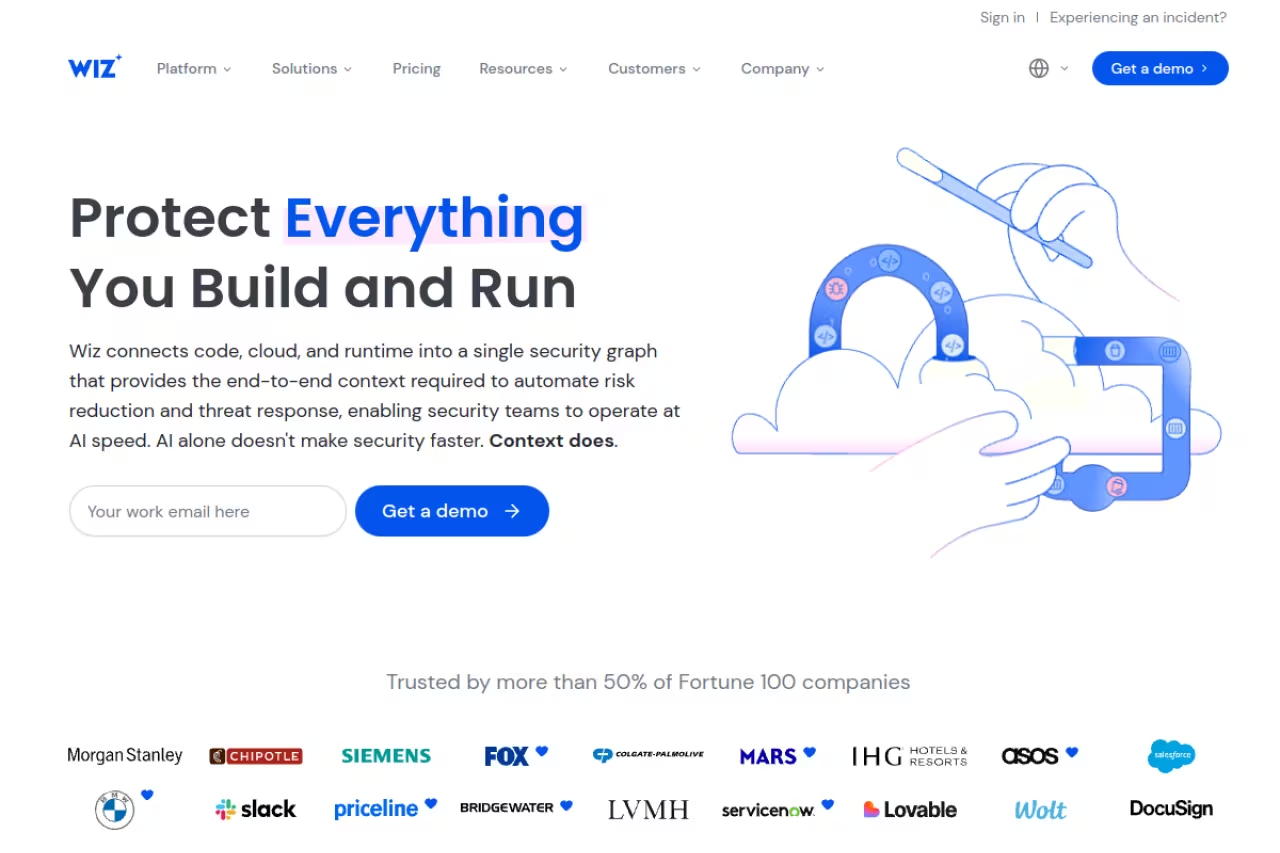
Wiz became the fastest company to hit $100M in ARR for a reason. It connects to your cloud through read-only API access, builds a graph of every resource, and surfaces the toxic combinations that turn a minor misconfiguration into a breach. No agents to deploy, visibility in hours not weeks.
The AI side is where it pulled ahead this year. Wiz AI-SPM (AI security posture management) builds an AI bill of materials that maps every model, SDK, and data source touching your cloud, which is exactly what you need now that engineers are wiring LLMs into production without telling security. The Security Graph then connects model usage, data flows, and permissions to find attack paths before they become incidents.
The enterprise default for multi-cloud teams that want one source of truth, with agentless setup and an attack-path graph that finds toxic combinations. It is enterprise-only with no free tier, so a 10-person startup will find it overkill in price and weight.
Pricing: not published, but reported figures put Wiz Essential around $24,000 a year for 100 cloud workloads and Wiz Advanced near $38,000. Real contracts for mid-size footprints land in the mid-five to low-six figures.
The catch: it is enterprise-only. No free tier, no self-service, and every deal goes through sales. For a 10-person startup it is overkill, both in price and in the operational weight of the platform.
Orca Security
Orca is the agentless alternative that shows up on every Wiz shortlist. Its patented SideScanning reads workload snapshots and cloud APIs to build a full picture without installing anything on your machines. Setup takes under an hour, and developers consistently report a lower false positive rate, which matters a lot when you are trying to get security checks into CI/CD without engineers revolting.
The platform covers CSPM, workload protection, CIEM, and data security in one place, with AI prioritization ranking risks by actual exploitability rather than raw severity. If your team drowned in a Wiz proof-of-concept that returned 9,000 findings, Orca's quieter output is the selling point.
The agentless alternative on every Wiz shortlist, ideal for teams that want broad coverage quickly and a quieter, lower false-positive output. Runtime depth is thinner than Sysdig, so it is not the first choice for container and Kubernetes detection.
Pricing: enterprise custom, with contracts commonly starting around $36,000 to $60,000 a year based on workload count. There is now a free tier and lower self-service plans for smaller environments.
Where it falls short: it competes directly with Wiz on posture but has thinner runtime depth than a Sysdig. For pure container and Kubernetes runtime detection, it is not the first choice.

Sysdig
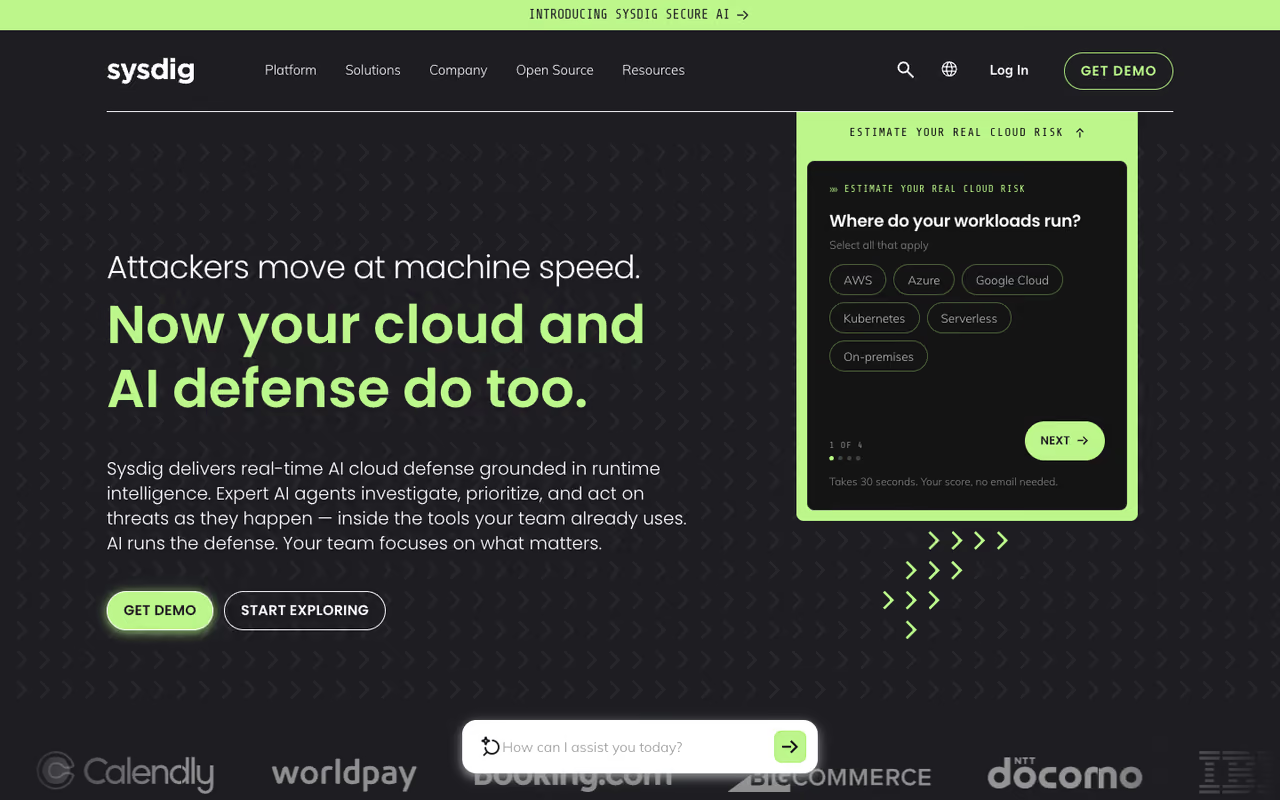
If your risk lives at runtime, in active containers, Kubernetes clusters, and live attacks, Sysdig has the deepest visibility of anything here. It is built on the open-source Falco project, so you get policy as code and real-time detection of what is actually happening inside your workloads, not just a snapshot of how they are configured.
The AI story is Sysdig Sage, which Sysdig calls the first agentic AI analyst fully integrated across a CNAPP. It translates plain-English questions into graph queries, summarizes security events, and suggests high-impact, low-effort fixes. Sysdig says customers cut mean time to respond by 76% and reclaimed more than 80 hours a week of manual triage. Sage is included for all customers at no extra cost, which is rare.
Best for: container-heavy and Kubernetes shops, regulated industries that need runtime evidence.
Go with Sysdig if your risk lives at runtime in containers and Kubernetes, and you need runtime evidence for a regulated industry. The trade-off is that posture management is less mature than Wiz or Orca, and the agent-based model adds overhead.
Pricing: enterprise, per-host, custom quote. Sage prompts are included but heavy usage can hit overage charges.
The catch: posture management is functional but less mature than Wiz or Orca, and the agent-based runtime model adds operational overhead that pure agentless platforms avoid. You are buying it for runtime, not for CSPM polish.
If you are also building out your operations stack, our guide to the best AI DevOps tools pairs well with a runtime-first security choice.

Prisma Cloud (now Cortex Cloud)
Prisma Cloud from Palo Alto Networks is the widest CNAPP by feature scope. It spans IaC scanning, SCA, secrets detection, CSPM, workload runtime protection, network security, and identity threat detection. No single competitor covers as many subcategories under one license. Palo Alto is folding it into a new platform called Cortex Cloud, merging cloud posture with detection and response and layering in agentic AI for triage.
The widest CNAPP by feature scope, aimed at large enterprises consolidating code-to-cloud security under one vendor. That breadth costs you in complexity: the credit model is hard to predict, and the platform is widely seen as the heaviest to operate.
Pricing: credit-based. Recent guides put the full CNAPP suite from roughly $45,000 a year, with modules consuming credits based on workload volume. Business and Enterprise editions are quoted separately.
Where it falls short: the breadth is also the problem. The credit model is genuinely hard to predict, the UI feels like several acquisitions stitched together, and the platform is widely seen as the heaviest to operate. You pay for completeness in complexity.

CrowdStrike Falcon Cloud Security
CrowdStrike built its name on endpoint detection, and Falcon Cloud Security extends that DNA into the cloud with one console for endpoint, identity, and cloud workloads. For teams already running Falcon EDR, adding cloud is the path of least resistance, and the shared threat intelligence is genuinely useful.
The AI layer is Charlotte AI, an agentic analyst that turns Falcon Cloud findings into faster remediation and lets you query your cloud inventory in natural language. In 2026 CrowdStrike launched the Charlotte AI AgentWorks ecosystem with partners including AWS, NVIDIA, OpenAI, and Anthropic, so you can build custom security agents on frontier models.
The path of least resistance for teams already running Falcon EDR, with one console across endpoint, identity and cloud. As a standalone cloud-only tool it is harder to justify against pure CNAPP players, and Charlotte AI is a paid add-on.
Pricing: custom, per-resource, enterprise sales motion. Charlotte AI is a paid add-on layered on the Falcon platform.
The catch: as a standalone cloud-only tool, it is harder to justify against pure CNAPP players. The value compounds when you are already in the CrowdStrike ecosystem, less so if you are starting fresh.
Microsoft Defender for Cloud
If most of your infrastructure lives in Azure, Microsoft Defender for Cloud is the obvious default. It is native, so onboarding Azure resources is trivial, and it still covers AWS and GCP through connectors. The CSPM and workload protection are solid, and the per-resource pay-as-you-go billing means you start small instead of signing a six-figure floor.
The AI angle is Microsoft Security Copilot, which plugs into Defender to summarize incidents, guide investigations, and write remediation steps. Microsoft now includes a Copilot allotment with Microsoft 365 E5, which softens the cost for shops already paying for E5.
The obvious default if most of your infrastructure lives in Azure or you hold Microsoft 365 E5, with pay-as-you-go billing that lets you start small. Coverage outside Azure feels secondary, and Security Copilot's SCU billing can surprise teams that do not cap overage.
Pricing: Defender plans bill per resource per hour. Security Copilot runs $4 per Security Compute Unit per hour for provisioned capacity, roughly $2,920 per SCU per month, with overage at $6. E5 customers get 400 SCUs per month for every 1,000 paid licenses.
Where it falls short: multi-cloud coverage outside Azure is real but feels secondary, and Copilot's SCU billing surprises teams that do not cap overage. Outside the Microsoft stack, dedicated CNAPP tools go deeper.

Aikido Security
Aikido is the one I push hardest for startups and developer-led teams. It bundles SCA, SAST, DAST, secrets detection, IaC scanning, container scanning, and CSPM into a single tool you can connect yourself, no sales call required. The free plan is genuinely usable: 10 repos, a cloud account, container scanning, and 2 AI AutoFixes a month.
The standout is AI AutoFix. When Aikido finds a fixable vulnerability, it generates a pull request you review and merge, which collapses the time from detection to patch. Its AI also cuts false positives by checking whether a flagged dependency is actually reachable in your code, so you stop chasing noise.
The one I push hardest for startups and developer-led teams: self-serve, a genuinely usable free plan, and AI AutoFix that opens pull requests for you. It is more AppSec-first than the CNAPP giants, but most teams under a few hundred engineers will not feel the ceiling.
Pricing: free forever tier, with paid plans starting around $350 a month and scaling on flat-rate fair-usage limits rather than per-seat. AutoFix limits rise with each tier.
The catch: it is more application-security-first than the pure CNAPP giants. For deep runtime threat detection across a massive multi-cloud estate, Wiz or Sysdig still go further. For most teams under a few hundred engineers, you will not feel the ceiling.
Picking the right tool stack is its own project. If you are assembling AI software across security and operations, our roundup of the top AI tools and the workflow templates in Dupple X can save you a few weeks of evaluation.
Lacework FortiCNAPP
Lacework was acquired by Fortinet in 2024 and now ships as FortiCNAPP, combining Lacework's anomaly detection with Fortinet's network threat intelligence. The differentiator is behavioral: instead of relying only on static rules, its machine learning builds baselines from your cloud API calls, process execution, and network activity, then flags deviations. That catches novel attack patterns rules-based systems miss.
It covers CSPM, CWPP, CIEM, and CDR, and won a 2025 SC Award for cloud workload protection. The Lacework AI Assist helps analysts investigate and triage in natural language.
Choose FortiCNAPP if behavioral anomaly detection is the core engine you want, especially in a Fortinet shop. Integration into Fortinet's wider portfolio is still maturing, and outside existing Fortinet customers it lacks the standalone gravity of Wiz or Orca.
Pricing: enterprise custom quote, no public tiers.
Where it falls short: the integration into Fortinet's broader portfolio is still maturing, and outside existing Fortinet customers it does not have the same standalone gravity as Wiz or Orca. If anomaly detection is your specific need, also compare dedicated AI anomaly detection tools.
How to choose
Start with where your risk actually concentrates, not with the vendor with the best Gartner placement.
If you are a startup or developer-led team and want results this afternoon, pick Aikido. Free tier, self-serve, AI fixes that ship as PRs.
If you are a multi-cloud enterprise and posture is the priority, run a head-to-head between Wiz and Orca. Wiz has the edge on AI-SPM and shadow-AI discovery. Orca wins on quieter output and faster rollout. Test both against your real environment and count the false positives.
If your crown jewels run in containers and Kubernetes and you need runtime evidence, Sysdig is the answer. If you live in Azure, start with Defender plus Security Copilot before you pay for anything else. And if you are already a CrowdStrike or Fortinet customer, evaluate their cloud modules first, since the integration value is real.
One more rule: the AI features only matter if they reduce your team's actual workload. Watch the remediation flow in a demo. If the AI tells you what is wrong but not what to do, you have bought a fancier alert generator.
Frequently asked questions
What is AI-SPM and do I need it?
AI security posture management discovers and secures the AI models, SDKs, and data pipelines running in your cloud. You need it the moment your engineers start wiring LLMs into production, which for most teams already happened. It catches shadow AI and the over-permissioned service accounts that AI integrations tend to create. Wiz, Prisma Cloud, and Sysdig all ship AI-SPM features now.
Are agentless cloud security tools as good as agent-based ones?
For posture management, configuration, and identity risk, agentless tools like Wiz and Orca are excellent and far easier to deploy. For real-time runtime detection of an active attack inside a container, agent-based platforms like Sysdig see more. Many teams run agentless for breadth and add a runtime agent on their most critical workloads.
What is the cheapest AI cloud security tool that is actually good?
Aikido Security has a free forever tier that includes cloud posture, container scanning, and AI AutoFix, which is the strongest free offering here. Sysdig Sage is included at no extra cost for paying Sysdig customers, and Orca now has a free entry tier. For enterprise CNAPP, expect to start in the low five figures per year.
How much should I budget for cloud security in 2026?
Industry pricing generally runs $10 to $50 per workload per month. A small team can start free with Aikido or Orca's entry tier. Mid-size companies running a full CNAPP land between $24,000 and $60,000 a year, and large multi-cloud enterprises with Wiz, Prisma Cloud, or CrowdStrike often pay well into six figures.
Do these tools replace my SOC team?
No. The AI analysts in Sysdig Sage, Charlotte AI, and Security Copilot speed up triage and remediation, sometimes by more than 70%, but they recommend and assist rather than decide. They free your team to focus on real threats instead of sorting noise. Think of them as a force multiplier for the analysts you have, not a replacement.
Ready to build out the rest of your AI stack? Dupple X gives you the vetted tools and workflows to move fast without learning every platform the hard way.
Related guides
Some offers on this page may be paid placements or contain affiliate links.
