
Best AI Text to Speech Tools (2026): The Top Voice Generators Compared

Key facts8 tools compared: ElevenLabs, Fish Audio, Cartesia, Hume Octave 2, Murf, Speechify, OpenAI…
- 8 tools compared: ElevenLabs, Fish Audio, Cartesia, Hume Octave 2, Murf, Speechify, OpenAI gpt-4o-mini-tts, PlayHT
- ElevenLabs (best for: All-rounder, creators): Free / $6 / $22 / $99 mo
- Fish Audio (best for: Voice cloning on a budget): Free / $11 / $75 mo
- Cartesia (best for: Real-time voice agents): $4-5 mo + usage
- Hume Octave 2 (best for: Emotional, expressive speech): $3 mo / $7.60 per 1M chars
The gap between robotic and real has basically closed. With the top two or three tools, listeners often can't tell it's a machine: breaths land in the right places, and a laugh doesn't sound bolted on. The kind of output you could drop into a podcast intro and nobody would blink.
So the question in 2026 isn't "which one sounds human." Most of the good ones clear that bar now. The real question is what you're building. A YouTube voiceover, a real-time voice agent that has to answer in under 100 milliseconds, an audiobook in five languages, or an API call buried in your product. Those are different jobs, and the tool that wins one loses another.
My short answer: ElevenLabs is still the one I'd hand most people, because it does the most things well and the free tier lets you find out in ten minutes. But if you're cloning voices on a budget, building a phone agent, or you need a voice to actually sound emotional, there's a better pick below. This is for creators, marketers, and developers who care about the output, not the marketing copy.
Quick comparison
| Tool | Best for | Price | Standout |
|---|---|---|---|
| ElevenLabs | All-rounder, creators | Free / $6 / $22 / $99 mo | Most natural overall, huge voice library |
| Fish Audio | Voice cloning on a budget | Free / $11 / $75 mo | Top of TTS-Arena, clones from 10-15s |
| Cartesia | Real-time voice agents | $4-5 mo + usage | ~90ms latency, ~40ms on Turbo |
| Hume Octave 2 | Emotional, expressive speech | $3 mo / $7.60 per 1M chars | Voices that actually emote |
| Murf | Marketing and e-learning teams | Free / $19 / $66 mo | Simple per-minute pricing, studio editor |
| Speechify | Listening to documents + voiceover | Free / $19 / $49 mo | Reader app plus a content studio |
| OpenAI gpt-4o-mini-tts | Developers, cheap API | ~$0.015 per minute | Steerable tone, dirt cheap at scale |
| PlayHT | High-volume flat-rate audio | Free / $31 / $49 mo | Unlimited-ish plans, 800+ voices |

ElevenLabs: the default pick for almost everyone
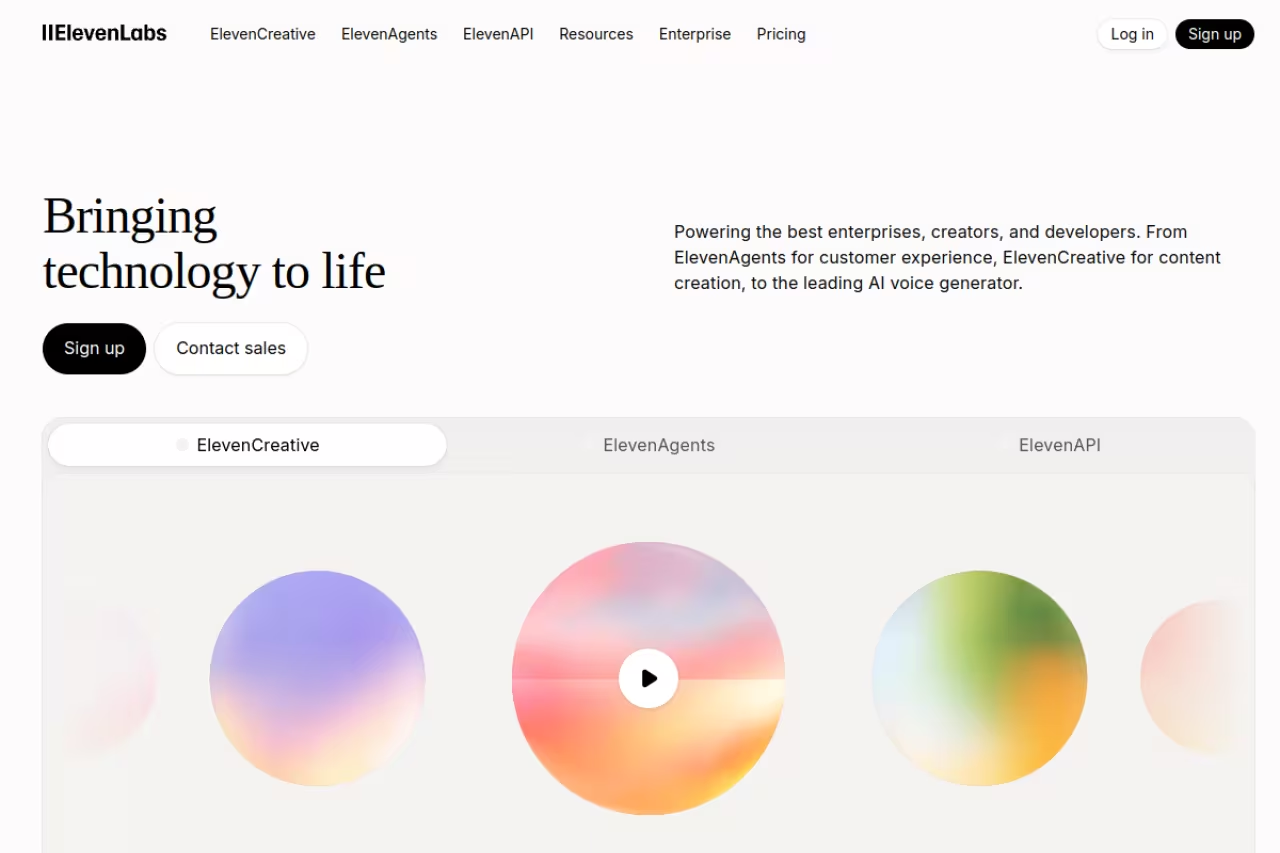
ElevenLabs is the tool I open first, and the one I'd recommend if you don't want to read this whole article. Its v3 model produces output that's hard to separate from a real recording, and the voice library is enormous, both the official voices and thousands of community-shared ones. Instant voice cloning takes about a minute from a short sample. Studio mode lets you build long-form projects with multiple speakers.
Who it's best for: creators, podcasters, and anyone who wants the highest baseline quality without fiddling. It also has a real API if you graduate from clicking buttons to writing code.
The safe default for creators and podcasters who want top baseline quality without fiddling, with a real API when you outgrow the buttons. Credits burn fast and professional cloning starts at the $22 tier, so heavy volume gets pricey.
Pricing is credit-based. The free plan gives you 10,000 credits a month but no commercial rights or cloning. Starter is $6/month and unlocks commercial use plus instant cloning. Creator is $22/month with professional voice cloning, and Pro jumps to $99/month for 600k credits and higher-quality audio output.
The catch: credits burn faster than you expect, and the metered model means a heavy month can get pricey compared to flat-rate competitors. Professional voice cloning (the good kind, trained on more audio) is gated to the $22 tier and up. If you're generating thousands of minutes a month, the per-character math stops working in ElevenLabs' favor.

Fish Audio: the cloning value champion
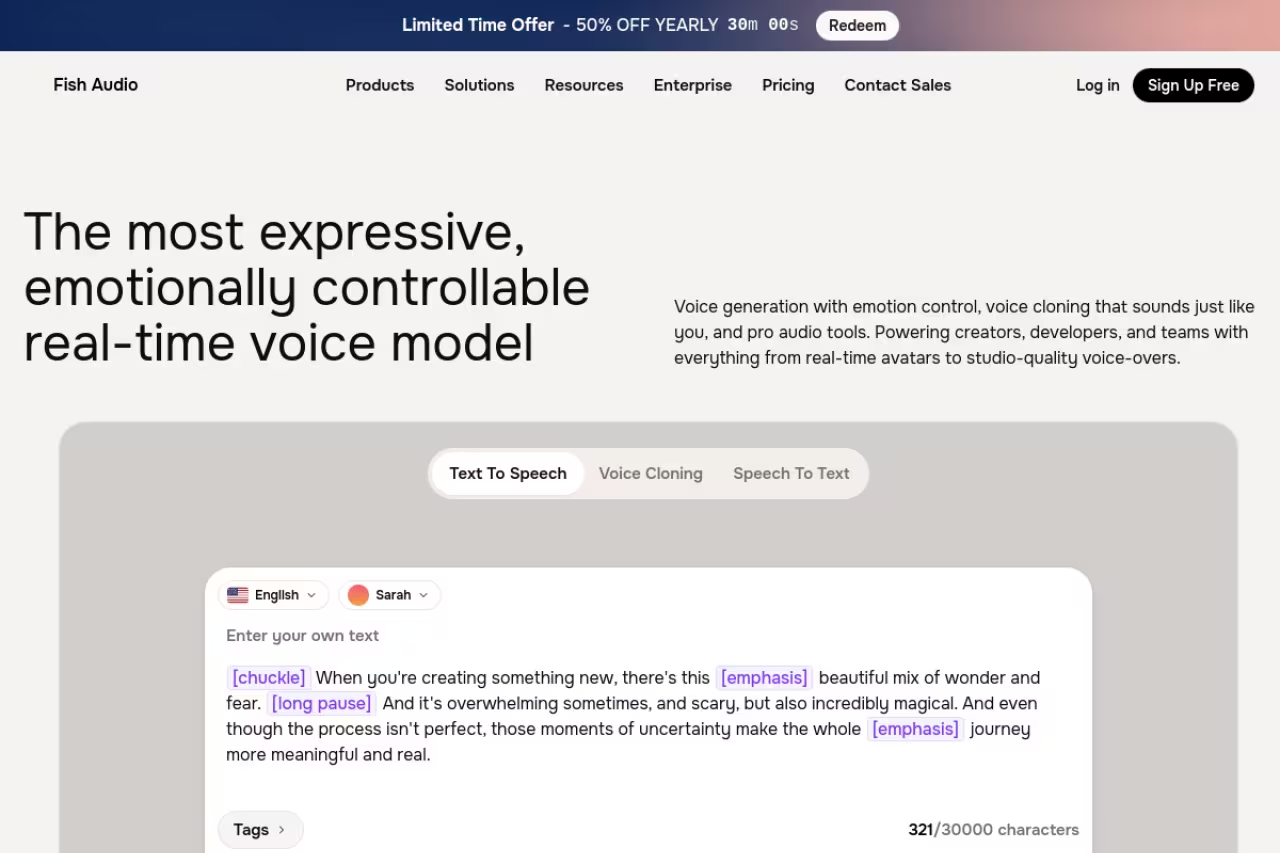
Fish Audio is the one that made me double-check I wasn't being fooled. Its S1 model topped TTS-Arena, the blind-test leaderboard where users pick the better sample without knowing the brand, and in those tests people preferred it over ElevenLabs and OpenAI. The current flagship, S2, pushes expressiveness and real-time response further. It clones a voice from 10 to 15 seconds of audio.
Who it's best for: anyone who clones voices a lot and doesn't want to pay ElevenLabs prices to do it. Developers like it too, since there's an API and a community library of over two million voices.
The pricing is where it gets interesting. The free tier gives you about 7 minutes a month, enough to test the quality. The Plus plan is $11/month for 200 minutes of the flagship model, with Pro at $75 and Max at $749. That $11 entry point for cloning-grade output undercuts most of the market.
The catch: the interface and docs feel rougher than ElevenLabs', and the brand is younger, so there's less hand-holding when something breaks. Some of those two million community voices are low quality or sketchily sourced, so you'll want to stick to the curated ones for anything commercial.
Go with it if you clone voices a lot and do not want ElevenLabs prices, since $11 a month buys cloning-grade output. The interface and docs are rougher, and some community voices are low quality, so stick to curated ones for commercial work.

Cartesia: built for real-time voice agents
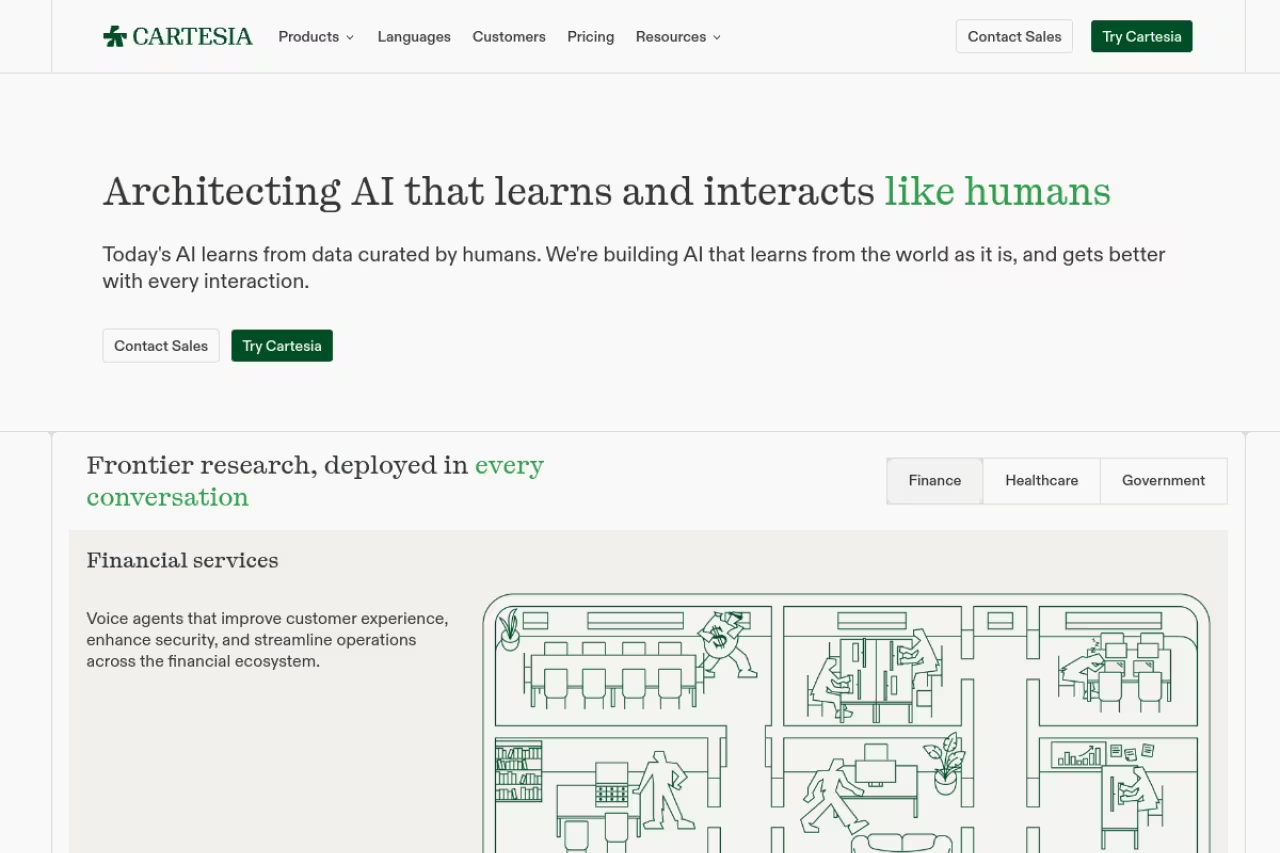
If you're building a voice agent, a phone bot, or anything where the AI has to talk back instantly, latency is the whole game, and Cartesia wins it. Its Sonic 3 model hits roughly 90ms time-to-first-audio, and Sonic Turbo drops that to around 40ms. For comparison, a human conversational gap is about 200ms, so Cartesia responds faster than people expect a person to. It pulls this off with a State Space Model architecture instead of the transformer approach everyone else uses.
Who it's best for: developers shipping real-time voice products where a half-second delay kills the illusion of a conversation. This is an infrastructure tool, not a click-and-export studio.
Cartesia's Sonic 3 runs around $35 per million characters on usage, with a cheap Pro subscription ($4-5/month) that includes limited credits before you pay per use. It supports 42 languages natively.
The catch: this isn't for someone who wants to type a script and download an MP3. It's an API-first product aimed at engineers. If you're not writing code, you'll find the experience confusing and the value invisible. The bundled subscription credits run out fast, so real production work means real usage billing.
The latency leader for developers building voice agents and phone bots, where a half-second delay kills the conversation. It is an API-first infrastructure tool, so anyone who just wants to type a script and download an MP3 will find little value.
Hume Octave 2: when the voice needs to feel something
Most TTS tools read words correctly. Hume AI's Octave 2 reads them with intent. It's a speech-language model that understands the meaning of what it's saying and adjusts delivery, so excitement sounds excited and sympathy sounds sympathetic instead of like a narrator pretending. For narration where flat delivery would kill the mood, this is the one I reach for.
Who it's best for: audiobook narration, character voices, emotional ads, and any project where the feeling carries as much as the words.
Octave 2 runs in 11+ languages, generates audio in under 200ms, and is 50% cheaper than Octave 1 at around $7.60 per million characters, which is among the lowest I found. The Starter subscription is $3/month for roughly 30 to 60 minutes of generation. It ships 60+ professional voices at 48kHz, plus cloning and voice design from a text description.
The catch: the emotional intelligence is the point, but it also means output can vary between generations in ways you don't always control. For dry, consistent corporate narration where you want zero surprises, a more predictable engine might serve you better. The free generation limits are tight, so testing emotional range across a long script eats your quota quickly.
Reach for it when emotional delivery carries the project, as with audiobooks, character voices and emotional ads. Output can vary between generations, so dry corporate narration is better served by a more predictable engine.

Murf: the no-nonsense pick for marketing teams
Murf doesn't try to win benchmarks. It tries to get a non-technical marketer from script to finished voiceover without a learning curve, and it succeeds. The studio editor lets you adjust pitch, pace, and emphasis on a timeline, sync audio to slides or video, and swap voices without re-recording. For explainer videos, e-learning modules, and product demos, that workflow matters more than topping a leaderboard.
Who it's best for: marketing and L&D teams who think in minutes of narration, not characters or tokens, and want predictable costs.
A no-nonsense pick for marketing and L&D teams who want script to finished voiceover with predictable costs. Voice cloning is locked to Enterprise and the stock voices are not the most lifelike, so realism seekers should look elsewhere.
Pricing is refreshingly clear. The free tier gives you 10 minutes. The Creator plan is $19/month billed annually ($29 monthly) for about 2 hours a month with commercial rights. Business is $66/month annually ($99 monthly) for roughly 8 hours. It supports dubbing across 25+ languages.
The catch: voice cloning is locked behind the Enterprise plan, so the cheaper tiers only give you Murf's stock voices. Those voices are good but not the most lifelike on this list. If absolute realism or custom-cloned voices is your priority, look at ElevenLabs or Fish Audio instead.
If you're already wiring AI into your marketing stack and want a faster way to find tools that actually ship, Dupple X tracks the ones worth your time so you can skip the testing grind.

Speechify: listening first, voiceover second
Speechify started as a reader app, the thing that turns your PDFs, emails, and articles into audio so you can listen on a commute, and it's still the best at that. But it also runs Speechify Studio, a separate product for producing voiceovers with commercial rights. Two tools, one brand.
Who it's best for: people who consume a lot of written content and want it read aloud, plus creators who want a decent voiceover studio in the same ecosystem.
For the studio side, Studio Free gives you 600 credits (about 10 minutes), Studio Starter is $19/month for around 2 hours, and Studio Creator is $49/month for roughly 8 hours. Plans include 120+ voices, voice cloning, and unlimited downloads. Credits are spent per second of generation, with dubbing and avatar video costing more.
The catch: the two-product split confuses people. The Reader subscription and the Studio subscription are different things with different pricing, and it's easy to buy the wrong one. For pure voiceover quality, the dedicated generators above edge it out. Speechify's strength is the reading experience, not the studio.
Choose it if you mostly listen to written content and want a decent voiceover studio in the same ecosystem. The Reader and Studio subscriptions are separate products, and for pure voiceover quality the dedicated generators edge it out.
OpenAI gpt-4o-mini-tts: the cheapest API at scale
If you're a developer and you just need solid voices wired into your product without a separate vendor, OpenAI's gpt-4o-mini-tts is hard to argue with. It's steerable, meaning you can prompt the tone ("speak like a sympathetic support agent"), and it runs about $0.015 per minute of generated audio. At volume, that's cheaper than basically everything with a subscription.
Who it's best for: engineers already using the OpenAI API who want to add voice without onboarding another platform.
It supports 13+ voices and 50+ languages, with pricing at $0.60 per million text-input tokens and $12 per million audio tokens. No subscription tiers, no minute caps. You pay for what you generate.
The catch: there's no studio, no timeline editor, no project management. It's an API endpoint. The voices are good but not the absolute most lifelike compared to ElevenLabs v3 or Fish Audio S2, and the 2,000-token input cap means you chunk long scripts yourself. This is plumbing, not a product.
The cheapest sensible route for engineers already on the OpenAI API who want steerable voices without onboarding another vendor. It is plumbing, not a product: no studio or timeline, and a 2,000-token input cap means chunking long scripts.

PlayHT: flat-rate for high-volume jobs
PlayHT (now part of PlayAI) earns its spot when you're generating a lot of audio and quality just needs to be "good enough." Its Unlimited plan is the draw: rather than metering every character, you pay a flat rate and generate freely within a fair-use cap. For someone turning hundreds of blog posts into audio articles, that math beats per-character billing.
Who it's best for: high-volume publishers, IVR and phone-system builders, and anyone who'd rather predict a flat bill than watch a credit meter.
The free plan offers about 5,000 characters with attribution. Creator is $31.20/month with commercial rights, and Unlimited is $49/month with a fair-use cap around 2.5 million characters. It has a library of 800+ voices and supports cloning on higher tiers.
The catch: "unlimited" has an asterisk. The 2.5M-character fair-use ceiling means truly heavy users can hit limits or extra charges. And while the voices are plentiful, the top end of quality doesn't match ElevenLabs or Fish Audio. You're trading a bit of polish for volume economics.
A good fit for high-volume publishers and IVR builders who would rather predict a flat bill than watch a credit meter. The fair-use cap means heavy users can still hit limits, and top-end quality trails ElevenLabs and Fish Audio.
How to choose
Pick based on the job, not the benchmark. Here's the short version.
- Just want the best all-around tool? ElevenLabs. Start on the free tier, upgrade to $6 when you need commercial rights.
- Cloning voices and watching the budget? Fish Audio at $11/month. Same blind-test quality for a fraction of the cost.
- Building a real-time voice agent? Cartesia. Nothing else touches its latency.
- Need emotional, expressive delivery? Hume Octave 2. The only one that genuinely emotes.
- Marketing or e-learning team that wants simple? Murf. Per-minute pricing, no jargon.
- A developer who just needs cheap API voices? OpenAI gpt-4o-mini-tts at $0.015/minute.
- Generating audio in bulk? PlayHT's Unlimited plan.
One more rule: test before you commit. Every tool here has a free tier, so run your actual script (not their demo text) through the top two or three and trust your ears. For free podcast-length audio from a script, compare the free allowances in the best free AI podcast generators. Voice quality is subjective, and the one that sounds best to you is the one that's best for you. For more curated picks across AI categories, our top tools roundup is a good next stop.
Frequently asked questions
What is the best AI text to speech tool in 2026?
For most people, ElevenLabs is the best all-around choice thanks to its natural voice quality, huge library, and a free tier that lets you test instantly. But Fish Audio matches its quality for cheaper if you mostly clone voices, and Cartesia wins for real-time voice agents. The "best" depends on whether you're making content, building an app, or listening to documents.
What is the most realistic AI voice generator?
In blind tests on TTS-Arena, Fish Audio's S1 model edged out ElevenLabs and OpenAI, so it's arguably the most realistic right now. That said, ElevenLabs v3 and Hume Octave 2 are close enough that most listeners can't reliably tell any of the top three apart from a human recording. Run your own script through all three and judge with your ears.
Is there a free AI text to speech tool with no watermark?
Yes. ElevenLabs' free plan gives you 10,000 credits a month without an audio watermark, though it lacks commercial rights. Fish Audio's free tier offers about 7 minutes monthly with full quality. For commercial use without restrictions, you'll need a paid plan, starting as low as $6/month with ElevenLabs Starter.
Can AI text to speech clone my own voice?
Yes, and it's gotten fast. Fish Audio clones a usable voice from 10 to 15 seconds of audio, and ElevenLabs' instant cloning takes about a minute. For higher fidelity, ElevenLabs' professional cloning (on the $22/month tier) trains on more audio. Always make sure you have permission to clone any voice that isn't your own. Several tools also let you design a brand-new voice from a text description.
Which AI text to speech is cheapest for developers?
OpenAI's gpt-4o-mini-tts is the cheapest at roughly $0.015 per minute of generated audio, with no subscription required. Hume Octave 2 is also very cheap at around $7.60 per million characters. For high-volume flat-rate billing, PlayHT's $49/month Unlimited plan can work out cheaper than per-character pricing if you generate millions of characters monthly.
What AI voice tool has the lowest latency for voice agents?
Cartesia leads on latency. Its Sonic 3 model delivers around 90ms time-to-first-audio, and Sonic Turbo gets that down to roughly 40ms, faster than the ~200ms gap people expect in human conversation. Hume Octave 2 and OpenAI are also sub-200ms, but for real-time phone bots and voice agents, Cartesia is the one to beat.
Related guides
Some offers on this page may be paid placements or contain affiliate links.
Across our whole catalogue the median is $24 a month and 33% of tools advertise a free tier. Figures are the lowest recurring monthly price quoted in our own review of each tool, read on 2026-08-19. Full method and every category.
