
The Best AI Legal Assistant Tools in 2026

Key facts8 tools compared: Spellbook, Harvey, CoCounsel, Lexis+ AI, Paxton AI, Vincent AI, Legora, Ivo
- 8 tools compared: Spellbook, Harvey, CoCounsel, Lexis+ AI, Paxton AI, Vincent AI, Legora, Ivo
- Spellbook (best for: Transactional lawyers, small firms): ~$199-350/user/mo
- Harvey (best for: BigLaw, complex research): ~$100-2,000/seat/mo
- CoCounsel (best for: Litigators needing Westlaw): $180-639/user/mo
- Lexis+ AI (best for: LexisNexis subscribers): ~$128-494/user/mo
A junior associate once told me she spent four hours summarizing a deposition that an AI tool finished in nine minutes. The summary needed editing. It still saved her most of an afternoon. That gap, between hours of grunt work and a draft you refine instead of build, is what every legal AI tool is selling in 2026.
The problem is that the category has split into camps that barely resemble each other. Some tools cost $40 a month and live inside your practice management software. Others cost six figures a year and require a six-month sales cycle. A few are built for one job (contract redlines) and do it better than the generalists. Picking wrong means either overpaying for power you won't use or underbuying and hitting a wall mid-matter.
This guide is for working lawyers, legal ops people, and in-house counsel who want to know what actually earns its keep. I'll be direct about pricing (most of which vendors hide) and honest about where each tool disappoints. If you want the short version: for most transactional lawyers, Spellbook gives you the most value without an enterprise contract. If you're at a large firm doing high-stakes research, Harvey is the one your competitors already bought.
Quick comparison
| Tool | Best for | Price | Standout |
|---|---|---|---|
| Spellbook | Transactional lawyers, small firms | ~$199-350/user/mo | Word-native contract review |
| Harvey | BigLaw, complex research | ~$100-2,000/seat/mo | Domain-trained breadth |
| CoCounsel | Litigators needing Westlaw | $180-639/user/mo | Bundled primary-law research |
| Lexis+ AI | LexisNexis subscribers | ~$128-494/user/mo | Cited research, brief analysis |
| Paxton AI | Solos and small firms | $499/mo or $2,999/yr | Transparent self-serve pricing |
| Vincent AI | Clio users, global research | From ~$399/mo | vLex global database |
| Legora | M&A diligence teams | ~$3,000+/user/yr | Tabular bulk review |
| Ivo | Enterprise in-house | Custom (5-figure) | Playbook-driven redlining |
Spellbook: the best value for transactional work
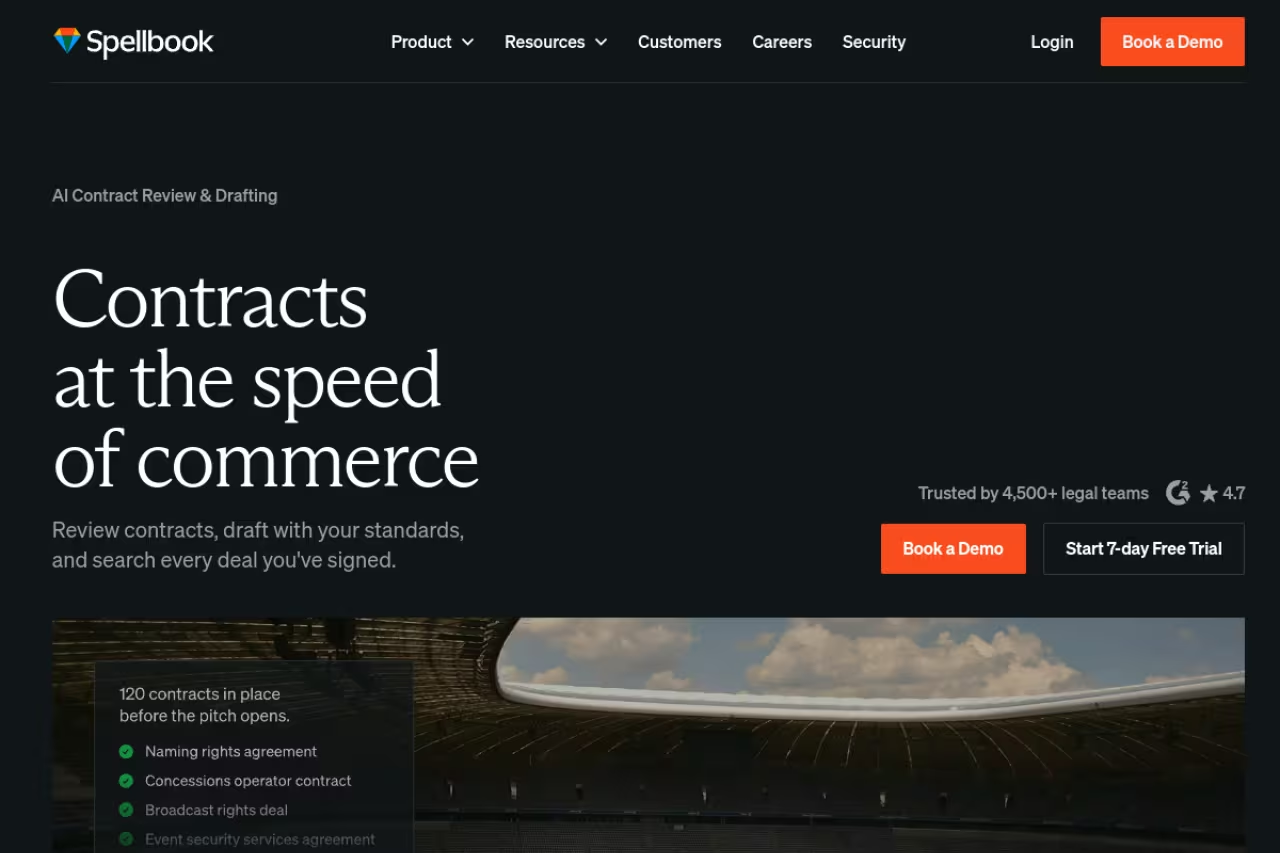
Spellbook runs as a Microsoft Word add-in, which sounds unremarkable until you've watched a lawyer copy-paste clauses between a research tool and their document forty times a day. Spellbook drafts, reviews, and redlines without leaving Word. That single design choice is why so many transactional lawyers default to it.
The practical choice for solos and small-to-mid firms doing contract-heavy work, because it drafts and redlines inside Word. Pricing is murky and has moved upmarket, and it is no help for deep case-law research.
The tool flags risky language, suggests redlines, benchmarks clauses against 2,300+ contract types, and now ships a feature called Library that learns from your own precedent documents. According to Spellbook, it's used by 4,500+ teams, and it runs on a mix of OpenAI and Anthropic models under the hood.
Pricing isn't published cleanly. Spellbook moved upmarket in late 2025, and enterprise plans now sit around $350 per user per month with a six-month minimum, though some third-party trackers still report $99-199 tiers for smaller setups. There's a 7-day free trial, which is more than most competitors offer.
The catch: pricing opacity makes budgeting annoying, and the upmarket shift means it's no longer the cheap entry point it was in 2023. It's also firmly a contract tool. If you need deep case-law research, Spellbook isn't your answer.

Harvey: the BigLaw standard

Harvey is the tool your competitors at large firms are already running. It combines frontier language models with legal-domain training to handle research, contract analysis, due diligence, and drafting. By the company's own numbers, more than 100,000 lawyers across 1,400+ customers use it, including over 60% of the AmLaw 100.
The enterprise standard for large firms and corporate legal teams on complex, high-stakes matters. It is strong at research and long-document synthesis, but opaque pricing and long sales cycles make it overkill for small teams.
Harvey is genuinely good at exploratory research and synthesizing across long documents, and its enterprise security posture is built for the most sensitive work.
Now the money. Harvey doesn't publish prices, and that's deliberate. Reported figures put large AmLaw deployments at roughly $100-200 per seat per month, while mid-market firms get quoted $1,000-2,000 per seat per month. Enterprise contracts land in the $50K-200K/year range. Sales cycles run six months or longer, and multiple buyers report knocking 40-60% off the initial quote by negotiating.
Where it falls short: the cost and friction make it overkill for small teams. You're buying a relationship, not a subscription, and the per-seat math only works at scale. Solos should look elsewhere.
Paxton AI: transparent pricing for solos
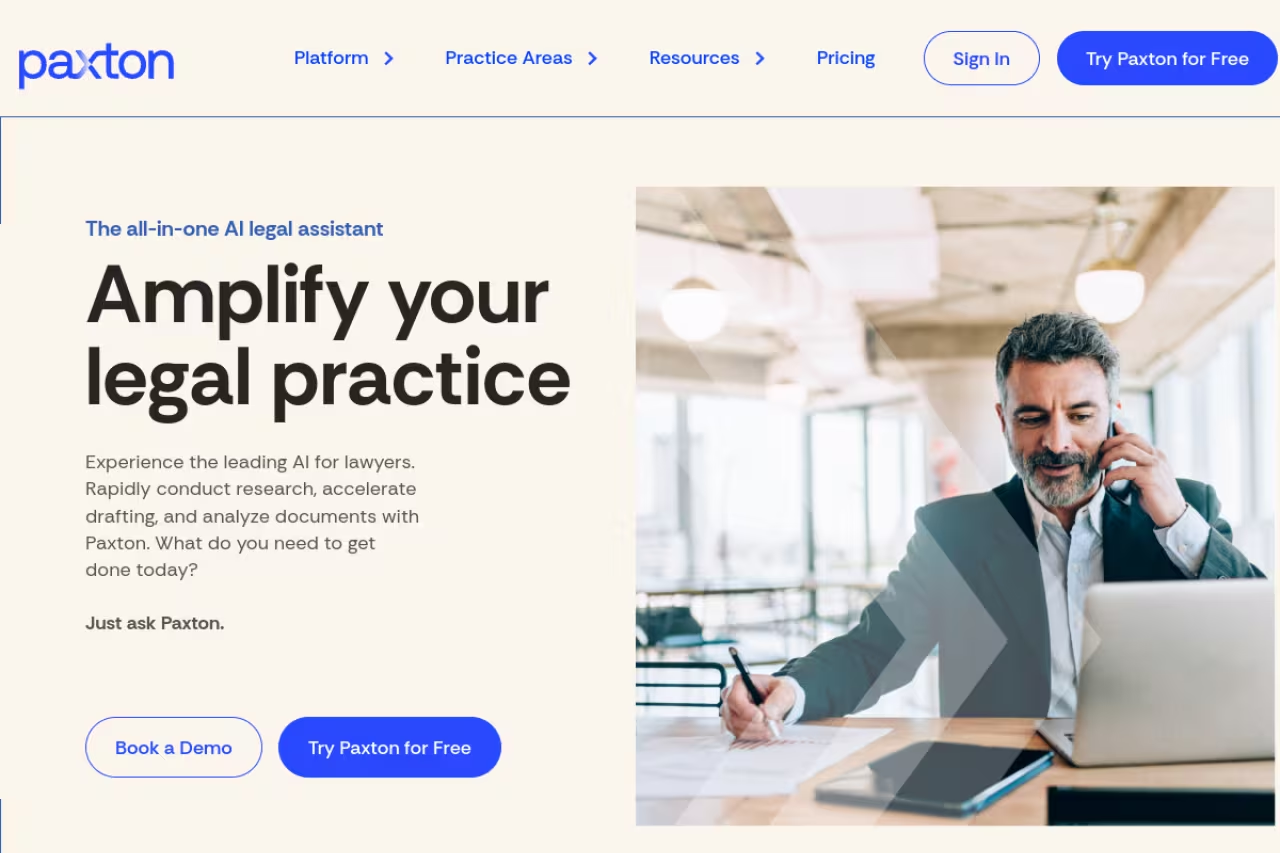
Paxton AI is refreshing for one reason most of this list can't claim: it publishes its prices and lets you sign up yourself. The Individual plan is $499 per user per month or $2,999 per year, which works out to a 50% discount for paying annually. There's a 7-day free trial and a $29/month rate for law students.
Pick it if you are a solo or small firm that wants to sign up and pay without a sales call. It handles drafting and document analysis, but $499/month is real money and it lacks Westlaw-grade research depth.
Paxton handles document drafting, file analysis, and even medical chronologies and billing summaries, which makes it useful for personal injury and litigation support work. It carries SOC 2, ISO 27001, and HIPAA certifications.
The catch: $499/month is real money for a solo, and you're not getting the deep research databases that Westlaw or Lexis bundle into their premium tiers. Paxton is a capable generalist assistant, not a full research replacement. Test it hard during the trial week before committing.
CoCounsel: research with Westlaw behind it
CoCounsel started as Casetext's GPT-4-powered assistant (the first of its kind to pass the bar exam) and now lives inside Thomson Reuters. It answers legal questions, summarizes case law, reviews documents, and drafts research memos, with the advantage that it sits on top of Westlaw's primary-law database.
The natural choice for litigators already on Westlaw, since answers are grounded in real, citable primary law. The catch is that it is bundled rather than standalone and has no self-service trial, so your real cost is Westlaw plus the add-on.
Because it draws on Casetext's legal corpus, it's far less prone to inventing fake citations than a general chatbot.
On price, CoCounsel runs $104 to $639 per user per month across four plans as of 2026. The Westlaw Advantage bundle tops out at $639/user/month; entry tiers start around $180. As of 2026 it's bundled with Westlaw rather than sold standalone, so your real cost is the Westlaw subscription plus the CoCounsel add-on.
Where it falls short: there's no self-service signup and no way to trial it without a Thomson Reuters rep. Pricing is negotiated per firm, which means smaller firms often pay more per seat than the big ones with use. The bundling also locks you into the Westlaw ecosystem.
Lexis+ AI: cited answers for LexisNexis firms
Lexis+ AI is LexisNexis's answer to CoCounsel, and the comparison is apt: it's a premium AI layer on top of an existing research giant. It drafts, summarizes, analyzes, and answers with citations pulled from the Lexis database, plus a Brief Analysis tool that reviews your filings, flags missing precedents, and suggests relevant cases.
Go with it if your firm already subscribes to Lexis+ and wants cited AI answers without leaving the platform. Judicial Analytics is a real edge for litigators, but standalone the math does not work and quality reviews are mixed.
The Judicial Analytics feature, which surfaces how specific judges tend to rule, is a genuinely useful edge for litigators planning strategy.
Quote-based pricing reportedly starts around $128/user/month and ranges up to $494 depending on tier, layered on top of your base Lexis+ cost. Like its competitors, it's custom-quoted with no public price list.
The catch: it only makes sense if you're already paying for Lexis. Standalone, the math doesn't work, and several user reviews flag the output quality as inconsistent compared to CoCounsel for certain research tasks. Run both through a trial if your firm subscribes to both ecosystems.
Vincent AI: the Clio-integrated researcher
Vincent AI comes from vLex, now part of Clio, and pairs a global legal database with research, drafting, document analysis, and litigation-strategy tools. The 2026 version added agentic features and a mobile app, and its global coverage makes it stronger than most US-only tools for cross-border work.
A strong research engine for Clio users and firms working across multiple jurisdictions. The $399 starting price is steep, so decide whether you need Vincent's research depth or only the lighter Clio Duo workflow helper.
Pricing starts around $399/month for a single user with volume discounts, and a free trial is available. If you're already in the Clio ecosystem, there's also Clio Duo (now Clio Manage AI), a lighter assistant that adds AI features for roughly $39-59/user/month on top of base Clio.
Where it falls short: Vincent's full power requires a vendor conversation, and the $399 starting point is steep next to Clio Duo for firms that only need basic AI inside their practice management. Decide whether you want a research engine (Vincent) or a workflow helper (Duo) before you buy, because they solve different problems.

Legora: built for diligence at volume
Legora is a Stockholm-built collaborative AI workspace that sits on top of Microsoft 365. Its Tabular Review environment is the headline: it extracts data across thousands of documents at once, which is exactly what M&A diligence and portfolio review demand. It also offers document-specific Q&A and a playbook-driven Word add-in.
Built for transactional teams running large diligence exercises, where Tabular Review extracts data across thousands of documents at once. The 10-seat minimum and five-figure floor rule out solos and small firms entirely.
The shared review threads inside Word and Outlook make it a real collaboration tool, not just a solo assistant.
Pricing starts around $3,000 per user per year with a 10-seat minimum, putting the floor near $30,000 in annual contract value, plus implementation and training fees. Buyers report 40-60% discounts are achievable on pushback.
The catch: the 10-seat minimum and five-figure floor rule it out for solos and small firms entirely. This is enterprise tooling for teams with volume to justify it. If you're reviewing a handful of contracts a month, you're paying for capacity you'll never touch.
Ivo: playbook redlining for in-house teams
Ivo is an AI contract intelligence platform aimed squarely at enterprise in-house legal teams. It does Word-native redlining driven by your company's playbook, learning your preferred fallback language over time, with three products spanning Intelligence, Review, and an Assistant.
Suits in-house counsel and legal ops teams processing dozens of agreements a week, with playbook-driven redlining that improves as you feed it. Pricing is fully opaque and there is no self-serve path, so expect a sales process first.
The playbook approach means it gets more useful the more you feed it, which suits high-volume review workflows.
Pricing is fully opaque. Ivo is sold to enterprises through demos, and reported deals land in five-figure annual territory. There's no self-serve option and no published numbers, so ROI planning means sitting through a sales process first.
Where it falls short: the lack of any transparent pricing or trial path makes it hard to evaluate without committing real time. For small teams or occasional contract work, the enterprise-only model is a poor fit. This is a tool you buy when contract volume is already a staffing problem.
How to choose
Start with your primary job, not the feature list. The fastest way to waste money here is buying a research powerhouse when you mostly redline contracts, or vice versa.
If contracts are your life, go Word-native: Spellbook for most firms, Legora or Ivo if you're doing bulk diligence at enterprise scale. If your work is research and litigation, the question becomes which database you already pay for. CoCounsel if you're on Westlaw, Lexis+ AI if you're on Lexis, Vincent AI if you're on Clio or need global coverage.
Budget sets the second filter. Under $500/month and self-serve points you to Paxton or Spellbook's lower tiers. Six-figure enterprise budgets unlock Harvey, which is the only tool here that credibly does everything at once, if you can stomach the sales cycle and seat minimums.
Finally, always run the trial. Output quality varies wildly by task and even by practice area, and vendor demos show you the happy path. Throw your real documents at it for a week. The tool that saves your associate an afternoon is worth more than the one with the longest feature list. If you're still mapping the wider AI stack your team should run, our /top-tools roundup and the best AI agents guide are good next stops, and Dupple X keeps you current on what's actually shipping in this space.
Want a weekly read on which AI tools are worth your time? Dupple X sends the signal without the noise.
Frequently asked questions
What is the best AI legal assistant tool in 2026?
There's no single winner, because the tools serve different jobs. For transactional lawyers and small firms, Spellbook offers the best value with Word-native contract review. For large firms doing complex research, Harvey is the de facto standard. For solos who want transparent pricing and self-serve signup, Paxton AI is the easiest place to start.
How much do AI legal assistant tools cost?
Pricing spans a huge range. Practice-management add-ons like Clio Duo start around $39/user/month. Mid-tier tools like Paxton run $499/month or $2,999/year. Research platforms like CoCounsel and Lexis+ AI sit between $104 and $639/user/month, usually bundled with a database subscription. Enterprise tools like Harvey and Legora reach $1,000-2,000 per seat monthly or five-to-six figures annually, almost always custom-quoted.
Are AI legal tools safe to use for confidential client data?
The reputable ones are built for it. Tools like Spellbook, Paxton, and Harvey hold certifications such as SOC 2, ISO 27001, or HIPAA, and many offer zero-data-retention agreements so your documents never train their models. The bigger risk is hallucination: AI can invent citations, so tools grounded in real legal databases (CoCounsel, Lexis+ AI, Vincent) are safer for research. Always verify AI output before filing.
Can AI legal assistants replace paralegals or junior associates?
Not yet, and not entirely. These tools compress hours of document review, summarization, and first-draft work into minutes, but the output still needs a trained human to check it. Think of them as a fast, tireless first-year whose work you always review rather than a replacement for legal judgment. The lawyers getting the most value use AI for the grunt work and keep their attention on strategy and accuracy.
Do I need Westlaw or Lexis to use legal AI?
No, but it changes which tools make sense. CoCounsel is now bundled with Westlaw, and Lexis+ AI requires a Lexis subscription, so those only pay off if you're already in those ecosystems. Standalone tools like Spellbook, Paxton, Harvey, and Vincent AI don't require a separate legacy research subscription, though their research depth varies.
Related guides
Some offers on this page may be paid placements or contain affiliate links.
