
Google AI Mode Is Swallowing Informational Search, and You Can't Measure It

Google is turning the search results page into a conversation, and it is doing it without a press release. On a growing share of informational queries, the familiar AI Overview no longer sits politely above the blue links waiting to be expanded. It opens up on its own, pulls a prompt box into view, and invites you to keep asking. Some results now come with interactive quizzes and visual tools baked right into the page.
Dupple is a Semrush affiliate. If you start a trial through the link in this article, Dupple may earn a commission, at no extra cost to you.
The effect is subtle if you are searching and enormous if you publish. A query that used to end with a click to someone's website now ends with a follow-up question to Google. The answer lives on Google's page. The next answer does too.
A product launch nobody announced
There is no official blog post explaining any of this. No keynote, no changelog, no help center article with a tidy diagram. What exists instead is a steady trickle of screenshots from practitioners who watch search results for a living and keep noticing that the page looks different than it did last month.
The clearest marker is the disappearance of the Show more button. For a long time, AI Overviews were truncated by default, and you had to tap to see the full response. That small bit of friction mattered, because it kept the summary short and left room for the organic results underneath. Search Engine Roundtable reported on 28 August 2026 that the Show more control is gone on some queries, and that the follow-up prompt box now loads by itself.
Put those two changes together and you get something that behaves a lot like AI Mode, Google's full chat-style search experience, except you never chose to enter it. The overview simply unfolds into it. Add quizzes and visual widgets for topics where people are trying to learn something, and the result page starts to look less like a directory and more like a destination.
That is the point. Informational searches (how does this work, what is the difference between, why does that happen) are exactly the queries where a generated answer can satisfy someone completely. Google has every reason to keep those users on its own surface, and the interface is being reshaped to do just that.
The second problem is that you can't see it
If Google were transparent about what happens inside these answers, publishers could at least adapt with their eyes open. They can't. The measurement tools Google provides were built for a world of ranked links, and they have barely changed.
Start with the Generative AI report. It exists, which sounds promising, but it shows no queries. You cannot see which searches triggered an AI answer that mentioned your site, which is the single most useful thing a report like that could tell you.
Search Console is not much better. It does not give click data for links inside AI Overviews as a separate slice, so a visit that came from a citation in a generated answer blends in with everything else. And when your page is cited, it shares one block-level position with every other source in that answer. Being the first citation and being the fifth look identical in the data, even though they almost certainly behave very differently in the real world.
The practical result is a strange kind of blindness. Teams watch their traffic drop on pages that still rank. They check for algorithm updates, technical errors, lost backlinks, and find nothing. The traffic did not go to a competitor. It went into an answer box, and nothing in the reporting says so.
What the losses look like
Large publishers have started putting numbers on this, and the numbers are not small. The BBC reported that HubSpot lost 140 million visits in a single year, and that the cause was AI. HubSpot built one of the most famous content engines on the internet precisely by answering informational questions at scale, which is exactly the category of search that Google is now answering itself.
That is one company's story as told by one news organization, not a universal law. But it lines up with what many content teams are seeing in their own dashboards: informational pages bleeding visits while commercial pages hold steadier. When the question can be fully answered in a paragraph, Google can now provide that paragraph, plus a follow-up, plus a quiz.
Rethinking where the effort goes
None of this means content stops mattering. It means the kind of content, and the way it is judged, has to change.
The first move is an honest audit. Go through your informational pages and compare them against the queries AI Mode now answers on the results page. Search the terms that used to drive traffic and look at what appears. If the answer box covers the question thoroughly and opens into a chat, that page is probably not going to win back its old click volume, no matter how well it is written. Some of those pages are still worth keeping because they earn citations and build authority. Others are quietly consuming maintenance time for very little return.
The second move is to shift weight toward intent that an AI summary handles poorly. Comparison content, where readers want to weigh specific products against each other, and bottom-of-funnel pages, where someone is close to a decision and wants detail, pricing context, and trust signals, still pull people through to a website. A generated paragraph can tell you what a CRM is. It is much less convincing when you are trying to decide which one to pay for.
There is also the audience that no results page can take away. Teams that build a real following on LinkedIn, YouTube, Instagram, or TikTok keep a stream of people who already know the brand and search for it by name, whatever Google does to the page next. The Semrush Social Toolkit covers that side of the work: it plans and schedules posts across those channels, benchmarks your accounts against competitors, and shows which formats actually grow your audience. Steady brand demand from social is what keeps the pipeline full when a search algorithm shift wipes out a chunk of informational traffic.
The third move is the one most teams resist, because it means admitting clicks are no longer the whole scoreboard. If your brand is being cited, summarized, and recommended inside AI answers, that presence has value even when nobody clicks. If a competitor is the one getting named, that is a loss even when your rankings look fine. You need a way to see that layer directly, since Google's own reports will not show it to you.
This is where third-party tracking has stepped in. The Semrush AI Visibility Toolkit measures brand presence, sentiment, and citations across ChatGPT, Perplexity, Gemini, Google AI Mode, and Claude, and Semrush says it is backed by a database of more than 158 million real LLM prompts. Whatever tool a team picks, the shift in mindset is the same: track whether you appear in the answer, how you are described, and which pages get cited, alongside the traffic numbers you already watch.
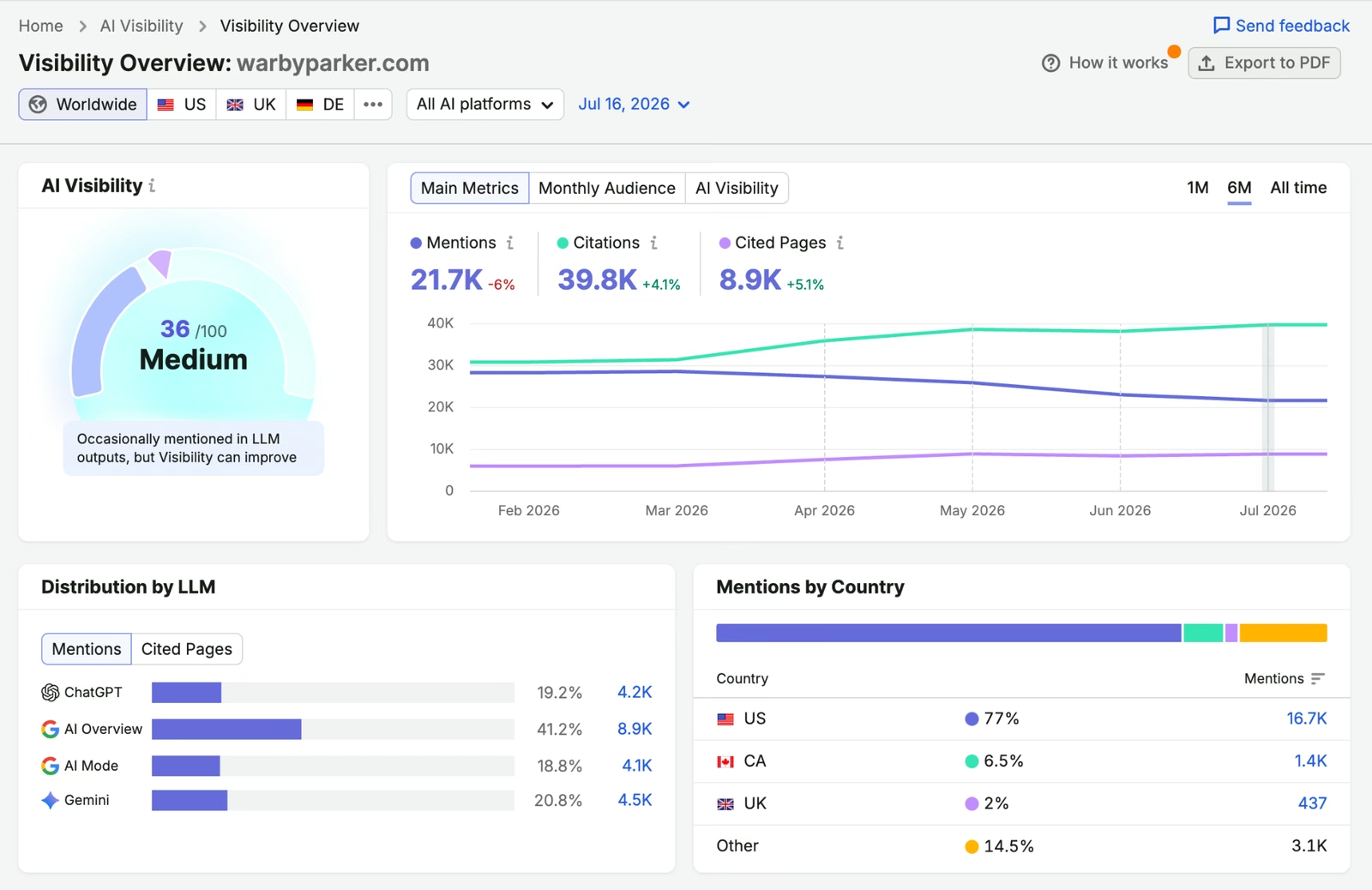
The Visibility Overview report in the Semrush AI Visibility Toolkit. In this example, the brand's citations rose 4.1% while its mentions fell 6%, the kind of shift Search Console would never surface. Screenshot: Semrush.
See how your brand appears across AI search with the Semrush AI Visibility Toolkit and track your mentions, citations, and visibility across leading AI platforms.
A results page that keeps the conversation
Google has spent more than two decades training people to type a question and click a link. It is now retraining them to type a question and keep talking. The changes are arriving piece by piece, a missing button here, a prompt box there, a quiz where a list of links used to be, and each one on its own looks minor.
Taken together, they move the center of gravity of informational search off the open web and onto Google's own page. The publishers who notice early will be the ones measuring what happens inside those answers, while everyone else keeps staring at a traffic chart that only tells them something is missing.
Some offers on this page may be paid placements or contain affiliate links.
