
The Best Secrets Management Tools in 2026

Key facts7 tools compared: Infisical, Doppler, HashiCorp Vault, AWS Secrets Manager, Google Secret…
- 7 tools compared: Infisical, Doppler, HashiCorp Vault, AWS Secrets Manager, Google Secret Manager, 1Password, Akeyless
- Infisical (best for: Most dev teams wanting open source): Free up to 5 identities, $18/identity/mo Pro
- Doppler (best for: Fast onboarding, no infra): Free for 3 users, $21/user/mo Team
- HashiCorp Vault (best for: Complex multi-cloud at scale): Free OSS, HCP Dedicated from ~$22/mo
- AWS Secrets Manager (best for: AWS-native shops): $0.40/secret/mo + API calls
A hardcoded API key in a public GitHub commit is still one of the fastest ways to turn a normal Tuesday into an incident channel full of angry messages. GitGuardian keeps finding millions of leaked credentials in public repos every year, and most trace back to the same root cause: secrets living somewhere they shouldn't, like a .env file someone forgot to gitignore.
That's the problem a secrets manager solves. It gives your applications, CI pipelines, and teammates a single place to store and fetch API keys, database passwords, certificates, and tokens, without those values ever touching your source code. The catch is that "secrets management" now spans a huge range, from a free open-source tool you self-host in an afternoon to a single-tenant enterprise cluster that needs a dedicated platform team.
I've worked with most of the serious options, and the short version is this: Infisical is the best pick for most teams in 2026. It's open source, the developer experience is excellent, and the pricing won't blindside you. But the right tool depends on where your stack already lives, so let's get into the options.
Quick comparison
| Tool | Best for | Price | Standout |
|---|---|---|---|
| Infisical | Most dev teams wanting open source | Free up to 5 identities, $18/identity/mo Pro | Self-host or cloud, clean UI |
| Doppler | Fast onboarding, no infra | Free for 3 users, $21/user/mo Team | Zero-to-secrets in minutes |
| HashiCorp Vault | Complex multi-cloud at scale | Free OSS, HCP Dedicated from ~$22/mo | Dynamic secrets, PKI engine |
| AWS Secrets Manager | AWS-native shops | $0.40/secret/mo + API calls | Deep IAM and Lambda rotation |
| Google Secret Manager | GCP-native shops | $0.06/version/mo + access ops | Cheap storage, simple model |
| 1Password | Human creds plus light CI | $8.99/user/mo Business | Secrets Automation add-on |
| Akeyless | SaaS with zero-knowledge needs | Custom (free tier available) | Distributed Fragments Crypto |

Infisical: the open-source pick I reach for first
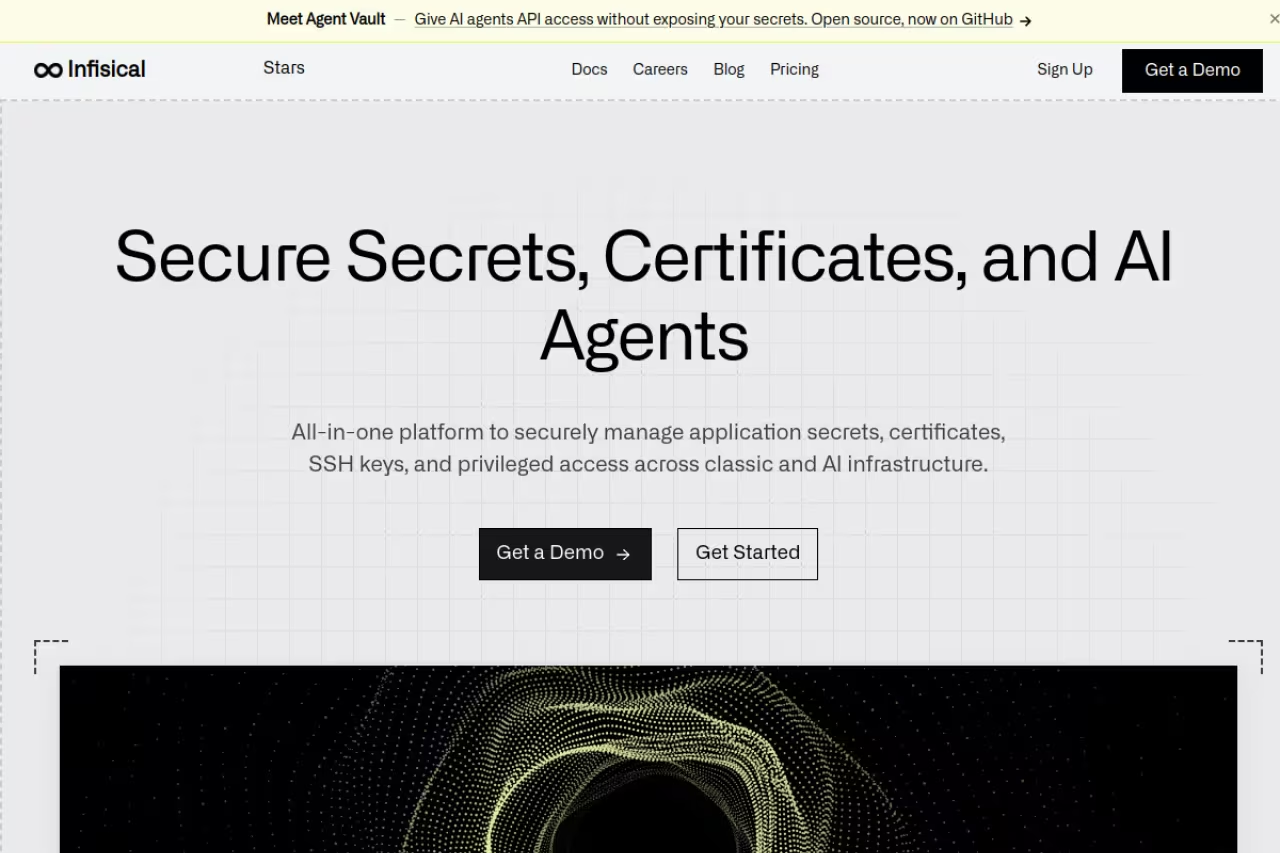
Infisical is what HashiCorp Vault would look like if someone rebuilt it for developers who don't have a platform team. It started in 2022 as an open-source secrets manager and has grown into a wider security platform covering secret rotation, PKI, SSH access, and leak scanning. It now carries over 17,000 GitHub stars and ships under an MIT license, so you can self-host the whole thing with no vendor lock-in.
Infisical is the open-source pick for teams that want a modern UI plus the option to self-host for compliance, under an MIT license. The free tier is generous, and you can move the same product onto your own servers later, though Pro bills $18 per identity per month.
The pricing is refreshingly readable. The free tier covers up to 5 identities, 3 projects, 3 environments, and 10 integrations, with secret scanning and all the cloud integrations included. The Pro plan is $18 per identity per month and adds secret versioning, point-in-time recovery, role-based access, SAML SSO, and 90-day audit logs. Dynamic secrets and SCIM sit in the custom Enterprise tier.
The standout is genuine optionality. You start on the free cloud tier, then move the exact same product onto your own servers when a customer audit demands it. Integrations cover AWS, Vercel, GitHub Actions, and Kubernetes out of the box, so wiring secrets into a pipeline takes minutes.
The catch: "identity" pricing means machine identities like CI runners and service accounts count toward your billable total, not just humans. A busy microservice setup racks up identities faster than you'd expect, so model your real count before assuming you'll stay cheap.

Doppler: the fastest path from zero to injected secrets
Doppler is the tool I recommend when a team wants secrets centralized by end of day and nobody wants to touch infrastructure. It's a fully managed, cloud-only platform with a polished dashboard where you set secrets per environment and sync them everywhere through one CLI command. Doppler claims you go from zero to injected secrets in under five minutes, and its documented setup flow backs that up.
Doppler is the fastest path from zero to injected secrets for cloud-native teams that value onboarding speed over self-hosting. It is managed and cloud-only, with a strong sync engine, though you give up the self-hosting option Infisical offers.
The free Developer plan covers 3 users (and up to 25 total at $8/month each beyond that), with 10 projects and 5 config syncs. The Team plan is $21 per user per month and unlocks change requests, SAML SSO, role-based access, automatic secret rotation, and 90-day activity logs. One detail I like: Doppler doesn't bill you for non-human identities like service accounts or CI pipelines, which is the opposite of Infisical's model.
The standout is the sync engine. Doppler pushes the same secret set into AWS, Vercel, GitHub Actions, and dozens of other targets, so you change a value once and it propagates everywhere instead of drifting across five dashboards.
Where it falls short: there's no open-source version and no self-hosting, period. For regulated industries or anyone who needs secrets to stay on their own infrastructure, that's a hard stop. At $21/user it's also the priciest per-seat option here, so a 25-person team is looking at roughly $525/month.
HashiCorp Vault: the heavyweight for complex infrastructure
HashiCorp Vault is the tool everyone benchmarks against. Its dynamic secrets engine generates short-lived, on-demand database and cloud credentials that expire automatically, plus it does encryption-as-a-service, a full PKI certificate authority, and fine-grained policy control. If your security model needs credentials that live for minutes instead of months, Vault still sets the bar.
The heavyweight for large organizations with multi-cloud infrastructure and a team that can actually operate it, and its dynamic secrets still set the bar. Running Vault is a real job, so for small teams it is overkill.
The Community Edition is free and includes the core engine, dynamic secrets, and identity-based access. Managed HCP Vault Dedicated starts around $0.03/hour (roughly $22/month) on the development tier, but production tiers jump to over $1,000/month for the cluster plus a per-client fee per authenticated identity. Enterprise self-hosted pricing is sales-only.
The standout is depth. Nothing else here matches Vault's breadth of secrets engines or its track record running mission-critical infrastructure at the largest companies.
The catch: operating Vault is a real job. The free version carries high setup and maintenance cost in engineering time, and big shops sometimes assign 10-plus engineers to Vault alone. IBM also finished acquiring HashiCorp in early 2025, and the simpler HCP Vault Secrets SaaS product was end-of-sale on June 30, 2025. For small teams, Vault is overkill.
AWS Secrets Manager: the obvious choice if you live in AWS
AWS Secrets Manager makes the most sense when your stack already runs on AWS. It integrates directly with IAM, Lambda, RDS, and the rest of the ecosystem, so access control rides on permissions your team already manages. The native rotation for RDS, Redshift, and DocumentDB is the feature that wins people over: AWS can rotate a database password on a schedule with a managed Lambda function and no custom code.
The obvious choice for teams already deep in AWS who want secrets governed by existing IAM roles, with native rotation for RDS, Redshift and DocumentDB. It is AWS only, and per-API-call billing can surprise high-traffic apps.
Pricing is straightforward and usage-based: $0.40 per secret per month plus $0.05 per 10,000 API calls. There's no per-seat cost, which is great for small secret counts, but no free tier for API calls either. Each cross-region replica counts as another $0.40 secret.
The standout is the IAM integration. Because access is governed by the same policies as the rest of your AWS resources, you don't bolt on a separate permission system.
Where it falls short: it's AWS-only, so the moment you go multi-cloud you're managing a second tool. And the per-API-call billing can surprise high-traffic apps that fetch secrets on every request instead of caching them. Pair it with a caching layer or your bill creeps up quietly.
Google Secret Manager: simple and cheap inside GCP
Google Cloud Secret Manager is the GCP counterpart to AWS Secrets Manager, and if your workloads run on Google Cloud it's the path of least resistance. It hooks into IAM, Cloud Run, GKE, and Cloud Functions, with versioning baked in so you can roll a secret back to a previous value cleanly.
Go with Google Secret Manager if you are GCP-native and want integration without extra tooling, since a small project can genuinely pay nothing. Per-version costs add up if you create a new version on every deploy, and it is single-cloud like AWS.
The model is even cheaper than AWS for low-volume use: $0.06 per active secret version per location per month and $0.03 per 10,000 access operations, with a free monthly allowance of 6 active versions and 10,000 access operations. For a small project you can genuinely pay nothing.
The standout is how little there is to learn. The model is small enough that a developer can be productive in an hour, and the versioning story is clean.
The catch: those per-version costs add up if you create a new version on every deploy. One widely shared write-up described 84 secret versions costing more than the entire Cloud Run app they served. Destroy old versions instead of letting them pile up. Like AWS, it's also single-cloud by design.

1Password: when your secrets are mostly human
1Password sits in an interesting spot. Most people know it as a password manager, but the Business plan unlocks Secrets Automation, which lets applications and CI pipelines pull secrets through Service Accounts or a self-hosted Connect server. If your team already lives in 1Password and your "secrets management" need is mostly shared logins plus some light API key usage, you may not need a separate tool at all.
A sensible shortcut for teams already on 1Password Business whose secrets are mostly human, letting you cover developer secrets without a second product. It is not a dynamic-secrets engine, and Service Account rate limits rule out high-throughput machine workloads.
1Password Business is $8.99 per user per month billed annually, and that unlocks Secrets Automation. Service Accounts are the modern way to fetch secrets programmatically; they carry hourly and daily rate limits that vary by tier, while a Connect server caches data locally for effectively unlimited re-requests.
The standout is consolidation. You manage human credentials and machine secrets in one place, with one bill and one access model, which is appealing for smaller teams.
Where it falls short: this is not a dynamic-secrets engine. There's no on-demand short-lived credential generation like Vault, and the Service Account rate limits mean it isn't built for high-throughput machine workloads. Treat it as a great fit for human-heavy use, not a replacement for a dedicated machine secrets platform.

Akeyless: SaaS that never sees your secrets
Akeyless is a unified SaaS platform that folds secrets management, certificate lifecycle, key management, and secure remote access into one product. Its differentiator is Distributed Fragments Cryptography: encryption keys get split into fragments, with one stored in your own environment so Akeyless itself never has access to your plaintext secrets. That zero-knowledge design is the pitch for teams that want managed convenience without handing over the keys.
Best for: organizations that want a SaaS vault but can't accept a provider holding their encryption keys.
Akeyless runs as SaaS plus a stateless Gateway that lives in your environment for caching, network fallback, and that local key fragment. It offers a free tier, with paid and enterprise pricing handled through sales rather than a public price page. The company claims it cuts operational overhead by removing self-managed vault infrastructure.
The standout is the zero-knowledge architecture. You get the low operational burden of SaaS while keeping cryptographic control that most managed vaults can't offer.
The catch: pricing isn't transparent, so you're booking a sales call to get real numbers. The platform is also broad, which is powerful but more than a small team chasing a simple secrets store usually needs.
Akeyless is for organizations that want a SaaS vault but cannot accept a provider holding their encryption keys, thanks to its zero-knowledge design. Pricing is not transparent, so expect a sales call, and the broad platform is more than a simple secrets store needs.
If you're still mapping out your security stack beyond secrets, our roundups of the best AI cloud security tools and best AI DevOps tools pair well with this one.
How to choose
Start with one question: where does your infrastructure already live?
If you're committed to one cloud, the native tool is usually the right call. AWS Secrets Manager and Google Secret Manager govern access through IAM you already manage and integrate with serverless and database services. Pick the one matching your cloud and only look elsewhere if you go multi-cloud.
If you want the best developer experience, choose between Infisical and Doppler. Pick Infisical if self-hosting matters for compliance or you prefer open source. Pick Doppler if you never want to run infrastructure and onboarding speed wins. Both are excellent; the deciding factor is whether you'll ever need to run it yourself.
If you operate complex, security-critical infrastructure at scale, Vault earns its complexity through dynamic secrets, PKI, and depth nothing else matches. Just budget for the engineering time.
If your secrets are mostly human credentials, 1Password covers it without a second tool. And if zero-knowledge SaaS is a hard requirement, Akeyless is the specialist.
One more rule, whatever you pick: pair the tool with secret scanning so a leaked credential gets caught before it ships. A vault doesn't help if developers paste keys into code anyway.
If you want to keep up with tooling shifts like the IBM acquisition reshaping Vault, the Techpresso newsletter tracks this stuff so you don't have to read ten changelogs a week. You can also browse our wider top tools directory for adjacent picks.
FAQ
What is the difference between a secrets manager and a password manager?
A password manager stores human-accessible credentials like website logins and shared team passwords, surfaced through a browser extension or app. A secrets manager stores machine credentials like API keys, database passwords, and certificates that applications fetch programmatically at runtime. They overlap (1Password does both), but a true secrets manager is built for code and CI pipelines, not just people. For the human side, see our guide to the best password managers for teams.
What is the best free secrets management tool?
For open source you can self-host, Infisical's free tier (5 identities, 3 projects) and HashiCorp Vault Community Edition are the strongest. For a managed free option, Doppler is free for up to 3 users. If you're already on a cloud, Google Secret Manager's free monthly allowance of 6 active versions and 10,000 access operations can cost you literally nothing for small projects.
Are dynamic secrets worth it?
Dynamic secrets are short-lived credentials generated on demand that expire automatically, so a leaked key is useless within minutes. They meaningfully shrink your attack window and are worth it for database and cloud access in security-sensitive environments. HashiCorp Vault is the deepest option here, with Infisical and Akeyless also offering it on higher tiers. For a simple app with a handful of static keys, they're more machinery than you need.
How much does secrets management cost for a small team?
It varies widely. A cloud-native option like Google Secret Manager can cost a few dollars a month for a small project. Per-seat tools land around $18 to $21 per user per month (Infisical Pro, Doppler Team), while 1Password Business is $8.99 per user. Self-hosting open-source Infisical or Vault Community Edition is free in licensing but costs engineering time to run.
Can I self-host a secrets manager?
Yes. Infisical (MIT licensed) and HashiCorp Vault Community Edition are both fully self-hostable, which matters for compliance regimes that require secrets to stay on your own infrastructure. Akeyless takes a hybrid approach with a Gateway in your environment. Doppler, AWS Secrets Manager, and Google Secret Manager do not offer self-hosting.
Do I still need secret scanning if I use a secrets manager?
Yes, and they solve different problems. A secrets manager gives developers a safe place to store secrets, but it can't stop someone pasting a key directly into code and committing it. Secret scanning catches those leaks in your repos and CI. Infisical bundles scanning into its free tier, and dedicated scanners like GitGuardian pair well with any vault.
Related guides
Some offers on this page may be paid placements or contain affiliate links.
Across our whole catalogue the median is $24 a month and 33% of tools advertise a free tier. Figures are the lowest recurring monthly price quoted in our own review of each tool, read on 2026-08-19. Full method and every category.
