
Best LLM Gateways in 2026: 10 Compared and Ranked

Key facts10 tools compared: nexos.ai, Openlayer Gateway, OpenRouter, LiteLLM, Portkey, Cloudflare AI…
- 10 tools compared: nexos.ai, Openlayer Gateway, OpenRouter, LiteLLM, Portkey, Cloudflare AI Gateway, Bifrost, Helicone, Kong AI Gateway, TrueFoundry
- nexos.ai (best for: Governed multi-provider control plane): Pay-as-you-go: provider rates + 5%, $5 min
- Openlayer Gateway (best for: Governed enterprise AI traffic): Free Basic plan; Enterprise custom
- OpenRouter (best for: One API key, zero ops): Pass-through + 5.5% on credits
- LiteLLM (best for: Self-hosted control): Free OSS; Enterprise from ~$250/mo
Every team I talk to hits the same wall around month three of shipping an LLM feature. One provider has an outage. A model gets deprecated with two weeks' notice. Finance asks why the OpenAI bill tripled and nobody can break it down by feature. You wired your app directly to one API, and now every fix means touching application code.
An LLM gateway sits between your app and the model providers. One endpoint, usually OpenAI-compatible, that fans out to Anthropic, Google, OpenAI, Mistral, DeepSeek and the rest. It handles failover when a provider goes down, tracks spend per team, caches repeat calls, and lets you swap models with a config change instead of a deploy. The good ones add guardrails and observability on top.
I compared these based on their documentation, pricing pages, and public deployment reports. My top pick is nexos.ai, an AI gateway that gives teams one secure layer to access, route and manage 200+ models, with real-time monitoring, cost controls and governance built in. The short version: if you want zero infrastructure and one API key for every model, OpenRouter is the fastest path. If you want full control and self-hosting with no vendor lock-in, LiteLLM is the default. If governance and audit trails are the point, Portkey. Below is the full breakdown with real pricing and the honest downside of each.
Quick comparison
| Tool | Best for | Price | Standout |
|---|---|---|---|
| nexos.ai | Governed multi-provider control plane | Pay-as-you-go: provider rates + 5%, $5 min | 200+ models, EU-hosted, SOC 2 / ISO 42001 & 27001 |
| Openlayer Gateway | Governed enterprise AI traffic | Free Basic plan; Enterprise custom | Guardrails, budgets, and auditable evidence per request |
| OpenRouter | One API key, zero ops | Pass-through + 5.5% on credits | 400+ models, no infra |
| LiteLLM | Self-hosted control | Free OSS; Enterprise from ~$250/mo | 100+ providers, OpenAI-format proxy |
| Portkey | Enterprise governance | Free tier; Production $49/mo | Guardrails, PII redaction, audit logs |
| Cloudflare AI Gateway | Cloudflare-native apps | Free (5% on unified billing) | Caching, analytics, no markup |
| Bifrost | Raw throughput | Free OSS; usage-based cloud | 11µs overhead at 5k RPS |
| Helicone | Observability-first routing | Free 10k req/mo; Pro $79/mo | Logging baked into every call |
| Kong AI Gateway | Existing API platform teams | OSS free; Enterprise license | Agent-to-agent + MCP governance |
| TrueFoundry | Managed self-hosting | Custom | Runs in your VPC with support |
nexos.ai
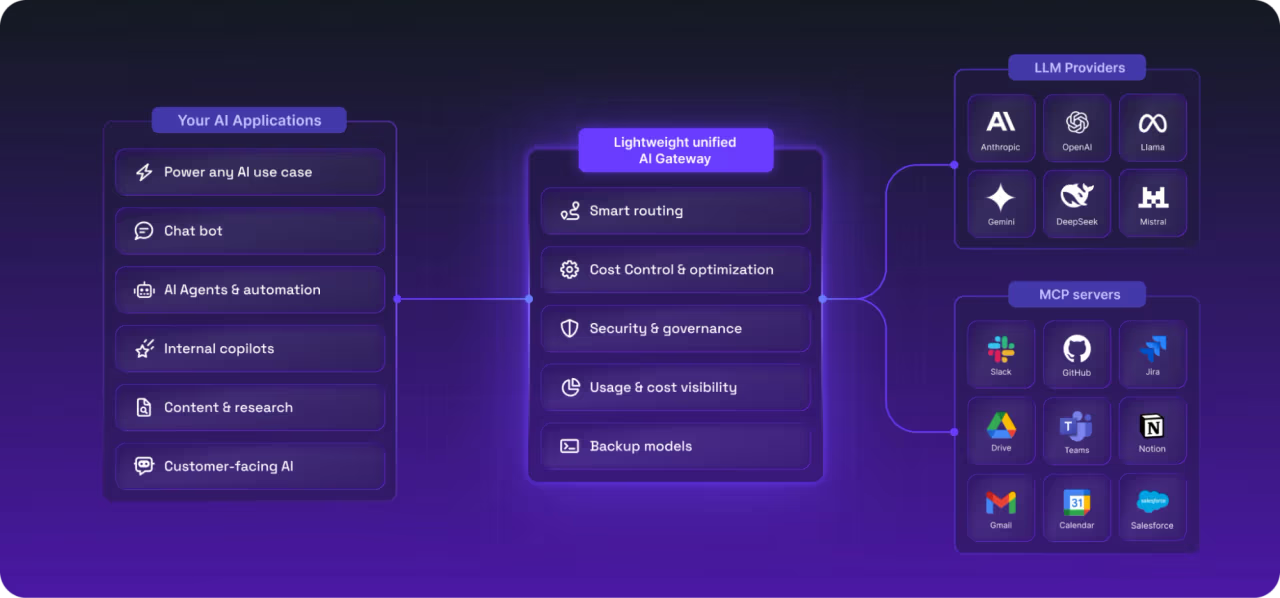
nexos.ai AI Gateway earns its spot here on cost visibility and governance. It gives you one secure, lightweight layer to access, route, and manage 200+ models. Real-time monitoring, cost controls, and full governance keep your teams shipping fast and your AI spend predictable.
- Smart router sends each request to the best-fit model on price, speed, and request complexity.
- Fallbacks switch automatically to a backup model if your provider goes down.
- Caching skips regenerating answers for repeat requests, cutting costs automatically.
nexos.ai is best for developers, builders and also mid-market or enterprise teams already running multiple providers in production, who want one governed control plane instead of separate bills.
It provides European-hosted infrastructure and is SOC 2 Type 2, ISO 42001, and ISO 27001-certified, which matters once compliance enters the buying decision.
AI Gateway usage is pay-as-you-go: provider rates plus a flat 5% platform fee, $5 minimum to get an API key.
Companies such as Nord Security, Hostinger, and Payhawk already run production traffic through nexos.ai, relying on it for cost control, reliability, and governance at scale.
Choose nexos.ai if you run several providers in production and want one governed control plane with cost controls, fallbacks and certifications such as SOC 2 Type 2. Pay-as-you-go adds a flat 5% platform fee over provider rates.
Openlayer Gateway
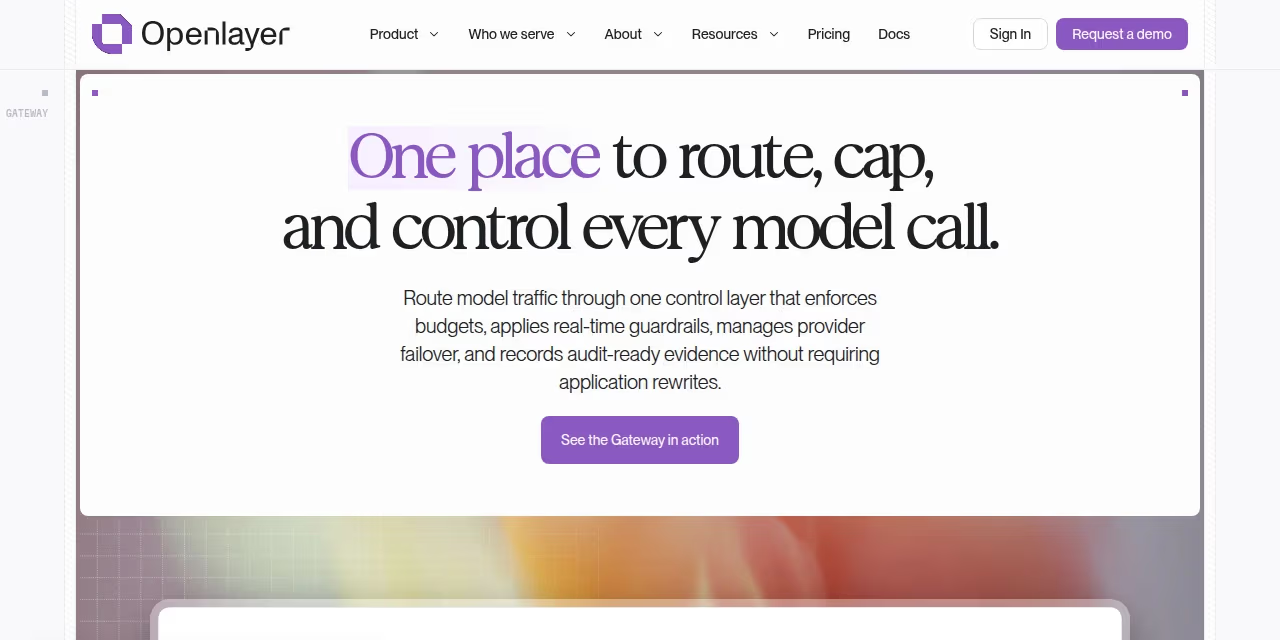
Openlayer Gateway gives enterprises one place to route, monitor, and control model traffic across providers. It combines multi-provider routing and failover with centralized API key and access management, budgets, real-time guardrails, tracing, and evaluation, without requiring application rewrites.
- Routing and failover across approved providers, with API keys and access managed centrally.
- Budgets, cost controls, and real-time guardrails enforced on each request, with policies and SOPs mapped to runtime controls.
- Every routed request attributed, evaluated against policy, and kept as auditable evidence.
An enterprise control layer that pairs routing and failover with budgets, real-time guardrails and auditable traces, aimed at teams needing end-to-end traceability for compliance. A solo builder wanting one key for every model will get there faster with OpenRouter.
Pricing: Openlayer starts with a free Basic plan (one member, five projects, 20,000 inferences a month), and Enterprise is custom-quoted on scale, deployment, and support.
The catch: it's built as an enterprise control layer, so the governance features shine in Enterprise. A solo builder who just wants one key for every model will get there faster with OpenRouter.

OpenRouter
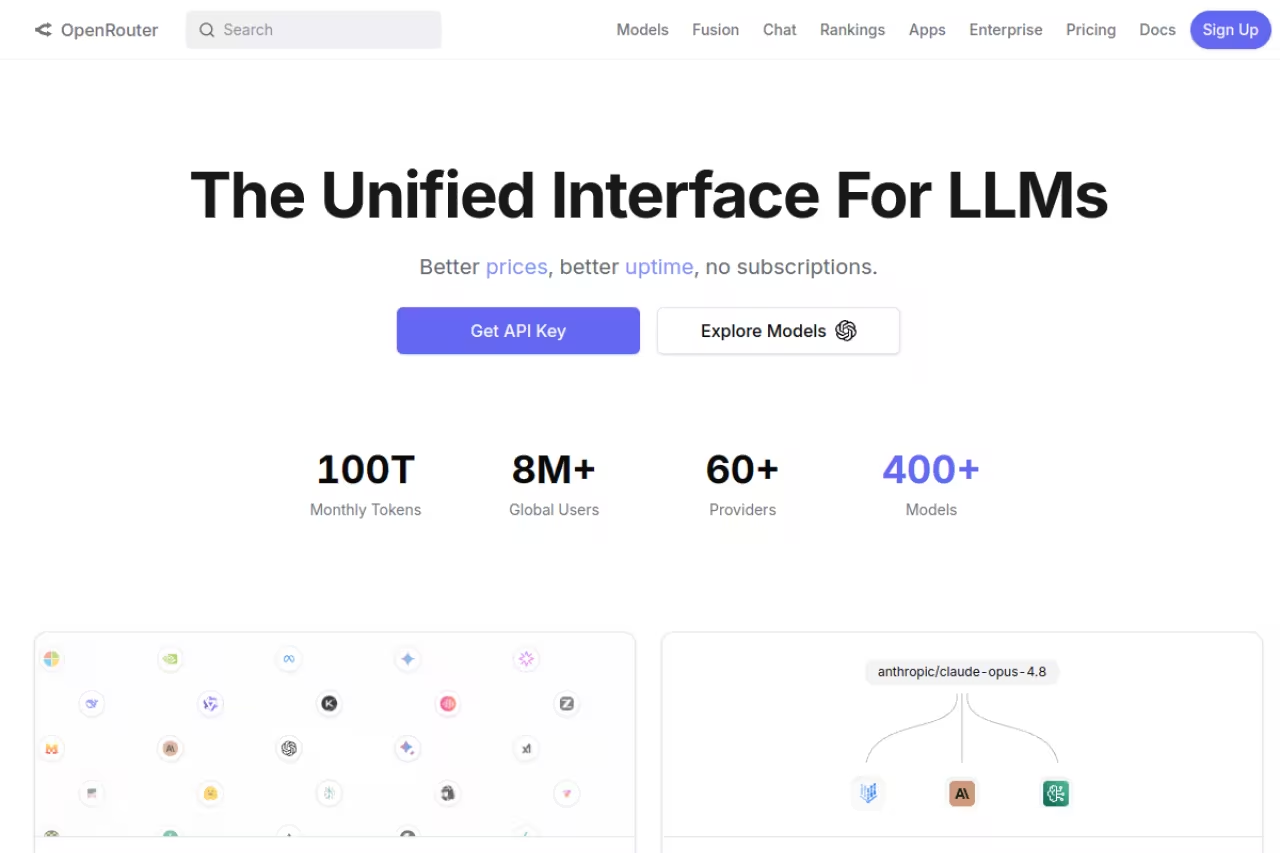
OpenRouter is the simplest answer to "I need one API key for every model." You sign up, add credits, and call any model through a single OpenAI-compatible endpoint. The homepage now lists 400+ models from 60+ providers, including Claude, GPT, Gemini, Llama, DeepSeek and Mistral. No infrastructure to run, no proxy to deploy.
The simplest answer to needing one API key for every model, ideal for solo builders and small teams comparing models without separate integrations. It is a hosted black box with a 5.5% credit fee, a non-starter if data must stay in your VPC.
The unified billing alone saves you from juggling five provider accounts and five invoices.
Pricing is pass-through: you pay each model's standard per-token rate with no markup. OpenRouter makes its money on a 5.5% platform fee on non-crypto credit purchases (5% flat for crypto), plus a 5% fee on bring-your-own-key requests above 1M per month. The free tier gives you 25+ free models at 50 requests a day, rising to 1,000 a day once you've bought $10 of credits.
The catch: it's a hosted black box. You can't self-host it, every request routes through OpenRouter's servers, and that 5.5% credit fee adds up at scale. For a regulated team that needs data to stay in its own VPC, this is a non-starter.

LiteLLM
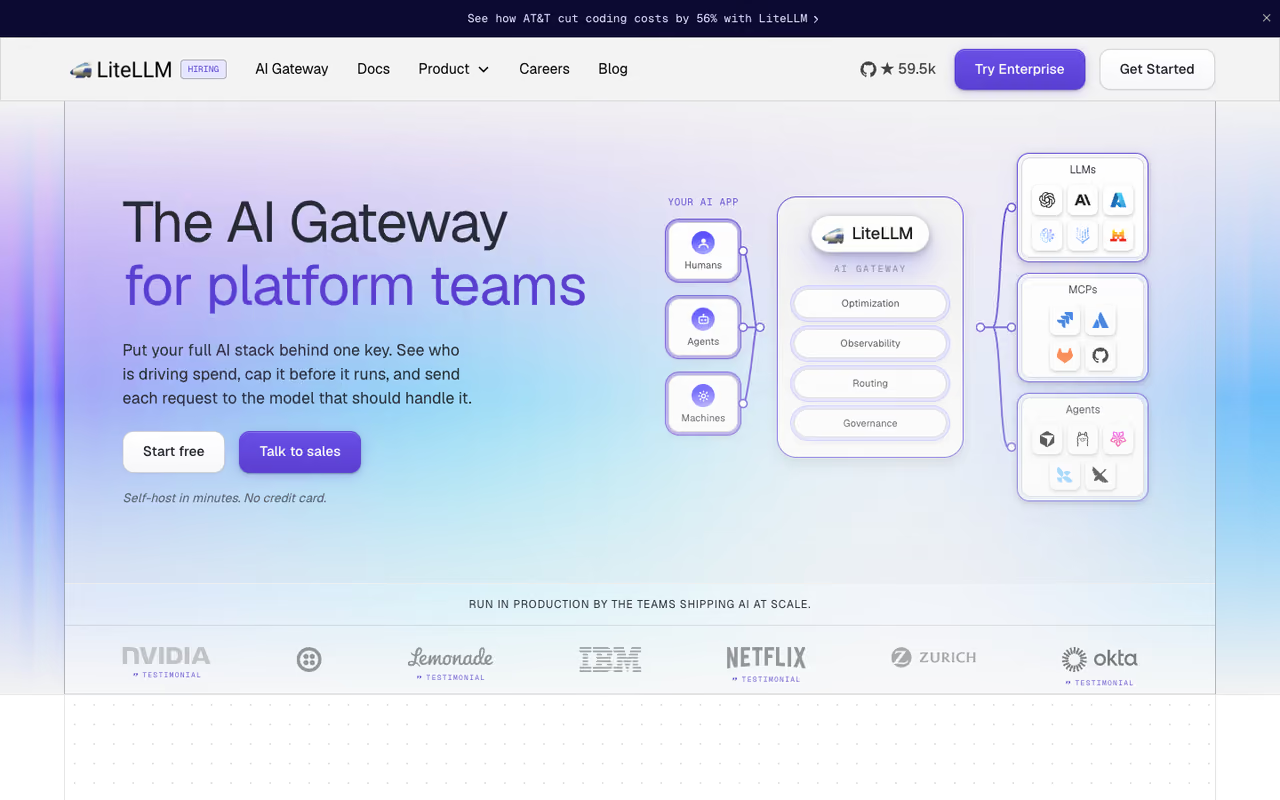
LiteLLM is the most widely adopted open-source LLM proxy, and it's the one I reach for when I want control. It gives you one OpenAI-format API for 100+ LLMs, handles the translation between provider formats, and ships with a polished admin UI for keys, budgets and rate limits. You self-host it, so your traffic never leaves infrastructure you own.
It's best for platform teams who want to standardize model access across an organization without locking into a vendor. The spend-tracking and virtual-key system is genuinely good: you hand each team a key, set a budget, and get per-key usage without building any of it yourself.
The open-source version is free. Infrastructure typically runs $200 to $500 a month depending on traffic. The Enterprise tier (SSO, SCIM, audit logs, support) isn't publicly priced, with references putting a basic plan around $250/month and larger contracts negotiated directly.
Where it falls short: LiteLLM is a Python proxy, and under heavy concurrency it adds real latency. Self-hosting also means you own the on-call. When the proxy falls over at 2am, that's your pager, not a vendor's. Budget for the DevOps time, not just the $0 license.
Choose LiteLLM when you want control: platform teams standardizing model access without vendor lock-in get strong virtual keys and budgets. Self-hosting means you own the on-call and the infrastructure bill, plus added latency under heavy concurrency.
If you're standardizing model access across an org, you're probably also building agents on top. My breakdown of the best AI agent frameworks pairs well with a gateway like this one.

Portkey
Portkey bets you need production safety more than another API proxy. Where LiteLLM focuses on routing, Portkey's differentiator is governance: guardrails, PII redaction, jailbreak detection and audit trails built into the gateway layer. Every request is logged, traced and attributed, so you see cost broken down by feature, user and model in a real-time dashboard. The homepage now claims access to 1,600+ LLMs through a unified API.
Portkey fits enterprise teams shipping AI into regulated environments, with guardrails, PII redaction and audit trails built into the gateway. If all you need is failover and a unified endpoint it is overkill, and log-volume pricing can bite chatty apps.
Worth noting: Portkey was acquired by Palo Alto Networks in 2026, which signals where it's headed (security and enterprise governance).
The free Developer tier covers 10,000 logs a month with 3-day retention. Production runs $49/month for around 100,000 logs, and most of what you pay for across tiers is log volume and retention, not request throughput. Enterprise is custom.
The catch: you're paying for observability and guardrails, so if all you need is failover and a unified endpoint, Portkey is more than the job requires. The log-volume pricing also means a chatty app can blow past the free tier fast. For a small team, that's overkill.
Cloudflare AI Gateway
Cloudflare AI Gateway is the near-zero-ops option if your app already lives in Cloudflare's ecosystem. It sits between your application and the model providers and adds analytics, caching, rate limiting and spend limits with almost no setup. The core features are free with just a Cloudflare account, and inference is passed through at the provider's own per-token rate with no markup.
The near-zero-ops option for teams already on Workers, Pages or Cloudflare's CDN, with caching, rate limiting and spend limits free with an account. It is lighter on advanced routing and guardrails than Portkey or Bifrost, and weaker without a Cloudflare footprint.
DLP scanning is free on all plans, which is a real perk for anyone worried about leaking data into prompts.
The newer Unified Billing feature lets you pay for third-party model usage (OpenAI and others) on your Cloudflare invoice, with a 5% fee on credits purchased that way. You don't have to use it; bring your own provider keys and the gateway itself stays free.
Where it falls short: it's lighter on advanced routing logic and guardrails than Portkey or Bifrost, and the experience is best inside Cloudflare. If you're on AWS or GCP with no Cloudflare footprint, the pull is weaker.
Picking the right infrastructure layer is the kind of decision that pays off for years. If you're assembling a full AI stack, our roundup of the best AI tools is a useful map of what plugs in where.
Bifrost
Bifrost, built by the Maxim AI team, is the gateway to reach for when raw throughput is the constraint. It's open source, written in Go, and the headline number is real: at 5,000 requests per second on a single instance it adds around 11 microseconds of overhead per request, versus the 8ms-plus you get from Python-based proxies. The team claims roughly 50x faster than LiteLLM on identical hardware, backed by reproducible load tests.
Reach for Bifrost when gateway latency shows up in your p99, since this open-source Go gateway adds around 11 microseconds of overhead at 5,000 requests per second. You trade maturity for speed, with a thinner community than LiteLLM.
It exposes a unified OpenAI-compatible API across 12+ providers (OpenAI, Anthropic, Bedrock, Vertex and more), plus automatic fallbacks, load balancing, semantic caching, governance and Vault-backed secret management. Setup takes under 30 seconds via npx or Docker.
It's free to self-host, with a managed cloud option for teams that don't want to run it themselves.
The catch: it's newer than LiteLLM, so the community, plugin ecosystem and battle-tested edge cases are thinner. Go is also a different operational profile than Python if your team has never shipped it. The speed is genuine, but you're trading maturity for it.

Helicone
Helicone is the observability-first gateway. It's open source (YC W23), routes traffic across 100+ models, and the pitch is that logging, tracing and analytics come baked into every request with no extra config. One line of code and every call is monitored. It also does caching, rate limiting and provider fallback like the others.
Helicone is the observability-first pick for teams that care more about debugging and analyzing LLM behavior than heavy routing, with one line of code to monitor every call. For serious multi-provider failover, a dedicated gateway like Bifrost or LiteLLM does the job harder.
You get traces, sessions, user analytics, alerts and queryable logs (with its own HQL query language), and it integrates cleanly with OpenAI, Anthropic, Azure, Gemini, plus LiteLLM and OpenRouter if you're already on those.
The Hobby tier is free with a 10,000 requests per month allowance. Pro is $79/month, Team is $799/month, and Enterprise (SOC 2, GDPR) is custom. There's no markup on the inference itself.
Where it falls short: Helicone leans observability over gateway. If your main need is multi-provider failover and intelligent routing at scale, a dedicated gateway like Bifrost or LiteLLM does that job harder. Many teams run Helicone alongside another gateway rather than as the only one. If observability is your real question, see our guide to the best LLM observability tools.
Kong AI Gateway
Kong AI Gateway is the right call if you already run Kong for your regular APIs. It extends the same proxy you know with an AI Proxy plugin that gives a unified interface across providers, so developers can switch models without touching application code. In 2026 Kong pushed hard into the agent era: version 3.14 shipped an Agent Gateway supporting agent-to-agent traffic and first-class Model Context Protocol support, including an MCP Registry.
It's best for platform and infrastructure teams that already standardized on Kong and want AI traffic governed by the same policies, rate limits and auth as everything else. The Semantic Policy Engine, which enforces rules based on the meaning of a request using on-gateway embeddings, is a sharp feature for safety-conscious teams.
The catch: the open-source version lacks the GUI, advanced analytics and the enterprise plugins (OIDC, SAML, AI Rate Limiting Advanced) you actually need for production AI. Those sit behind a paid Enterprise license that isn't cheap, and the total cost of ownership climbs once you add them. This is the heaviest option here. Don't adopt Kong just for the AI gateway; adopt it if you already live in Kong.
Adopt Kong AI Gateway only if you already live in Kong and want AI traffic under the same policies, rate limits and auth. It is the heaviest option here, and the enterprise plugins you need for production sit behind a pricey license.
If you're heading toward agent-to-agent and MCP traffic, our roundup of the best MCP servers covers what connects on the other end.
TrueFoundry
TrueFoundry rounds out the list as the managed-but-self-hosted middle ground. It runs an AI gateway inside your own cloud (VPC), pairing the data-residency benefit of self-hosting with the support and SLAs of a managed vendor. You get unified model access, spend tracking, budgets and rate limits, but you're not the only one on call when something breaks.
A managed-but-self-hosted middle ground that runs the gateway inside your own VPC with vendor support and SLAs. Pricing is quote-based with no free self-serve tier, so it is an enterprise buy, and small teams may prefer running LiteLLM themselves.
Pricing is custom and quote-based, so you'll need to talk to sales. There's no free self-serve tier the way LiteLLM or Helicone offer.
Where it falls short: the lack of transparent pricing makes it hard to evaluate quickly, and for a small team the commercial commitment is heavier than just running open-source LiteLLM and eating the DevOps cost. This is an enterprise buy, not a weekend experiment.
How to choose
Start with one question: can your data leave your own infrastructure? If the answer is no, your list is the self-hosted ones (LiteLLM, Bifrost, Kong, or TrueFoundry in your VPC) and you can skip the hosted options entirely.
If data residency isn't a hard constraint, decide what you're optimizing for:
- Speed to first call. OpenRouter. One key, 400+ models, nothing to deploy. Accept the 5.5% credit fee as the cost of zero ops.
- Control without lock-in. LiteLLM. Free, self-hosted, 100+ providers. Budget the DevOps time, not just the license.
- Governance and compliance. Portkey. Guardrails, PII redaction and audit logs are the product, not an add-on.
- Raw throughput. Bifrost. If gateway latency shows up in your p99, 11µs of overhead is the answer.
- You already run Cloudflare or Kong. Use their gateway. The integration tax of a new tool isn't worth it when you've got one in-house.
One more thing: don't over-engineer this on day one. A direct provider SDK is fine until you feel the pain of an outage, a surprise bill, or a deprecated model. The moment you feel any of those, that's your signal to put a gateway in front. Most teams pick OpenRouter or LiteLLM first and graduate to Portkey or Bifrost when scale or compliance forces the question.
If you're building on these tools all day, Dupple X tracks what's shipping across the AI infrastructure space so you're not finding out about a new gateway from a competitor's changelog.
FAQ
What is an LLM gateway and why do I need one?
An LLM gateway is a proxy that sits between your application and model providers like OpenAI, Anthropic and Google. It gives you one endpoint (usually OpenAI-compatible) to reach any model, plus failover when a provider goes down, per-team spend tracking, caching and the ability to swap models with a config change instead of a code deploy. You need one once you're past a prototype and an outage, a surprise bill, or a deprecated model starts costing you real time.
What is the best LLM gateway for a small team or solo developer?
OpenRouter, for most people. You get one API key for 400+ models, zero infrastructure to run, and pass-through pricing with a 5.5% fee on credits. If you'd rather self-host and avoid that fee, LiteLLM is free and open-source, but you take on the DevOps work. Both are far less effort than wiring up each provider separately.
Is LiteLLM or Portkey better?
They solve different problems. LiteLLM is an open-source, self-hosted proxy focused on routing and spend tracking with no vendor lock-in. Portkey is a managed gateway focused on governance: guardrails, PII redaction, audit logs and deep observability. Pick LiteLLM if you want control and your data must stay in your infrastructure. Pick Portkey if compliance, guardrails and per-feature cost attribution are the priority and you're fine with a hosted dashboard.
Do LLM gateways add latency?
They add a small amount, and how much depends on the implementation. Python-based proxies like LiteLLM can add several milliseconds under heavy concurrency. Go-based gateways like Bifrost add roughly 11 microseconds per request at 5,000 RPS. For most applications the failover and caching benefits outweigh the overhead. If gateway latency shows up in your p99, that's the signal to pick a performance-focused option.
Are there free LLM gateways?
Yes. LiteLLM, Bifrost and Helicone are open-source and free to self-host (you pay only for infrastructure). Cloudflare AI Gateway's core features are free with a Cloudflare account. Portkey and Helicone both offer free hosted tiers (10,000 logs and 10,000 requests a month respectively), and OpenRouter gives free access to 25+ models at a daily request cap.
Related guides
Some offers on this page may be paid placements or contain affiliate links.
