
7 Best AI Threat Detection Tools in 2026 (Compared and Ranked)

Key facts7 tools compared: CrowdStrike Falcon, Microsoft Defender XDR, Darktrace, SentinelOne…
- 7 tools compared: CrowdStrike Falcon, Microsoft Defender XDR, Darktrace, SentinelOne Singularity, Vectra AI, Wazuh, Checkmarx
- CrowdStrike Falcon (best for: Endpoint-first security teams): From $59.99/device/yr
- Microsoft Defender XDR (best for: Microsoft 365 shops): Included in E5 / $2.46 per GB Sentinel
- Darktrace (best for: Network and email anomaly detection): Custom, ~$55K/yr median
- SentinelOne Singularity (best for: Autonomous response and ransomware rollback): From $69.99/endpoint/yr
Signature-based security misses anything it hasn't seen before. That used to be a tolerable gap. In 2026 it isn't, because attackers now generate novel malware and phishing kits with the same AI you read about every week. The only thing that catches behavior nobody has cataloged yet is a model that learns what "normal" looks like on your network and flags the deviation.
I compared the platforms that claim to do this against their documentation and public benchmark results. Some are genuinely good at it. Some are dashboards with "AI" in the marketing copy. The honest version: detection quality at the top has converged, so the real decision is about your stack, your budget, and whether you have a security team to babysit the alerts.
If you want the short answer, CrowdStrike Falcon is the safest pick for most companies that take security seriously, and its detection numbers back that up. But if you're already deep in Microsoft licensing, or you care more about network anomalies than endpoints, the right tool is different. This guide is for founders, IT leads, and security operators choosing where to spend the budget. Here's how the seven I'd actually recommend stack up.
Quick comparison
| Tool | Best for | Price | Standout |
|---|---|---|---|
| CrowdStrike Falcon | Endpoint-first security teams | From $59.99/device/yr | Charlotte AI agentic triage, 98% MITRE detection |
| Microsoft Defender XDR | Microsoft 365 shops | Included in E5 / $2.46 per GB Sentinel | Native to Windows, no agent to deploy |
| Darktrace | Network and email anomaly detection | Custom, ~$55K/yr median | Self-learning baseline, autonomous response |
| SentinelOne Singularity | Autonomous response and ransomware rollback | From $69.99/endpoint/yr | One-click ransomware recovery |
| Vectra AI | Identity and cloud attack detection | Custom quote | Attack Signal Intelligence cuts alert noise |
| Wazuh | Budget-conscious and self-hosted teams | Free (open source) | Full SIEM + XDR at zero license cost |
| Checkmarx | Application and code security | Custom quote | AI-powered AppSec with risk prioritization |

CrowdStrike Falcon
Falcon is the one I'd hand to a CISO who doesn't want to explain a tooling choice to the board later. It's a cloud-native endpoint detection and response platform that watches process behavior across Windows, macOS, Linux, mobile, and containers, then scores anomalies against a threat intelligence graph built from trillions of daily events.
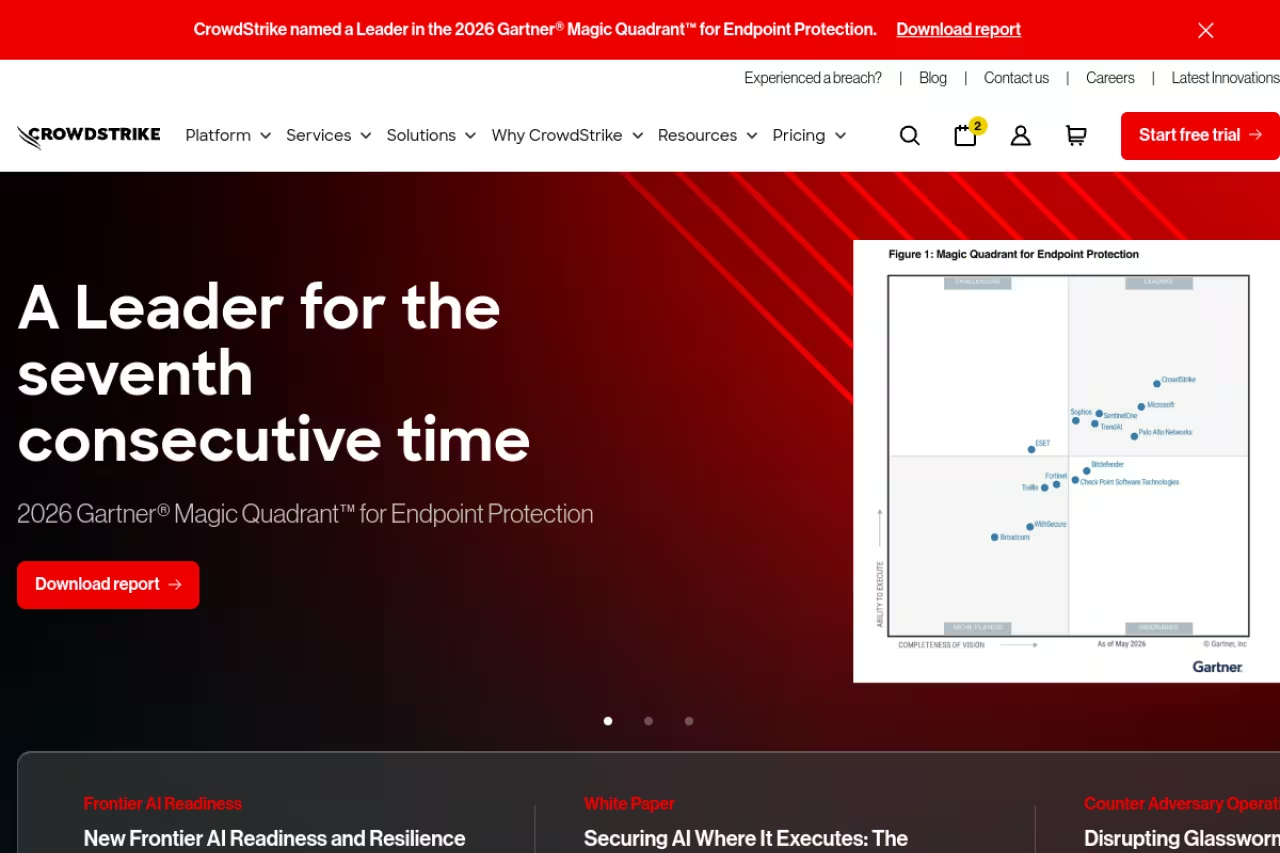
Who it's best for: companies that want endpoint protection as the center of gravity and have, or plan to build, a real SOC. CrowdStrike has held a Leader spot in Gartner's Magic Quadrant for Endpoint Protection Platforms for several years running, and in the MITRE ATT&CK Round 6 evaluation it posted around 98% technique detection, the top of the field.
The AI layer is Charlotte AI, an agentic assistant that triages alerts and answers threat-hunting questions in plain English instead of forcing you to write structured queries. Teams that adopted it report meaningfully faster triage per incident, which matters when your analysts are drowning.
Real pricing: the entry Falcon Go bundle is $59.99 per device per year (or $7.99/device monthly), capped at 100 devices, with next-gen antivirus, USB device control, and mobile protection. The serious tiers with full EDR and Charlotte AI run higher and are quote-based, landing most mid-market buyers in the $15-per-endpoint range annually.
The catch: the price climbs fast once you add modules, and the platform genuinely rewards a team that knows how to use it. Buy Falcon, leave it on defaults, and never tune it, and you've overpaid for an expensive antivirus.
The safe pick for a CISO who wants endpoint protection at the center and a real SOC behind it, backed by strong MITRE results. Prices climb fast with modules, and left on defaults it is an expensive antivirus.
Microsoft Defender XDR
If your company lives in Microsoft 365, Defender XDR is hard to argue against on pure economics. Defender for Endpoint is built into Windows itself, so there's no separate agent to push to modern machines, and it correlates signals across endpoints, identities, email, and cloud apps into a single incident view.
Who it's best for: the roughly 75% of large enterprises already standardized on Microsoft. You get endpoint EDR, advanced hunting, and XDR-level alert correlation without buying a third-party agent, and Defender XDR scored about 96% technique detection in MITRE Round 6, within three points of CrowdStrike.
The AI piece is Security Copilot, which does natural-language investigation and incident summaries. Pair it with Microsoft Sentinel for cloud SIEM and you have a full detection-and-response stack from one vendor.
Real pricing: Defender for Endpoint comes bundled in Microsoft 365 E5. Sentinel ingestion runs about $2.46 per GB pay-as-you-go, dropping to roughly $1.10 to $1.23 per GB on commitment tiers, and Defender XDR data flows in at zero ingestion cost. Security Copilot is billed by compute at $4 per Security Compute Unit hour, with E5 customers getting an SCU allotment included.
Where it falls short: Sentinel ingestion costs can balloon if you pipe in everything without filtering, and the Microsoft security portal sprawls across several consoles that don't always feel like one product. Non-Windows coverage works but isn't where the platform shines.
Hard to beat on economics if you already live in Microsoft 365, with EDR built into Windows and detection within three points of CrowdStrike in MITRE Round 6. Sentinel costs can balloon, the portal sprawls, and non-Windows coverage is weaker.

Darktrace
Darktrace took a different bet years ago: instead of matching known signatures, it builds a self-learning model of normal behavior for every user and device, then flags anything that breaks the pattern. Its ActiveAI Security Platform now spans network, email, cloud, identity, endpoint, and OT.
Who it's best for: teams whose biggest blind spot is the network and email layer, and who want autonomous response that can act before an analyst wakes up. The unsupervised learning approach is genuinely good at catching insider threats and slow-burn intrusions that signature tools sail right past.
The RESPOND module can take surgical action on its own, like throttling a specific connection, without shutting down the whole environment. That autonomy is the selling point.
Real pricing: Darktrace doesn't publish list prices. Independent market data puts the median deal around $55,200 per year, with mid-market deployments of 500 to 2,000 devices commonly landing between $150,000 and $500,000 in annual contract value, depending on which modules you license.
The catch: it's expensive, the pricing opacity makes budgeting hard, and the tuning period is real. Early on, Darktrace flags a lot of benign anomalies while it learns your environment, and small teams without someone to triage that noise can get fatigued before the model settles.
Choose it if the network and email layer is your blind spot and you want autonomous response that acts before an analyst wakes up. It is expensive, pricing is opaque, and early tuning produces benign alerts that can fatigue small teams.

SentinelOne Singularity
SentinelOne is the platform I'd point at if autonomous response and ransomware recovery top your list. Its Singularity agent runs detection and remediation locally on the endpoint, so it can act even when a device is offline, and its one-click ransomware rollback restores files to their pre-attack state.
Who it's best for: organizations that want machine-speed response without a fully staffed SOC, and anyone who has been burned by ransomware. SentinelOne scored about 96% technique detection in MITRE Round 6, statistically tied with the leaders.
Its AI assistant, Purple AI, handles natural-language threat hunting and is included from the Complete tier up, with an autonomous Agentic SOC Analyst gated to the Enterprise tier. The company reported Purple AI hitting a 40% attach rate, which tells you adoption is real and not shelfware.
Real pricing: tiers run from Singularity Core at $69.99 per endpoint per year up to around $229.99 for the top bundles, with Singularity Complete (where Purple AI lives) at roughly $159.99 per endpoint annually.
Where it falls short: the best AI features sit behind the higher tiers, so the headline $69.99 price isn't what you'll actually pay for the autonomous capabilities. Some teams also find the console less polished than CrowdStrike's once you get into advanced hunting.
The one to look at if autonomous response and ransomware recovery top your list, with one-click rollback and no need for a fully staffed SOC. The best AI features sit behind higher tiers, so the headline $69.99 is not what you will pay.

Vectra AI
Vectra AI solves a problem the endpoint and CNAPP crowd mostly ignores: identity-based attacks. Stolen credentials and privilege abuse don't trip endpoint alarms, because nothing is technically "malware." Vectra's Attack Signal Intelligence watches behavior across network, cloud, SaaS, and identity to spot an attacker using legitimate access.
Who it's best for: SOC teams buried in alerts who need higher signal, and security leaders worried about post-breach lateral movement rather than the initial infection. Vectra was named a Leader in the 2026 Gartner Magic Quadrant for Network Detection and Response, and its whole pitch is triaging the noise down to the handful of detections that actually matter.
A strong complement for SOC teams buried in alerts and worried about stolen credentials and lateral movement after a breach. It is not a complete stack, needs separate endpoint protection, and has no public pricing.
Real pricing: Vectra doesn't publish public pricing, so you'll need a quote. Expect enterprise-tier figures scaled to monitored IPs and cloud footprint.
The catch: it's a complement, not a complete stack. You still need endpoint protection elsewhere, and the no-public-pricing model means more sales cycles before you can even compare. It's overkill for a small company without an identity-attack threat model.
Wazuh
Wazuh is the answer when the budget is "as close to zero as possible" and you have the engineering hours to run your own stack. It's a genuinely capable open-source SIEM and XDR platform that does file integrity monitoring, vulnerability detection, configuration assessment, and behavioral anomaly analysis.
Who it's best for: startups, lean IT teams, and anyone who'd rather trade money for control. Reviewers regularly peg Wazuh at delivering most of the core SIEM functionality you'd pay Splunk heavily for, plus native XDR features at no license cost. It won two 2026 Cybersecurity Stars Awards, for SIEM and cloud security.
The behavioral analysis layer flags deviations from normal patterns that may signal an intrusion, and the agent scans for malware, rootkits, and suspicious anomalies on each monitored host.
Real pricing: free. The code is on GitHub and there's no per-endpoint license. You pay only for the infrastructure you run it on and a paid support subscription if you want one.
Where it falls short: "free" means free as in puppy. You're responsible for deployment, tuning, scaling, and upkeep, and there's no agentic AI assistant doing your triage. For a team without security engineering depth, the time cost can exceed what a commercial license would have run.
The answer when budget is near zero and you have the engineering hours to run your own SIEM and XDR. Free means you own deployment, tuning and upkeep, and without security depth the time cost can exceed a commercial license.

Checkmarx
Checkmarx belongs on this list because not every threat lives on an endpoint or the network. A growing share of breaches start in your own code, and Checkmarx is an AI-powered application security platform that catches them before they ship.
Who it's best for: engineering-heavy companies shipping software, where the attack surface is your codebase and dependencies. It combines deep code analysis with ASPM-driven risk prioritization, so developers see the vulnerabilities that actually matter instead of a flat wall of findings.
The agentic AI assistants help developers and security teams act on risks in real time, inside the workflow where code gets written, rather than as a quarterly audit nobody reads.
Real pricing: quote-based, scaled to team size and codebase. There's no public list price, which is standard for enterprise AppSec.
The catch: it's narrow by design. Checkmarx secures the software you build, not the laptops and servers you run, so it's a complement to an endpoint or network tool rather than a substitute. Pair it with one of the platforms above for full coverage.
Pick it if your attack surface is your own codebase and dependencies, with risk prioritization so developers see what matters. It is narrow by design and secures the software you build, so pair it with an endpoint or network tool.
How to choose
Detection accuracy at the top has converged to within a few percentage points, so don't pick on benchmark numbers alone. Pick on fit.
Start with your stack. If you're a Microsoft 365 E5 shop, Defender XDR is already half-paid-for, and walking away from that economics rarely makes sense. If you're heterogeneous or want the strongest standalone endpoint product, CrowdStrike Falcon is the default.
Then ask what you're actually worried about. Endpoint compromise points you to CrowdStrike or SentinelOne. Network and email anomalies point to Darktrace. Identity and credential abuse points to Vectra. Code-level risk points to Checkmarx. Most mature programs end up running two: a primary endpoint or XDR platform plus a specialized layer for their biggest blind spot.
Finally, be honest about your team. Autonomous response (SentinelOne, Darktrace) earns its keep when you don't have analysts watching 24/7. A platform that rewards tuning (CrowdStrike) needs people who'll tune it. And a free tool (Wazuh) is only free if you have the engineering hours to run it.
If you want to keep up with how these tools and the threats they chase keep shifting, Dupple X tracks the AI security space alongside the rest of the stack our readers actually use. You can also browse our top AI tools directory or related guides like the best AI agents and the best AI tools for developers.
FAQ
What are the best AI threat detection tools in 2026?
For most companies, CrowdStrike Falcon is the strongest all-around choice, with around 98% MITRE technique detection and agentic triage via Charlotte AI. Microsoft Defender XDR is the best value for Microsoft 365 shops, Darktrace leads on self-learning network and email anomaly detection, and Wazuh is the best free, open-source option. SentinelOne and Vectra AI are excellent for autonomous response and identity-attack detection respectively.
How much do AI threat detection tools cost?
Pricing varies widely. CrowdStrike Falcon starts at $59.99 per device per year and climbs with modules. SentinelOne runs from about $69.99 per endpoint per year. Microsoft Sentinel charges roughly $2.46 per GB ingested. Darktrace and Vectra AI use custom quotes, with Darktrace deals averaging around $55,000 per year. Wazuh is free to license, costing only infrastructure and optional support.
Is AI better than signature-based threat detection?
For novel and behavior-based threats, yes. Signature detection only catches malware it has already cataloged, so it misses zero-day attacks and AI-generated variants. Behavioral AI flags deviations from normal patterns even when the specific threat has never been seen before. In practice the best platforms combine both: signatures for known threats and AI for the unknown.
Can small businesses use AI threat detection tools?
Yes. CrowdStrike Falcon Go is built for small businesses at $59.99 per device per year for up to 100 devices, and Microsoft Defender is included with many Microsoft 365 plans. Wazuh is free if you have the technical capacity to self-host it. The bigger platforms like Darktrace and Vectra are priced and tuned for enterprise budgets and teams.
Do I need a security team to run these tools?
It depends on the tool. Autonomous platforms like SentinelOne and Darktrace can detect and respond with minimal hands-on management, which suits teams without a 24/7 SOC. CrowdStrike rewards active tuning by skilled analysts, and Wazuh requires engineering hours to deploy and maintain. Match the tool's operating model to the staff you actually have.
What is the difference between EDR, XDR, and NDR?
EDR (endpoint detection and response) watches laptops, servers, and devices. NDR (network detection and response) watches traffic between them for anomalies. XDR (extended detection and response) correlates signals across endpoints, network, identity, email, and cloud into unified incidents. CrowdStrike and SentinelOne are endpoint-first XDR, Darktrace and Vectra lead on NDR, and Microsoft Defender XDR spans the full set for Microsoft environments.
Related guides
Some offers on this page may be paid placements or contain affiliate links.
