
The Best HRIS for Small Business in 2026 (Compared and Ranked)

Key facts8 tools compared: Gusto, BambooHR, Rippling, Deel, Factorial, Justworks, Paychex Flex, HiBob
- 8 tools compared: Gusto, BambooHR, Rippling, Deel, Factorial, Justworks, Paychex Flex, HiBob
- Gusto (best for: US payroll + HR in one): $49/mo + $6/employee
- BambooHR (best for: Employee experience & people data): ~$250/mo flat (≤25 staff)
- Rippling (best for: Fast-growing, HR + IT): $8/employee + ~$35 base
- Deel (best for: Global teams & contractors): Free HRIS up to 200
Most HRIS buying guides read like they were written by someone who has never had to run payroll on a Friday afternoon while an employee asks why their PTO balance is wrong. I have. I have also spent the last few months poking at the major platforms, reading their pricing fine print, and talking to founders who actually live in these tools every day.
Here is the tension: a small team does not need an enterprise HR suite, but it does need something better than a spreadsheet and a shared Google Drive folder. The trap is that "HRIS" now means everything from a free org-chart tool to a full payroll-plus-benefits-plus-IT platform that costs more than your office rent. Picking wrong means either paying for features you will never touch or outgrowing your tool in eight months.
If you want the short version: for most US small businesses that need payroll and HR in one place, Gusto is the pick. It is honest about pricing, easy to run, and built for teams under 50. If your priority is the employee experience and clean people data over payroll, BambooHR is the better buy. And if you are global or hiring contractors abroad, Deel gives you a genuinely free HRIS up to 200 people. The rest of this guide is who each tool is actually for, what it really costs, and where it falls short.
Quick comparison
| Tool | Best for | Price (starting) | Standout |
|---|---|---|---|
| Gusto | US payroll + HR in one | $49/mo + $6/employee | Transparent, easy payroll |
| BambooHR | Employee experience & people data | ~$250/mo flat (≤25 staff) | Onboarding and reporting |
| Rippling | Fast-growing, HR + IT | $8/employee + ~$35 base | Automation across HR and IT |
| Deel | Global teams & contractors | Free HRIS up to 200 | Free core HR, global reach |
| Factorial | Lean teams wanting low cost | ~$8/user/mo | Affordable all-in-one |
| Justworks | Outsourced HR via PEO | $50/mo + $8/employee (payroll) | PEO benefits buying power |
| Paychex Flex | Payroll-first micro teams | $39/mo + $5/employee | Tax filing & support network |
| HiBob | Culture-led teams of 25-200 | ~$8-12/employee/mo | Modern UX, engagement tools |
Gusto: the default for US small businesses
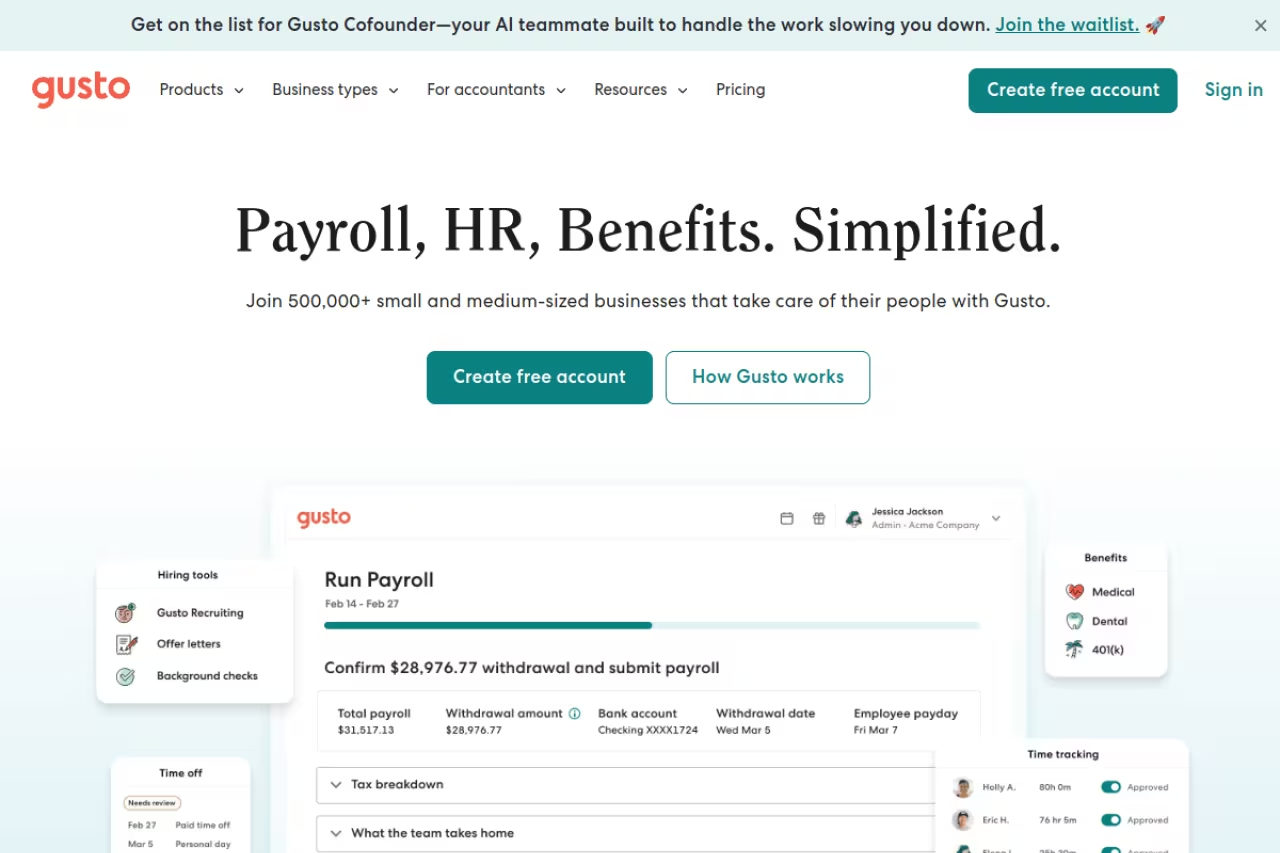
Gusto started as payroll software and grew into a full HRIS, which is exactly the right order for a small business. You run payroll first, then add hiring, onboarding, time tracking, and benefits as you grow. The interface is the friendliest of this bunch. Running payroll genuinely takes a few clicks, and tax filing happens automatically across all 50 states.
Who it is best for: US-based teams of 2 to 50 people who want payroll and HR under one login without hiring an HR person to manage it.
The default for US-based teams of 2 to 50 who want payroll and HR under one login without an HR hire. Public pricing and easy onboarding help, but it is US-only and the cheapest Simple plan lacks time tracking.
Pricing is refreshingly public. The Simple plan is $49/month plus $6 per employee, Plus is $80/month plus $12 per person (adds time tracking, PTO, and next-day deposit), and Premium is $180/month plus $22 per person. Gusto raised the Simple base from $40 to $49 in March 2026, so older guides quoting $40 are stale.
The standout is how little it asks of you. Onboarding sends offer letters, collects I-9 and W-4 forms, and sets up direct deposit before someone's first day, with almost no admin work on your end. Gusto also ranked as a Leader on G2's Spring 2026 Small-Business grids for core HR and payroll.
The catch: Gusto is US-only. If you hire anyone outside the United States, it does nothing for you, and you will need a second system. The cheapest Simple plan also lacks time tracking, which pushes most teams that need it up to Plus at $12 per head.
BambooHR: built around the employee, not the paycheck
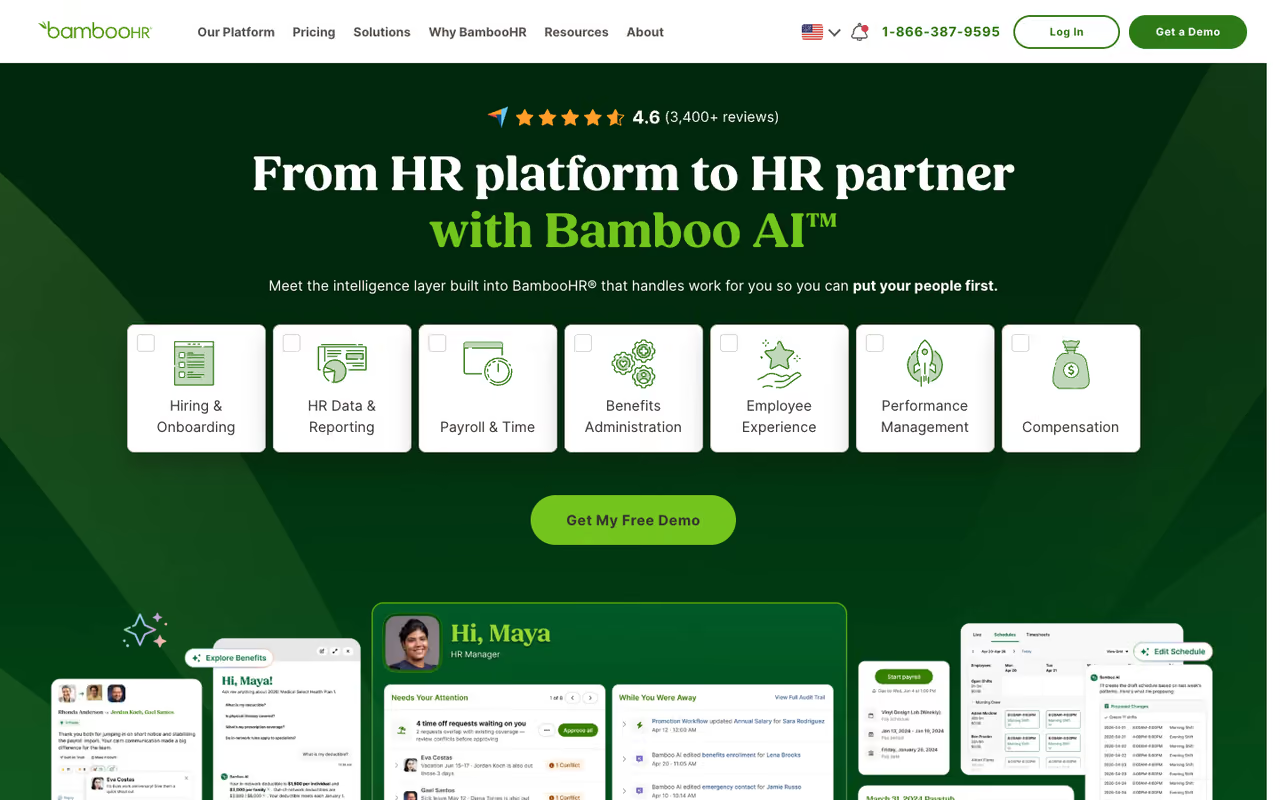
If Gusto is payroll-first, BambooHR is people-first. It is the system you choose when you care most about onboarding, employee records, performance reviews, and reporting, and you treat payroll as a module you bolt on. For teams in the 25 to 200 range, it is the closest thing to a default that the HR world has.
Who it is best for: small to mid-size companies that want a polished employee experience, clean org data, and strong reporting more than they want the cheapest payroll.
Pick BambooHR if you care about the employee experience, onboarding and reporting more than the cheapest payroll. Payroll and benefits are paid add-ons, and the flat minimum means a 10-person team effectively pays $25 per head.
Pricing here is less transparent and you have to request a quote. Published third-party figures put it at roughly $10 per employee/month for Core and $17 for Pro once you are over 25 employees. Below that, BambooHR charges a flat monthly minimum that starts around $250/month, which is the part small teams need to watch.
The standout is the day-to-day polish. Onboarding workflows, e-signatures, an employee self-service portal, and customizable reports all feel built for humans rather than accountants. The mobile app is one of the better ones in this category.
Where it falls short: payroll and benefits are paid add-ons, not included, so your real bill climbs fast once you stack them. And that flat minimum means a 10-person team effectively pays $25 per head, which is steep next to Gusto or Factorial.

Rippling: the power tool that grows with you
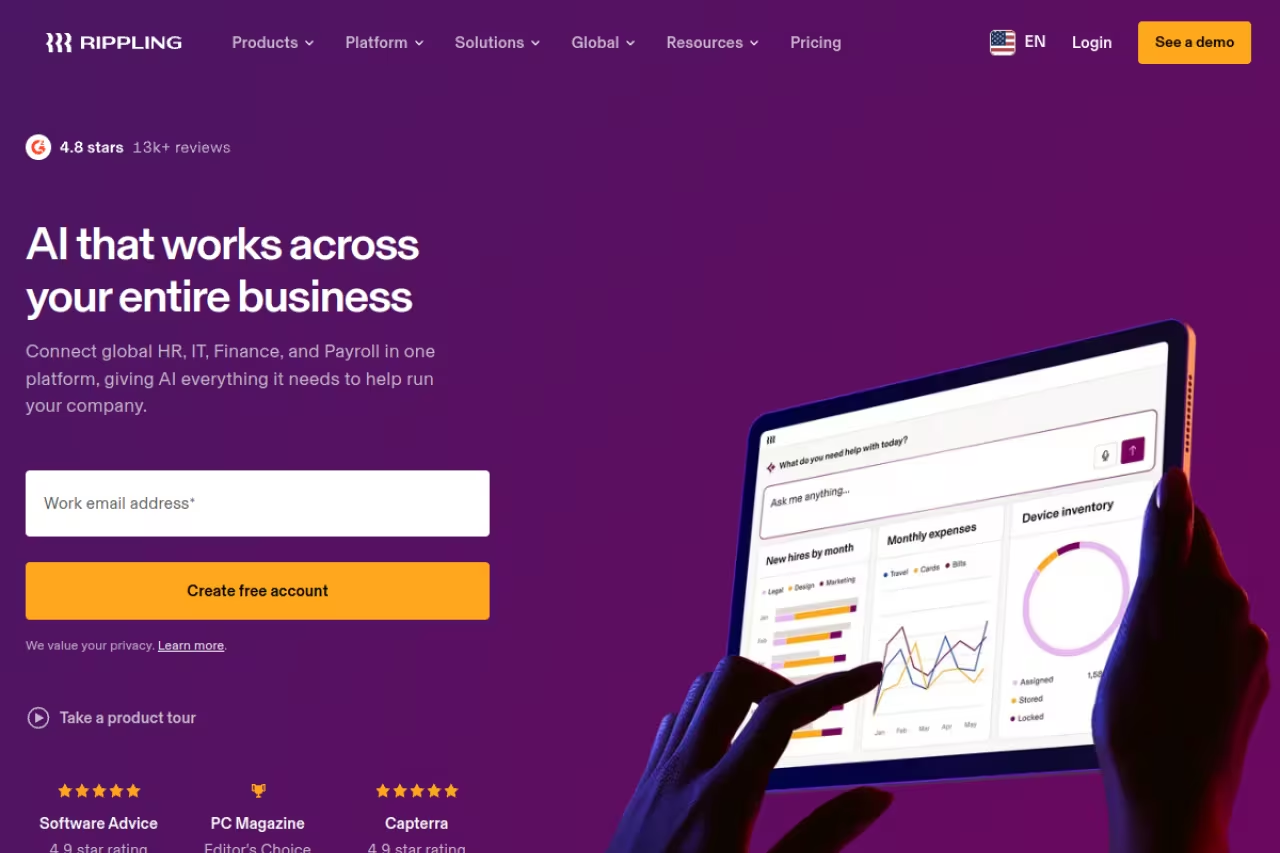
Rippling is what you graduate to when "HR software" stops being enough and you want HR, payroll, benefits, and IT (device management, app provisioning, single sign-on) running off one source of truth. Onboard a new hire and Rippling can order their laptop, create their accounts, enroll them in benefits, and add them to payroll from a single workflow. For a fast-growing team, that is real time saved.
Who it is best for: teams scaling past 20 to 25 people, especially remote-first ones, that are tired of stitching together HR and IT tools.
The power tool for teams scaling past 20 to 25 people that want HR, payroll, benefits and IT off one source of truth. It is overkill for a 5-person team, and its pricing is the least predictable in this guide.
Pricing starts at $8 per employee/month for the base Unity platform plus a roughly $35 to $40 monthly fee, but that number is misleading. Modules are priced separately and quote-based, so most teams land at $15 to $25 per employee once they add payroll and benefits, and the full stack runs closer to $35.
The standout is automation depth. The trigger-and-action workflows across HR and IT are genuinely ahead of everyone else here, and the platform scales without you migrating off it.
The catch: it is overkill for a 5-person team, and the pricing is the least predictable in this guide. Module prices are not published, every contract is custom, and onboarding the platform takes real setup time. Small teams that only need payroll will pay for complexity they do not use.
If figuring out which of these actually fits your stack feels like a part-time job, that is the kind of decision our team writes about constantly. Dupple X breaks down tools like these for operators every week.

Deel: free HRIS that happens to be global
Deel built its name on global contractor payments and employer-of-record hiring, but the part that matters for this list is Deel HR, which is free for up to 200 employees. That is not a stripped trial. It includes employee records, PTO tracking, org charts, document management, and onboarding and offboarding workflows.
Who it is best for: companies with any international footprint, or US teams that want a free, capable core HRIS and plan to add payroll or contractor management later.
A free HRIS for up to 200 employees with global compliance baked in, ideal for any company with an international footprint. Purely domestic US businesses may find its payroll less proven than Gusto's, and the free tier funnels you toward paid services.
Pricing: the HRIS core is free up to 200 people, then $5 per employee/month beyond that. Contractor management starts around $49 per contractor/month, and full employer-of-record hiring runs about $599 per employee/month, which is where Deel makes its money.
The standout is obvious: a real, free HRIS with global compliance baked in. If you hire a developer in Portugal and a designer in Brazil, Deel handles the paperwork that would otherwise require a lawyer.
Where it falls short: if you are a purely domestic US business that just needs payroll, Deel's US payroll is newer and less proven than Gusto's, and the free HR tier is a funnel toward its paid global services. You are adopting a global platform whether or not you need one yet.

Factorial: the budget all-in-one
Factorial is a Barcelona-built platform that hit $100M ARR in 2025 and serves 15,000-plus companies. It packs core HR, time tracking, time off, document management, and basic payroll tools into one affordable place, and it leans clearly toward smaller organizations.
Who it is best for: cost-conscious small teams, including those in Europe, that want a single tidy system and do not need deep US payroll-tax automation.
The budget all-in-one for cost-conscious small teams, including in Europe, with more breadth than most tools at this price. US payroll-tax handling is not its strength, so a US-only team that lives by compliance should look elsewhere.
Pricing starts around $8 per user/month, structured as a Core HR base plus optional Time and Talent hubs, with a free trial. For the money you get more breadth than most tools at this price, and the interface is clean.
The catch: US payroll-tax handling is not its strength the way it is for Gusto or Paychex, and some advanced features sit behind the higher hubs. For a US-only team that lives by payroll compliance, it is a weaker fit.

Justworks: hand your HR headaches to a PEO
Justworks is a professional employer organization, which means it co-employs your team so you can access big-company benefits, handle compliance, and get HR support without building the function in-house. For a small business that wants to offer strong health insurance without the brokerage runaround, that pooled buying power is the whole point.
Who it is best for: small businesses that want premium benefits and outsourced compliance, and are fine paying a per-employee premium for it.
Choose Justworks if you want premium benefits and outsourced compliance and accept a per-employee premium. It is the most expensive way to do HR per head, and co-employment means giving up some control.
Pricing: standalone Justworks Payroll is $50/month plus $8 per employee. The PEO plans cost more: PEO Basic around $79 per employee/month and PEO Plus around $109, with rates dropping for larger headcounts. Benefits premiums, workers' comp, and EPLI are billed on top.
The standout is access to enterprise-grade health, dental, and 401(k) plans that a 10-person company could never negotiate alone, plus real human HR support.
Where it falls short: the PEO model is the most expensive way to do HR per head, and co-employment is not for everyone. You give up some control, and if you leave, you have to re-source all those benefits yourself.

Paychex Flex: payroll-first with a deep support bench
Paychex Flex is the established payroll giant's answer for small teams. It is less slick than Gusto, but it pairs solid payroll and tax filing with a large network of HR professionals you can phone, which matters if compliance keeps you up at night.
Who it is best for: micro and small teams that want dependable payroll, automatic tax filing, and human support over a polished modern interface.
A dependable payroll engine for micro and small teams that value phone support and decades of tax experience over a polished interface. The interface feels dated next to Gusto, and pricing gets opaque above Essentials.
Pricing: the Essentials plan runs about $39/month plus $5 per employee, aimed at businesses under 20 people. Higher tiers add HR features but move to custom quotes. The real draw is the support network and Paychex's decades of payroll-tax experience.
The catch: the interface feels dated next to Gusto, pricing gets opaque above Essentials, and you may hit per-payroll-run fees on some configurations. It is a payroll engine with HR attached, not an HR platform with payroll.
HiBob: modern HR for culture-led teams
HiBob (the product is called Bob) is the engagement-forward option, built for growing companies that treat culture as a product. Think club-style homepages, kudos, surveys, and clean people analytics. It is more HR-platform than payroll-engine, and it shines once you cross 25 people.
Who it is best for: companies of roughly 25 to 200 that want a modern, employee-facing experience and strong engagement tooling. Bob is one of the best-looking HR tools in the category, and the engagement features feel native rather than bolted on.
Modern, engagement-forward HR for culture-led companies of roughly 25 to 200, with kudos, surveys and clean analytics. Payroll is not its core, and there is an effective headcount minimum, so skip it for micro teams.
Pricing is quote-based, with published estimates around $8 to $12 per employee/month for smaller teams. Worth flagging: HiBob has reportedly closed accounts that fell below a 25-to-50 employee minimum, so it is not really aimed at micro teams.
Where it falls short: there is an effective headcount minimum, payroll is not its core, and the per-seat model is poor value under 25 people. Below that threshold, you are better off elsewhere.
How to choose
Skip the feature checklists. Three questions get you most of the way:
First, do you hire outside the US? If yes, your shortlist is Deel (free core, global) or Rippling (global stack). Most domestic-only tools simply cannot run foreign payroll, and bolting on a second system later is painful.
Second, is payroll the job or is people data the job? If payroll is the daily pain, start with Gusto or Paychex. If onboarding, records, reviews, and reporting matter more, start with BambooHR or HiBob and add payroll as a module.
Third, how big are you, and how fast are you growing? Under 25 people on a budget, Factorial and Gusto give the best value. Scaling past 25 and tired of duct-taping tools together, Rippling pays off. Want to outsource HR entirely for premium benefits, choose a PEO like Justworks.
One practical tip: run your real numbers. A "$6 per employee" tool with a $250 monthly minimum costs a 10-person team $25 a head. Always multiply by your actual headcount before you fall for the per-employee sticker price.
FAQ
What is the best HRIS for a small business in 2026?
For most US small businesses, Gusto is the best overall HRIS because it combines easy payroll, automatic tax filing, and HR features at transparent pricing starting at $49/month plus $6 per employee. If you care more about the employee experience and people data than payroll, BambooHR is the stronger pick, and if you hire internationally, Deel's free HRIS is the better starting point.
How much does HRIS software cost for a small business?
Expect $6 to $25 per employee per month for most small-business HRIS tools, plus a base or minimum fee. Gusto starts at $49/month plus $6 per employee, BambooHR carries a flat minimum near $250/month for teams under 25, and Rippling starts around $8 per employee plus a $35 base before modules. Watch for monthly minimums, which can double your effective per-head cost on small teams.
Is there a free HRIS for small businesses?
Yes. Deel HR is free for up to 200 employees and includes employee records, PTO tracking, org charts, and onboarding workflows, which is unusually generous for a free tier. Most other vendors offer only free trials rather than a permanently free plan, so Deel is the main option if a $0 core HRIS is a hard requirement.
What is the difference between an HRIS and a PEO?
An HRIS like Gusto or BambooHR is software you run yourself to manage payroll, records, and HR tasks while remaining the sole employer. A PEO like Justworks co-employs your staff, so it handles compliance and gives you access to pooled benefits, but at a higher per-employee cost and with less control. Choose an HRIS for software and savings, a PEO for outsourced HR and enterprise-grade benefits.
Which HRIS is best for a remote or global team?
Deel and Rippling lead for distributed teams. Deel is built for global hiring and contractor payments with compliance handled in each country, and its core HRIS is free up to 200 people. Rippling suits fast-growing remote companies that also want unified IT and device management alongside HR and payroll. Domestic-only tools like Gusto and Paychex cannot run payroll outside the US.
When should a small business move off spreadsheets to an HRIS?
Most teams should switch around 5 to 10 employees, when tracking PTO, onboarding paperwork, and payroll by hand starts causing real errors. The earlier signal is compliance risk: once you are filing payroll taxes, storing I-9s, and managing benefits enrollment, a proper HRIS pays for itself by preventing mistakes that cost far more than the monthly fee.
Want more honest, tested breakdowns of the tools founders and operators actually use? Dupple X sends them to your inbox, and our top tools roundup is a good place to keep going. If AI is creeping into your hiring and ops stack, our guide to the best AI agents covers what is worth your time.
Related guides
Some offers on this page may be paid placements or contain affiliate links.
