
Best Free AI Research Assistants in 2026

Key factsFree AI research tools compared: literature search vs web search
- Consensus and Elicit search peer-reviewed literature, while Perplexity and NotebookLM search the web or uploaded documents.
- Consensus holds a 4.8 rating across 1,869 reviews, versus Elicit's 4.8 rating based on just 2 reviews.
- Perplexity has a 4.3 rating across 361 reviews and costs $20/month for its Pro tier, checked in 2026.
- Consensus costs $9.99/month for Premium and Elicit costs $11/month billed annually for Plus, both with free tiers.
- NotebookLM and STORM are free tools with no aggregated rating; NotebookLM answers only from uploaded documents.
There are two entirely different products hiding under the phrase "AI research assistant", and choosing the wrong one wastes a week.
The first searches the published scientific literature: peer-reviewed papers, with citations you can follow to a DOI. Consensus and Elicit do this. The second searches the open web, or the documents you upload, and synthesises what it finds. Perplexity and NotebookLM do this.
Both are useful. Only the first can answer "what does the evidence say", and only the second can answer "what is going on with this topic right now". Neither substitutes for the other, and most comparison articles list them in one table as though they compete.
A rating that belongs to someone else
Before the tables, the same warning we had to give in our GraphQL guide.
Stanford's STORM is a well-regarded free research tool that generates Wikipedia-style articles with citations. Search a software directory for "STORM" and you will find a 4.6 rating across 14 reviews attached to a company at storm.com, which is not Stanford's project at all.
We are not publishing that number, and we are telling you it exists because it is exactly the kind of figure that ends up in a comparison table looking authoritative. STORM has no aggregated rating. It is still worth using, and it is free, and the reason to use it is what it produces rather than what a directory says about a different company with the same name.
The ratings
Aggregated by Toolradar across G2, Capterra and other platforms.
| Tool | Aggregated rating | Reviews |
|---|---|---|
| Consensus | 4.8 | 1,869 |
| Elicit | 4.8 | 2 |
| Perplexity | 4.3 | 361 |
NotebookLM and STORM carry no aggregated rating.
Those first two rows are the clearest illustration we have of why review counts belong next to every score. Consensus and Elicit both show 4.8. One of them is built on 1,869 reviews and the other on 2. Ranked by score they are tied. Ranked by evidence they are not in the same conversation.
Consensus's 4.8 across 1,869 is, in fact, one of the strongest results in any category we cover: a high score on a genuinely large sample, which usually do not go together.
The prices, verified
Checked against Toolradar's pricing records between 15 and 23 August 2026.
| Tool | Free tier | First paid tier | Price checked |
|---|---|---|---|
| NotebookLM | Free | n/a | 16 Aug 2026 |
| STORM | Free | n/a | n/a |
| Consensus | Free, $0 | Premium, $9.99/month | 23 Aug 2026 |
| Elicit | Basic, $0 | Plus, $11/month (billed annually) | 24 Sep 2026 |
| Perplexity | Free | Pro, $20/month | not in directory record |
The whole paid column tops out at $20. This is the cheapest category we have written about, and the two literature tools land within about a dollar of each other at roughly $10.
Consensus
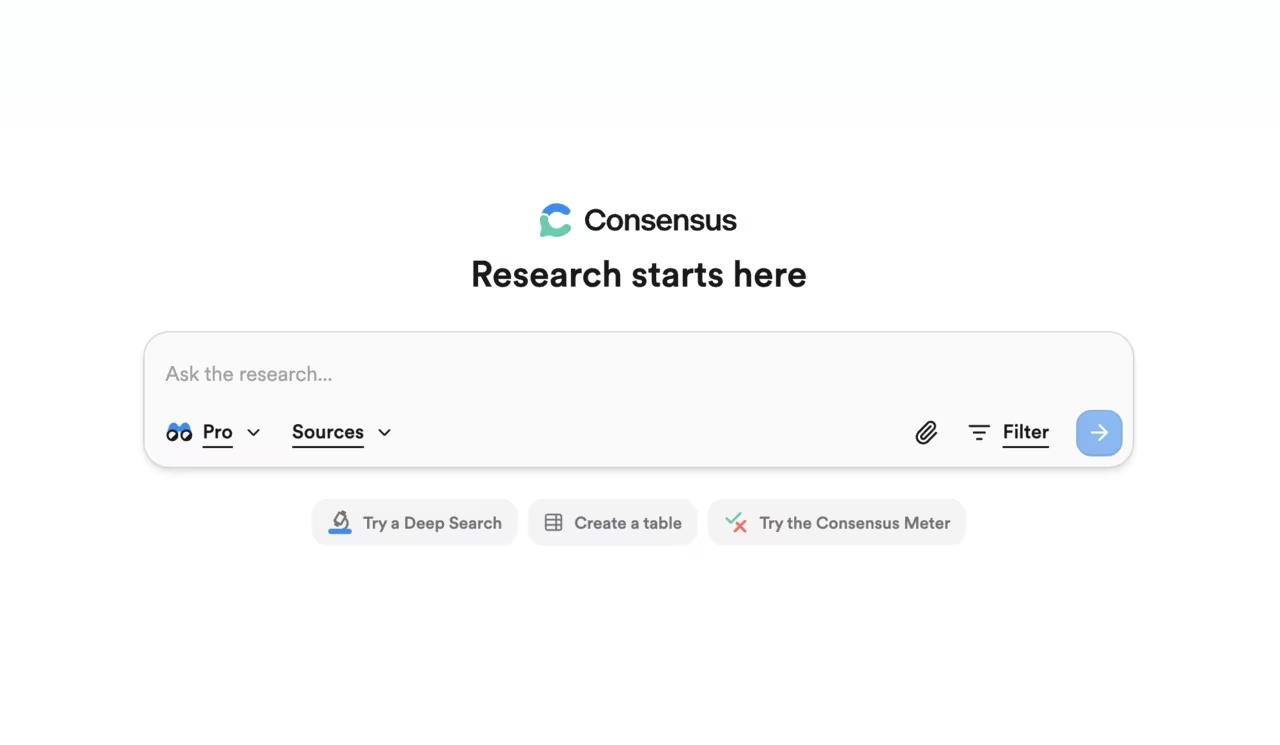
Consensus searches peer-reviewed papers and answers a question with what the studies actually found, each claim linked to the paper it came from.
Its defining feature is the consensus meter: ask a yes-or-no research question and it shows you the proportion of studies that support, oppose or are unclear on it. That is a genuinely different output from a summary, because it surfaces disagreement instead of averaging it away.
Free tier available, Premium at $9.99 a month, checked 23 August 2026.
The 4.8 across 1,869 reviews is the best-evidenced score in this article by an enormous margin, and it is why Consensus is the first thing to try if your question has a literature behind it.
The limitation to understand: it can only tell you about published work. For anything recent, commercial or unstudied, it will find nothing and that absence is not evidence.
The first thing to try when your question has a published literature, since its consensus meter shows how many studies support, oppose or are unclear on it. It cannot see recent or unstudied topics. Premium is $9.99 a month.

Elicit
Elicit works on the same corpus with a different interface. You give it a question and it builds a table: one row per paper, one column per attribute you care about, such as sample size, population, method and finding.
That table is the product. Extracting fifteen papers' methodology sections into a comparable grid is the tedious part of a literature review, and Elicit does it in minutes.
Basic is $0, Plus is $11 a month billed annually, as of September 2026.
Its 4.8 rests on two reviews. That is not a rating and we would rather say so than let it sit next to Consensus's number implying equivalence.
Pick Elicit for the tedious part of a literature review, turning fifteen papers into a grid of sample size, method and finding in minutes. Basic is $0 and Plus is $11 a month, but its 4.8 rests on only two reviews.
NotebookLM
NotebookLM inverts the problem. Instead of searching a corpus, you supply one: upload your PDFs, papers, notes and transcripts, and it answers questions using only those documents, citing the passage it drew from.
This is the right tool when you already have the sources and the work is understanding them. It will not tell you what the literature says. It will tell you what your forty documents say, and it will not invent things outside them, which is the property that makes it trustworthy for this job.
It is free, checked 16 August 2026, and carries no aggregated rating, which is what happens to a feature shipped inside a platform rather than sold.
The right tool when you already have the sources and need to understand them, answering only from your uploaded documents with cited passages. It is free, but it will not tell you what the wider literature says.

Perplexity
Perplexity searches the live web and answers with linked sources, which makes it the right first stop for anything current: a company, a product, a policy change, a technology that has no academic literature yet.
Free tier, Pro at $20 a month. Its 4.3 across 361 reviews is decent evidence of a decent product, and the score sits below the literature tools for a reason worth naming: the open web is a messier corpus, so the answers are more variable, and users notice.
Treat its citations as a starting point rather than a verification. A linked source proves the claim came from somewhere, not that the somewhere was right.
The first stop for anything current, such as a company, a policy change or a technology with no academic literature yet. Pro is $20 a month, but treat its citations as a starting point, since the open web is messier.
STORM
STORM, from Stanford, takes a topic and writes a structured, cited article about it by first researching from multiple perspectives, then outlining, then writing.
It is free and it is the best tool here for the specific job of getting oriented in an unfamiliar field quickly. What it produces reads like a decent encyclopaedia entry with references, which is exactly what you want before you know enough to ask a precise question.
No rating, for the reason explained at the top.
Use STORM to get oriented quickly in an unfamiliar field, since it researches from multiple perspectives and writes a cited, encyclopaedia-style article. It is free from Stanford, but it is for orientation, not precise questions.
How to actually use these
The sequence matters more than the tool.
Start with STORM or Perplexity to get oriented and learn the vocabulary of the field, because you cannot search a literature you cannot name.
Move to Consensus once you have a specific question, and pay attention to where the consensus meter shows disagreement rather than only to where it agrees.
Use Elicit when you have narrowed to a set of papers and need them compared systematically.
Finish in NotebookLM with the papers you actually chose, because that is where you will do the reading, and it is the only tool here that stays inside your sources.
The failure mode is skipping to the end. People upload five papers to NotebookLM and ask it what the evidence says, and it answers from five papers as though they were the field. They are not the field, they are the five you happened to find.
One thing no tool here does
None of these evaluates study quality. A screener returns matches; a research assistant returns citations. Neither knows that the paper it just cited has a sample of twelve, was never replicated, or was retracted.
Consensus surfaces disagreement, which is closer to this than anything else in the list, and it is still counting papers rather than weighing them. The judgment about whether a source deserves weight remains yours, and it is the part of research that has not been automated.
Related: free AI search engines, free AI tools and free note taking apps.
Some offers on this page may be paid placements or contain affiliate links.
Across our whole catalogue the median is $23.50 a month and 37% of tools advertise a free tier. Figures are the lowest recurring monthly price quoted in our own review of each tool, read on 2026-10-23. Full method and every category.
