
Best Construction Estimating Software in 2026: 8 Tools I'd Actually Bid With

Key facts8 tools compared: STACK, Togal.AI, Contractor Foreman, Kreo, PlanSwift, Forma (Autodesk)…
- 8 tools compared: STACK, Togal.AI, Contractor Foreman, Kreo, PlanSwift, Forma (Autodesk) Takeoff, Buildertrend, Procore
- STACK (best for: Cloud takeoff + estimating combo): From $2,599/user/yr
- Togal.AI (best for: AI auto-takeoff from drawings): $299/user/mo
- Contractor Foreman (best for: Small crews wanting all-in-one): From $49/mo
- Kreo (best for: Budget AI takeoff): From $35/user/mo
A blown estimate is the most expensive mistake in construction. Win the bid too low and you eat the loss. Pad it too high and the job goes to the contractor down the street. The spreadsheet that got you here stops scaling the moment you're juggling more than a couple of active bids a month.
So I spent weeks digging through the estimating tools that contractors actually use in 2026: cloud takeoff platforms, the new AI plan-readers that measure drawings for you, and the all-in-one systems that bundle estimating into project management. I checked real pricing, free trials, and where each one quietly falls apart.
The short version: if you want the most proven cloud takeoff and estimating combo, STACK is the safe pick. If you want AI to do the measuring, Togal.AI is the most accurate of the tools here. And if you're a small crew that wants estimating bundled with everything else for one flat price, Contractor Foreman is hard to beat. Here's the full breakdown so you can match a tool to how you actually bid.
Quick comparison
| Tool | Best for | Price | Standout |
|---|---|---|---|
| STACK | Cloud takeoff + estimating combo | From $2,599/user/yr | Proven, balanced takeoff and estimate engine |
| Togal.AI | AI auto-takeoff from drawings | $299/user/mo | Detects and measures plan elements automatically |
| Contractor Foreman | Small crews wanting all-in-one | From $49/mo | Estimating bundled with full PM suite |
| Kreo | Budget AI takeoff | From $35/user/mo | Cheapest entry into AI measurement |
| PlanSwift | Desktop power users | ~$1,749 one-time / ~$2k/yr | Drag-and-drop point-and-click takeoff |
| Forma (Autodesk) Takeoff | BIM and Revit shops | $1,250/user/yr | Ties into Autodesk Construction Cloud |
| Buildertrend | Residential builders/remodelers | $499-$1,099/mo | Estimating inside a client-facing build system |
| Procore | Large commercial GCs | Custom (from ~$4,500/yr) | Enterprise-grade preconstruction at scale |

STACK: the cloud takeoff and estimating workhorse
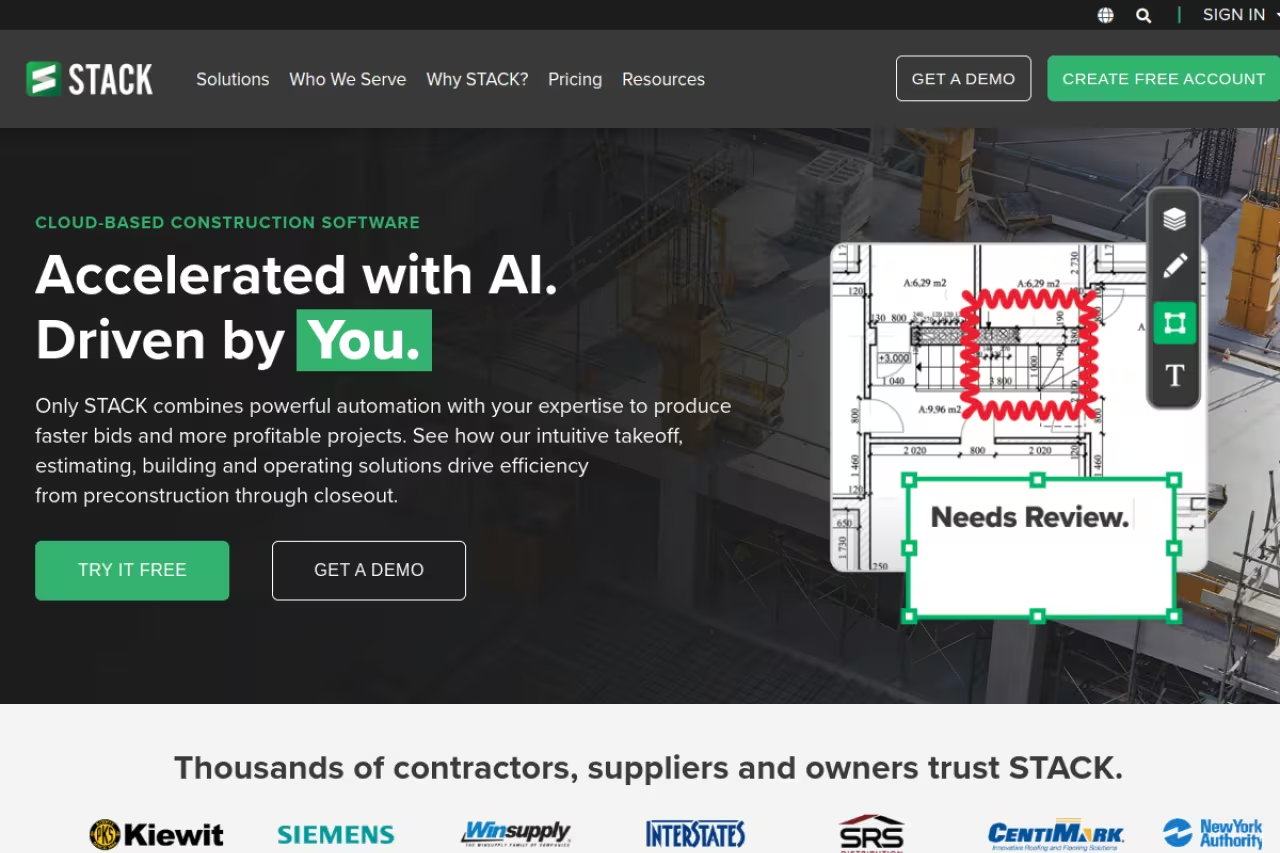
STACK is the tool I'd hand a new estimator and trust them not to drown. It does cloud-based takeoff and estimating in one place, so the measurements you pull off a plan feed straight into a priced bid without re-keying anything. Autocounts, area and volume measurement, and assembly-based pricing are all there.
Who it's for: General contractors and specialty trades who bid regularly and want one platform from measurement to proposal, without installing desktop software.
A trustworthy cloud pick for general contractors and trades who want takeoff and estimating in one flow, from measurement to bid. It is cloud-only, and at $2,599 a seat to start, a solo contractor with few bids will feel the price.
The Standard plan starts at $2,599 per user per year, and Premium (which adds AI features) runs $2,999 per user per year. Teams of three or more drop to about $2,199 per user, and there's a 7-day free trial to kick the tires before committing, per STACK's own pricing.
The standout: Balance. Plenty of tools are great at takeoff or great at estimating. STACK is genuinely strong at both, and the handoff between them is tight. You measure, the quantities populate your estimate, you adjust markups, and you export a bid.
The catch: It's cloud-only, so if you prefer desktop software or work in spots with patchy internet, it can frustrate. And at $2,599 a seat to start, a solo contractor doing a handful of bids a year will feel the price.
Togal.AI: let the AI do the takeoff

Togal.AI is the one that made me rethink how long a takeoff has to take. Instead of clicking around a plan for hours, you upload your drawings and its computer vision detects, measures, and labels the elements for you. The company claims up to 98% accuracy on its automated detection.
Who it's for: Estimators buried in takeoff volume who want to cut the grunt work, and teams comfortable trusting AI measurements they then verify.
Pick Togal.AI if you are buried in takeoff volume and comfortable verifying AI measurements, since it detects and labels elements for you. It is takeoff first, with lighter estimating than STACK, and messy plans produce bad detections.
The Growth plan is $299 per user per month billed yearly, with unlimited automated takeoffs, chat prompts, and image searches. A Business tier for teams of four-plus is custom-priced and adds onboarding, SSO, and a classification library, according to Togal's pricing page.
The standout: Speed on repetitive takeoffs. If you're measuring the same wall types, doors, and rooms across dozens of sheets, watching the AI tag them in seconds instead of hours is the moment the price justifies itself.
Where it falls short: It's a takeoff tool first. The estimating side is lighter than a full platform like STACK, so some shops use Togal for measurement and push the quantities elsewhere for pricing. You also still have to check the AI's work. Garbage or messy plans produce garbage detections.

Contractor Foreman: estimating bundled with everything else
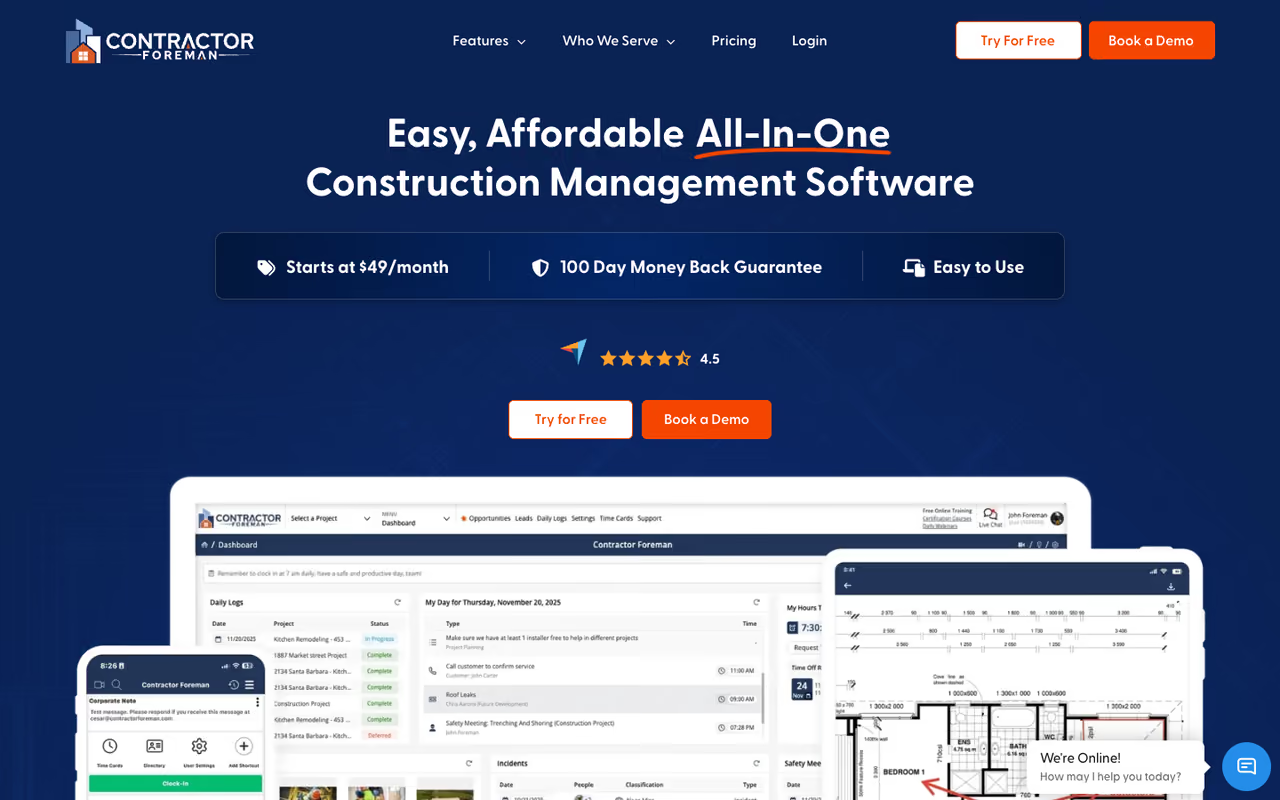
Contractor Foreman isn't a dedicated takeoff engine. It's an all-in-one platform where estimating sits alongside scheduling, time tracking, invoicing, change orders, and a client portal. For a small contractor, that bundling is the whole pitch: one login, one bill, instead of stitching five tools together.
Who it's for: Small to mid-size crews who want decent estimating without buying a separate $2,500 takeoff seat, and who'd happily run their whole back office in one place.
Strong value for small to mid-size crews who want estimating plus scheduling, invoicing, and a client portal under one login, from $49/month. It is a generalist, not an estimating specialist, so you may outgrow it.
This is where it wins. The Basic plan is $49/month for one user, Standard is $105/month for three users, and the Unlimited plan is $332/month for unlimited users, per Contractor Foreman's pricing. Every tier includes estimates, bid management, and invoicing, plus a 30-day free trial.
The standout: Value per dollar. A 30-person crew on the Unlimited plan pays about $332/month total. That's roughly $11 per user for estimating plus project management plus financials plus CRM. Nothing else on this list comes close on raw price.
The catch: The estimating and takeoff features are good enough, not best-in-class. If you do high-volume, detail-heavy commercial bidding, you'll outgrow it and want a specialist tool. It's a generalist that does estimating well, not an estimating specialist.
If you're already shopping for software to run a lean operation, it's worth a look at how the broader AI productivity tools ecosystem can cover the gaps a construction-specific tool leaves open, like proposals, email, and admin. And if you want a curated shortlist across categories, our top tools roundup is a faster starting point than another G2 rabbit hole.
Kreo: the cheapest way into AI takeoff
Kreo is the budget door into AI-assisted measurement. Like Togal, it reads PDF drawings, identifies scales, measures dimensions, and categorizes elements automatically. The difference is the entry price and a credit-based option that suits lighter or seasonal usage.
Who it's for: Quantity surveyors, estimators, and smaller contractors who want AI takeoff without a $299/month commitment.
The cheapest door into AI takeoff for quantity surveyors and smaller contractors, starting at $35 per user per month. The AI only arrives higher up (from $70), so the headline price is a bit of a tease.
The Lite plan starts at $35 per user per month billed annually (collaboration, comments, and markups, but no AI tools). AI capability kicks in higher up: Plus at $70/month, Pro at $175/month, with Enterprise custom-priced, according to Kreo's pricing.
The standout: Accessibility. At $35 to start and AI from $70, it's the lowest-friction way to test whether automated takeoff fits your workflow before betting real money on it.
The catch: You need the higher tiers to get the AI that's the actual draw, so the headline $35 is a bit of a tease. And as a younger platform, its template library and integrations aren't as deep as the incumbents.
PlanSwift: desktop takeoff for power users
PlanSwift, now part of Trimble, is the desktop veteran. Drag-and-drop, point-and-click takeoff across concrete, drywall, electrical, flooring, framing, and HVAC, with automated calculations that handle areas, lengths, volumes, and perimeters in a few clicks.
Who it's for: Estimators who prefer working locally on a Windows machine and want a fast, tactile takeoff interface without depending on the cloud.
A loyalist favorite for estimators who want fast, tactile manual takeoff on a local Windows machine. It is desktop-centric with no native collaboration, and pricing is ambiguous, so confirm the model with Trimble first.
Pricing references vary. PlanSwift has historically been sold as a roughly $1,749 one-time perpetual license, though some 2026 listings put it closer to a $2,000-per-user annual subscription. Confirm the current model with Trimble before buying, because it has been shifting.
The standout: The interface. People who've used PlanSwift for years are loyal to how quick and direct the manual takeoff feels. Nothing gets between you and the plan.
Where it falls short: It's desktop and Windows-centric in a market moving to the cloud. No native collaboration the way STACK or Togal offer, and the pricing ambiguity makes budgeting annoying.
Forma (Autodesk) Takeoff: built for BIM shops
Autodesk's takeoff product, which it has rebranded toward Forma Takeoff, is the pick if you already live in the Autodesk world. It plugs into Autodesk Construction Cloud and works with Revit models, so 2D and BIM takeoffs share one environment alongside bid management (BuildingConnected) and estimating (ProEst).
Who it's for: Contractors and preconstruction teams doing model-based estimating who already use Revit and Autodesk Construction Cloud.
The natural home for BIM shops on Revit and Autodesk Construction Cloud who need quantities from 3D models. Outside the Autodesk ecosystem the value drops fast, and a standalone tool gives more estimating muscle.
Around $1,250 per user per year billed annually, or roughly $155 per user per month monthly, per Construction Coverage's 2026 analysis. You can buy it standalone or bundle it with ProEst and the rest of the ACC preconstruction suite at a negotiated price.
The standout: BIM integration. If your estimates need to pull quantities from 3D models, not just flat PDFs, this is the natural home.
The catch: Outside the Autodesk ecosystem, the value drops fast. You're partly paying for the integration, so if you don't use Revit or ACC, a standalone tool gives you more estimating muscle for the money.

Buildertrend: estimating inside a residential build system
Buildertrend is project management software for residential builders and remodelers, with estimating built in. Scheduling, client communication, selections, budgets, and estimates all live in one client-facing system, which is the appeal for home builders who sell to homeowners.
Who it's for: Custom home builders and remodelers who want estimating tied to a polished client experience, not a standalone takeoff tool.
Suited to custom home builders and remodelers who want estimating tied to a polished homeowner portal. It is project management with estimating, not a powerhouse, and real costs often run above the advertised entry price.
Buildertrend advertises a flat monthly fee in the $499 to $1,099 range, though many users report real annual costs landing between $8,000 and $10,000 after the sales process and add-ons.
The standout: The homeowner-facing side. Estimates, selections, and approvals flow through a portal your clients actually see, which matters a lot in residential remodels where communication is half the job.
The catch: It's a project management platform with estimating, not an estimating powerhouse. The takeoff capabilities are thinner than a STACK or PlanSwift, and the real cost often runs well above the advertised entry price.

Procore: enterprise preconstruction at scale
Procore is the heavyweight. It dominates among large commercial general contractors, and its preconstruction and estimating tools are part of a much larger platform that runs entire project portfolios. Procore reports the kind of revenue retention that signals enterprise teams rarely leave once they're in.
Who it's for: Large GCs and commercial builders running many concurrent projects who need estimating as one piece of a company-wide system.
The heavyweight for large commercial GCs running many concurrent projects, with estimating as one piece of a company-wide system. It is overkill and over budget for small teams, and quotes are custom.
Procore doesn't publish prices. Quotes are custom, based on your annual construction volume, with reported figures starting around $4,500/year for small contractors and scaling to $25,000 and well beyond for mid-market and enterprise.
The standout: Scale and ecosystem. For a big contractor, the value isn't the estimating module alone, it's having preconstruction, project management, and financials under one roof across dozens of jobs.
The catch: Overkill and over-budget for small teams. If you're a three-person crew, Procore is a cannon for a nail you could've handled with Contractor Foreman at a fraction of the price.
How to choose
Match the tool to how you bid, not to the longest feature list.
- Pick by your core job. If estimating is the job, get a specialist: STACK, Togal, Kreo, or PlanSwift. If estimating is one task inside running a business, get a platform: Contractor Foreman for small crews, Buildertrend for residential, Procore for enterprise.
- Decide if you want AI to measure. If takeoff volume is your bottleneck, Togal.AI (premium) or Kreo (budget) earn their keep by reading plans for you. If you trust your own clicks and like control, STACK or PlanSwift.
- Be honest about size. A solo or small contractor shouldn't pay $2,599 a seat. Start with Contractor Foreman or Kreo. A 50-person commercial GC shouldn't run on a residential tool. That's where Procore or the Autodesk stack fit.
- Use the free trials. STACK offers 7 days, Contractor Foreman offers 30. Run a real bid through each finalist before you commit. The tool that feels fast on your actual plans is the right one, regardless of the spec sheet.
If you're building out a broader software stack beyond estimating, our guides to the best AI tools for business and the latest best AI agents cover the automation layer that sits on top of tools like these.
Want a faster way to keep up with which tools are actually worth your time? Dupple X tracks the best new software and AI tools so you don't have to read fifteen review sites to make one decision.
FAQ
What is the best construction estimating software in 2026?
For most contractors, STACK is the most balanced pick because it combines cloud takeoff and estimating in one proven platform. If you want AI to handle measurement, Togal.AI is the most accurate of the tools here. For small crews on a budget, Contractor Foreman bundles estimating into a full project management suite from $49/month.
How much does construction estimating software cost?
It ranges widely. Budget all-in-one tools like Contractor Foreman start at $49/month, AI takeoff tools like Kreo start at $35/user/month, and dedicated cloud platforms like STACK start at $2,599/user/year. Enterprise systems like Procore are custom-quoted and can run from roughly $4,500/year into the tens of thousands.
Is there free construction estimating software?
Most serious tools offer free trials (STACK 7 days, Contractor Foreman 30 days) rather than permanent free plans. Spreadsheet templates are the only truly free option, but they break down once you're managing multiple active bids and don't handle digital takeoff.
Can AI do construction takeoffs accurately?
Yes, with verification. Tools like Togal.AI and Kreo use computer vision to detect and measure elements on drawings, with Togal claiming up to 98% accuracy on clean plans. The AI is fast on repetitive work, but you still need to review its output. Messy or low-quality drawings produce weaker detections.
What's the difference between takeoff and estimating software?
Takeoff is measuring quantities off the plans (square footage, linear footage, counts). Estimating turns those quantities into a priced bid using costs, labor, and markups. Some tools focus on one (PlanSwift and Togal lean takeoff), while platforms like STACK do both in a connected workflow.
Which estimating software is best for small contractors?
Contractor Foreman offers the best value for small crews because estimating comes bundled with scheduling, invoicing, and a client portal from $49/month. Kreo is the cheapest entry into AI takeoff at $35/user/month. Both avoid the $2,500-per-seat pricing of dedicated enterprise estimating tools.
Related guides
Some offers on this page may be paid placements or contain affiliate links.
Across our whole catalogue the median is $24 a month and 33% of tools advertise a free tier. Figures are the lowest recurring monthly price quoted in our own review of each tool, read on 2026-08-19. Full method and every category.
