
What is Typewise?
Enterprise AI agent platform for customer service and sales automation
Typewise is a customer support tool that we've reviewed as part of our directory. Here's what it does well, where it falls short, and whether it's worth your money.
How We Evaluated Typewise
We looked at Typewise on five things: ease of setup, core feature quality, pricing transparency, integration options, and documentation. Same checklist we use for every customer support tool in the directory, so the comparisons are like for like.
That meant using the product, testing the features that matter most for customer support work, reading the docs, and checking whether pricing is upfront or hidden behind a sales call. We also compared it against Wati and Pylon to see where it stands.
Key Features
What Typewise actually gives you:
- Workflow Automation: Automates repetitive tasks to save time on routine operations
- AI-Powered Intelligence: Uses AI to surface insights and automate decisions
- Customization: Flexible customization to match your specific workflow
Pricing
Typewise publishes its pricing: Starter is $99 and Growth $599 per month plus a per-resolution fee, Business is $2,000 per month billed annually, Enterprise is custom, and every plan starts with a 14-day free trial.
To give you a rough sense of the market, comparable customer support tools like Wati and Pylon charge in the range of custom pricing to custom pricing/mo, which should help you calibrate expectations.
Prices checked on the Typewise pricing page in September 2026. Plans and limits change, so confirm before you buy.
Pros and Cons
What we like
- This is a tool built specifically for customer support, which means the features are tailored to real use cases in this space rather than being generic functionality that sort of applies
- It focuses on doing one thing well rather than trying to be a Swiss Army knife, which usually means the core features get more development attention and polish than they would in an all-in-one platform
What could be better
- The feature set is clearly aimed at larger organizations, which means freelancers or very small teams may find themselves paying for complexity they don't actually need
Typewise Alternatives
If Typewise isn't the right fit, here are the closest competitors worth looking at:
| Tool | What it does | Pricing |
|---|---|---|
| Wati | Wati.io is a business tool available at wati.io. Sign up to see pricing, features, and ... | From $49/mo |
| Pylon | Pylon is a business tool available at usepylon.com. Sign up to see pricing, features, a... | From $100/mo |
| Textline | Textline is a business tool available at application.textline.com. Sign up to see prici... | From $59/mo |
| SimpleTexting | SimpleTexting is a business tool available at simpletexting.com. Sign up to see pricing... | From $39/mo |
We track hundreds of customer support tools in our tools directory. Worth browsing if none of these match what you need.
Who It's For (and Who It's Not)
Good fit: Typewise makes the most sense for teams that use customer support tools daily and need something reliable and well-maintained. If that sounds like your situation, it's worth at least testing it out.
Skip it if: you only need this occasionally. A simpler or free tool would save you money and setup time. In that case, you might want to look at Wati as a lighter-weight option.
Bottom Line
Does its core job well. Worth the investment if customer support is central to your daily work. If you only need it occasionally, look at a simpler option.
In short: Typewise is a strong choice for teams that use customer support tools daily and need something reliable and well-maintained. you only need this occasionally.
Try TypewiseHow Typewise works
Typewise is an AI agent platform for customer service teams, built by a Swiss company that started out selling an AI writing assistant and browser extension for support agents and has since moved to full agentic automation. It deploys AI agents that resolve support, sales and commerce tickets end to end (returns, billing, quotes, renewals) across email, web chat, WhatsApp, SMS and social messaging, with humans kept in the loop through approvals and handoffs. The vendor states 10M+ tickets solved and 200+ deep integrations, and prices on outcomes, advertised as starting from $1 per resolution.
The deployment model is a layer above your existing stack rather than a replacement for your helpdesk. You connect the inbox and CRM, ingest knowledge sources (documentation, help center, ERP fields, order data), then define agent behavior with Natural Language Instructions instead of flowcharts or code, so business teams can edit automations without pulling in IT. You configure an AI supervisor plus domain specialist agents, set automation levels and hand-off criteria (low confidence, risk, policy exceptions), and validate every change with built-in policies, simulation and automated evaluations before it goes live.
Integrations are pre-built API connectors for major CRM, ERP, billing, ITSM and commerce systems, plus webhooks, REST and Model Context Protocol support (the vendor cites 6,000+ MCP connectors). Where a step cannot be automated at all, for example a legacy mainframe, you define a manual action so the AI hands that step to a person and resumes the ticket afterwards. An Insights Hub reports resolution rate, escalation points, intents, quality and policy adherence, and CSAT.
Where Typewise wins
- Natural-language workflow authoring. Automations are written in plain language, and the vendor explicitly positions this as removing coding and flowchart building so business teams can change agent behavior directly.
- Governance is a first-class feature. Automation levels, approval steps, simulation and evaluation gates before release, audit logs and policy-based permissions are part of the product, not bolted on later.
- An explicit hand-off model. Partial resolutions are tracked separately, and manual actions cover steps a legacy system cannot automate, so the AI picks the ticket back up once a human has done its one step.
- Strong EU data posture. ISO 27001 certification, claimed GDPR and EU AI Act compliance, EU-only data hosting on AWS, a zero-data-retention mode, optional PII masking before data reaches the model, and a stated commitment never to train on customer data across tenants.
- Named enterprise references. Documented deployments at DPD, IVECO, Planzer, Brack.ch and STEF, rather than a wall of anonymous logos.
Where it falls short
- Per-resolution fees sit on top of the plan price. Starter is $99 per month plus $2 per resolution, Growth is $599 per month with volume packages down to $1 per resolution, Business is $2,000 per month on annual billing, and Enterprise is custom, so costs rise with ticket volume.
- Voice is not shipped. The site lists voice on the channel strip and on the SMB page as "coming soon", and the FAQ says voice workflows are on the roadmap, so phone support stays outside the platform for now.
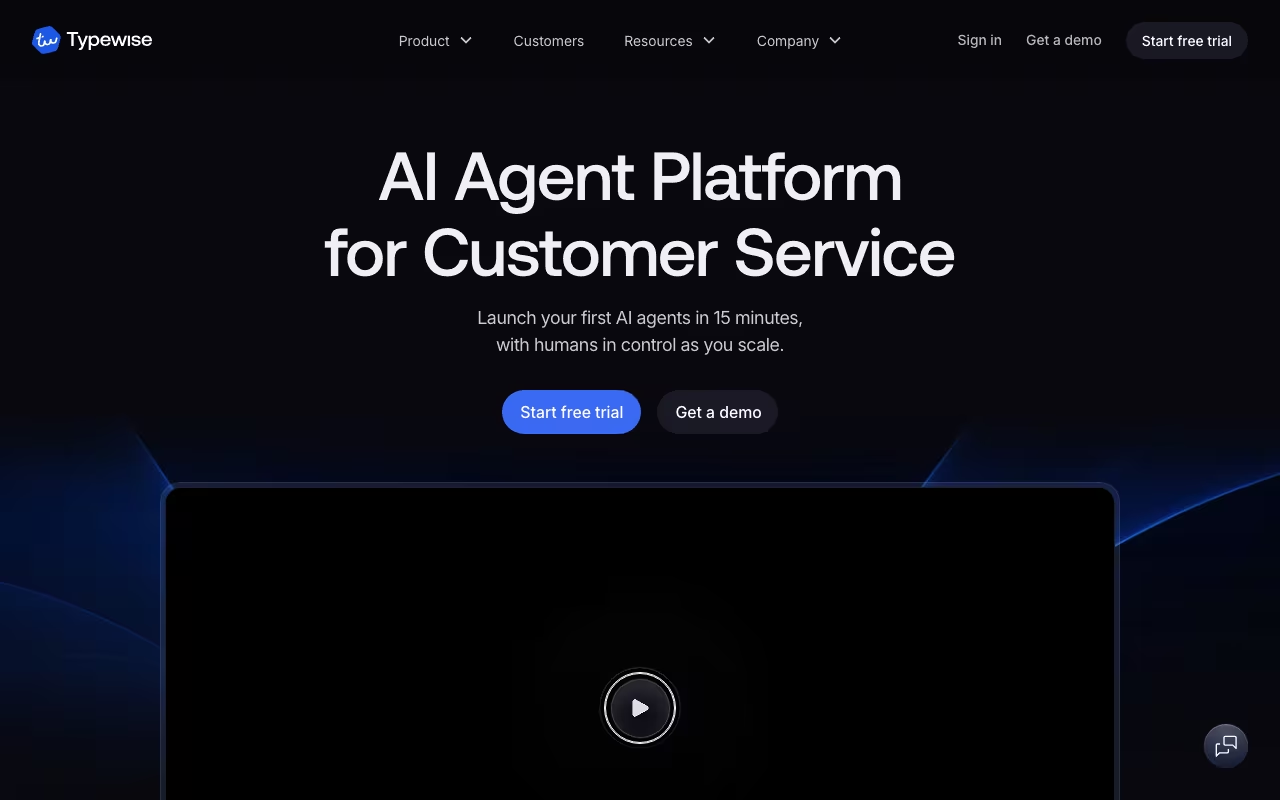
- Time-to-value claims are inconsistent on the vendor's own site. The hero says "launch your first AI agents in 15 minutes", the FAQ says most teams go live in 1 to 2 days, and the rollout timeline runs to "week 4+" for company-wide scale. Budget for the longer figure.
- EU-only hosting cuts both ways. It is a strength for European buyers, but the site advertises no US or APAC data residency option and no self-hosted or on-prem deployment.
- The funnel is demo-led. Positioning is mid-market and enterprise. There is a separate startup and SMB page, and Starter and Growth begin with a 14-day free trial with no card required, but Enterprise pricing is custom.
Who should use Typewise
Typewise fits European mid-market and enterprise support teams with real ticket volume, legacy backend systems and compliance obligations (GDPR, EU AI Act, EU data residency) who want AI agents layered over an existing helpdesk and CRM rather than a rip-and-replace project. If approval workflows and audit trails matter more to you than the speed of a self-serve setup, the governance tooling here is the reason to look.
Skip it if you need voice support today, or if you need US data residency or an on-prem deployment.