
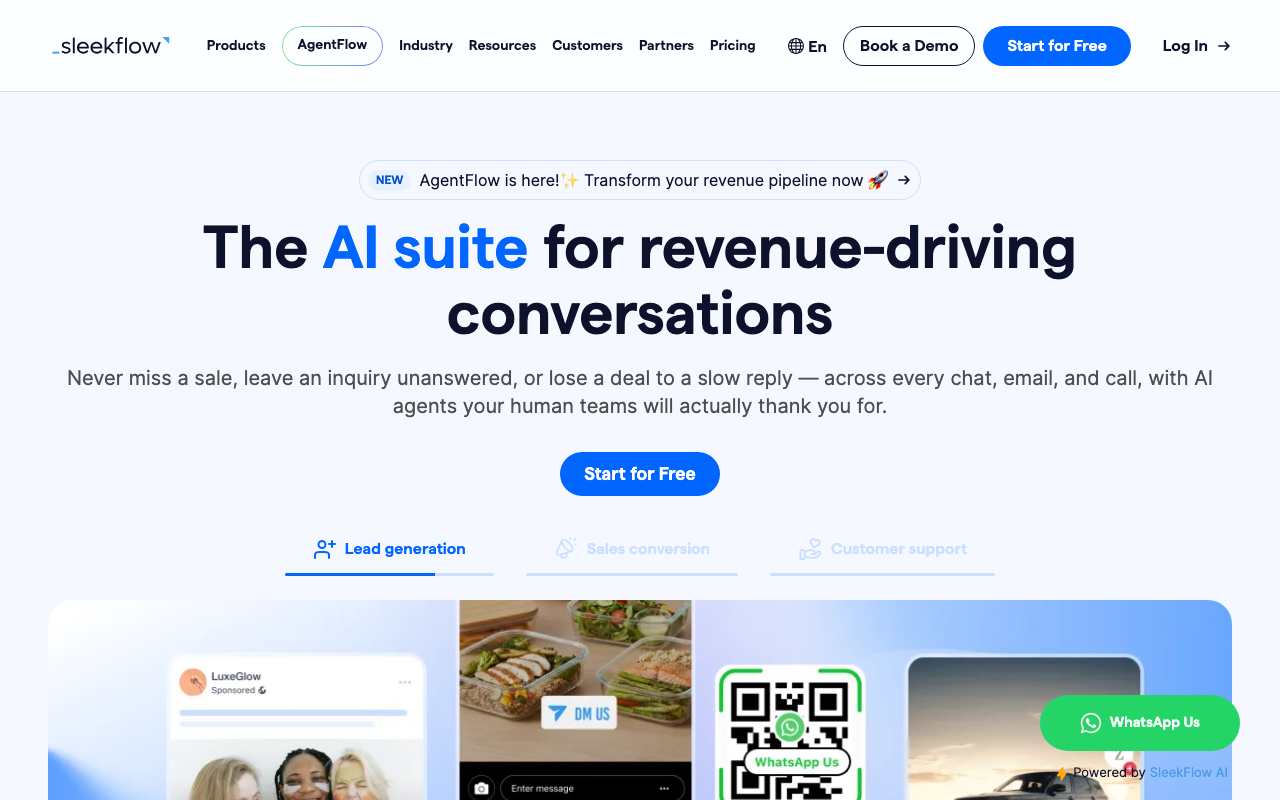
What Is SleekFlow?
SleekFlow is the omnichannel messaging platform that unifies WhatsApp, Instagram, Messenger, SMS, email, and web chat into one inbox for customer service and marketing. Founded in 2019 in Hong Kong, SleekFlow serves SMBs and growing brands primarily across Asia, the Middle East, and increasingly Europe.
The pitch is multichannel from day one. Most messaging platforms specialize in one channel (Wati for WhatsApp, Front for email). SleekFlow treats all channels equally with shared inbox, unified automations, and broadcast campaigns that work consistently across every channel customers actually use.
The product targets ecommerce brands selling through WhatsApp commerce, retail businesses managing customer service across channels, and service businesses where customers prefer messaging over email.
Try SleekFlow Free Get started →How SleekFlow Works
Connect channels: WhatsApp Business API (requires Meta verification), Instagram Direct, Facebook Messenger, SMS (Twilio integration), email, web chat widget. Each channel feeds messages into one unified inbox where agents respond.
Agents work from the unified inbox with shared tags, assignments, SLAs, and team views. Conversation context follows customers across channels; if a customer starts on WhatsApp then switches to email, the full thread stays connected.
Automation builders create chatbot flows triggered by keywords, events, or schedule. Visual flowcharts let business users build sophisticated conversation paths without code. Common automations include lead qualification, FAQ responses, order tracking, and appointment scheduling.
Broadcast campaigns send template messages to opt-in audiences on WhatsApp, SMS, and email. Segmentation based on customer attributes (purchase history, tags, location) targets specific groups. Performance tracking shows delivery, opens, and replies.
Integrations cover Shopify, HubSpot, Salesforce, Zapier for connecting messaging to CRM and ecommerce workflows. Native ecommerce features let customers complete purchases inside WhatsApp through catalog browsing and Pay by Stripe.
SleekFlow Pricing in 2026
Free: 1 user, 1 channel, basic features. Limited.
Pro: $79/month annually. 3 users, multiple channels, basic automation.
Premium: $199/month annually. 5 users, advanced automation, deeper integrations.
Enterprise: Custom pricing for larger teams with advanced security and SLA requirements.
WhatsApp messaging fees apply on top per conversation, set by Meta. Typical costs: $0.005-$0.05 per outbound conversation depending on country.
See SleekFlow Plans See plans →Where SleekFlow Wins
- Multichannel inbox: WhatsApp + Instagram + Messenger + SMS + email in one view.
- Shopify integration: ecommerce flows work natively.
- Visual automation builder: business users build flows without code.
- Strong APAC presence: pricing and support tuned for the region.
- WhatsApp commerce: complete purchases inside WhatsApp.
Where It Falls Short
- UI feels busy: many features compete for screen space.
- Pricing tiers escalate: small teams may outgrow Pro quickly.
- Knowledge base lighter than competitors: less self-help content.
- Newer brand than Zendesk or Intercom: less recognition in enterprise procurement.
SleekFlow vs Wati vs Trengo vs Twilio Flex
Customer Support tools, published pricing
| Tool | Pricing | Model |
|---|---|---|
| SleekFlow | $79/mo (lowest published recurring price) | Subscription |
| Wati | $49/mo (lowest published recurring price) | Subscription |
| Pylon | $100/mo (lowest published recurring price) | Subscription |
| Textline | $59/mo (lowest published recurring price) | Subscription |
| SimpleTexting | $39/mo (lowest published recurring price) | Subscription |
| Freshdesk | Free, $15/agent/mo (Growth), $49/agent/mo (Pro) | Freemium |
Wati is WhatsApp-first. Pick Wati if WhatsApp is the only channel that matters.
Trengo targets European SMBs with similar scope.
Twilio Flex is developer-first contact center. More flexible, more setup work.
Manychat targets messenger chatbot automation specifically.
Who Should Use SleekFlow
Ecommerce brands in APAC: WhatsApp plus Instagram plus Shopify in one stack.
Service businesses with multichannel customer base: unified inbox simplifies workflows.
Brands running WhatsApp commerce: native catalog and payment features.
Skip it if: WhatsApp is your only channel (Wati is cheaper), you operate primarily in markets where SMS dominates, or you need enterprise contact center capability (use Twilio Flex).
How SleekFlow works
SleekFlow is an omnichannel messaging platform that pulls WhatsApp, Instagram DM, Messenger, TikTok messaging, SMS, Telegram, Viber, LINE, WeChat, email and VoIP calls into one shared team inbox. Around that inbox it sells a social CRM, broadcast campaigns, a no-code automation flow builder, a ticketing system, an in-chat catalog with payment links, and analytics. The current positioning is an AI suite for revenue-driving conversations: the AgentFlow layer adds an inbound AI agent that handles tasks and writes results back to the CRM, plus a data-analyst agent that mines conversations for insights. It is a WhatsApp-first commerce and support tool rather than a general-purpose helpdesk.
Setup starts with channels. WhatsApp runs through the Business API with SleekFlow acting as the BSP, so the number is provisioned through them. You also connect Facebook and Instagram, TikTok Business Messaging and Instant Forms, SMS, and VoIP powered by Twilio. Contacts land in the built-in social CRM and can sync two ways with Shopify, HubSpot, Salesforce, Google Sheets or VTEX.
Automation happens in a visual flow builder. You get event-driven triggers per channel, enrollment conditions that filter who enters a flow, branching paths, time delays and waits until a specific timestamp, timeout nudges when a customer goes quiet, auto-reply and conversation-assignment actions, flow variables that reference trigger data or chat responses, and steps that create or update records. Generative AI steps drop into the same flows. Broadcasts are sent per channel with personalization, while analytics dashboards and webhook or API access sit above the entry plan.
Where SleekFlow wins
- Channel breadth that is unusual at this size. WhatsApp, Instagram, Messenger, TikTok (including Messaging Ads and Instant Forms), SMS, Telegram, Viber, LINE, WeChat, email and VoIP. LINE, Viber and WeChat coverage in particular matters for APAC operators.
- A flow builder that is properly featured, not a toy. Conditions, branching, delays until a timestamp, timeout nudges, flow variables drawn from trigger or chat data, and record create/update steps, all without code.
- Commerce lives inside the thread. The product catalog and payment links let an agent close a sale inside WhatsApp instead of pushing the buyer out to a web checkout.
- There is a real $0 tier (50 monthly active contacts, 3 users, 3 channels), so you can touch the core product before paying, and paid plans advertise unlimited AI usage rather than metering it.
- Two-way CRM integrations with Shopify, HubSpot and Salesforce, plus Google Sheets and VTEX, so conversations do not stay stranded in a separate inbox.
Where it falls short
- Billing follows contact volume, not seats. Pro AI starts at 500 monthly active contacts ($99/mo, $79 annual) and Premium AI at 1,000 ($299/mo, $249 annual), with add-ons required beyond that. A busy inbox can outgrow a tier quickly.
- WhatsApp message costs sit on top of the subscription. SleekFlow's own calculator notes the listed rates are Meta's and that charges may vary across BSPs due to exchange rates and gateway fees. It does not disclose its own markup, so true cost per campaign is not knowable from the site.
- Operational essentials are gated to Premium ($299/mo): analytics dashboards, webhook and API calls, role-based access control and advanced AI agents. A small team that needs API access or permissions has to jump three tiers.
- Salesforce integration and PII masking are Enterprise-only (custom quote), which is a hard stop for regulated buyers looking at the self-serve plans.
- The free plan is a demo, not a workspace. Three users, three channels, 50 monthly active contacts and limited AI.
Who should use SleekFlow
The clean fit is an ecommerce or consumer-facing sales and support team in APAC, the Middle East or Europe whose customers genuinely live in WhatsApp, Instagram or LINE, and who want to sell and collect payment inside the chat. A team of roughly 3 to 10 agents with predictable contact volume gets the most out of it, because that is where the flow builder and in-chat catalog pay for themselves without the monthly active contact count spiralling.
Skip it if your support is ticket-first or email-first, since a conventional helpdesk will cost less and fit better. Skip it if you need Salesforce sync or PII masking without an enterprise budget, because both are behind a custom quote. And be careful if your contact volume is high and unpredictable: contact-based pricing combined with separate Meta message fees makes the monthly bill hard to forecast in advance.
Frequently Asked Questions
Does SleekFlow support Instagram DMs?
Yes through Meta's API.
Can I send broadcasts on WhatsApp?
Yes using approved template messages.
Does it integrate with Shopify?
Yes natively including catalog browsing inside WhatsApp.
What about voice channels?
No native voice; SleekFlow focuses on text and messaging channels.
How are WhatsApp template approvals handled?
SleekFlow manages template submission to Meta as part of campaign setup.