
What Is Moosend?
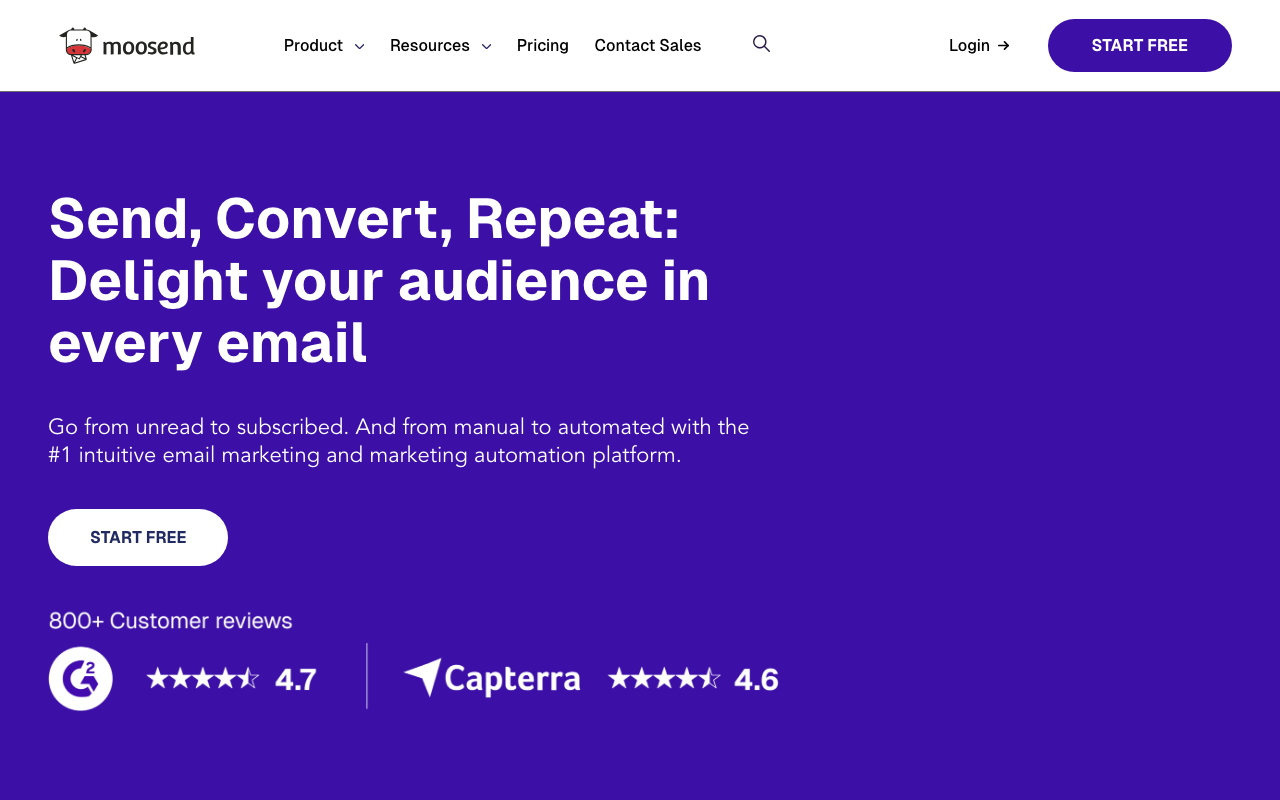
Moosend is the email marketing and automation platform for SMBs and e-commerce brands. Founded in 2011 and acquired by Sitecore in 2021, Moosend serves over 80,000 businesses globally with email campaigns, automation workflows, landing pages, and subscription forms at prices typically 30-50% below Mailchimp.
The pitch is "Mailchimp features without the price hikes." Moosend covers the email marketing essentials with strong automation depth and clean templates. The pricing model favors growing businesses: charging per subscriber rather than tiered with feature lockouts, the marginal cost stays predictable as your list grows.
The product supports e-commerce integration with Shopify, WooCommerce, BigCommerce, Magento, and PrestaShop. Abandoned cart workflows, product recommendations, and revenue tracking work natively for online stores.
Try Moosend Free Get started →How Moosend Works
Build campaigns in the drag-and-drop editor with templates or from scratch. Customize colors, fonts, and content blocks to match your brand. Test emails render correctly across email clients before sending.
Segment your list by behavior, demographics, custom fields, or e-commerce activity. Combine criteria to create precise segments (subscribers who opened the last 3 emails, bought in the past 60 days, and live in Europe).
Automation workflows trigger from events: signup, purchase, cart abandonment, anniversary date, custom event. The visual workflow builder handles multi-step sequences with conditions and branches. Common automations include welcome series, post-purchase nurture, win-back campaigns, and birthday promotions.
Landing pages and subscription forms capture leads from outside your site. Hosted landing pages remove friction; embedded forms convert site traffic into subscribers.
Analytics show open rates, click rates, conversion rates, and revenue per email. E-commerce integration ties email engagement to actual purchases for proper ROI measurement.
Moosend Pricing in 2026
Free trial: 30 days, full features.
Pro: From $9/month for 500 subscribers. Scales by subscriber count.
Sample tier pricing:
- 500 subscribers: $9/month
- 2,500 subscribers: $35/month
- 10,000 subscribers: $100/month
- 50,000 subscribers: $440/month
Enterprise: Custom pricing for large lists with dedicated IP and account management.
Compared to Mailchimp at $20 for 500 contacts ($35/month feature complete), Moosend is significantly cheaper at every subscriber level. Compared to ActiveCampaign at $29/month for 500 contacts, similar discount.
See Moosend Plans See plans →Where Moosend Wins
- Pricing competitive vs Mailchimp: 30-50% cheaper at most subscriber levels.
- Automation depth strong: visual workflow builder handles complex sequences.
- E-commerce integration native: abandoned cart, product recommendations, revenue tracking.
- Landing pages included: no separate Unbounce subscription needed.
- Subscription-based pricing: predictable monthly costs.
Where It Falls Short
- Smaller ecosystem than Mailchimp: fewer template libraries and third-party content.
- Less brand recognition: marketers know Mailchimp; Moosend requires education.
- UI less polished than newer competitors: works well but feels older than ActiveCampaign or Klaviyo.
- Deliverability variable: depends on sender practices; not as well-established as some competitors.
Moosend vs Mailchimp vs ActiveCampaign vs Brevo
Mailchimp dominates SMB email marketing with a stronger brand and integration ecosystem. More expensive.
ActiveCampaign wins on automation depth. More expensive at similar list sizes.
Brevo (formerly Sendinblue) is the closest budget competitor with similar pricing.
MailerLite is similar in pricing and feature scope. Choose based on UI preference.
Who Should Use Moosend
SMBs cost-conscious about email marketing: real savings vs Mailchimp.
E-commerce brands: abandoned cart and revenue tracking native.
Growing businesses: pricing scales smoothly with list growth.
Skip it if: you need maximum brand recognition (use Mailchimp), require enterprise features (use Marketo), or live deep in HubSpot's ecosystem.
How Moosend works
Moosend is an email marketing and marketing automation platform built around three jobs: sending campaigns, running automated customer journeys, and growing the list. The email side gives you a drag-and-drop editor with more than 130 templates, dynamic content, A/B testing and real-time reporting. Around it sit a landing page builder and a subscription form builder, each with their own analytics, so the capture surface and the sending surface live in the same account.
The working sequence is straightforward. You import contacts and organise them with segments, custom fields and tags, then either build a campaign in the editor or design a landing page and opt-in form that Moosend hosts for you. Automations are assembled in a visual workflow builder that is driven by user-behaviour tracking, which matters more than it sounds: triggers fire off site and product activity rather than list membership alone, so a journey can react to what someone did rather than only to which list they landed on. An AI layer, Moosend AI, adds an AI Writer for copy, product recommendations, and audience discovery.
Connections are where you need to plan. Native integrations cover WooCommerce, Magento, OpenCart, CS-Cart, Zen Cart, WordPress, Google Contacts and Salesforce. Most other stacks, including HubSpot, ActiveCampaign, Zoho and Pipedrive, connect only through Zapier, Make, APIXDrive or viaSocket, or you wire them yourself through the API. There are 82 integrations in total. For transactional traffic (receipts, notifications, password resets) you point your application at Moosend's SMTP server or its transactional email API, which means one vendor can cover both marketing and app mail.
Where Moosend wins
- Landing pages and forms are included in the Pro plan rather than sold as a separate product, and each comes with its own analytics.
- SSO and SAML are listed as Pro-plan features, not held back for an enterprise tier, which is unusual at this level of the market.
- An SMTP server and transactional email API ship alongside marketing sending, so your receipts and your campaigns can come from the same vendor.
- Pay-as-you-go email credits that never expire: 350,000 to 1,000,000 credits for $350 to $1,000, which suits irregular senders better than a monthly subscription.
- A modular Moosend+ tier lets you attach individual enterprise add-ons (dedicated IPs, audience discovery, custom dashboards, hosted files, extra seats) without signing a full Enterprise contract.
- A 30-day trial with unlimited sends up to 1,000 contacts and no credit card required, which is enough runway to actually migrate and test.
Where it falls short
- There is no free-forever plan. The only free option is the 30-day trial. After it expires you must buy a plan or credits to keep sending. Your data is retained, but sending stops.
- No native Shopify integration appears among the 82 listed integrations, which is a real gap for a platform pitching ecommerce automation and product recommendations.
- Native CRM support is effectively Salesforce only. HubSpot, Pipedrive, Zoho and ActiveCampaign are Zapier-mediated, which adds both cost and latency to every sync.
- Pricing is calculator-only on the site. There is no published entry price, so you cannot line Moosend up against competitors without first configuring a quote.
- The headline Pro price is not the landed cost. Dedicated IPs, custom reports, audience discovery, extra team members and priority support are all add-ons or gated behind Enterprise.
Who should use Moosend
Moosend fits SMB and mid-market marketers running on WooCommerce, Magento or WordPress who want email, automation, landing pages and transactional sending from a single vendor. If you value SSO without paying an enterprise premium, or you send in bursts and prefer buying credits that never expire over a monthly subscription, the commercial model works in your favour. The modular Moosend+ add-ons also help teams that need one enterprise capability, such as a dedicated IP, without buying the whole tier.
Skip it in three cases. If you run Shopify, the missing native integration undercuts exactly the ecommerce features Moosend markets. If your CRM is HubSpot or Pipedrive and you want a first-party sync rather than a Zapier bridge, look elsewhere. And if you need a permanently free tier to start on, the 30-day trial is a deadline rather than an entry point.
Frequently Asked Questions
Does Moosend support transactional emails?
Yes via add-on or higher tiers. Most senders use a dedicated transactional service (SendGrid, Postmark) for high-volume transactional.
Can I import from Mailchimp?
Yes. Migration tools handle subscribers, lists, and active campaigns.
Does it integrate with Shopify?
Yes natively. Stock, orders, and customer data sync for e-commerce workflows.
Is there a free tier?
30-day free trial. No permanent free tier.
Are there transactional sending limits?
Pricing tiers include monthly send limits; overages cost extra.