
What is iContact?
Email marketing automation platform for small businesses
iContact puts your campaigns in one place instead of scattered across a dozen tabs. It's built for teams that ship campaigns weekly, not once a quarter.
How We Evaluated iContact
We looked at iContact on five things: campaign management, audience targeting, analytics integration, automation capabilities, and reporting clarity. Same checklist we use for every marketing tool in the directory, so the comparisons are like for like.
That meant using the product, testing the features that matter most for marketing work, reading the docs, and checking whether pricing is upfront or hidden behind a sales call. We also compared it against TheTop and Hopp for Business to see where it stands.
Key Features
What iContact actually gives you:
- Workflow Automation: Automates repetitive tasks to save time on routine operations
- AI-Powered Intelligence: Uses AI to surface insights and automate decisions
- Email Campaigns: Create and send targeted email campaigns at scale
Pricing
iContact publishes its pricing: for 500 contacts Standard is $9, Premium $16 and Ultimate $24 per month, with tiers up to 50,000 contacts, 15% off yearly and a 30-day free trial.
To give you a rough sense of the market, comparable marketing tools like TheTop and Hopp for Business charge in the range of custom pricing to custom pricing/mo, which should help you calibrate expectations.
Prices checked on the iContact pricing page in September 2026. Plans and limits change, so confirm before you buy.
Pros and Cons
What we like
- This is a tool built specifically for marketing, which means the features are tailored to real use cases in this space rather than being generic functionality that sort of applies
- The campaign workflows feel like they were designed by someone who's actually run marketing at a real company. They follow the natural rhythm of how campaigns get planned, launched, and measured
- It focuses on doing one thing well rather than trying to be a Swiss Army knife, which usually means the core features get more development attention and polish than they would in an all-in-one platform
What could be better
- Because it focuses on marketing specifically, you'll still need separate tools for sales, customer support, and other functions. It won't replace your entire stack
- Larger organizations with complex requirements may find that some of the advanced features they expect from enterprise software are missing or underdeveloped
iContact Alternatives
If iContact isn't the right fit, here are the closest competitors worth looking at:
| Tool | What it does | Pricing |
|---|---|---|
| TheTop | TheTop is a business tool available at thetop.com. Sign up to see pricing, features, an... | From $99/mo |
| Hopp for Business | Hopp for Business is a business tool available at business.gethopp.com. Sign up to see ... | From $9/mo |
| POWR | POWR, Inc. is a business tool available at powr.io. Sign up to see pricing, features, a... | From $9/mo |
| Roster | Roster is a business tool available at getroster.com. Sign up to see pricing, features,... | From $500/mo |
We track hundreds of marketing tools in our tools directory. Worth browsing if none of these match what you need.
Who It's For (and Who It's Not)
Good fit: iContact makes the most sense for marketing teams and agencies that are juggling multiple campaigns simultaneously and need a central place to plan, execute, and measure everything without losing track of what's running where. If that sounds like your situation, it's worth at least testing it out.
Skip it if: you only run one campaign a quarter and it's mostly a single email blast, this level of tooling adds complexity without giving you much in return. In that case, you might want to look at TheTop as a lighter-weight option.
Bottom Line
Does its core job well. Worth the investment if marketing is central to your daily work. If you only need it occasionally, look at a simpler option.
In short: iContact is a strong choice for marketing teams and agencies that are juggling multiple campaigns simultaneously and need a central place to plan. you only run one campaign a quarter and it's mostly a single email blast, this level of tooling adds complexity without giving you much in return.
Try iContactHow iContact works
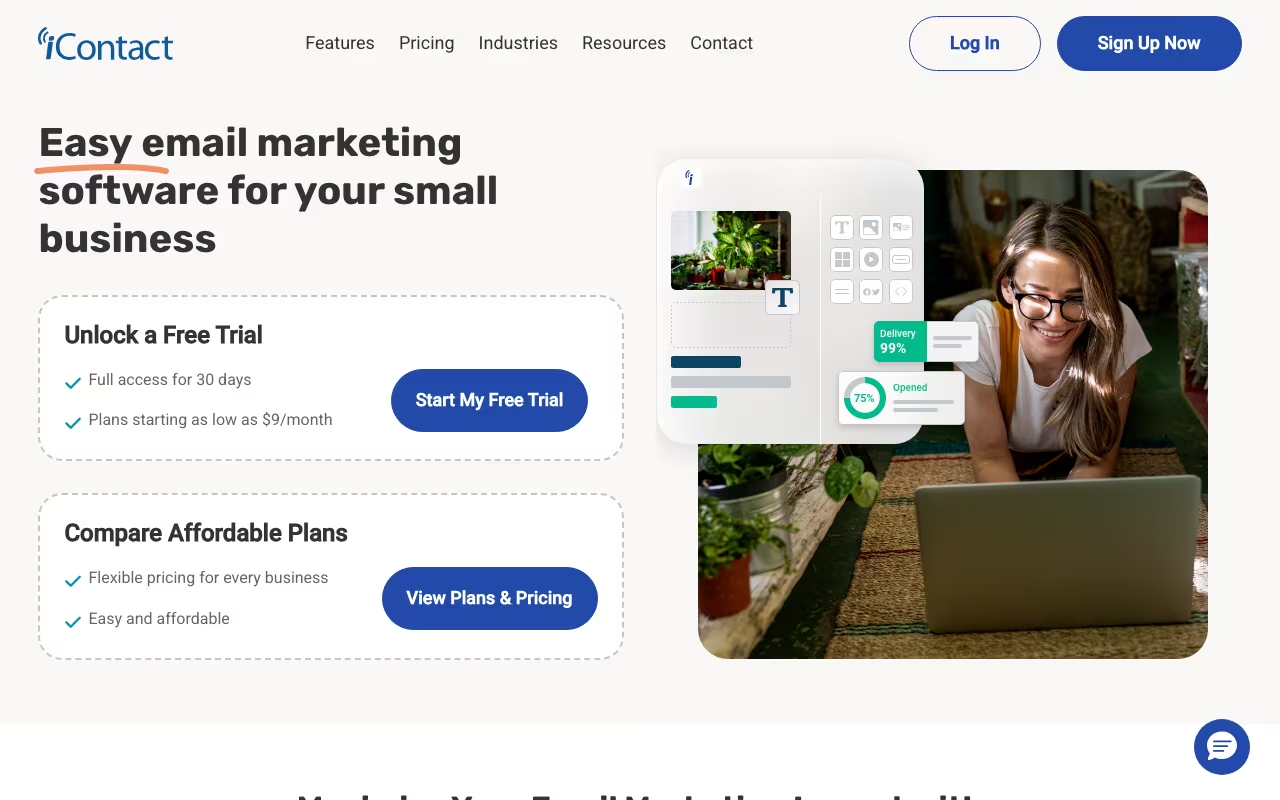
iContact is a small-business email marketing platform that has been running since 2003 and is now owned by J2 Martech Corp, a Ziff Davis company. It handles list management, drag-and-drop email design, landing pages and signup forms, segmentation, trigger-based automation, social posting and reporting. It is a newsletter-and-campaign tool rather than a full marketing automation suite, and recent additions are an AI email generator and Kickbox-powered address verification.
The workflow starts with importing contacts into lists, then building segments on subscriber data, behaviour and engagement level. You design emails in a drag-and-drop block editor or from a template, then send immediately, schedule to a date and time, or wire the email into an automation. Automations are trigger-based rather than a visual journey builder: available triggers are Subscribe (for welcome emails), a Specific Date, custom per-subscriber dates such as birthdays or renewals, segment qualification, and engagement events like opens, clicks and landing page visits. Ecommerce integrations can trigger automations from purchase history.
Before sending you get inbox previews, spam review and A/B testing. List hygiene runs through Kickbox verification, which flags each address as Deliverable, Risky, Undeliverable or Unknown and is priced separately from about $1/month. Growth tools cover hosted web forms and landing page templates. Connections come from a catalogue of 100+ integrations including HubSpot CRM, a WordPress plugin and many routed through Zapier (Eventbrite is the example given), plus a deeper native Salesforce package that lets you build campaigns, schedule sends, manage preferences and run custom reports without leaving Salesforce. Pricing runs $9/month for 500 contacts on Standard, $16 on Premium and $24 on Ultimate, with 15% off annual and a full-feature 30-day trial. The AI generator writes subject lines, headlines, body copy and CTAs and produces custom images inside the editor.
Where iContact wins
- Cheapest entry point in its bracket. $9/month for 500 contacts on Standard, $16 Premium and $24 Ultimate, with 15% off annual billing and a full-feature 30-day trial to test first.
- Real phone support with a published sales line (1-877-820-7837). Customer testimonials on the site consistently name support as the reason they stayed a decade or more, which is unusual at this price point.
- Native Salesforce integration that goes past a contact sync. You can run campaigns, scheduling, preference management and custom reporting inside Salesforce itself.
- Email verification built in via Kickbox, with a four-state result, so list hygiene happens in-platform instead of through a separate vendor.
- AI generation lives in the editor (copy, subject lines, images, brand alignment) and can be tried free inside the account, with AI templates and images on the top tier.
Where it falls short
- No free-forever plan. The 30-day trial converts to paid, and pricing scales by contact tier from 500 up to 50,000, beyond which you need a custom quote.
- Send limits are tied to your contact count but the pricing page does not quantify them, so a high-frequency sender on a small list can hit a ceiling they could not plan for.
- The cheap Standard plan is deliberately capped. The vendor's own FAQ says it restricts feature access and limits the number of lists, segments, automations and landing pages, so most real use starts at Premium ($16) or Ultimate ($24).
- Automation is thin next to modern competitors. Triggers and schedules (subscribe, date, segment qualification, engagement events) do the job, but there is no branching visual journey builder.
- Key features are paywalled or metered separately. Unlimited users and the AI content assistant start at Premium; email verification, dynamic content and AI templates/images are Ultimate only, and verification is billed on top from around $1/month.
- The marketing site itself is unreliable. Several linked feature pages 404, and the site loads a consent framework naming 823 advertising partners, which is friction for privacy-sensitive buyers.
Who should use iContact
iContact makes sense for small and independent businesses, nonprofits and retailers sending a regular newsletter or promotional campaign to a list under roughly 25,000, where low cost and access to a human on the phone matter more than automation depth. It is a particularly strong fit for Salesforce shops that want email operated from inside the CRM rather than bolted alongside it.
Skip it if you need branching multi-step lifecycle automation, a permanent free tier, sophisticated ecommerce revenue attribution, or a modern developer-friendly API-first stack. Budget for Premium or Ultimate rather than Standard, since the entry plan is capped on lists, segments, automations and landing pages.