
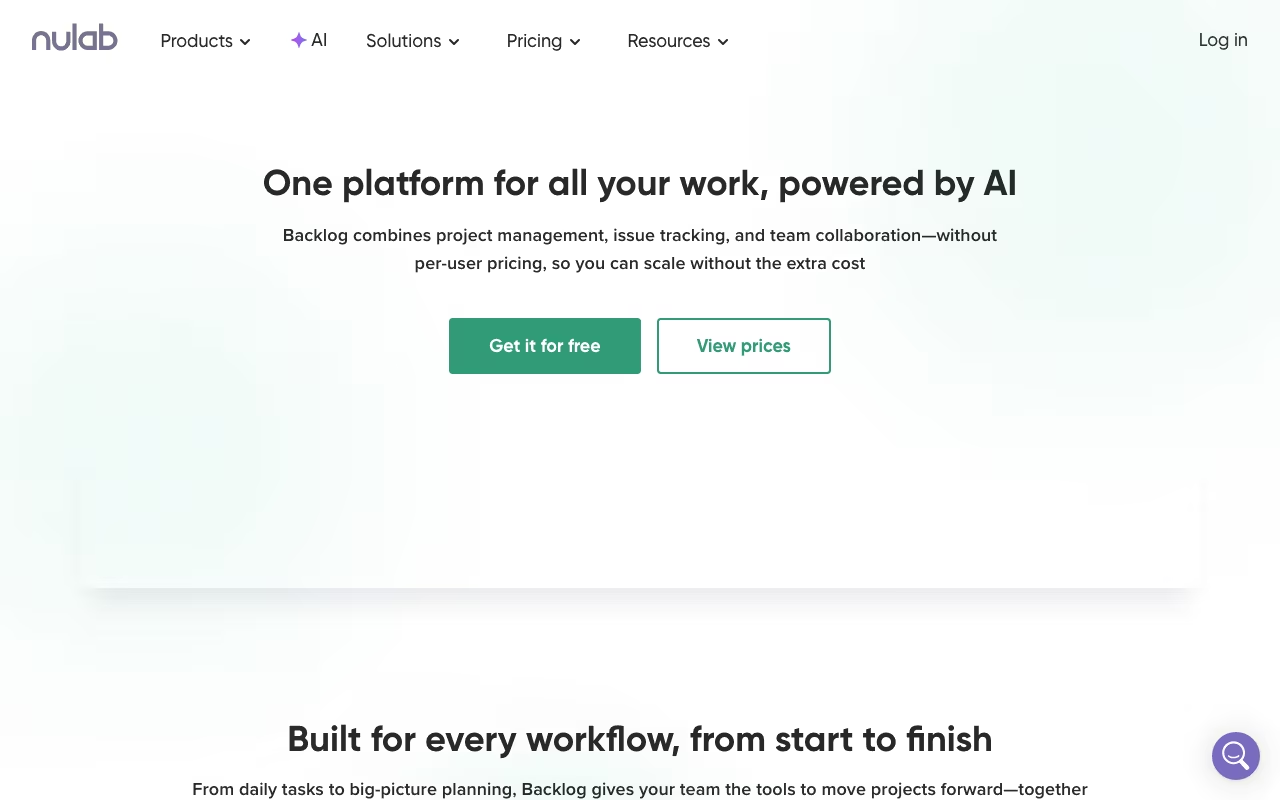
What is Backlog?
Project management platform for teams with bug tracking and collaboration tools
Backlog is a productivity tool that we've reviewed as part of our directory. Here's what it does well, where it falls short, and whether it's worth your money.
How We Evaluated Backlog
We looked at Backlog on five things: workflow automation, task organization, team collaboration, integrations, and mobile support. Same checklist we use for every productivity tool in the directory, so the comparisons are like for like.
That meant using the product, testing the features that matter most for productivity work, reading the docs, and checking whether pricing is upfront or hidden behind a sales call. We also compared it against Hermes Agent and Blinq to see where it stands.
Key Features
What Backlog actually gives you:
- Team Collaboration: Built-in collaboration tools for real-time teamwork
- Performance Tracking: Track and measure performance across key metrics
- Core Functionality: Purpose-built feature set for productivity workflows
- User Interface: Clean interface designed for productivity
Pricing
Backlog publishes its pricing: there is a free plan for 10 users and 1 project, then Starter at $35, Standard at $100 and Premium at $175 per month per space, with Enterprise quoted by sales.
To give you a rough sense of the market, comparable productivity tools like Hermes Agent and Blinq charge in the range of custom pricing to custom pricing/mo, which should help you calibrate expectations.
Prices checked on the Backlog pricing page (Nulab) in September 2026. Plans and limits change, so confirm before you buy.
Pros and Cons
What we like
- This is a tool built specifically for productivity, which means the features are tailored to real use cases in this space rather than being generic functionality that sort of applies
- It integrates with the tools you're probably already using rather than asking you to change your entire workflow, which makes adoption significantly easier for teams
- It focuses on doing one thing well rather than trying to be a Swiss Army knife, which usually means the core features get more development attention and polish than they would in an all-in-one platform
What could be better
- Adding another tool to your stack is only worthwhile if people actually use it, and productivity tools have a particularly high rate of being purchased, set up, and then quietly ignored
- Larger organizations with complex requirements may find that some of the advanced features they expect from enterprise software are missing or underdeveloped
Backlog Alternatives
If Backlog isn't the right fit, here are the closest competitors worth looking at:
| Tool | What it does | Pricing |
|---|---|---|
| Hermes Agent | Open-source AI agent from Nous Research that lives across Telegram, Discord, Slack, Wha... | From $20/mo |
| Blinq | Blinq is a business tool available at blinq.me. Sign up to see pricing, features, and c... | From $4/mo |
| 1Password | 1Password is a business tool available at start.1password.com. Sign up to see pricing, ... | From $2/mo |
| Laxis | Laxis is a business tool available at laxis.com. Sign up to see pricing, features, and ... | From $17/mo |
We track hundreds of productivity tools in our tools directory. Worth browsing if none of these match what you need.
Who It's For (and Who It's Not)
Good fit: Backlog makes the most sense for remote teams and busy professionals who need a reliable system to organize their day, track tasks across projects, and make sure nothing falls through the cracks when things get hectic. If that sounds like your situation, it's worth at least testing it out.
Skip it if: your current setup already works well and you're productive. Adding another tool on top of that just creates one more thing to manage. In that case, you might want to look at Hermes Agent as a lighter-weight option.
Bottom Line
Does its core job well. Worth the investment if productivity is central to your daily work. If you only need it occasionally, look at a simpler option.
In short: Backlog is a strong choice for remote teams and busy professionals who need a reliable system to organize their day. your current setup already works well and you're productive.
Try BacklogHow Backlog works
Backlog is Nulab's project and issue tracking tool, and its defining choice is that it bundles issue tracking with built-in Git and Subversion repositories, so code and tickets live in the same product. You start by creating a Nulab space, then add projects inside it. Each project holds issues (with parent tasks, subtasks, milestones and versions, plus custom fields on Premium), and you can view the work on a Kanban board, a Gantt chart, a dashboard or a burndown chart. Projects also store documents and files attached to issues. Where the built-in Git or SVN repositories are used, commits and branches link back to the issues they belong to.
The commercial model is the part worth understanding before anything else: pricing is per space, not per user. A plan buys you a user ceiling, a project ceiling and a storage quota rather than a number of seats. Standard is $100/mo, Premium is $175/mo, and there is a free tier plus a Starter tier at $35/mo below them; Enterprise is a custom quote.
Integrations are configured per space. The published list covers Slack, Microsoft Teams, Microsoft Copilot, Google Chat, Google Drive, OneDrive, Dropbox, Cacoo diagrams, Jenkins, LambdaTest, Google Sheets bulk issue import and iCal calendar sync, alongside webhooks and an open REST API at developer.nulab.com with OAuth 2.0. Importers exist for Jira and Redmine if you are migrating. Mobile apps ship on both the App Store and Google Play.
The newer layer is the AI Assistant, which drafts issues from a plain-English description, summarises threads, bulk-updates tasks and generates progress reports. It runs on credits, with 2,000 per month included on Premium and Enterprise and extra packs available for purchase. It always asks for human approval before acting, respects project permissions, and logs whether a change was made by a person or by the AI. Nulab reports over 4 million users, and cites Omron and SoftBank as customers.
Where Backlog wins
- Per-space pricing, not per seat. Standard ($100/mo) and above give unlimited users, so adding people to a project costs nothing extra.
- Version control is built in. Git and SVN repositories are part of the product, with commits and branches linked to issues, so a dev team does not need a separate code host.
- The free tier is genuinely usable and does not expire: 10 users, 1 project, 100 MB, and it still includes version control and the Kanban board.
- Real mobile apps on both iOS and Android rather than only a responsive web view.
- AI actions are governed. Every AI Assistant action is gated behind human approval, respects project permissions, and lands in the audit trail marked as AI rather than person.
- Migration and custom tooling are practical: Jira and Redmine importers to get in, plus an open REST API with OAuth 2.0 and webhooks to build around.
Where it falls short
- Planning views are gated high. Gantt charts and burndown charts are not available below Standard ($100/mo), and Gantt is capped at a 6-month window until Premium ($175/mo).
- Storage is stingy on the lower tiers: 100 MB on Free, 1 GB on Starter, 30 GB on Standard, which is tight for a tool that stores both file attachments and repositories.
- The AI Assistant is Premium and Enterprise only, and metered by credits once you pass the included 2,000 per month.
- SAML SSO, SCIM provisioning, audit logs and centralised access management are Enterprise-only, on a custom quote.
- The cheap plans are bare. Custom fields start at Premium, and Starter mainly adds subtasking over the free tier.
- Small ecosystem. Nulab advertises 15+ integrations, well short of Jira or Asana, and the vendor feature page does not advertise workflow automation rules or native time tracking.
Who should use Backlog
Backlog fits small to mid-size software and agency teams that want issue tracking and their Git or SVN repositories in one tool and dislike per-seat billing. The economics get better the larger your headcount, so a team of 40 on a fixed budget benefits far more than a team of four. The free tier is a fair way to see whether the issue model and the board suit you before spending anything.
Skip it if you need heavy workflow automation, a deep third-party app ecosystem, or enterprise SSO and provisioning on a mid-tier budget, since those sit behind an Enterprise quote. Also think twice if your projects are attachment-heavy, because the storage quotas below Standard will bite quickly.