
The 8 Best Webhook Management Tools in 2026

Key facts8 tools compared: Hookdeck, Svix, ngrok, webhook.site, Convoy, Hookdeck Outpost, Hook0, Zapier…
- 8 tools compared: Hookdeck, Svix, ngrok, webhook.site, Convoy, Hookdeck Outpost, Hook0, Zapier Webhooks
- Hookdeck (best for: Receiving + routing inbound webhooks): Free, then $39/mo
- Svix (best for: Sending webhooks to your customers): Free, then $490/mo
- ngrok (best for: Local dev + testing webhooks): Free, then $8/mo
- webhook.site (best for: Inspecting a raw payload fast): Free, then $9/mo
Webhooks look simple until they aren't. You set up an endpoint, a provider POSTs JSON at it, and everything works in the demo. Then production hits: Stripe retries a duplicate event, your endpoint times out during a deploy, a customer swears your app never sent the order-paid event, and now you're grepping logs at 2am trying to reconstruct what happened. There's no UI, no replay button, no record of what got delivered.
That's the gap webhook management tools fill. Some sit in front of your endpoints to receive, queue, and replay inbound events. Others handle the opposite job: reliably sending webhooks to your own customers. A few just let you eyeball a payload in five seconds. The category is messier than most "best of" lists admit, because "webhook tool" can mean four different products.
If you want one answer: Hookdeck is the tool I reach for when receiving and routing inbound webhooks matters, and Svix is the one I'd build on if I were shipping webhooks as a feature to my own users. For quick local testing, nothing beats ngrok. Below is the full breakdown, who each tool is for, and where each one falls short.
Quick comparison
| Tool | Best for | Price | Standout |
|---|---|---|---|
| Hookdeck | Receiving + routing inbound webhooks | Free, then $39/mo | Queueing, filtering, full replay UI |
| Svix | Sending webhooks to your customers | Free, then $490/mo | Embeddable portal, used by Brex/Clerk |
| ngrok | Local dev + testing webhooks | Free, then $8/mo | Expose localhost in one command |
| webhook.site | Inspecting a raw payload fast | Free, then $9/mo | URL in seconds, no signup |
| Convoy | Self-hosted gateway (send + receive) | Free OSS, cloud $99/mo | One gateway both directions |
| Hookdeck Outpost | Cost-sensitive outbound delivery | $10 per million events | 9 destination types, OpenTelemetry |
| Hook0 | Open-source outbound, same features self-hosted | Free OSS, Pro EUR190/mo | Cloud and self-host feature parity |
| Zapier Webhooks | No-code teams catching events | From $19.99/mo | Webhooks wired into 8,000+ apps |

Hookdeck
Hookdeck is a managed gateway that sits in front of your application and catches inbound webhooks before they ever reach your code. Instead of pointing Stripe or GitHub directly at your server, you point them at Hookdeck, and it queues every event, retries failures, filters out noise, and gives you a dashboard to inspect and replay anything.
This is the one to reach for when receiving webhooks. The replay feature alone can save hours of debugging. When an endpoint goes down during a deploy, events pile up in the queue instead of vanishing, and you replay them when you're back. The filtering is genuinely useful too: you can route invoice.* events to one endpoint and customer.* to another without writing routing logic yourself.
Who it's best for: backend teams who consume a lot of third-party webhooks and are tired of building retry-and-replay plumbing themselves.
The one to reach for when receiving webhooks, built for backend teams tired of hand-rolling retry and replay plumbing. The jump from $39 to $499/month is steep, and the 5 events-per-second default can pinch on spiky traffic.
Pricing is reasonable to start. The free Developer tier covers up to 10,000 events a month with 3-day retention. The Team plan starts at $39/month with 7-day retention and unlimited team members, and Growth jumps to $499/month for a 99.999% uptime SLA, 30-day retention, and SSO. Overages are tiered, starting at $3.00 per 100k events.
The catch: that jump from $39 to $499 is steep, and the 5 events-per-second default throughput on lower tiers can pinch if you have spiky traffic. Extra capacity costs more. If you only need to glance at a payload once, this is overkill.

Svix
Svix solves the other half of the problem: sending webhooks to your own customers. If your product needs to fire events at user-configured endpoints (think "notify me when a deal closes"), Svix gives you the entire sending stack so you don't build it yourself. It powers webhooks for Brex, Clerk, Resend, Replicate, Lob, and PagerDuty, which tells you how production-tested it is.
What you get: automatic retries with exponential backoff, signature verification, an embeddable consumer portal your customers use to manage their own endpoints, payload transformations, FIFO ordering, and a strong compliance story including HIPAA and PCI-DSS. The embeddable portal is the real differentiator. You drop it into your app and your users get a polished webhook management UI without you designing one.
Who it's best for: SaaS companies shipping webhooks as a customer-facing feature, especially in regulated industries.
The free tier is generous for testing: 50,000 messages a month and 200 messages per second, with no credit card required. Only attempted messages count, and retries are free. Then it cliffs hard.
The catch: Professional starts at $490/month. There is no middle ground between free and nearly five hundred dollars, so hobby projects and small startups get priced out fast. It's also strictly an outbound tool. If you need to receive webhooks, that's a different product.
A production-proven sending stack for SaaS companies shipping webhooks as a customer-facing feature, especially in regulated industries. There is no middle ground between the free tier and Professional at $490/month, and it only handles outbound.

ngrok
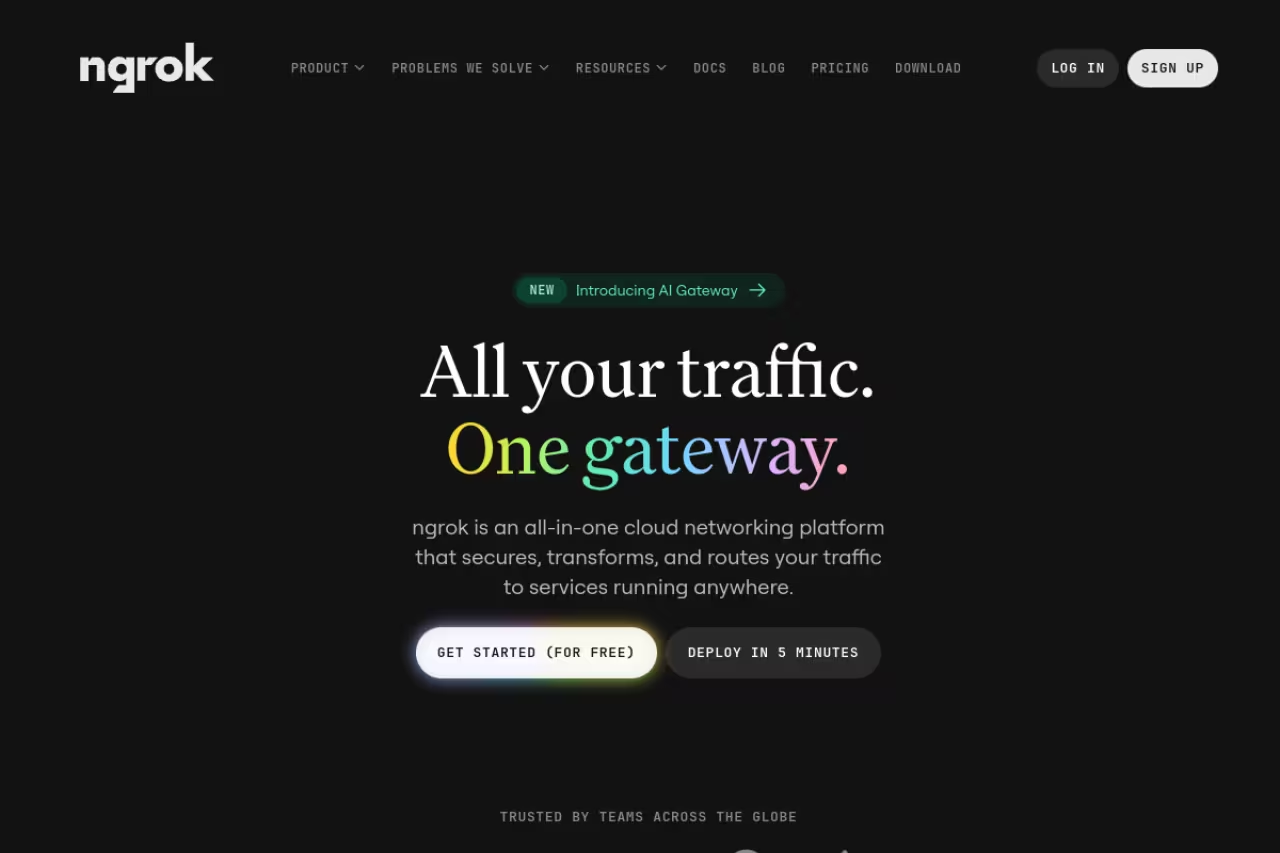
ngrok isn't a webhook platform, it's a tunneling tool, but it's the fastest way to test webhooks during local development and that earns it a spot here. Run one command and ngrok gives you a public HTTPS URL that forwards to your localhost. Paste that URL into Stripe's webhook settings and you can debug the real payload hitting your actual code on your laptop.
ngrok has been a fixture on integration projects for years. Before it, testing a webhook meant deploying to a staging server on every code change. Now you set a breakpoint, trigger the event, and inspect it live. The traffic inspector shows you every request, and you can replay them without re-triggering the provider.
Who it's best for: any developer building or debugging a webhook integration locally.
The free plan covers up to 3 endpoints, 1GB of transfer, and 20k HTTP requests a month with a $5 one-time credit. The Hobbyist plan is $8/month billed annually (or $10 monthly) and bumps you to 100k requests. Pay-as-you-go starts at $20/month with unlimited endpoints.
The catch: ngrok is for development, not production webhook handling. It has no queueing, no durable retries, no event store. Treat it as a debugging tool, not infrastructure. Free-tier URLs also rotate unless you pay, which breaks any provider that expects a stable endpoint.
Any developer debugging a webhook integration locally should have this: one command exposes your localhost on a public HTTPS URL. It is a tunnel for development, not production handling, with no queueing or durable retries.
webhook.site
When you just need to see what a provider actually sends, webhook.site is the fastest path. Open the page and you instantly get a unique URL with no signup. Point any webhook at it and the raw request appears in the browser: headers, body, query params, all of it. I keep a tab open whenever I'm reverse-engineering an undocumented payload.
Paid plans go further with custom actions, email notifications, scripting, and basic workflow automation, which nudges it past pure testing. But the free, zero-friction inspection is why everyone knows it.
Who it's best for: anyone who needs to inspect or share a payload right now without setting anything up.
The fastest way to inspect a payload right now, with no signup, for anyone reverse-engineering an undocumented webhook. Free limits and short retention make it a one-off tool, and never send real secrets through a public endpoint.
Pricing: free for basic use, with Pro at $9/month for more requests, longer retention, and the automation features.
The catch: the free tier has request limits and short retention, so it's for one-off inspection, not ongoing monitoring. And because the endpoint is public, never send real production secrets through it.
Building integrations and content workflows around tools like these is exactly what we cover in Dupple X, our membership for operators who want the practical playbooks, not theory.
Convoy
Convoy is an open-source webhook gateway that handles both directions: sending webhooks to customers and receiving them from providers, in one tool. That dual nature is rare. Most products pick a side. Convoy gives you retries, payload signing, rolling secrets to prevent SSRF attacks, portal links, and transformations.
Who it's best for: teams that want self-hosted control over their full webhook pipeline, or anyone who wants one system instead of stitching together a sender and a receiver.
The self-hosted version is open source and free to run via Docker. Convoy Cloud starts at $99/month for the Pro plan with a 25 events-per-second rate limit, which undercuts both Hookdeck's Growth tier and Svix's Professional plan. Enterprise adds VPC peering, private networking, and a 99.999% SLA.
The catch: running it self-hosted means you own the uptime, scaling, and upgrades. That's real operational work. The cloud tier is cheaper than rivals but the ecosystem and integration count are smaller than Svix's, so you're trading polish and battle-testing for price and flexibility.
A rare open-source gateway that both sends and receives webhooks, suited to teams wanting self-hosted control over the whole pipeline. Self-hosting means owning uptime and upgrades, and the ecosystem is smaller than Svix's.
Hookdeck Outpost
Outpost is Hookdeck's separate product for sending outbound webhooks, and it competes directly with Svix on price. It went GA recently and delivers events natively to nine destination types: standard webhooks plus SQS, S3, Pub/Sub, Service Bus, RabbitMQ, EventBridge, and Kafka. That multi-destination delivery is unusual and handy if your customers want events in a queue rather than an HTTP endpoint.
Who it's best for: cost-sensitive teams that need managed outbound delivery and value queue/streaming destinations.
The headline is price: $10 per million events, roughly 10x cheaper than Svix's $100 per million, with OpenTelemetry observability on every tier and full open-source parity under Apache 2.0. The managed and self-hosted versions run identical code.
The catch: it's newer and thinner. As of now it lacks payload transformations, FIFO ordering, and endpoint throttling, and it doesn't have the production maturity or compliance depth Svix carries. For a customer-facing webhook surface in a regulated industry, that gap matters.
A fit for cost-sensitive teams wanting managed outbound delivery, including queue and streaming destinations, should look here, at $10 per million events. It is newer and thinner, lacking transformations and FIFO ordering, which matters in regulated industries.
Hook0
Hook0 is another open-source outbound webhook server, and its pitch is consistency: the self-hosted and cloud versions ship the exact same features. With most open-source-plus-cloud tools, the hosted version quietly gets the good stuff. Hook0 doesn't play that game, which is reassuring if you plan to self-host long term.
Who it's best for: teams that want to send webhooks, prefer source-available software, and want a clean migration path between self-hosted and managed.
Self-hosting is free via Docker Compose or Kubernetes. The free cloud tier dispatches up to 3,000 events a month with 7-day history, and Hook0 Pro runs EUR190/month (about $205). It's licensed under SSPL, so you can view, fork, and self-host freely. The only real restriction is that you can't resell it as a managed service without open-sourcing your whole stack.
The catch: SSPL is more restrictive than the MIT or Apache licenses behind Svix and Outpost, which matters if you're license-sensitive. The free cloud tier's 3,000-event cap is tiny, so you'll be self-hosting or paying quickly.
Pick Hook0 if you want to send webhooks with identical features self-hosted and in the cloud, and a clean path between them. The SSPL license is more restrictive than MIT or Apache, and the free cloud tier's 3,000-event cap is tiny.
Zapier Webhooks
If you're not a developer, the Webhooks by Zapier app is the easiest entry point. Its Catch Hook trigger accepts any incoming POST, PUT, or GET request, parses the body, and lets you route that data into any of Zapier's 8,000+ connected apps without writing code. Webhook comes in, row gets added to a sheet, Slack message fires. Done.
Who it's best for: marketers, ops people, and no-code builders who need to react to webhook events without standing up a backend.
Webhooks are available on paid plans, starting with the Starter plan at $19.99/month billed annually for 750 tasks. Professional at $49/month unlocks multi-step Zaps and the full feature set most people actually want.
The catch: this is task-metered automation, not webhook infrastructure. There's no real queue depth, replay, or observability, and high-volume webhook streams will burn through your task allowance and your budget fast. It's for low-volume, glue-the-apps-together work, not for handling thousands of events an hour.
The easiest on-ramp for marketers and no-code builders who need to react to webhooks without a backend. It is task-metered glue, not infrastructure, with no replay or observability, so high volumes burn your allowance fast.
How to choose
Start by answering one question: are you receiving webhooks or sending them?
If you're receiving (consuming events from Stripe, GitHub, Shopify), you want a gateway in front of your app. Hookdeck is the managed pick; Convoy if you want to self-host. For just inspecting a payload, webhook.site. For local debugging, ngrok.
If you're sending (your product fires events at your customers' endpoints), you want a webhook server. Svix is the production-grade default and the right call if it's customer-facing or regulated. Outpost or Hook0 if budget matters more than the deepest feature set, with Convoy as the dual-purpose option.
Then sanity-check three things: your monthly event volume against each tier's included quota, whether you need a stable endpoint (rules out free ngrok), and whether compliance certifications are a real requirement (favors Svix). Don't over-buy. A two-person team rarely needs a $499/month gateway, and a regulated fintech shouldn't lean on a free tunneling tool. Match the tool to the job, not the hype.
For more tooling breakdowns like this, browse our top tools directory or related guides on the best AI agents and the best automation tools.
FAQ
What is a webhook management tool?
It's software that handles the reliability layer around webhooks: receiving inbound events, queueing them, retrying failed deliveries, filtering and routing, and giving you a UI to inspect and replay. Some tools handle inbound (receiving), some handle outbound (sending to your customers), and a few do both. Raw webhooks have none of this built in, which is why teams reach for a dedicated tool once volume grows.
What's the difference between Hookdeck and Svix?
Hookdeck is built for receiving inbound webhooks: it sits in front of your app to queue, filter, and replay events from providers like Stripe or GitHub. Svix is built for sending outbound webhooks to your own customers, with an embeddable portal and retry logic. They solve opposite problems, and plenty of companies use both. Hookdeck also has a separate outbound product, Outpost, that competes more directly with Svix.
Is there a free webhook management tool?
Yes, several. ngrok, webhook.site, and Hook0 all have free tiers, and Convoy and Outpost are open source so you can self-host them at no software cost. Hookdeck's free Developer tier covers 10,000 events a month, and Svix's free tier allows 50,000 messages a month. The free tiers are fine for testing and low volume; you typically pay once you need higher throughput, longer retention, or compliance features.
Do I need a webhook tool, or can I just build it myself?
You can build retries, a queue, and a replay system yourself, and for a single low-volume integration that's often fine. The case for a tool gets stronger as you add more providers, higher volume, and stricter reliability needs, since rebuilding that plumbing for every integration adds up. If webhooks are customer-facing, a tool like Svix saves months of work on the portal and delivery logic alone.
Which webhook tool is best for local development testing?
ngrok is the standard choice. It exposes your localhost with a public HTTPS URL in one command, so you can point a real provider at code running on your laptop and debug live. webhook.site is the other go-to when you just want to see a raw payload without wiring up any code at all. Both are testing tools, not production infrastructure.
Webhooks rarely get the attention they deserve until one silently fails and costs you a customer. Pick the tool that matches your direction and volume, set it up before you need it, and you'll skip the 2am log-grepping entirely. If you want help building reliable integration and content workflows around tools like these, Dupple X is where we share the playbooks.
Related guides
Some offers on this page may be paid placements or contain affiliate links.
