
The 8 Best Market Intelligence Tools in 2026

Key facts8 tools compared: AlphaSense, Crayon, Klue, Similarweb, Semrush .Trends, Brandwatch, Contify…
- 8 tools compared: AlphaSense, Crayon, Klue, Similarweb, Semrush .Trends, Brandwatch, Contify, Visualping
- AlphaSense (best for: Financial & strategic research): ~$12K-$50K+/yr, quote-only
- Crayon (best for: Enterprise competitive intel): ~$15K-$40K/yr
- Klue (best for: Sales-facing CI + battlecards): ~$20K-$40K/yr
- Similarweb (best for: Digital market & traffic data): $1,500+/yr, quote-only
Most "market intelligence" you act on is six weeks stale. By the time a competitor's pricing change reaches a slide deck, they've already moved twice. The whole point of a market intelligence tool is to close that gap, to put the competitor's move, the market shift, and the buying signal in front of you while it still matters.
The problem is that "market intelligence" covers wildly different jobs. Tracking a rival's website changes is not the same as reading 500 million financial filings, and neither is the same as listening to what 100,000 customers are saying on Reddit. Buy the wrong category and you'll pay $30,000 a year for a tool that answers a question you weren't asking.
I've spent the last few weeks digging through pricing pages, demos, and reviews to sort the real contenders by job. If you want one answer up front: for deep market and financial research, AlphaSense is the most capable platform on this list, and it's priced like it. For sales-facing competitive intelligence that sellers actually use in deals, Klue and Crayon lead. The rest of this guide covers who each one is genuinely for.
Quick comparison
| Tool | Best for | Price | Standout |
|---|---|---|---|
| AlphaSense | Financial & strategic research | ~$12K-$50K+/yr, quote-only | Generative search across 500M+ documents |
| Crayon | Enterprise competitive intel | ~$15K-$40K/yr | AI "Sparks" digesting competitor moves |
| Klue | Sales-facing CI + battlecards | ~$20K-$40K/yr | Compete Agent feeds reps mid-deal |
| Similarweb | Digital market & traffic data | $1,500+/yr, quote-only | Traffic estimates for any site or market |
| Semrush .Trends | Marketing-led CI | $289/mo + base plan | Market Explorer + traffic analytics |
| Brandwatch | Consumer & social listening | ~$800+/mo, quote-only | Listening across social and forums |
| Contify | Curated news & exec briefings | ~$10K-$20K/yr | 1M+ vetted sources, no noise |
| Visualping | Page-change & price tracking | Free; paid from ~$14/mo | Cheapest way to watch competitor pages |
AlphaSense
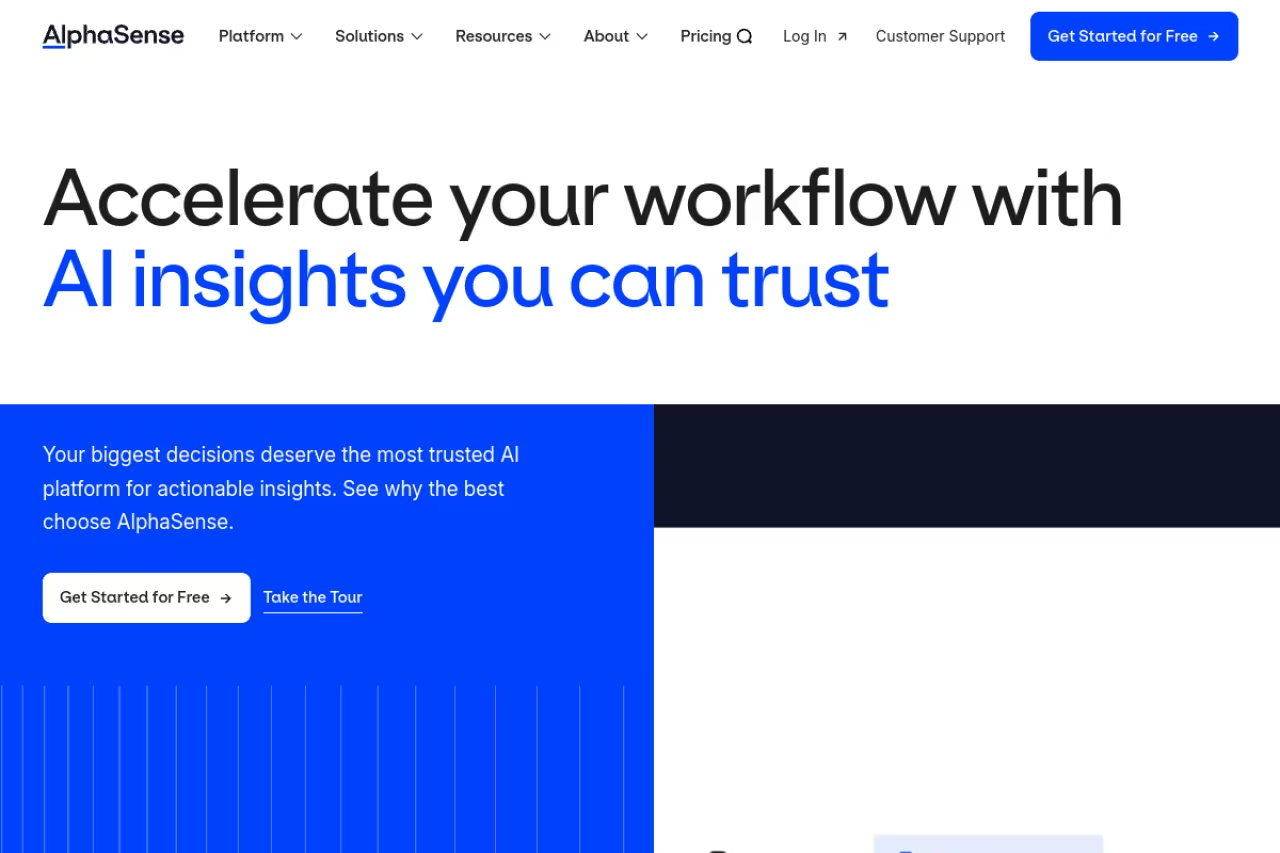
AlphaSense is the heavyweight here, and it's not close. It indexes more than 500 million premium documents: corporate filings, earnings call transcripts, broker research, and a large library of expert interview calls. You search across all of it with AI on top, so instead of reading 40 filings yourself, you ask a question and get a structured answer with citations back to the source.
The heavyweight for investment and strategy teams who need to understand a market or company deeply, with AI search across filings, transcripts and expert calls. Pricing is quote-only and steep.
Generative Grid lets you run one natural-language question across hundreds of documents and get a table back, the kind of thing that used to eat an analyst's whole week. Deep Research does multi-step synthesis and drafts a report, taking up to 30 minutes for a thorough output.
Pricing is quote-only and steep. Reported figures put entry deals around $12K/year, with most seats landing in the $10K-$20K range each and enterprise contracts running well past $50K-$100K, according to third-party pricing data on Vendr. The catch: this is a research platform, not a sales-enablement tool. If your team wants battlecards and Slack alerts when a competitor ships a feature, AlphaSense is overkill and the wrong shape entirely. Buy it for depth, not for speed-to-rep.
Crayon
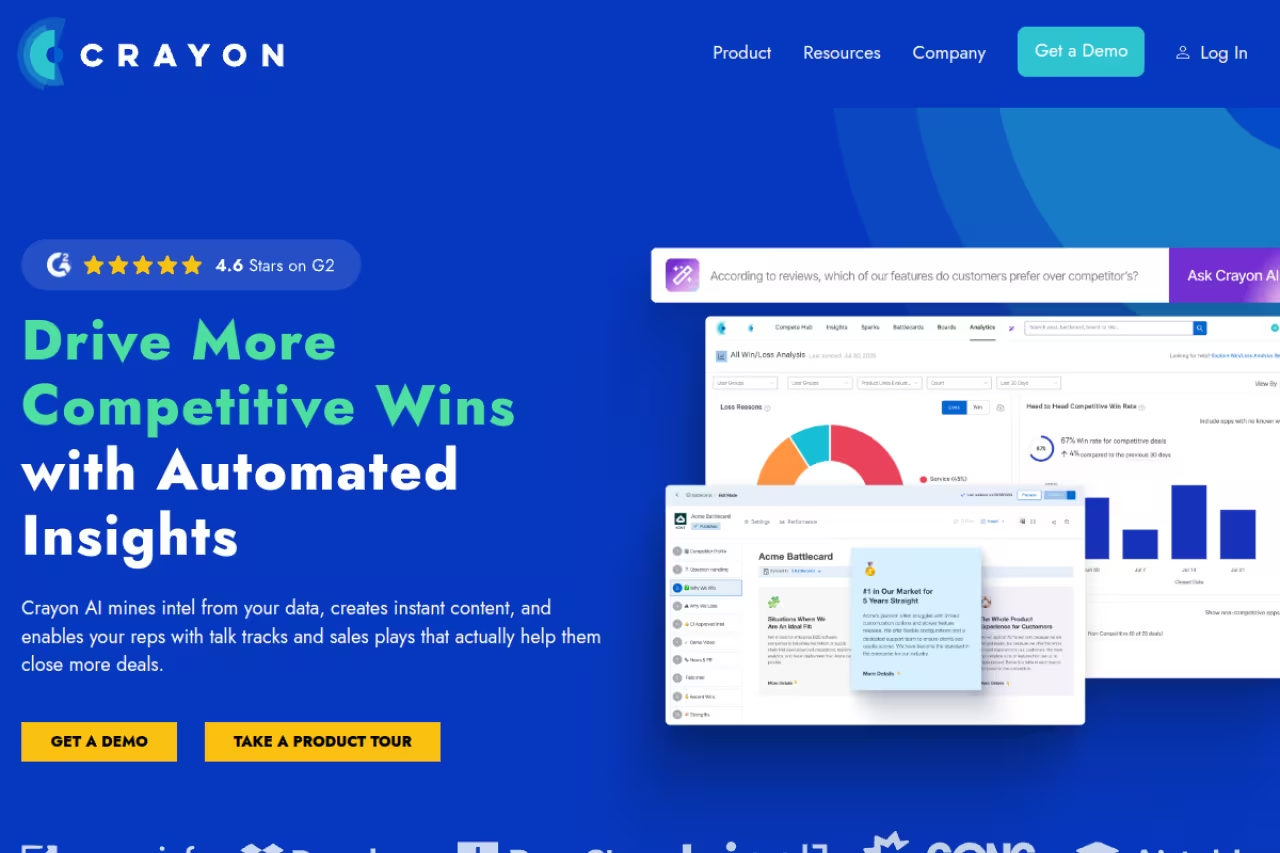
Crayon is the enterprise standard for competitive intelligence as a discipline. It continuously tracks competitor websites, pricing pages, product updates, job postings, and ad campaigns, then uses AI to separate signal from noise so your CI team isn't drowning in every meta-tag change. The output flows into battlecards that push straight into Salesforce and Slack.
The 2026 version leans hard on AI. "Sparks" reads a competitor's strategic moves and writes the summary for you, and Win Story Insights mines call transcripts and deal notes to surface the moments where you actually beat a rival, then turns them into sales content. That second feature is the one I'd pay for. Most CI programs die because nobody updates the battlecards. Pulling real win stories out of recorded calls keeps them alive.
The enterprise standard for competitive intelligence, with battlecards flowing into Salesforce and Slack and AI that surfaces real win stories from calls. Pricing is unpublished and mid-market deals run well into five figures.
Pricing isn't published, but mid-market deals typically run $20,000-$40,000/year, with entry tiers around $15K, per aggregated buyer data on Vendr. One thing to factor in: SoftwareOne completed a $1.4 billion acquisition of Crayon in mid-2025, so you're now buying into a much larger org. Where it falls short: it's a real program, not a quick win. A single overworked product marketer won't get value from it. Crayon assumes someone owns CI as part of their actual job. If nobody does, the tool gathers dust.

Klue
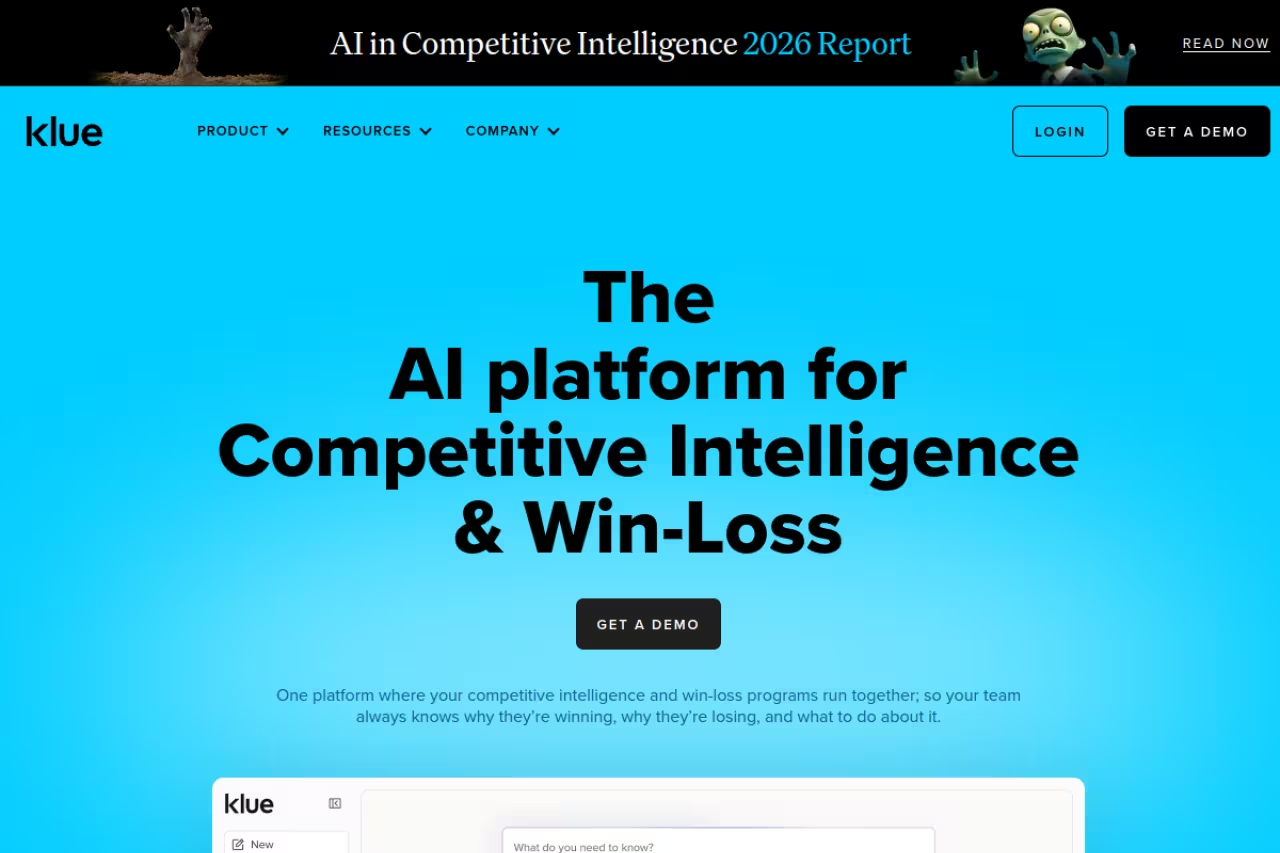
Klue is Crayon's closest rival and the one I'd hand to a sales-led org. Same core idea, automated collection of competitor intel feeding living battlecards, but Klue obsesses over the last mile: getting the right insight to the right rep at the right moment in a deal. Its Compete Agent is the most aggressive agentic-AI play in the category. It collects intel from websites, sales calls, and win-loss interviews, refreshes competitor profiles daily, monitors every call for competitor mentions, and sends sellers "Deal Tips" with specific counter-tactics within minutes.
That's the difference that matters in practice. Crayon and Klue both build good battlecards. Klue is better at making sure a seller reads one before the call instead of after they lose. The platform now serves more than 250,000 users, and Klue acquired Ignition in September 2025 to fold a product-marketing toolkit into the same place.
The sales-led org's choice, better than Crayon at getting the right insight to a rep before the call rather than after the loss. Pricing sits in the same band as Crayon, which is real money.
Pricing sits in the same band as Crayon, roughly $20K-$40K/year depending on seats and competitors tracked. The catch: that price is real money for a tool whose value depends entirely on sales adoption. If your reps ignore enablement content today, Klue's agent will nag them, but it can't force the win. Pilot it with one motivated sales team before you roll it company-wide. For a deeper look at this slice, our guide to the best AI sales enablement tools goes further.
If you're tracking the broader category of autonomous tools doing this kind of monitoring, our roundup of the best AI agents covers the same agentic shift happening across software.

Similarweb
Similarweb answers a question the CI platforms above can't: where is a competitor's traffic actually coming from? It estimates website traffic, top channels, referring sites, audience demographics, and keyword sources for almost any domain, plus market-level views so you can size a whole category and see who's gaining share.
It's the go-to for digital strategy, demand-gen teams sizing markets, and anyone running competitive SEO or paid analysis. The data is modeled, not measured, so treat the numbers as directional. For relative comparisons (Competitor A is growing while B shrinks) it's reliable. For absolute precision it isn't, and Similarweb doesn't pretend otherwise.
The self-service Starter plan lists around $1,500/year (about $199/month), with Professional higher, though Similarweb has moved most pricing to quote-only and serious team deals land in the $30K-$70K+ range. Where it falls short: the free and cheap tiers throttle data hard, capping date ranges and result counts. You often hit a wall right where the analysis gets interesting, which is exactly the nudge toward a sales call. Still, for understanding digital market dynamics, nothing else is this fast.
The go-to for seeing where a competitor's traffic comes from and for sizing markets in digital strategy and SEO work. The data is modeled, so treat it as directional, and cheaper tiers throttle data hard.

Semrush .Trends
If you already live in Semrush for SEO, its .Trends add-on is the most cost-effective market intelligence you can buy. It bundles four tools: Traffic Analytics (any site's traffic and engagement), Market Explorer (size your niche and spot the players), EyeOn (auto-monitors competitors' new content and promos), and One2Target (audience demographics and overlap).
It's best for marketing-led CI where the same team owns SEO, content, and competitive tracking. You get a Similarweb-style view of competitor traffic plus market sizing without buying a second platform. The numbers are modeled like Similarweb's, so the same directional caveat applies.
The cost: .Trends runs $289/month on top of a base Semrush plan, and the base Pro plan starts at $139.95/month, per Semrush's pricing page. So you're looking at roughly $430/month combined, which is genuinely cheap next to the $30K+ platforms. The catch: .Trends is a marketer's lens, not a sales-enablement engine. There are no battlecards, no Slack deal alerts, no rep-facing workflow. It tells you what's happening in the market. It won't help a seller win a specific call.
The most cost-effective market intelligence if you already live in Semrush for SEO, giving marketing-led teams traffic analytics and market sizing. It is a marketer's lens, with no battlecards or rep-facing workflows.
If competitive monitoring is your main goal rather than market sizing, our list of the best AI competitive intelligence tools compares the dedicated options side by side.

Brandwatch
Brandwatch is consumer intelligence: social and web listening at scale. It monitors what people say about your brand, your competitors, and your category across social platforms, forums, news, and review sites, then layers sentiment and trend analysis on top. This is the voice-of-the-market angle the other tools mostly miss.
Consumer intelligence for brand, comms and product teams who need to know how a market feels, through social and web listening. It demands real setup, since sloppy Boolean queries bury you in noise, and pricing is fully custom.
When a competitor's launch flops with customers, or a pricing change triggers a backlash, Brandwatch catches it in the chatter before it shows up anywhere else.
Pricing is fully custom. Third-party data puts the floor near $800/month, with mid-market deployments at $20,000-$45,000/year and enterprise reaching $60,000-$150,000+, according to aggregated figures on Vendr. Where it falls short: listening tools demand real setup. Your Boolean queries determine your data quality, and a sloppy query buries you in irrelevant mentions. Budget time to tune it, or the insights will be noise. It also reads sentiment, not strategy, so pair it with one of the CI platforms above if you need both.
Contify
Contify takes the news-and-narrative approach to market intelligence. It monitors more than 1 million vetted global sources for mentions of your competitors, customers, and industry, filters out the noise, and delivers curated intelligence as digests and briefings. It can also pull in internal signals from tools like Gong and SharePoint.
A curated news-and-narrative feed for strategy teams and executives rather than sales reps. It is priced below the Crayon and Klue band, but has no auto-generated battlecards for sellers mid-deal.
Where Klue and Crayon point at sales reps, Contify points at the leadership team and cross-functional planning.
Pricing runs roughly $10K-$20K/year, which sits below the Crayon/Klue band while still being a real commitment. The catch: Contify is built for breadth and curation, not deal-level enablement. There are no auto-generated battlecards pushed to sellers mid-deal. If your core need is "help my reps win the next call," this isn't the shape you want. If it's "keep our leadership genuinely informed about the market without drowning them," few tools do it cleaner.
Visualping
Visualping is the scrappy entry point, and for a lot of small teams it's all you need to start. It watches any web page and alerts you when it changes: a competitor's pricing page, product page, careers listings, or homepage messaging. No platform, no contract, no CI team required.
The scrappy entry point for founders and lean teams who just want alerts when a competitor page changes, with a free tier and low-cost paid plans. It tells you something changed, not what it means.
The free tier gives you 150 checks a month with no credit card, and paid plans start around $14/month, per Visualping's own pricing. You can stand up a basic competitor-monitoring system in an afternoon.
Where it falls short: it tells you a page changed, not what the change means or what to do about it. There's no AI digest separating signal from noise, no battlecards, no market sizing. It's a monitor, not an intelligence platform. But as a first step, or a permanent solution for a tiny team, it's the best value on this list by a wide margin.
How to choose
Match the tool to the job, not to the marketing. Three questions sort almost every buyer:
Who consumes the intelligence? If it's sales reps in live deals, you want Klue or Crayon. If it's analysts and strategy leads making big calls, AlphaSense or Contify. If it's marketers running competitive SEO and demand gen, Semrush .Trends or Similarweb. If it's brand and product teams reading the market's mood, Brandwatch.
What's your budget reality? Under $1,000/year, you're choosing between Visualping and a Semrush add-on, and honestly that combo covers most early-stage needs. The $10K-$40K band is where the dedicated platforms (Contify, Crayon, Klue) live, and they only pay off if someone owns the program. Above $50K, you're in AlphaSense and enterprise-Brandwatch territory, justified only when the decisions you're informing are worth far more than the tool.
Do you have an owner? This is the one buyers skip. Every platform above $10K assumes a human keeps it fed and acts on it. No owner, no value, no matter how good the AI is. If you can't name that person, start with Visualping and grow into the bigger tools when you can.
A reasonable starter stack for a small team: Visualping for page tracking, Semrush .Trends for market and traffic data, and a free Similarweb account for spot checks. That's under $500/month and covers the essentials before you commit to anything enterprise.
If you'd rather not stitch this together yourself, Dupple X curates the tools and signals worth your attention so you skip the trial-and-error. And our top tools directory is a good place to compare options across categories.
FAQ
What is the difference between market intelligence and competitive intelligence?
Market intelligence is broader. It covers the whole market: trends, customer sentiment, market size, and macro shifts, alongside competitors. Competitive intelligence is a subset focused specifically on rival companies, their products, pricing, and moves. AlphaSense and Contify lean market-wide. Klue and Crayon are squarely competitive. Many teams need both, which is why the stack approach often beats a single tool.
How much do market intelligence tools cost in 2026?
It spans three tiers. Lightweight tools like Visualping start free or around $14/month. Marketing add-ons like Semrush .Trends run roughly $289-$430/month combined. Dedicated platforms like Crayon, Klue, and Contify typically cost $10,000-$40,000 per year, and enterprise research platforms like AlphaSense and Brandwatch run $50,000 or more annually. Almost all the enterprise tools are quote-only.
Are free market intelligence tools good enough?
For a small team starting out, yes. Visualping's free tier and a free Similarweb account cover basic competitor page tracking and traffic spot-checks. You add Google Trends and your competitors' own newsletters and you've got a workable system for $0. The free tools fall short when you need AI to digest signals at scale, push intelligence to sales reps, or analyze financial documents. That's when paid platforms earn their keep.
Which market intelligence tool is best for a B2B SaaS company?
For most B2B SaaS teams, the choice comes down to Klue or Crayon, because both turn competitive intel into battlecards your sales team uses in deals. Klue edges ahead on sales adoption and agentic AI. Crayon edges ahead on enterprise breadth. If you're earlier-stage and budget-constrained, pair Semrush .Trends with Visualping and revisit the dedicated platforms once you have someone to own the program.
Can AI replace a market intelligence analyst?
Not yet, but it's changing the job. Tools like AlphaSense's Deep Research and Klue's Compete Agent now handle the collection and first-pass synthesis that used to eat an analyst's week. What they can't do is judgment: deciding which signal matters, framing the strategic question, and connecting intelligence to a decision. The analysts who thrive in 2026 use these tools to skip the grunt work and spend their time on the thinking. For more on where agents help, see our guide to AI agents.
Want curated signals without building the stack yourself? Try Dupple X free for a year and skip the trial-and-error.
Related guides
Some offers on this page may be paid placements or contain affiliate links.
