
The Best Free VPNs in 2026 (Compared and Ranked)

Key facts6 tools compared: Proton VPN, PrivadoVPN, Windscribe, Planet VPN, hide.me, TunnelBear
- 6 tools compared: Proton VPN, PrivadoVPN, Windscribe, Planet VPN, hide.me and TunnelBear
- A 2024 study of the 100 most popular free Android VPNs found 88% leaked data and 71% shared personal data with third parties.
- Proton VPN's free plan offers unlimited data with no ads, though it limits users to one device and an automatically assigned server.
- Planet VPN's free plan has no signup, no traffic, bandwidth or time limits, and 6 servers in 5 countries: the US, UK, Netherlands, Germany and France.
- TunnelBear's free plan caps at 2GB per month but works on up to 5 devices across 40-plus countries.
Most free VPNs are a bad trade. You install one to hide your traffic, and the app quietly sells your browsing history to a data broker. A 2024 study of the 100 most popular free Android VPNs (over 2.5 billion installs combined) found 88% leaked data and 71% shared personal data with third parties. That is the opposite of what a VPN is for.
So the real question isn't "what's the best free VPN." It's "which free VPNs are actually safe, and which one gives me enough without the catch." Based on years of coverage in this category, the short answer up top: Proton VPN has the best free plan in 2026, full stop. It's the only well-audited provider that gives you unlimited data on a free tier with no ads and a real no-logs policy.
This guide is for people who want privacy on a budget: a developer on hotel Wi-Fi, a founder traveling through a censored country, anyone who needs a VPN a few hours a week and refuses to pay $5/month for it. Below are the six free VPNs in this ranking. 6 tools compared: Proton VPN, PrivadoVPN, Windscribe, Planet VPN, hide.me and TunnelBear.
Quick comparison
| Tool | Best for | Free data | Standout |
|---|---|---|---|
| Proton VPN | Unlimited free use | Unlimited | No data cap, no ads, audited |
| PrivadoVPN | Streaming on a budget | 10 GB/mo | Picks server location yourself |
| Windscribe | Power users who tinker | 10 GB/mo | Custom rules, ad blocker |
| Planet VPN | Unlimited data, no signup | Unlimited | No account, no data cap, ad-supported |
| hide.me | No-signup privacy | 10 GB/mo | No email required, no logs |
| TunnelBear | Total beginners | 2 GB/mo | Dead-simple, friendly UI |
What the ratings can tell you here, and what they cannot
We aggregate review scores across G2, Capterra and Trustpilot in Toolradar. For VPNs specifically, the coverage is uneven in a way worth stating.
| VPN | Aggregated rating | Reviews |
|---|---|---|
| NordVPN | 4.5 | 2,187 |
| ExpressVPN | 4.6 | 286 |
| Surfshark | 4.3 | 923 |
| Mullvad | 4.5 | 3 |
Notice which names are there. The heavily-marketed commercial VPNs have review presence; the privacy-first services do not. Mullvad, widely regarded as the strongest choice for people who genuinely need privacy, has three reviews. The free services this article covers, Proton VPN, PrivadoVPN, Windscribe, Planet VPN, hide.me and TunnelBear, have no aggregated ratings in our data at all.
That is not a quality signal, it is an advertising signal. NordVPN and Surfshark run enormous affiliate and review-site programmes, which puts them in front of far more people at the moment of purchase. Mullvad famously does not, sells at a flat rate with no affiliate scheme, and is invisible to the review economy as a result.
So in this category the ratings tell you which vendors market hardest, which is close to the opposite of what you want to know. Judge on the audit history, the jurisdiction, the logging policy and whether the free tier caps your data, all of which are verifiable and none of which appear in a star score.
Proton VPN: unlimited free data with no ads
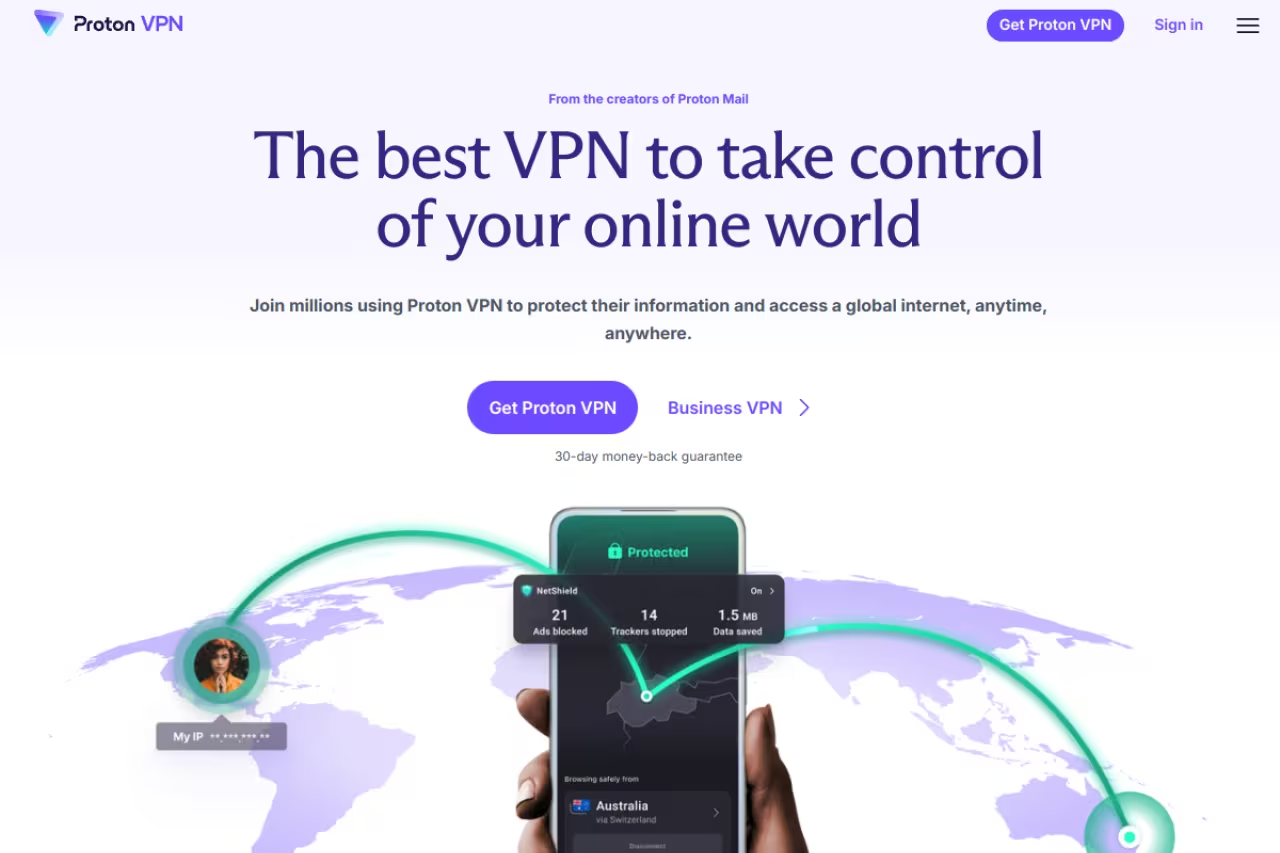
Proton VPN is what happens when the team behind Proton Mail decides to build a VPN and gives the free tier away as a privacy stance rather than a funnel trick. It's based in Switzerland, open source, and independently audited.
The free plan is the headline. There's no data cap, no ads, and a strict no-logs policy confirmed on the official page. You don't watch a video to unlock 15 minutes. You just connect. In late 2025 Proton doubled the free server countries from five to ten, so you now route through places like the US, Netherlands, Japan, Switzerland, and Singapore.
Who it's best for: anyone who wants a free VPN they can leave on. If you only remember one name from this article, it's this one.
The free VPN to leave on, with no data cap, no ads and a strict no-logs policy. The free plan is limited to one device, auto-assigns your server, blocks P2P and feels throttled for 4K streaming.
Free forever with unlimited data. Paid Plus is $9.99/month month-to-month, dropping to roughly $4.99/month on a two-year plan, which unlocks 110+ countries, 10 devices, and streaming-optimized servers.
The standout: unlimited bandwidth on a genuinely trustworthy, no-ads free tier. Every other well-audited provider on this list makes you ration gigabytes.
The catch: the free plan limits you to one device and assigns your server automatically. You can't manually pick a country, P2P is blocked, and free speeds are slower than paid because free users share fewer servers. For casual browsing it's fine. For 4K streaming, you'll feel the throttle.
PrivadoVPN: the best free pick for occasional streaming
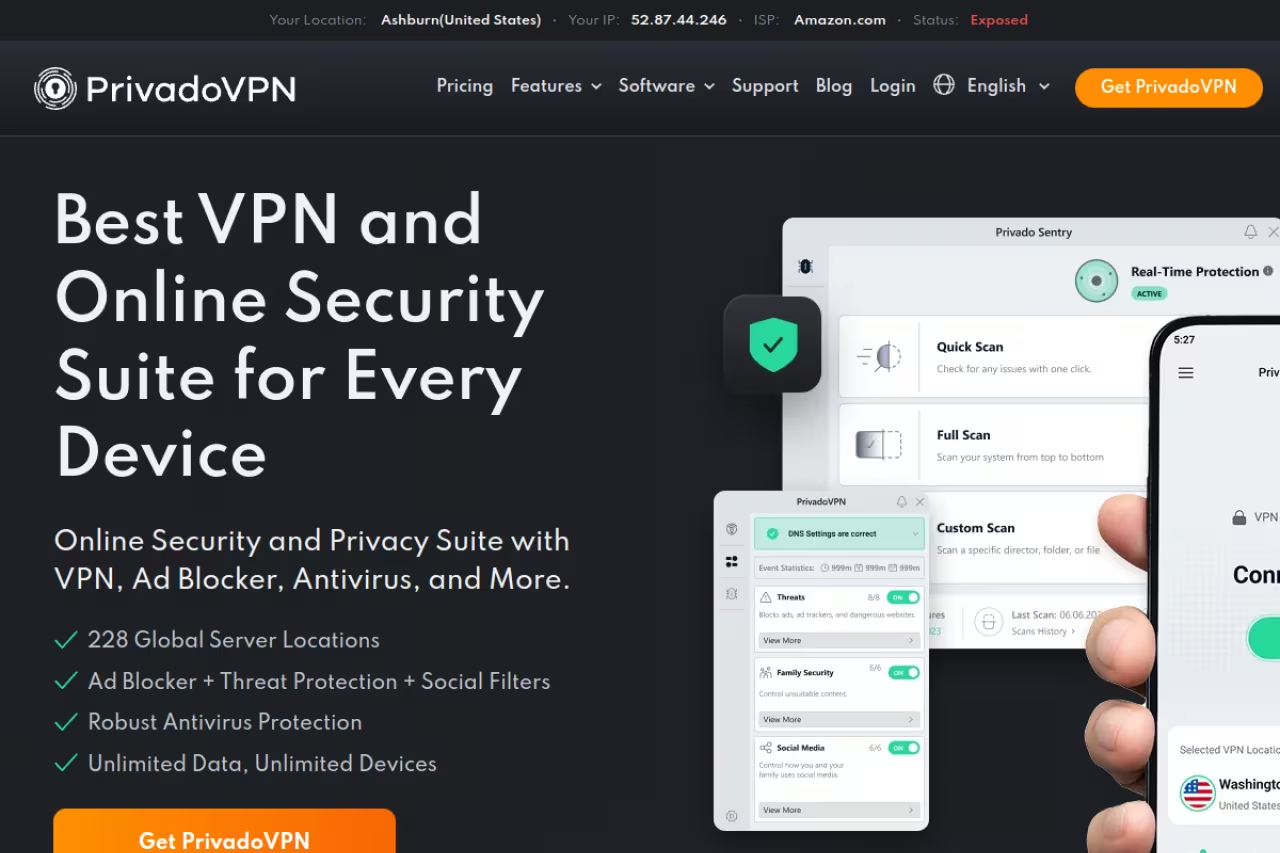
PrivadoVPN is the free VPN I recommend to people who actually want to unblock something. The free tier gives you 10 GB of full-speed data per month across 13 server locations in 10 countries, including the US, UK, Germany, Switzerland, and Canada. That's more freedom of choice than Proton's free tier, because you pick the city yourself.
It runs AES-256 encryption, a kill switch, split tunneling, an ad blocker, and it allows P2P on the free plan, which is rare. When you burn through 10 GB, your speed drops to 1 Mbps rather than cutting you off, so you can still load a webpage in a pinch.
Who it's best for: someone who wants to watch a few episodes of a region-locked show or torrent occasionally without paying.
The free pick for occasional streaming or torrenting, with 10 GB of full-speed data a month, a choice of server city and P2P allowed. That 10 GB is roughly 3 hours of 1080p Netflix before speeds drop to 1 Mbps.
Free with 10 GB/month. Paid plans run around $1.99/month on the longest term, which removes the cap and adds more servers.
The standout: you choose your server location on the free plan, and it doesn't throttle you until you hit the cap.
Where it falls short: 10 GB disappears fast. That's roughly 3 hours of 1080p Netflix before you're stuck at 1 Mbps. The server network is small next to a premium VPN, so peak-hour speeds wobble.

Windscribe: the free VPN for people who like knobs to turn
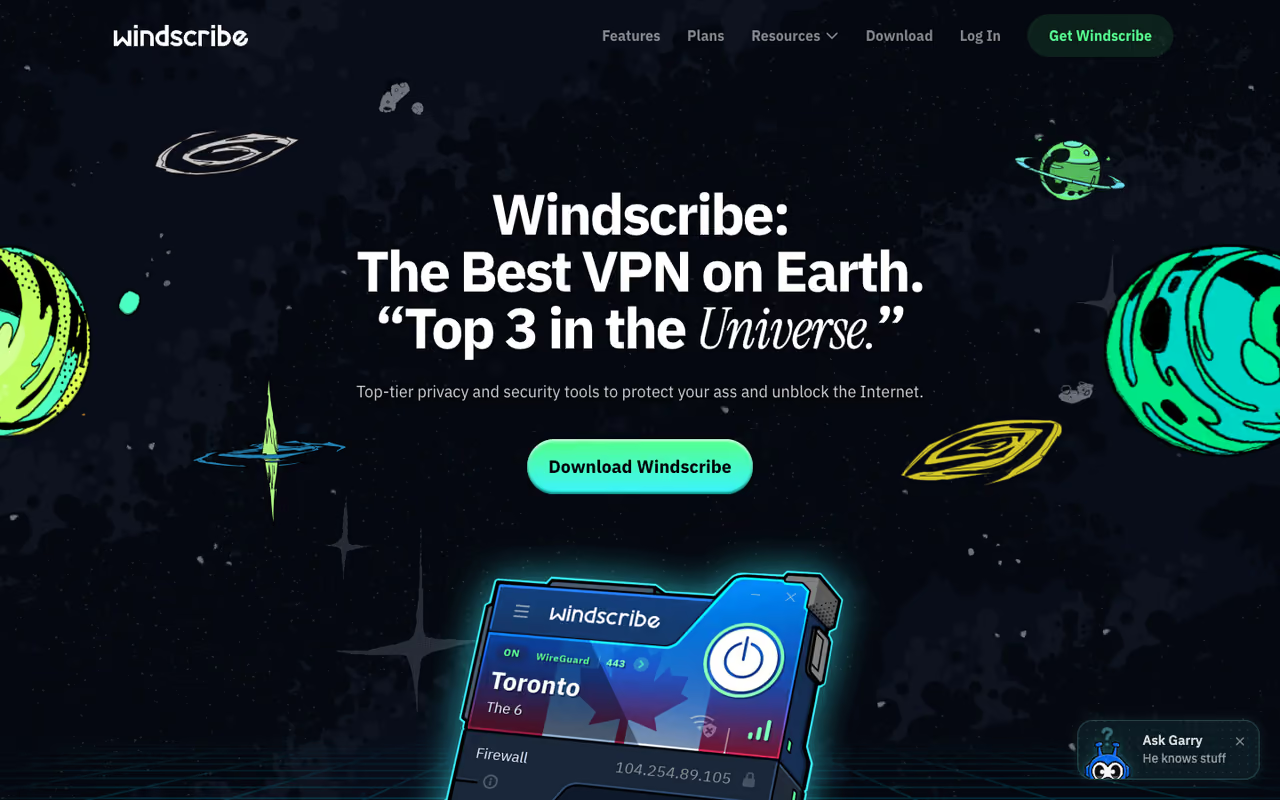
Windscribe is the tinkerer's free VPN. Out of the box you get 2 GB a month, but verify your email and it jumps to 10 GB. Tweet about Windscribe and you can grab a few more gigs on top. It feels like a service run by people who use VPNs themselves.
The reason power users like it: R.O.B.E.R.T., its built-in DNS-level blocker for ads, trackers, and malware domains, works on the free plan. There's a config generator, browser extensions with extra features, and granular control over protocols. Free users get access to servers in 10+ countries.
Who it's best for: developers and privacy nerds who want to configure things, block trackers network-wide, and don't mind verifying an email for the full 10 GB.
For tinkerers and privacy nerds who want R.O.B.E.R.T. network-wide blocking and fine protocol control for free. The full 10 GB requires email verification, with a stingy 2 GB before it, so the headline claim has an asterisk.
Free with 10 GB/month after email verification. The "Pro" plan is around $5.75/month annually for unlimited data and all locations. There's also a flexible "Build a Plan" option at $1/location/month with 10 GB, handy if you only need one country.
The standout: R.O.B.E.R.T. and the sheer configurability. No other free VPN gives you this much control.
The catch: the interface is busier than the rest, and 10 GB is still 10 GB. The default 2 GB before email verification is stingy, so the "10 GB free" claim has an asterisk.
Planet VPN: free unlimited data with no account required
Planet VPN combines two things free VPNs usually make you trade off: no data cap and no signup. You install the app and connect, with no account and no email. It is run by FREE VPN PLANET S.R.L., a company based in Bucharest, Romania, which is outside the 14 Eyes alliance, and it states a strict no-logs policy: no browsing history, IP addresses, connection timestamps or session activity are stored.
The free plan gives you 6 servers across 5 countries (the US, the UK, Germany, France and the Netherlands) with no limits on traffic, bandwidth or session time, and you pick the location yourself, which Proton's free tier does not allow. Planet VPN supports OpenVPN, IKEv2 and StarGuard, its own protocol built for speed, with 256-bit encryption, a kill switch and DNS and WebRTC leak protection. Apps cover Windows, macOS, Linux, iOS, Android, Android TV and Huawei devices, plus extensions for Chrome, Firefox, Edge and Opera.
Who it's best for: the privacy-first user who doesn't want to create yet another account but also doesn't want to ration gigabytes, or anyone who needs a VPN on several devices for everyday browsing.
A good fit when you want unlimited free data without signing up: no email, no account, a stated no-logs policy and 5 free countries. The free tier shows short ads, and streaming, P2P and split tunneling are reserved for Premium.
Free with unlimited data. Premium is $9.99/month month to month, $3.99/month on the annual plan and $1.99/month on the 4-year plan, which removes ads and unlocks 1,260+ servers in 100+ locations, streaming and P2P support, Double VPN, split tunneling and 24/7 support.
The standout: unlimited data with no account at all. Among the free VPNs on this list, Proton VPN has no cap but requires a signup, while hide.me, the other no-signup option, caps free data at 10 GB a month.
The catch: free server choice is limited to 5 countries in Europe and North America, so users in Asia or Australia will see higher latency. The free plan is ad-supported, and it isn't the pick for Netflix or torrenting unless you upgrade. Unlike Proton VPN, hide.me and TunnelBear, Planet VPN does not publish an independent security audit on the pages we read. It's best for general browsing, public Wi-Fi and travel.

hide.me: free privacy with no account required
hide.me wins on one specific thing: you don't have to hand over an email to use the free plan. No signup, no account, no name attached to your traffic. For a privacy tool, that's the right default. It's based in Malaysia, runs a strict no-logs policy, and has passed independent audits.
The free plan gives you 10 GB of data per month with no ads and a handful of free server locations. It supports WireGuard, and the apps are clean across Windows, Mac, iOS, and Android.
Who it's best for: the privacy-first user who doesn't want to create yet another account, or anyone setting up a VPN for a quick anonymous session.
Choose hide.me when you do not want to create an account: no email, no signup, and a strict no-logs policy, with 10 GB a month and no ads. Free server choice is limited and distant servers slow sharply.
Free with 10 GB/month. Paid plans land around $2.59/month on a multi-year term for unlimited data and the full ~2,600-server, 90-plus-country network.
The standout: no email, no account, real no-logs. That's about as anonymous as free gets.
Where it falls short: free server choice is limited to a few locations, and speeds on distant free servers drop hard. Connect to Australia from Europe and you'll feel it. It's fine for general browsing, less so for latency-sensitive work.

TunnelBear: the friendliest free VPN for beginners
TunnelBear is the one I install on a non-technical friend's laptop. The bear theme makes it approachable, the app has roughly two buttons, and it's been independently audited by Cure53 every year, which matters for a VPN owned by McAfee. It uses AES-256 and supports WireGuard.
The catch is right there in the data allowance. The free plan caps you at 2 GB per month, which is the tightest limit on this list. That's enough for occasional browsing on public Wi-Fi, not for streaming. On the plus side, you can use it on up to 5 devices and connect to its full network of 40-plus countries even on the free tier.
Who it's best for: the absolute beginner who wants protection on coffee-shop Wi-Fi and would be intimidated by Windscribe's settings.
The friendliest VPN for beginners on coffee-shop Wi-Fi, audited by Cure53 every year and usable on up to 5 devices. The free 2 GB a month is the tightest cap here, about 20 minutes of HD video, and it does not reliably unblock Netflix.
Free with 2 GB/month. Unlimited paid plans run around $3.33/month on the annual term.
The standout: simplicity plus a serious audit history. You can hand this to anyone and they'll figure it out in 30 seconds.
The catch: 2 GB is barely a rounding error. Roughly 20 minutes of HD video and you're done for the month. It also doesn't reliably unblock Netflix on free servers.
A quick word on what to avoid
Hotspot Shield gets recommended a lot for "unlimited free" speeds, but the free tier is ad-gated (watch a 15-30 second ad for 15 minutes of use) or capped at 500 MB/day depending on platform, with a heavy upsell. It's usable, but the experience is rough next to the six above.
The bigger warning: stay away from no-name free VPNs from the app stores. The research showing 88% of free VPNs leak data was about those exact apps. If a VPN has no audit, no published company, and no clear funding model, the product is you. Proton VPN, PrivadoVPN, Windscribe, hide.me and TunnelBear all have audits and a paid tier that funds the free one. Planet VPN publishes a company (FREE VPN PLANET S.R.L) and a Premium tier; its free plan is funded by short ads, per the vendor's site on October 15, 2026. A published funding model is what makes a free VPN safer than a no-name app.
If you're building a privacy stack, a VPN is one layer. Pair it with one of the best free password managers and decent antivirus software, and you've covered the basics without spending a cent. Teams that take security seriously also lean on dedicated AI cybersecurity tools for the heavier lifting.
Want the tools we actually use to stay productive and secure? The Dupple X bundle packages our recommended apps in one place.
How to choose your free VPN
Don't overthink it. Match the VPN to how you'll actually use it.
- You want one VPN to leave on and forget: Proton VPN. Unlimited data means you never hit a wall, and you don't have to think about it.
- You want to stream or torrent sometimes: PrivadoVPN. You pick the server, and 10 GB covers a few sessions a month.
- You're technical and want control: Windscribe. R.O.B.E.R.T. and the config options are worth the busier UI.
- You want unlimited data without creating an account: Planet VPN. No signup, no data cap, six free servers in five countries.
- You refuse to create an account and want a published audit: hide.me. No email, full stop.
- You're setting this up for a parent or a friend: TunnelBear. The 2 GB cap is the price of the simplest app here.
One rule overrides all of the above: if you need a VPN for daily streaming or work where downtime costs you money, a free plan is the wrong tool. The 10 GB caps and shared free servers will frustrate you within a week, and a paid plan at $2-5/month is cheaper than your wasted time. The free tiers above are best as a safety layer, a travel tool, or a trial before you commit. For more privacy and AI picks, browse our top tools directory.
Frequently asked questions
Are free VPNs safe to use?
Most are not. A study of the 100 most popular free Android VPNs found 88% leaked data and 71% shared personal information with third parties. The exceptions are providers with a paid tier funding the free one, independent security audits, and a published no-logs policy. Proton VPN, hide.me, Windscribe, PrivadoVPN, and TunnelBear all meet that bar. Random app-store VPNs do not.
What is the best free VPN with unlimited data?
Proton VPN is the only well-audited provider offering genuinely unlimited data on its free plan, with no ads and a strict no-logs policy. Planet VPN also advertises unlimited traffic, bandwidth and time on its free plan, with no signup, six servers and short ads, per its site on October 15, 2026. The other reputable free VPNs here cap you somewhere between 2 GB and 10 GB per month. If unlimited data without ads is your priority, Proton VPN is the clear pick.
Can I use a free VPN for Netflix and streaming?
Sometimes, but expect limits. PrivadoVPN's free plan lets you choose your server and unblock some libraries, but 10 GB only covers about 3 hours of 1080p video a month. Proton VPN's free servers don't let you pick a country and run slower, which makes streaming hit or miss. For regular streaming, a paid plan is the realistic answer.
Do free VPNs slow down your internet?
Yes, usually. Free users share a smaller pool of servers, so speeds drop during peak hours. PrivadoVPN and Windscribe give you full speed until you hit the data cap, then throttle hard. Proton VPN's free servers are slower than its paid ones by design. For light browsing the slowdown is tolerable; for large downloads it's noticeable.
Is a free VPN enough, or do I need to pay?
It depends on use. If you need a VPN a few hours a week for public Wi-Fi or occasional privacy, a free plan from this list is plenty. If you stream daily, work remotely over the connection, or run multiple devices, the data caps and device limits will push you to a paid plan, which typically runs $2-5/month on a longer term. Start free, upgrade only if you hit the wall.
Related guides
Some offers on this page may be paid placements or contain affiliate links.
