
The Best Employer of Record Services (2026)

Key facts8 tools compared: Deel, Remote, Multiplier, Rippling, Oyster HR, Velocity Global (Pebl)…
- 8 tools compared: Deel, Remote, Multiplier, Rippling, Oyster HR, Velocity Global (Pebl), Papaya Global, Native Teams
- Deel (best for: Most companies, broad coverage): $599
- Remote (best for: Compliance-first, IP protection): $599 (annual) / $699 monthly
- Multiplier (best for: APAC hiring, lower cost): ~$400
- Rippling (best for: Existing Rippling HR/IT customers): $500-$1,000+ (quote)
Hiring someone in another country sounds simple until you read the fine print. You can't legally pay a developer in Brazil or a designer in Germany without a local entity, and setting one up costs tens of thousands of dollars and months of paperwork. An employer of record (EOR) solves this by becoming the legal employer on paper, handling payroll, taxes, benefits and compliance, while the person still works for you.
The catch is that almost every EOR now claims the same thing: hire anyone, anywhere, fully compliant. The differences are in pricing structure, how many countries they actually own entities in (versus renting through a partner), and how badly they nickel-and-dime you on currency conversion and offboarding. I've worked with global teams long enough to know the headline price is rarely the real price.
If you want the short version: Deel is the safest default for most companies. It owns entities in more countries than almost anyone, the platform is genuinely good, and at $599 per employee per month it's priced in line with the rest of the market. But the right pick depends on where you're hiring and how many people. Here's how the top options actually compare.
Quick comparison
| Tool | Best for | Price (per employee/mo) | Standout |
|---|---|---|---|
| Deel | Most companies, broad coverage | $599 | 110+ owned-ish entities, all-in-one |
| Remote | Compliance-first, IP protection | $599 (annual) / $699 monthly | Owns its entities, transparent |
| Multiplier | APAC hiring, lower cost | ~$400 | Cheapest of the big names, 150+ countries |
| Rippling | Existing Rippling HR/IT customers | $500-$1,000+ (quote) | One system for HR, IT, EOR |
| Oyster HR | Mission-driven teams, wide reach | $699 | 180+ countries, strong support |
| Velocity Global (Pebl) | Enterprise, complex cases | ~$599-$660 | High-touch service |
| Papaya Global | Large workforces, payroll depth | $650-$770 | Payments and payroll engine |
| Native Teams | Freelancers, solo hires, budget | ~$99-$400 | Cheapest entry point |

Deel: the default choice for most teams
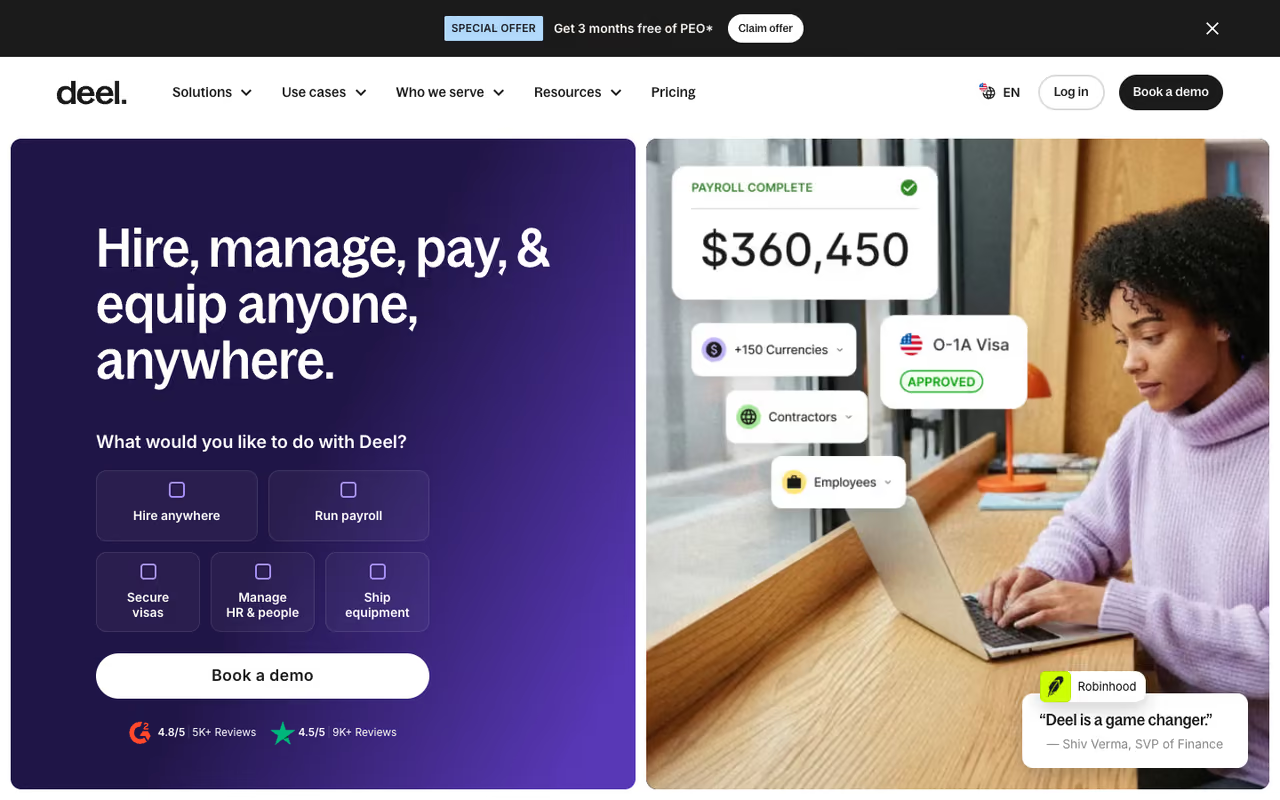
Deel is the one I recommend when someone has no strong reason to pick anything else. It covers full legal employment in 110+ countries and bundles EOR, contractor management, global payroll and immigration into a single platform. Onboarding a new hire often takes a few days rather than weeks, and the dashboard handles contracts, expenses and time off without you touching a spreadsheet.
Who it's best for: companies hiring across many different countries who want one tool to do everything. With 40,000+ customers, it's also the safest bet if you care about a vendor that won't disappear.
The safe default for companies hiring across many countries who want EOR, contractors, payroll and immigration in one platform, with 40,000+ customers behind it. Standard EOR is $599 per employee per month, and currency margins and add-on fees creep up.
Pricing is $599 per employee per month for the Standard EOR plan, and $899 for Enterprise, which adds a dedicated onboarding manager, in-app contract redlining and legal response guarantees. Contractor management is much cheaper if that's mostly what you need.
The catch: Deel grew fast, and it shows in the extras. Currency conversion margins and add-on fees creep up, and support quality varies by country. You're buying breadth and reliability, not the lowest sticker price.

Remote: the compliance purist
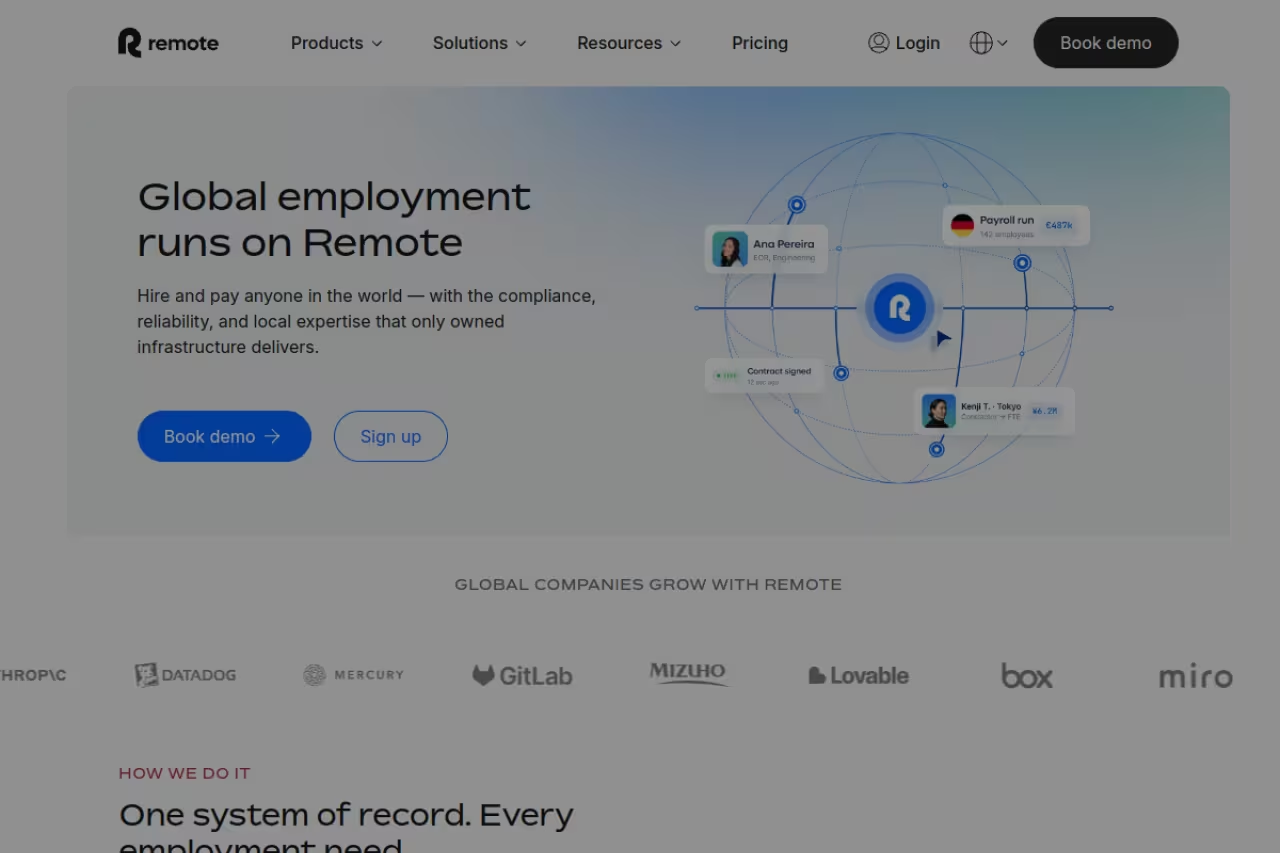
Remote built its reputation on owning its own legal entities rather than renting them through third parties, which matters more than it sounds. When your EOR owns the entity, there's no mystery middleman handling your employee's compliance, and your intellectual property assignment is cleaner. For a startup whose code or designs are the whole company, that's worth paying attention to.
Who it's best for: teams that put compliance and IP protection first, especially in markets where Remote has direct entities. It covers 90+ countries with no minimums and no setup fees.
The compliance purist's pick for teams that put IP protection first, since it owns its own legal entities. It costs $599 per employee per month billed annually, and its directly-owned coverage is narrower than Deel's or Multiplier's, so check your target country.
Pricing is $599 per employee per month billed annually, or $699 month-to-month, a 14% discount for committing. Pre-seed through Series A companies can get 15% off for the first year, bringing it closer to $509. Notably, Gusto's global EOR runs on Remote's infrastructure, so if you're a Gusto shop you're already in this ecosystem.
The catch: Remote's directly-owned coverage is narrower than Deel's or Multiplier's. If you're hiring in a long-tail country, check whether Remote serves it directly or falls back to a partner, which undercuts the main reason to choose them.

Multiplier: best value, especially in Asia-Pacific
Multiplier is what I point people toward when budget matters and they're hiring in Asia. At around $400 per employee per month, it undercuts Deel and Remote by roughly $200 a head, which adds up fast across a team of ten. It covers 150+ countries and the platform is clean without feeling stripped down.
Who it's best for: companies hiring in Singapore, India, Australia, Japan or elsewhere in APAC, where Multiplier's local support tends to beat Western-focused providers. It's also a strong pick for smaller teams watching costs.
Choose it when budget matters and you are hiring in APAC, at around $400 per employee per month, roughly $200 under Deel and Remote. It is a younger, leaner company, so confirm whether the entity is owned or partner-run in obscure markets.
Pricing is refreshingly simple: one flat fee per employee, billed monthly, cancel anytime. Global payroll and immigration are quoted separately based on your countries and headcount.
The catch: Multiplier is a younger, leaner company than Deel or Remote. The brand recognition isn't there yet, and if you're hiring in obscure markets you'll want to confirm whether the entity is owned or partner-run. For mainstream APAC and European hiring, though, it's hard to beat on price.
If you're building a distributed team and want help spotting the right tools across hiring, ops and growth, Dupple X is worth a look.

Rippling: only if you already live in Rippling
Rippling is an unusual case because EOR isn't its core product. It's an HR, IT and finance platform that bolts EOR on top. If you already run payroll, devices and app provisioning through Rippling, adding international employees in the same system is genuinely convenient.
Who it's best for: existing Rippling customers who want everything in one place.
Only worth it if you already run payroll, devices and apps through Rippling and want international hires in the same system. EOR runs through partners in 80+ countries and rates are not published, so starting here just for EOR rarely pays off.
Pricing is where it gets murky. The platform starts at $8 per user per month, and EOR sits on top at quote-based rates that third parties peg anywhere from $500 to $1,000+ per employee per month. Complex markets like Brazil, India or France can push that toward $800-$1,200.
The catch: Rippling runs its EOR through third-party in-country partners in 80+ countries, fewer than Deel or Multiplier, and it doesn't publish country rates, so you only learn the real cost during the sales process. If you're not already a Rippling shop, the math rarely favors starting here just for EOR.

Oyster HR: wide reach with a human touch
Oyster HR markets itself to mission-driven and distributed-first companies, and the positioning isn't just branding. The product is solid, support gets consistently good reviews, and it reaches 180+ countries, among the widest stated coverage of any provider here.
Who it's best for: globally distributed teams that value responsive support and want to hire in a lot of different places, including less common markets.
The pick for globally distributed teams that value responsive support and want 180+ countries, including less common markets. The headline $699 per employee per month is on the high end, and some markets run through partners rather than owned entities.
Pricing is $699 per employee per month for EOR, with annual deals reported closer to $499-$599. Like everyone, that figure covers the platform and compliance, not salary, employer taxes or statutory benefits.
The catch: the headline $699 is on the higher end, and the very wide country count means some of those markets run through partners rather than owned entities. Watch for fees on currency conversion and offboarding, which is where the real cost often hides with any EOR.

Velocity Global (Pebl): built for the enterprise edge cases
Velocity Global, now operating its platform under the Pebl brand, leans toward larger companies with complicated requirements. Think mergers, acquired teams that need to be transitioned, or hires in jurisdictions that scare off smaller providers.
Who it's best for: enterprises and companies with messy, high-stakes global employment situations that need a high-touch partner rather than a self-serve dashboard.
A service-led choice for enterprises with messy, high-stakes situations like mergers or tough jurisdictions. The $399 promotional rate is rarely what you get, with real quotes closer to $660, and it is overkill if you just want one engineer in Poland.
Pricing advertises a $399 per employee per month promotional rate, but standard pricing lands around $599, and real-world quotes including the layered fees often come closer to $660. As with most enterprise vendors, the number you see and the number you pay diverge.
The catch: the self-serve experience is weaker than Deel's or Multiplier's, and the promotional pricing is rarely the rate you actually get. This is a service-led provider, which is great if you need hand-holding and overkill if you just want to hire one engineer in Poland.

Papaya Global: payroll muscle for big workforces
Papaya Global is really a global payroll and payments company that also does EOR. Its strength is moving money to large, distributed workforces accurately, with a payments engine that handles the messy reality of paying hundreds of people in dozens of currencies.
Who it's best for: companies running sizable global teams who care as much about payroll and payments infrastructure as about the EOR layer itself.
EOR starts around $650 per employee per month, with a premium tier near $770 that adds dedicated HR support. Companies with 50+ employees on annual contracts report rates dropping into the $450-$550 range, and global payroll for your own entities runs about $25 per employee per month.
The catch: Papaya is priced and built for scale. For a startup hiring its first international employee, it's more platform than you need, and the entry price reflects that.
The fit for sizable global teams that care as much about payroll and payments infrastructure as the EOR layer, starting around $650 per employee per month. For a startup making its first international hire, it is more platform than you need.
Native Teams: the budget entry point
Native Teams is the cheapest way onto this list, which makes it interesting for freelancers, solo founders and very small teams. Its starting prices are far below the big providers, and it leans toward serving individual contractors and small operations rather than scaling enterprises.
Who it's best for: freelancers who want to get paid compliantly across borders, and tiny teams making their first international hire on a tight budget.
The lean choice for freelancers and tiny teams making a first international hire on a tight budget, with real EOR rates in most countries between $300 and $400. Coverage and depth are thinner than larger providers, so a fast-scaling global team will likely outgrow it.
Pricing starts as low as ~$99 per employee per month on paper, though real EOR rates in most countries land in the $300-$400 range, still meaningfully below Deel and Remote.
The catch: you get what you pay for on coverage and depth. Native Teams doesn't match the country breadth or enterprise-grade compliance machinery of the larger providers. For one or two hires in common markets it's a smart, lean choice. For a fast-scaling global team, you'll likely outgrow it.
How to choose
Forget the feature checklists for a second. Three questions decide this:
Where are you hiring? Match the provider to your countries, and confirm the entity is owned, not rented through a partner, in the specific markets you care about. Deel and Multiplier have the broadest owned-ish coverage; Multiplier is strongest in APAC; Oyster reaches the most countries on paper.
How many people, and how fast? One or two hires in common markets? Native Teams or Multiplier keep costs down. A growing team across many countries? Deel or Remote give you one reliable system. A large enterprise with edge cases? Velocity Global or Papaya.
What already runs your stack? If you're on Rippling for HR and IT, or Gusto for payroll, staying in that ecosystem saves real integration pain even if the per-head price isn't the lowest.
One rule applies to all of them: the monthly platform fee is the small part. The real cost is salary plus employer taxes plus statutory benefits, which can add 30-40% on top of gross in countries like France or Germany. Ask every provider for a full cost breakdown for your specific country before you sign, and read the fine print on currency conversion and offboarding fees. You can browse more vetted software in our top tools directory.
If you're assembling a remote-first stack beyond hiring, the guides to the best AI tools for HR, communication tools for remote teams and accounting software for startups cover the rest of the toolkit. And if you want a curated shortlist instead of trawling reviews, Dupple X does the legwork.
FAQ
What is an employer of record and how is it different from a PEO?
An employer of record legally employs workers on your behalf in countries where you have no entity, taking on payroll, taxes, benefits and compliance. A PEO (professional employer organization) co-employs staff in a country where you already have a legal presence, typically within your home market. Put simply: use an EOR to hire abroad without an entity, and a PEO to outsource HR where you already operate.
How much does an employer of record cost per employee?
Most established EOR providers charge $499 to $699 per employee per month for the platform and compliance, with Multiplier around $400 and Native Teams starting lower for small teams. That fee does not include the employee's salary, employer taxes or statutory benefits, which in high-cost countries can add 30-40% on top of gross pay. Always get a full cost breakdown for your specific country.
Which is the best employer of record service overall?
For most companies, Deel is the strongest default thanks to broad country coverage, an all-in-one platform and a large, stable customer base. Remote is the better pick if compliance and IP protection top your list, and Multiplier wins on price, especially for hiring in Asia-Pacific. The right choice depends on where you hire and how many people.
Does an EOR own its own legal entities or use partners?
It varies by provider and by country. Owning the entity means the EOR directly handles compliance and your employee's contract, which gives cleaner IP assignment and fewer middlemen. Some providers own entities in their core markets and rent through partners elsewhere. Remote emphasizes owned entities; Deel and Multiplier own many but use partners in long-tail countries. Always confirm the model for the specific country you're hiring in.
Can I use an employer of record to hire one person in one country?
Yes, and it's one of the most common use cases. There are no minimums with most providers, so you can hire a single employee in a single country without setting up an entity. For one or two hires in common markets, lower-cost options like Multiplier or Native Teams often make the most sense before you scale up to a broader platform.
Related guides
Some offers on this page may be paid placements or contain affiliate links.
Across our whole catalogue the median is $24 a month and 33% of tools advertise a free tier. Figures are the lowest recurring monthly price quoted in our own review of each tool, read on 2026-08-19. Full method and every category.
