
The 8 Best AI Voice Cloning Tools in 2026 (Compared)

Key facts8 tools compared: ElevenLabs, Cartesia, Resemble AI, PlayAI (PlayHT), Descript, Murf AI…
- 8 tools compared: ElevenLabs, Cartesia, Resemble AI, PlayAI (PlayHT), Descript, Murf AI, Speechify, Chatterbox
- ElevenLabs (best for: Highest-fidelity narration): Free; paid from $6/mo
- Cartesia (best for: Real-time voice agents): Free; paid from $5/mo
- Resemble AI (best for: Enterprise + on-prem): Pay-per-use from $0
- PlayAI (PlayHT) (best for: Long-form content creators): Free; paid from ~$31/mo
Voice cloning has gotten unsettling. Record a short sample, generate a paragraph that was never spoken aloud, and play it back: the breathing might land in the wrong places, but a stranger listening cold would likely not catch that it isn't the real person.
Picking a tool is the hard part. There are dozens now, the pricing models are a mess of credits and characters and per-second billing, and most "best of" lists are stuffed with affiliate filler that never looked past the marketing page. So this compares eight platforms on documented output quality, latency, languages, and what it actually costs once you go past the free tier.
If you want the short answer: ElevenLabs is still the one to beat for raw quality, and it's where I'd send most people. But it is not the cheapest, and it is not the right pick for real-time voice agents or for teams that need on-prem control. Those have better homes. Here's how the field breaks down for founders, marketers, and developers who actually ship audio.
Quick comparison
| Tool | Best for | Price | Standout |
|---|---|---|---|
| ElevenLabs | Highest-fidelity narration | Free; paid from $6/mo | Most natural output, 30k+ voices |
| Cartesia | Real-time voice agents | Free; paid from $5/mo | ~90ms latency, 3-sec clone |
| Resemble AI | Enterprise + on-prem | Pay-per-use from $0 | Deepfake detection, SOC 2 |
| PlayAI (PlayHT) | Long-form content creators | Free; paid from ~$31/mo | Pacing and pause control |
| Descript | Editors who fix audio | Free; paid from $16/mo | Clone built into the editor |
| Murf AI | Studio voiceovers for teams | Free; paid from $19/mo | Polished UI, 20+ languages |
| Speechify | Listening + personal clones | Free; clone on Premium+ | 60+ languages, mobile-first |
| Chatterbox | Developers who want open source | Free (self-hosted) | Beat ElevenLabs in blind tests |

ElevenLabs: the quality benchmark
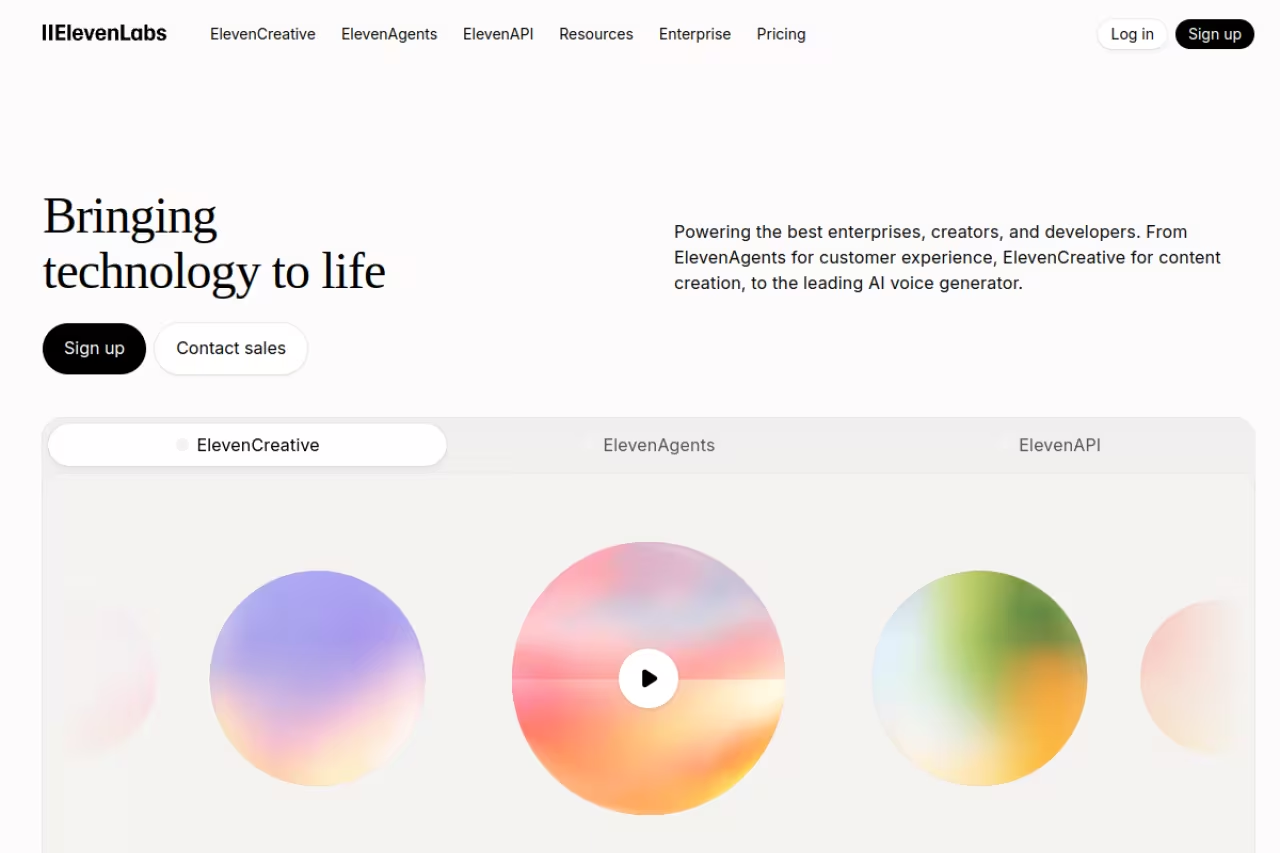
ElevenLabs is the tool everyone else gets compared against, and there's a reason. The output is the most natural of the tools here. Pauses land where a human would put them, intonation rises and falls in the right spots, and on long passages it doesn't drift into that flat, robotic cadence that gives cheaper tools away.
It offers two cloning modes. Instant Voice Cloning needs about a minute of audio and is good enough for drafts and short clips. Professional Voice Cloning wants more training data and produces a far more stable replica that holds up across hours of narration. In an independent accuracy test, ElevenLabs hit roughly 82% pronunciation accuracy, the highest in the group.
The quality benchmark for creators and narrators whose audio reaches an audience and has to sound real. Credits burn fast (Starter is $6/mo for 30k), and quality outside the top dozen of its 74 languages is weaker than advertised.
Free tier with 10,000 credits a month. Instant cloning starts on the Starter plan at $6/mo (30k credits). Professional cloning unlocks on Creator, which is $11/mo after a first-month discount (121k credits). Pro is $99/mo for 600k credits. See the official pricing page for current numbers.
The catch: Credits burn fast. A single Professional clone plus a few thousand words of generation can blow through a Starter allotment quickly, and overages are where the bill creeps up. It's also English-strongest. Its newest model reaches 74 languages, but quality outside the top dozen is noticeably weaker than the marketing implies.

Cartesia: for voice agents that answer in real time
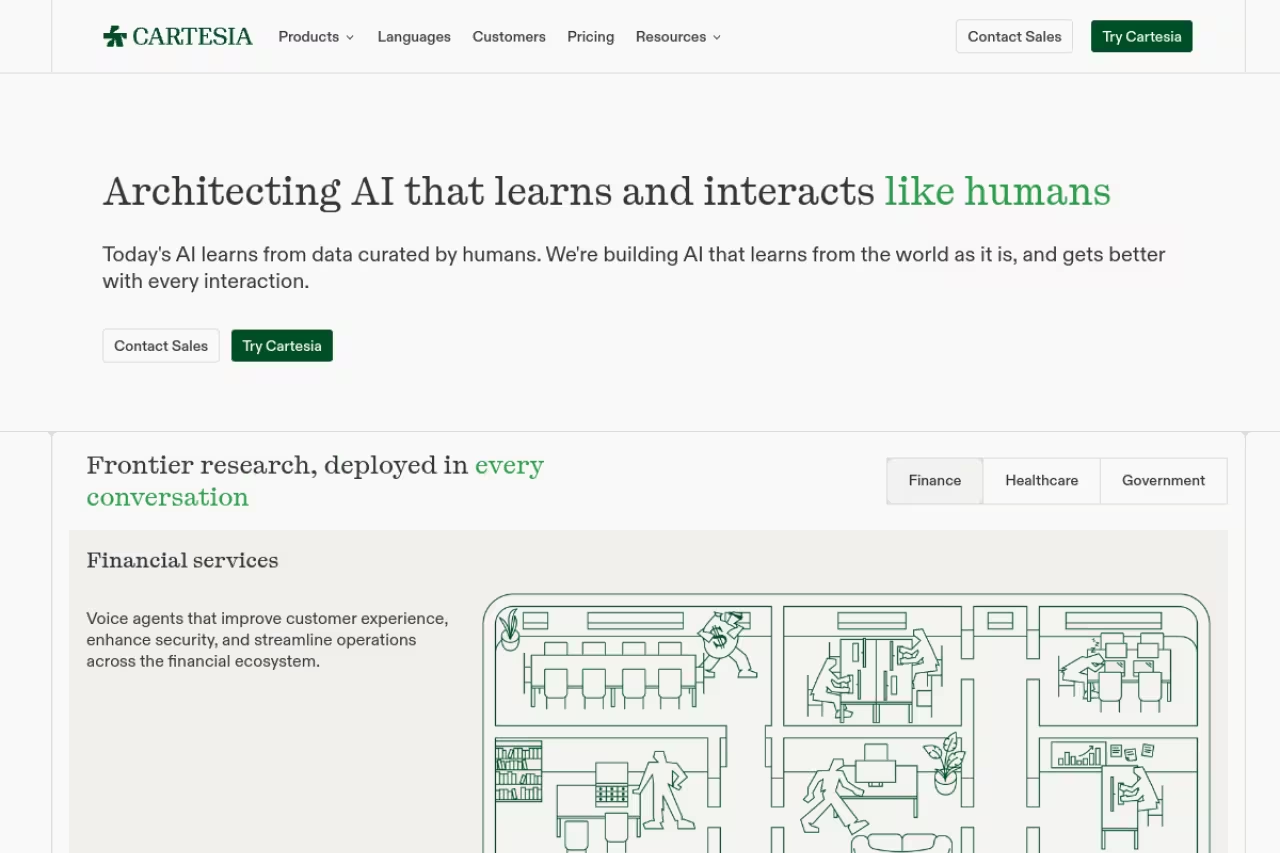
If you're building a phone agent, a live assistant, or anything where a person is waiting for the voice to respond, latency matters more than the last 2% of fidelity. Cartesia is built for exactly that. Its Sonic model delivers around 90ms time-to-first-audio, which is the difference between a conversation that feels alive and one that feels like a call center hold.
It clones a usable voice from a 3-second clip, the lowest bar I came across. For a real-time product, that's a real advantage: you can let users register their own voice in seconds instead of asking them to read a paragraph.
Built for developers shipping voice agents, IVR and low-latency apps where a person is waiting, with around 90ms to first audio. Cheap plans run out of credits quickly, and ElevenLabs and PlayAI sound a touch warmer for polished narration.
Free tier to start. The Pro plan is $5/mo ($4 on annual). API usage is roughly $0.03 per minute of TTS. Enterprise is custom with dedicated allocations and SLAs.
Where it falls short: Included credits on the cheap plans run out fast, so any production workload pushes you into usage billing. And for polished, expressive narration where you can afford to wait a second, ElevenLabs and PlayAI still sound a touch warmer.

Resemble AI: built for companies, not hobbyists
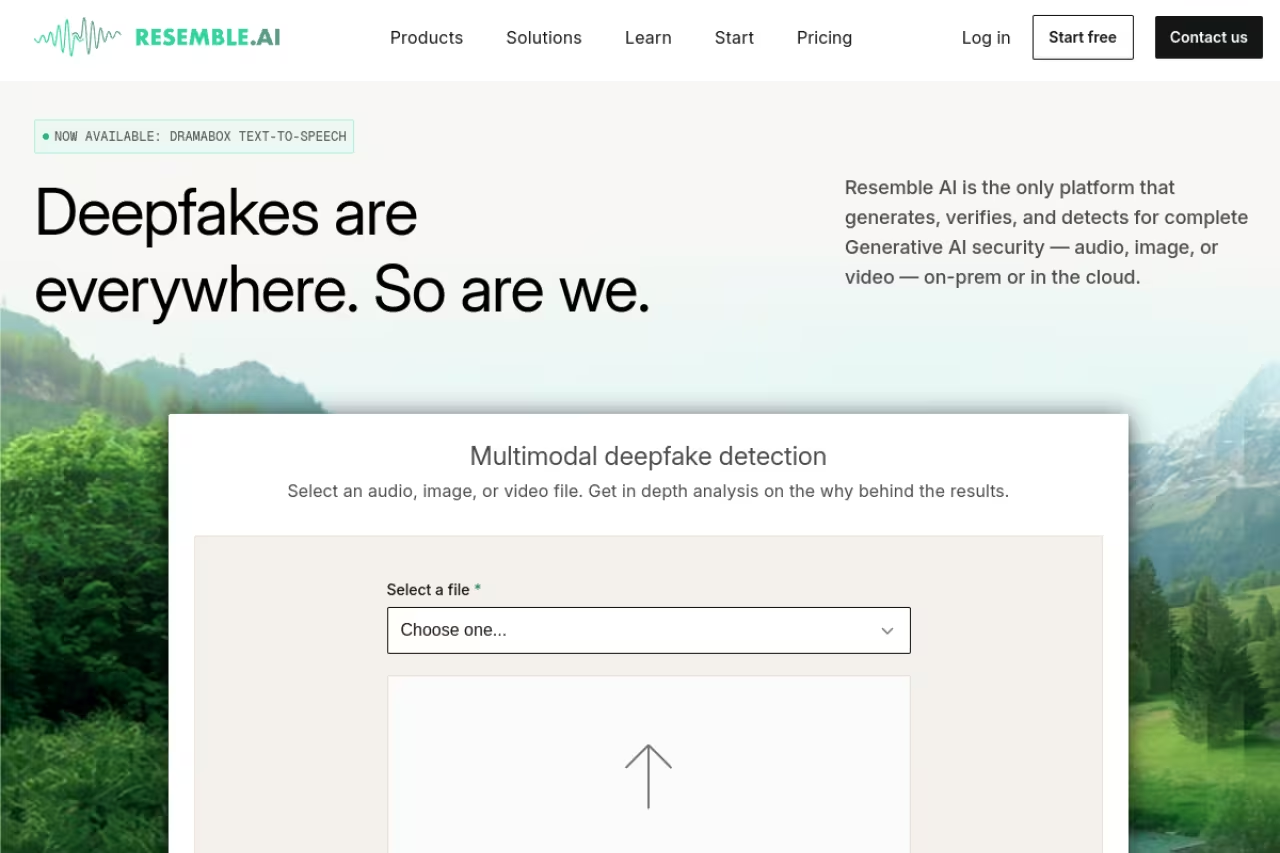
Resemble AI is the one I'd point an enterprise buyer toward. It clones a voice from about five seconds of audio across 20+ languages, but the reason companies pick it is everything around the clone: on-prem deployment, SOC 2 Type 2, SSO/SAML, and a built-in deepfake detector ("Detect") that flags AI-generated audio. If your legal team cares where the voice data lives, this is the answer.
Resemble also gave the world Chatterbox (more on that below), and its hosted Chatterbox model beat ElevenLabs in 63.75% of blind listener tests, so the underlying quality is genuinely competitive, not just enterprise box-checking.
The enterprise answer for brand voices and regulated industries, with on-prem deployment, SOC 2 Type 2 and a built-in deepfake detector. It is overkill for solo creators, and per-second pricing suits heavy steady use better than a few clips a month.
The 2026 model is pay-per-use. The Flex plan starts at $0 with credits that never expire, billed per second of output (around $0.0005/sec for TTS). Rapid clones run $2/mo per voice, Professional clones $5/mo per voice. Enterprise is quote-based with volume discounts.
The catch: It's overkill for a solo creator. The per-second pricing rewards heavy, steady usage; if you're generating a few clips a month, simpler subscription tools are easier to reason about. The interface also assumes you're a developer or a brand team, not a casual user.
If you're mapping out a broader AI stack and not just the voice layer, our guide to the best AI tools for startups covers how a voice clone fits next to writing, design, and automation.
PlayAI (formerly PlayHT): long-form narration with control
PlayAI, which was acquired by Meta in mid-2025, is my pick for people producing a lot of long-form audio: audiobooks, course narration, YouTube voiceovers. It clones a voice from about 30 seconds of recording, and what sets it apart is fine control over pacing, pauses, and emphasis, which is exactly what you need when a single mispaced sentence in a 40-minute file ruins the whole thing.
Independent testers put its clone similarity around 85% of the original voice. Not the absolute best, but with the pacing controls it produces very listenable long content.
My pick for high-volume long-form narration such as audiobooks and course voiceovers, thanks to fine control over pacing and emphasis. The Meta acquisition clouds the consumer roadmap, and the free tier's character cap is tight.
Free plan includes one voice clone and 12,500 characters a month. The Creator plan is around $31/mo, Unlimited around $49/mo, with custom enterprise pricing. API pricing scales down with volume.
Where it falls short: The Meta acquisition leaves some uncertainty about the consumer roadmap, and the free tier's character cap is tight enough that you'll hit it on a single chapter. Voice quality on tricky phrasing is a step below ElevenLabs.
Descript: voice cloning where you already edit
Descript approaches this from the opposite direction. It's an audio and video editor first, and its Overdub clone is a feature inside that workflow. The payoff: you can edit your podcast by editing the transcript, and when you need to fix a flubbed word, Overdub generates it in your voice so you don't re-record. For podcasters and video editors, that single feature saves hours.
Choose Descript if you are a podcaster or video editor who wants cloning baked into post-production, so flubbed words are fixed in your own voice. As a standalone cloner it is weaker, and you are really buying the editor.
Free tier exists. Paid plans run Hobbyist at $16/mo, Creator at $24/mo, and Business at $50/mo on annual billing. Overdub is available with a trial on lower tiers, but free and Creator clones are capped to a 1,000-word vocabulary; unlimited vocabulary needs a higher plan. Descript moved to usage-based "media minutes" and AI credits in late 2025, so check the current plan details.
The catch: As a standalone voice cloner, Descript is weaker than the dedicated tools. The clone is good for patching your own narration, less so for generating fresh long-form audio from scratch. You're buying the editor and getting the clone as a bonus.

Murf AI: studio voiceovers for marketing teams
Murf AI is the most "agency-friendly" option here. The interface is clean, it handles 20+ languages, and it's tuned for producing polished corporate voiceovers, explainer videos, and e-learning narration. Both Rapid and Professional cloning work from roughly two minutes of clean audio.
Agency-friendly for marketing and L&D teams making polished corporate voiceovers at scale. The big catch is that voice cloning is gated to the Enterprise plan only, so you are into a sales conversation.
Free plan available. Creator is $19/mo on annual (24 hours of generation a year), Business is $66/mo on annual (96 hours). Enterprise is custom.
Where it falls short: This is the big one. Voice cloning is gated to the Enterprise plan only. It's not on Free, Creator, or Business, so if you specifically want to clone a voice, you're into a sales conversation and a higher commitment. For Murf's stock voices that's fine; for cloning, it's a real barrier.

Speechify: clones with a listening-first twist
Speechify started as a text-to-speech reader and grew a voice cloning feature on top. That heritage shows: it's mobile-first, supports 60+ languages, and is the most pleasant of these to use if your main job is turning articles and documents into audio you listen to. You can clone your voice, generate multiple takes, and adjust speed and emotion.
Pick Speechify if you mostly turn articles and documents into audio and want a personal clone on the side. Clone quality is solid but not class-leading, and commercial cloning needs Premium+ at around $249/year.
Free tier with basic voices. Premium is about $139/year (roughly $11.58/mo). Commercial voice cloning requires Premium+ at around $249/year. Studio plans run from $19 to $49 per user per month.
The catch: The clone quality is solid but not class-leading, and the most useful cloning rights sit behind the pricier Premium+ tier. If cloning is your primary goal rather than listening, you'll get better fidelity per dollar from ElevenLabs or PlayAI.
Chatterbox: the open-source pick
Chatterbox is Resemble AI's fully open-source model, and it's the one to grab if you want to run cloning on your own hardware with no per-credit billing. It does zero-shot cloning from a few seconds of audio across 20+ languages, includes emotion-intensity control, and embeds an imperceptible watermark on generated audio. In blind testing it was preferred over ElevenLabs a meaningful share of the time, which is remarkable for a free model.
The open-source pick for developers and privacy-conscious teams who want to self-host with no per-credit billing. It is not plug-and-play: you need a GPU, Python comfort and patience, and there is no dashboard or support line.
Free. You pay only for the compute you run it on.
Where it falls short: This is not plug-and-play. You need a GPU, comfort with Python, and patience for setup. There's no polished dashboard, no support line, and quality depends on your reference audio and tuning. For non-engineers, a hosted tool is the better trade.
How to choose
Skip the feature-by-feature paralysis and answer one question first: what are you actually building?
- You need it to sound human to a real audience (narration, ads, audiobooks): start with ElevenLabs. PlayAI if you're doing high volume and want pacing control.
- A person is waiting for the voice to respond (agents, IVR, live assistants): Cartesia, because latency beats fidelity here.
- Your company has security or compliance requirements: Resemble AI for on-prem and SOC 2, or self-host Chatterbox.
- You already edit audio and just want to patch your own voice: Descript, no contest.
- You're a marketing team that wants a clean studio workflow: Murf AI, budgeting for the Enterprise tier if cloning is essential.
One more rule: test with your own voice and your real script before you commit. Free tiers exist on almost every tool here. The clone that sounds best in a demo reel might choke on your accent, your industry's jargon, or the way you actually talk. Twenty minutes of testing saves you a wasted subscription.
If you're assembling a full creative stack around this, Dupple X bundles access to a wide set of AI tools under one subscription, which is handy when you're still deciding which voice tool sticks. You can start a yearly trial here and try a few before you settle.
For the rest of your toolkit, our roundups of the best AI tools for content creation and the best AI video generators pair naturally with a voice clone, and you can browse everything in our top tools directory.
FAQ
What is the most realistic AI voice cloning tool in 2026?
ElevenLabs produces the most realistic output for narration and long-form content, with the highest pronunciation accuracy in independent testing. For real-time use, Cartesia is close enough in quality while being far faster. Resemble's open-source Chatterbox model is the surprise: it has beaten ElevenLabs in blind listener tests despite being free.
How much audio do I need to clone a voice?
It depends on the tool and the quality you want. Cartesia and Resemble can produce a usable clone from 3 to 5 seconds. ElevenLabs Instant Voice Cloning wants about a minute, and PlayAI works from roughly 30 seconds. For the most stable, professional-grade clones, expect to provide 10 to 25 minutes of clean recording, which is what ElevenLabs Professional and Resemble Professional clones use.
Is AI voice cloning legal?
Cloning your own voice, or a voice you have explicit written permission to use, is legal in most places. Cloning someone else's voice without consent can violate publicity rights, and several jurisdictions have passed or proposed laws targeting non-consensual voice cloning. Reputable tools require you to verify consent and many, like Chatterbox and Resemble, watermark generated audio. Always get permission in writing before cloning a voice that isn't yours.
What is the cheapest way to clone a voice?
The cheapest hosted option is Cartesia or ElevenLabs at $5 to $6 a month, both of which include instant cloning on their entry plans. Resemble's pay-per-use model can be cheaper for light usage since credits never expire. If you have technical skills and your own GPU, the open-source Chatterbox model is completely free to run.
Can I use a cloned voice commercially?
Yes, but check each plan. ElevenLabs, PlayAI, and Murf include commercial rights on their paid tiers. Speechify gates commercial cloning behind its Premium+ plan. Free tiers often restrict commercial use, so if you're putting the voice in ads or a product, confirm the license on the plan you're buying before you publish.
Which AI voice cloning tool is best for developers?
For real-time apps, Cartesia has the lowest latency and a clean API. For enterprise needs with security and deepfake detection, Resemble AI's API is the strongest. If you want full control and no usage fees, self-host the open-source Chatterbox model. ElevenLabs has the largest developer community and the best documentation if you want the path of least resistance.
Related guides
Some offers on this page may be paid placements or contain affiliate links.
Across our whole catalogue the median is $24 a month and 33% of tools advertise a free tier. Figures are the lowest recurring monthly price quoted in our own review of each tool, read on 2026-08-19. Full method and every category.
