Last updated: September 2026
What Fabric Actually Is
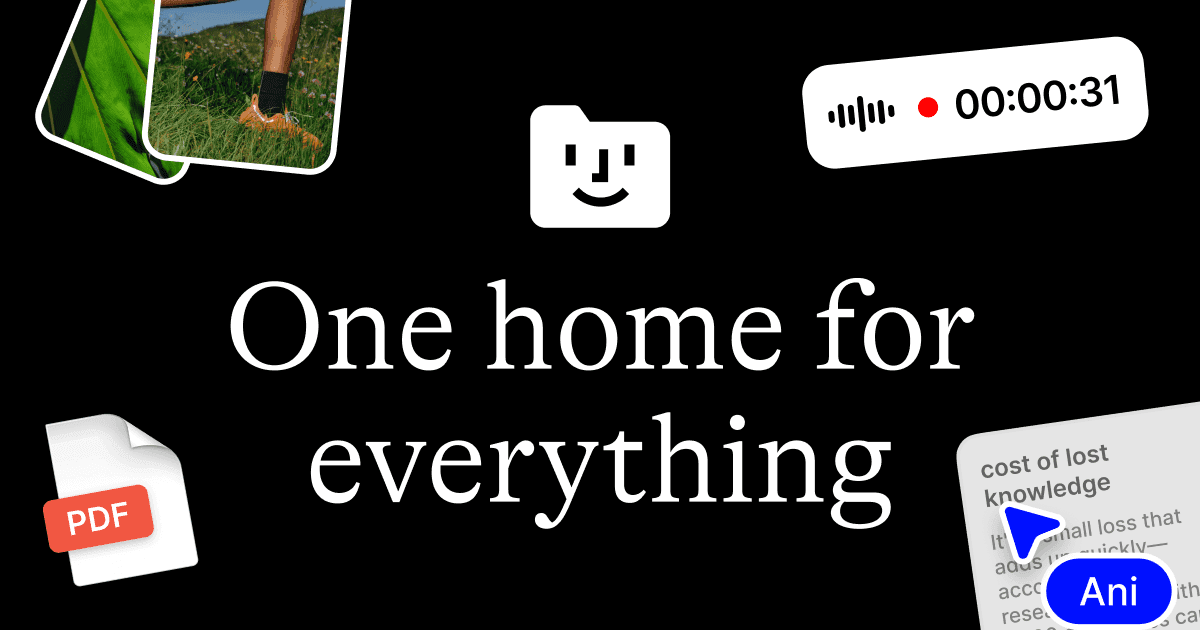
Fabric is an AI workspace that acts as a single home for your files, notes, links, meetings, and ideas. Instead of asking you to build folders and tag everything by hand, it ingests whatever you save (PDFs, videos, voice memos, screenshots, spreadsheets, web pages, and more than twenty other formats), reads the contents, and organizes them so you can find and reason across everything later. The company calls it "the workspace that thinks with you," and that framing is accurate, because the AI layer is not a bolt-on chatbot but the way you actually interact with your own material.
Founded in 2022 in London by Jonathan Bree, Fabric began as a self-organizing file explorer and has grown into a broader productivity suite. Where a note app stores text and a cloud drive stores files, Fabric tries to hold both plus the connective tissue between them, so a saved article, a meeting transcript, and a rough note about the same project all sit in one searchable, queryable space.
Try Fabric Get started →Deep Search: Finding Things by Meaning
The feature that most clearly sets Fabric apart is Deep Search, a semantic search that works across your entire library rather than matching keywords. You can describe what you half remember about something (the gist of a report, the topic of a call, the look of an image) and Fabric surfaces the right item even when you cannot recall its title or the exact words it contained. It searches inside documents, transcripts, and connected apps at the same time, so a single query can pull a line from a PDF, a moment from a recorded meeting, and a clipped web page together in one result set. That is the difference between a filing cabinet and something that understands what you filed.
Two narrower modes round this out. Visual Search finds similar images from a reference picture, and Color Search finds assets by palette, which matters if you work with a lot of visual material. Paired with the AI assistant, which keeps a memory of your work and answers questions using your own stored content as its source, Deep Search turns a pile of saved material into something closer to a personal knowledge base you can interrogate in plain language. The assistant can draw on several underlying models, so you are not locked to a single engine.
What Else It Does
Canvas and Multiplayer
Canvas is an infinite visual space for arranging notes, files, and links spatially, which suits research boards, moodboards, and early project planning. It supports real-time collaboration, so several people can work on the same canvas or space at once, and a Kanban view is available when you want to track progress in a more structured column layout rather than a freeform board. It is the part of Fabric that feels most like a thinking surface rather than a storage bin.
Meeting and Voice Notes
Fabric records and transcribes meetings and voice memos, then extracts the key points automatically. The real advantage is placement: because the transcripts live in the same library as everything else, they are covered by Deep Search and can be referenced by the AI assistant. A decision made on a call three weeks ago is retrievable in the same query as the document that prompted it, which is the practical payoff of keeping recordings alongside your files instead of in a separate meeting tool.
Agents, Tasks, and Recap
Beyond the assistant, Fabric offers Agents, named AI workers you can assign to run scheduled or autonomous tasks, alongside priority-based Tasks and Reminders with due dates, and Recap, which delivers AI summaries by email. Email-to-Fabric lets you forward messages straight into your workspace for processing, so material can flow in without you opening the app. Taken together, these features push Fabric past passive storage toward a system that can act on what it holds.
Capture and Sharing
On the capture side there is a web clipper (Fabric Tag), a handwriting scanner, ScreenshotAI, and annotations you can add to any file or link. On the sharing side, Publish turns a space into a password-protected portal that visitors can open without creating an account, and link analytics show how shared content is being viewed. Fabric also connects to more than fifty external apps, so material from the tools you already use can be pulled into the same library rather than stranded elsewhere.
Pricing
Fabric runs on a freemium model, and the free plan is unusually complete. Rather than locking capabilities behind a paywall, it hands you the full toolkit (AI assistant with multiple models, semantic search across your whole library, transcription, notes, annotations, canvas, and the web clipper) and instead caps storage and AI usage. For light to moderate use that free tier is genuinely workable rather than a short trial, which is rare in this category.
When you outgrow the caps, the entry paid plan is a flat $5 per month, and Fabric does not charge per seat, so upgrading a small team stays inexpensive rather than scaling with head count. Higher tiers raise the limits: a Pro level adds your own AI agent, the AI meeting notetaker, roughly 50GB of storage, and several times more AI usage at around $12.50 per month, while a top Max tier (around $32.50 per month) pushes AI throughput and storage further for heavy users. Prices are lowest when billed annually. New users who sign up through the link on this page get 20% off for the first six months.
- Free: full feature set with storage and AI usage caps.
- Plus: from $5 per month, flat pricing with no per-user charge, caps removed.
- Pro: around $12.50 per month, own AI agent, meeting notetaker, more storage and AI usage.
- Max: around $32.50 per month, highest AI usage and storage for heavy workloads.
Who It Is For
Fabric fits people who accumulate a lot of mixed material and want one place to keep and query it: researchers, students, founders, writers, designers, consultants, marketers, and analysts. If you currently juggle a notes app, a cloud drive, a read-it-later tool, and a separate meeting recorder, Fabric's pitch is to fold those into a single searchable workspace with AI sitting on top of all of it. The flat, no-per-seat pricing also makes it attractive to solo operators and small teams who balk at paying per head for tools they use lightly.
It is a weaker fit for teams that need a heavyweight document editor, a full project-management system, or a structured relational database, since tools like Notion go deeper on those fronts. Fabric is deliberately a capture-and-retrieve layer first, and it is opinionated about auto-organization, which suits people who dislike maintaining folder trees more than those who want tight manual control. If your core problem is that you save things and then cannot find or connect them again, that focus is the whole point rather than a limitation.
Is Fabric free to use?
Yes. Fabric has a free plan with no time limit that includes the full feature set, including the AI assistant, semantic search, transcription, notes, canvas, and the web clipper. The free tier caps storage and AI usage rather than removing features, so it stays useful for light to moderate work before you need to upgrade.
What file types can Fabric handle?
Fabric supports more than twenty formats, including PDFs, videos, voice memos, images, EPUBs, spreadsheets, and clipped web pages. It reads the contents of what you save, which is what allows Deep Search and the AI assistant to work across all of that material regardless of its original format.
Does Fabric record and transcribe meetings?
Yes. Fabric records meetings and voice notes, transcribes them, and extracts the key points automatically. Because the transcripts sit in the same library as your files, they are searchable through Deep Search and can be referenced by the AI assistant alongside your other documents.
How is Fabric different from Notion?
Notion is built around structured documents and databases you design and maintain. Fabric is built around automatic organization and semantic search across many content types, including files, transcripts, and links. Fabric prioritizes capturing and finding information, while Notion prioritizes structuring and editing it.
Can I share work with people who do not use Fabric?
Yes. The Publish feature turns a space into a password-protected portal that visitors can open without an account or login. Link analytics then show how the shared content is being viewed, which is useful for research handoffs and client-facing pages.