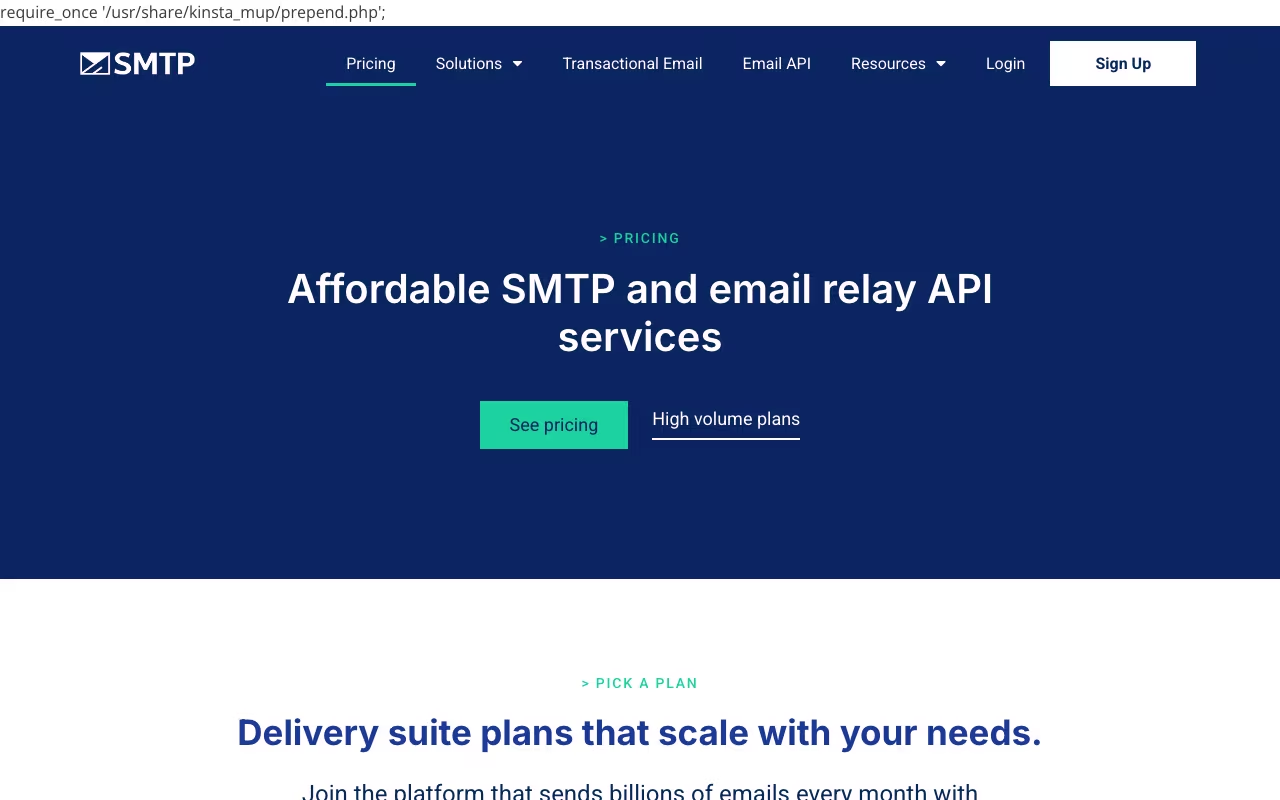
SMTP.com has been in the email delivery business since 1998. That is longer than most of its competitors have existed. It does one thing: relay your emails and try to get them into inboxes instead of spam folders. No email builder, no marketing automation, no drag-and-drop templates. Just infrastructure. Originally founded as EMUmail in 1998, the company has changed hands multiple times before settling as SMTP, Inc. It went public on Nasdaq in 2014 and claims over 100,000 customers. The longevity is notable, but longevity alone does not guarantee the best value in a market that has changed dramatically.
Pure Email Relay
SMTP.com is an SMTP relay and email API service. You point your application or email system at their servers, and they handle the actual delivery. This includes transactional emails (order confirmations, password resets, shipping notifications) and bulk marketing sends. The platform manages bounce processing, address suppression, and deliverability optimization behind the scenes.
On the security and authentication side, SMTP.com enforces SPF, DKIM, and DMARC protocols. Their Reputation Defender dashboard monitors your sender score and tracks blacklist status in real time. Dedicated IP addresses are available starting from the Starter plan ($80/month), which gives you full control over your sending reputation rather than sharing it with other senders.
The REST API is straightforward and well-documented. Integrations exist for WordPress, Salesforce, HubSpot, Shopify, BigCommerce, and Zapier. If your use case is "send emails reliably at volume," SMTP.com covers the basics competently. Open and click tracking provide campaign-level visibility, and event-triggered email tracking lets you monitor delivery outcomes in real time.
Try SMTP.com Get started →Pricing Tiers
SMTP.com prices purely on email volume. Every plan includes the same features:
- Essential ($25/month): 50,000 emails/month, shared IP
- Starter ($80/month): 100,000 emails/month, dedicated IP
- Growth ($300/month): 500,000 emails/month, dedicated IP
- Business ($500/month): 1,000,000 emails/month, dedicated IP, deliverability expert access
- High Volume (custom pricing): 1M+ emails/month, fully customized infrastructure
Whether a free trial exists is genuinely unclear. Some sources cite a 30-day trial with 50,000 emails. Others, including a detailed GMass review, state there is no free trial and the minimum commitment is $25/month. The signup process itself involves business verification and website confirmation, which can take multiple days. Be prepared for that.
Prices checked on the SMTP.com pricing page in September 2026. Plans and limits change, so confirm before you buy.
The Problems You Should Know About
SMTP.com's review scores tell an interesting story. G2 rates it 3.5/5 from 42 reviews. Capterra gives it 4.0/5. But Trustpilot rates it 2.4/5 from 68 reviews, which is solidly in "poor" territory. The gap between professional review sites and consumer feedback is significant.
The number one complaint across platforms is the cancellation policy. Users report a strict 30-day cancellation notice requirement, difficulty finding cancellation options in the dashboard, and unexpected charges after attempting to cancel. For a service that competes with providers offering no-commitment free tiers, this is a red flag worth investigating before you sign up.
Other recurring complaints: the user interface feels dated and loads slowly, some users report their assigned dedicated IPs getting blacklisted with slow remediation from SMTP.com's team, and customer support quality varies widely depending on who you get. The reliability itself scores well in user feedback, but the experience around the service frustrates people.
Compare SMTP.com Plans See plans →Against the Competition
This is where SMTP.com faces its toughest challenge. The email infrastructure market has evolved significantly since 1998, and SMTP.com has not kept pace.
SendGrid (owned by Twilio) offers a permanent free tier with 100 emails/day, a full drag-and-drop email builder, marketing automation, A/B testing, and extensive documentation. Paid plans start at $19.95/month. It is the market leader for a reason.
Mailgun is the developer favorite with SDKs for Python, Ruby, PHP, Java, Go, and C#. Its Flex plan charges $0.80 per 1,000 emails with no monthly minimum. For developers building email into applications, Mailgun's tooling is far more sophisticated than SMTP.com's basic REST API.
Amazon SES costs roughly $0.10 per 1,000 emails with no monthly commitment. For pure relay at volume, it is dramatically cheaper than SMTP.com. You trade managed support for cost savings.
SMTP.com's positioning is "managed deliverability with dedicated account managers." If you want someone to actively manage your sender reputation and consult on deliverability strategy, SMTP.com's Business plan with deliverability expert access is that service. But for most businesses that just need reliable email delivery, SendGrid, Mailgun, or Amazon SES offer better value, better tools, and more transparent billing practices.
Who Should Consider SMTP.com
Mid-size businesses sending 100,000-1,000,000 emails monthly who want managed deliverability support and dedicated IPs without building internal email expertise. If you have staff who can handle email infrastructure decisions, the self-service alternatives will save you money. If you want a provider that actively manages your sending reputation and you are comfortable with the pricing and cancellation terms, SMTP.com has 25+ years of infrastructure behind it. Just read the contract carefully before committing.
Visit SMTP.com Get started →How SMTP.com works
SMTP.com is a transactional email relay and RESTful email API run by J2 Global Canada, part of the Ziff Davis Martech division, with more than two decades of sending history behind it. You point your application or platform at its relay, or call the v4 API, and it delivers password resets, receipts, shipping updates, authentication messages and notifications, with reporting and up to 90 days of data retention.
Setup goes one of two ways. You either configure standard SMTP relay credentials in an app you already run, or you integrate the v4 REST API, a JSON API following the JSend response spec. Authentication is flexible: an API key passed via URL, HTTP Basic, a Bearer token, the X-SMTPCOM-API header or a query string. On the DNS side you set SPF records and custom DKIM, and the API exposes a CreateDkimKey call for that. Reputation Defender, the list-hygiene add-on, needs no integration at all: you enable it at signup and it suppresses invalid addresses in real time before each send.
Prebuilt integrations are listed for WordPress, Shopify, Slack, Trello, Airtable, Wufoo, Google Forms, Docs and Calendar, and Google Lead Form Extensions. Enterprise and high-volume accounts get a dedicated account manager, a tailored IP-warming and ramp plan, callbacks and webhooks, on-demand statistics aggregation, and turnkey migration help off SendGrid, Mailgun and similar. Above 250M emails per month, each customer gets a dedicated instance of the platform in a private cloud, with its own IP and MTA and no shared mail queue.
Where SMTP.com wins
- Deliverability is the actual product, not a checkbox: 20 years of IP reputation with mailbox providers, feedback loops, and in-house delivery experts reachable by phone, chat and email on every plan regardless of tier.
- A dedicated IP is included from the $80 per month Starter plan up, with hybrid shared and dedicated pools available. Most rivals charge extra for a dedicated IP.
- Up to 90 days of data retention as standard, which the vendor calls the longest in the category, with no retention upsell.
- Reputation Defender suppresses invalid addresses before you send with zero technical integration, protecting domain and IP reputation automatically.
- Assisted migration is a real offering. The vendor says it runs hundreds of turnkey migrations a month off SendGrid, Mailgun and others, with managed onboarding and custom API integration help.
- A true high-volume path exists: a dedicated platform instance, dedicated IP and MTA, no shared queue, and scalable webhooks for senders above 250M emails per month.
Where it falls short
- No free tier and no advertised free trial. The entry point is $25 per month for 50,000 emails, so you pay before you can test deliverability for yourself.
- Volume tiers jump in big steps ($25, $80, $300 and $500 per month for 50K, 100K, 500K and 1M emails) with nothing in between, and the next step above 1M is a custom quote with a 250M minimum.
- The two most-promoted capabilities are paid add-ons, each priced at 20% of your plan cost. A 1M-email plan with both Reputation Defender and the Insight Engine is effectively $700 per month.
- The integration list is short and skewed to no-code and office tools (WordPress, Shopify, Slack, Trello, Airtable, Google apps). No official SDK list, no framework libraries and no CMS breadth are documented on the site.
- Marketing-side features are thin: no template editor, contact management, campaign builder or automation. This is relay infrastructure, and the SMTP for marketers page currently 404s.
- Reliability claims contradict each other between pages. The homepage and pricing say 99.99% uptime while the API and transactional pages say 99%, and customer-satisfaction figures differ too (95% versus 98%).
Who should use SMTP.com
This suits product and platform teams sending meaningful transactional volume, roughly 100K emails a month and up, who care more about inbox placement, a dedicated IP and a human to call than about a modern developer experience. It also suits enterprises that need a dedicated sending instance rather than a shared queue, and teams moving off SendGrid or Mailgun who want the migration handled for them.
Hobbyists, side projects and anyone who wants to trial a relay before paying should look elsewhere, because there is no free tier. So should teams hoping to run marketing campaigns from the same product: templates, contacts and automation are not here.