What is Qoyod?
Cloud-based accounting and financial management platform for businesses
Qoyod is a finance tool that we've reviewed as part of our directory. Here's what it does well, where it falls short, and whether it's worth your money.
How We Evaluated Qoyod
We looked at Qoyod on five things: transaction accuracy, reporting depth, compliance features, integration with banks, and automation. Same checklist we use for every finance tool in the directory, so the comparisons are like for like.
That meant using the product, testing the features that matter most for finance work, reading the docs, and checking whether pricing is upfront or hidden behind a sales call. We also compared it against Xero and Aplos to see where it stands.
Key Features
What Qoyod actually gives you:
- Core Functionality: Purpose-built feature set for finance workflows
- User Interface: Clean interface designed for productivity
- Integration Support: Connects with popular tools in your stack
Pricing
Qoyod publishes its pricing: Basic is SAR 1,200, Professional SAR 1,800 and Advanced SAR 2,211 per year.
To give you a rough sense of the market, comparable finance tools like Xero and Aplos charge in the range of custom pricing to custom pricing/mo, which should help you calibrate expectations.
Prices checked on the Qoyod pricing page in September 2026. Plans and limits change, so confirm before you buy.
Pros and Cons
What we like
- This is a tool built specifically for finance, which means the features are tailored to real use cases in this space rather than being generic functionality that sort of applies
- It replaces hours of manual bookkeeping and data entry with automated workflows, which is the kind of improvement that compounds every single month
- It focuses on doing one thing well rather than trying to be a Swiss Army knife, which usually means the core features get more development attention and polish than they would in an all-in-one platform
What could be better
- Getting the initial configuration right is critical. Mistakes in the setup phase will cascade through your books and create headaches that take much longer to fix than they did to cause
- Larger organizations with complex requirements may find that some of the advanced features they expect from enterprise software are missing or underdeveloped
Qoyod Alternatives
If Qoyod isn't the right fit, here are the closest competitors worth looking at:
| Tool | What it does | Pricing |
|---|---|---|
| Xero | Xero is a business tool available at xero.com. Sign up to see pricing, features, and cu... | From $15/mo |
| Aplos | Aplos, Raisely & Keela is a business tool available at aplos.com. Sign up to see pricin... | From $59/mo |
| Heard | Heard is a business tool available at joinheard.com. Sign up to see pricing, features, ... | From $149/mo |
| Aspire | Aspire is a business tool available at aspireapp.com. Sign up to see pricing, features,... | From $200/mo |
We track hundreds of finance tools in our tools directory. Worth browsing if none of these match what you need.
Who It's For (and Who It's Not)
Good fit: Qoyod makes the most sense for finance teams and accountants who are drowning in manual bookkeeping, reconciliation, and reporting, and need automation to keep the books clean without spending hours on data entry every week. If that sounds like your situation, it's worth at least testing it out.
Skip it if: you're a sole proprietor with straightforward finances. A spreadsheet and your bank's built-in reports will get you through tax season just fine. In that case, you might want to look at Xero as a lighter-weight option.
Bottom Line
Does its core job well. Worth the investment if finance is central to your daily work. If you only need it occasionally, look at a simpler option.
In short: Qoyod is a strong choice for finance teams and accountants who are drowning in manual bookkeeping. you're a sole proprietor with straightforward finances.
Try QoyodHow Qoyod works
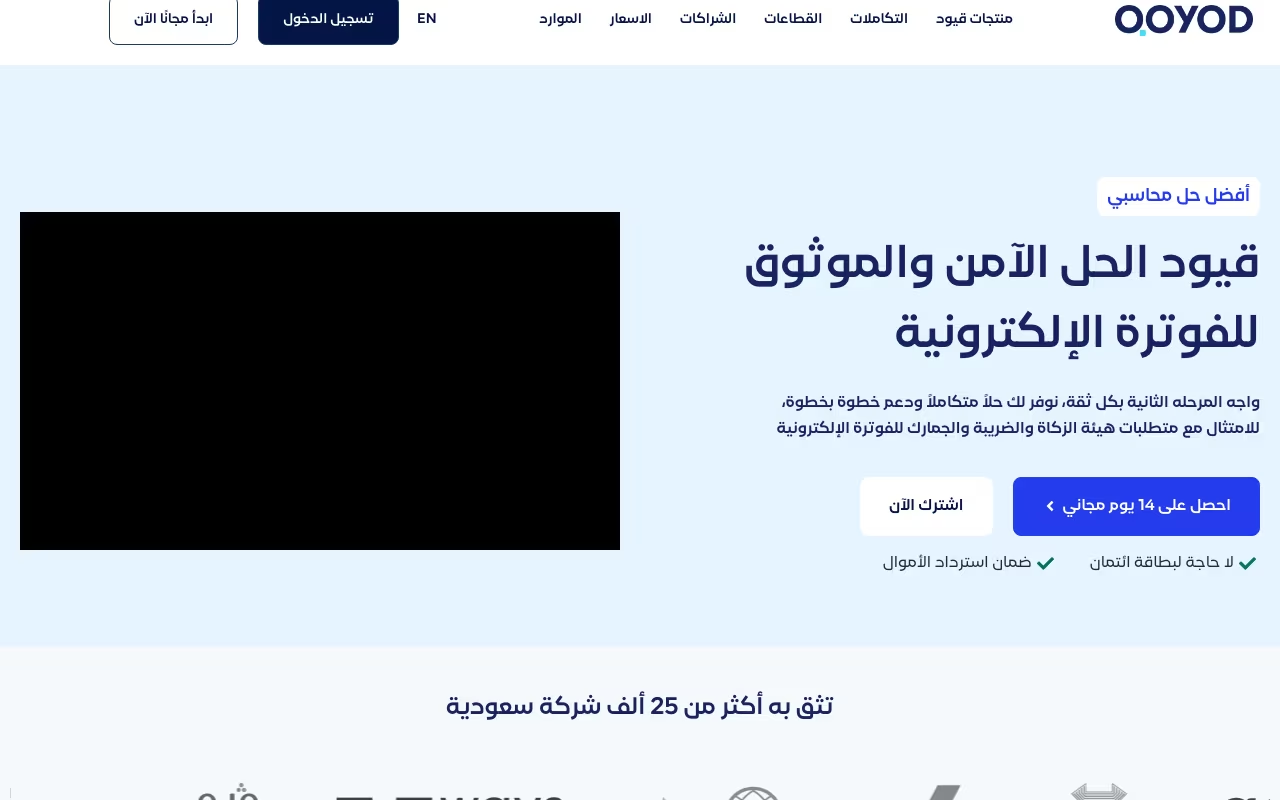
Qoyod is cloud accounting built specifically for the Saudi market, with ZATCA e-invoicing compliance at its centre. It covers invoicing and VAT, sales, expenses, inventory, multi-branch and multi-currency operation, fixed assets with automatic depreciation, cost centres and project tracking, recurring journal entries and auditor reports. Two editions exist, one aimed at business owners and one at accountants. Alongside the accounting core it sells a POS product, Q.Flavours (a restaurant and café POS with kitchen display), and Pro Services, where SOCPA-certified accountants handle the bookkeeping, VAT filing, setup or historical cleanup for you. The company claims 25,000+ active businesses.
Onboarding for e-invoicing is deliberately non-technical: enter legal name, tax number and contact details, pick your invoice type in settings, complete a one-time OTP handshake with ZATCA's Fatoora platform, then start issuing. Qoyod says this takes under an hour with no developer involvement, and it runs 10 automatic pre-submission checks graded as blocking alerts, critical warnings or non-blocking guidance. Invoices go out as UBL/XML with QR code, digital signature and cryptographic stamp, submitted in real time, with cloud archiving retrievable by date or invoice number, and a sandbox for testing before going live. Integrations are regional and practical: Salla, Zid, WooCommerce and Shopify for e-commerce, Tamara, Tabby, Moyasar and HyperPay for payments, Jisr and Idaratech for HR and payroll, plus WhatsApp and Google Sheets. Developers get a documented REST API with OAuth 2.0, JSON endpoints, real-time webhooks (new invoice, payment received, product updated), a free sandbox and a marketplace listing. POS runs on preconfigured Sunmi hardware sold by Qoyod (Sunmi V3 handheld at 800 SAR, Sunmi D3 Pro counter unit at 1,459.35 SAR, 80mm thermal printer at 747.50 SAR) and keeps selling offline, syncing when the connection returns.
Where Qoyod wins
- ZATCA Phase 2 handled end to end. UBL/XML, QR code, digital signature, cryptographic stamp and live Fatoora submission, with a sandbox and 10 pre-submission validation checks that catch rejections before they happen.
- Setup claimed at under an hour with no developer or technical integration, which matters because the alternative is running compliance as a project.
- The integrations Saudi businesses actually use: Salla, Zid, Tamara, Tabby, Moyasar, HyperPay and Jisr, rather than a generic international list.
- A proper API for a regional SMB tool: REST, OAuth 2.0, real-time webhooks, a free sandbox, docs in both Arabic and English, and developer support with a 24-business-hour response target.
- Accountant-grade depth beyond invoicing: cost centres, project tracking, fixed-asset depreciation, recurring journal templates, granular permissions and external auditor reports.
- POS works offline and keeps issuing invoices until it can sync, with hardware sold at listed prices rather than bundled opaquely.
Where it falls short
- Subscription pricing is not published. The plan selector redirects to app.qoyod.com behind a JavaScript app, so you cannot compare tiers, user counts or invoice limits before signing up. Only the 14-day free trial (no card) is advertised.
- Pro Services is quote-only, priced after a diagnostic meeting based on entry volume, branches and sector complexity.
- It is a Saudi-specific product. Compliance, tax logic, integrations and support are built around ZATCA, VAT and Zakat, and the international integration list is thin (Shopify and WooCommerce aside).
- No banking automation is claimed. Bank reconciliation appears on the product pages as a manual task or something Pro Services does for you, not as an automatic bank feed.
- POS platform coverage is unclear. The site markets Sunmi Android hardware and a mobile app, with no stated native iOS, Windows or iPad POS client.
- No published transaction, user or inventory-item limits, so you cannot verify capacity fit before purchase.
Who should use Qoyod
Qoyod is the right pick for Saudi SMEs, retailers, restaurants and accounting firms that need ZATCA Phase 2 compliance without turning it into an integration project, and it is a particularly easy call if you sell through Salla or Zid or take Tabby and Tamara payments. The accountant edition plus Pro Services also covers firms that want the software and the bookkeeping from one supplier.
Skip it if you operate outside Saudi Arabia, since the value is concentrated in local compliance and local integrations. Skip it too if you need automated bank feeds, or if your buying process requires comparing plan pricing before you commit to a trial and a sales conversation.