What Is Aspire?
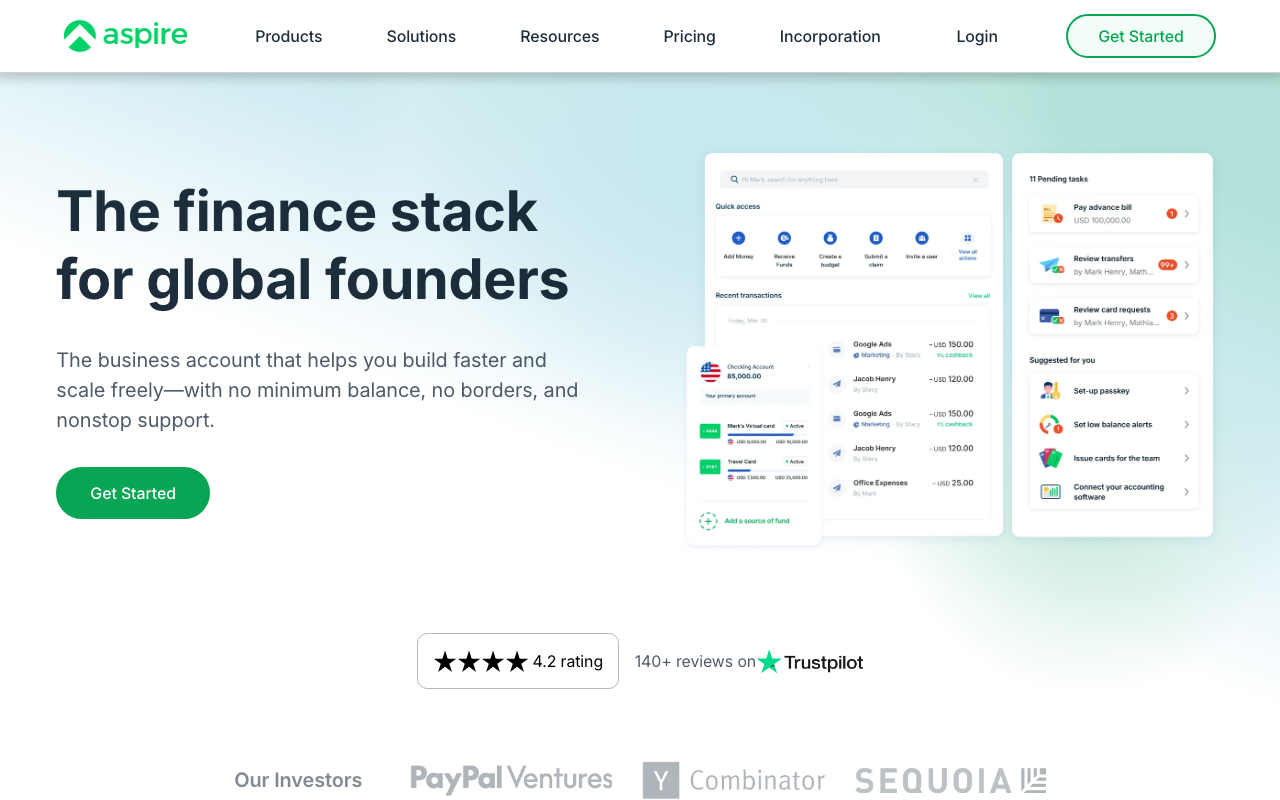
Aspire is the all-in-one business banking and finance platform for SMBs, startups, and freelancers in Asia and globally expanding. Founded in 2018 in Singapore, Aspire combines business accounts, multi-currency wallets, corporate cards, expense management, accounts payable, and accounting integrations in one stack.
The pitch is consolidation for Asian SMBs. Traditional Asian banking required physical branch visits, separate vendors for FX and expense management, and slow international transfers. Aspire bundles modern fintech experiences (instant account opening, virtual cards, real-time spending controls) that exist for US startups through Brex and Mercury but were unavailable in Asia.
The product targets startups, ecommerce brands, and growing SMBs in Singapore, Hong Kong, Indonesia, Vietnam, and increasingly other Asian markets. International expansion to UK and other markets continues.
Try Aspire Get started →How Aspire Works
Open a business account online through Aspire's app or web platform. KYC verification typically completes in 1-3 business days for Singapore entities. Once approved, your business account is live with multi-currency support.
Issue corporate cards to team members. Virtual cards generate instantly for online subscriptions; physical cards ship within days. Spending controls let admins set per-card limits, merchant category restrictions, and approval workflows.
Pay international suppliers with competitive FX rates. Aspire uses mid-market rates plus a transparent margin, typically 0.5-1.5% on conversions. This beats traditional bank FX (often 3-5% margins) significantly. Support for major currencies (USD, EUR, GBP, HKD, IDR, MYR, others).
Expense management automates receipt capture, categorization, and reimbursement. Employees snap photos of receipts; the system matches them to card transactions automatically. Policies enforce spending rules without manual review for every transaction.
Accounts payable handles vendor invoice processing. Capture invoices via email, extract data, route for approval, schedule payment. Integration with Xero and QuickBooks pushes the data to accounting.
Aspire Pricing in 2026
Account opening: Free for most business types in supported countries.
Account fees: $0/month for basic business account.
Card fees: Free virtual and physical cards on most plans.
FX margins: 0.5-1.5% on currency conversions.
International wires: $5-$15 typical, depending on destination.
Premium features: $30-$200/month for advanced expense management, accounts payable automation, and dedicated support.
Compared to traditional Asian business banking (HSBC, DBS, OCBC) plus separate expense and FX vendors, Aspire's bundled approach saves significantly for active SMBs.
See Aspire Pricing See plans →Where Aspire Wins
- Asian SMB focus: strongest in markets where Brex and Mercury have minimal presence.
- Competitive FX: substantially cheaper than traditional bank conversions.
- Integrated expense management: cards plus receipts plus policies in one stack.
- Fast onboarding: account opening online without bank branch visits.
- Multi-currency wallets: hold USD, SGD, HKD, EUR balances natively.
Where It Falls Short
- US presence limited: Brex and Mercury dominate US fintech banking.
- Account limits: very high-volume operations may need traditional banking relationships.
- Newer brand than legacy banks: some procurement processes prefer established names.
- Customer support quality varies: rapid growth occasionally outpaces support capacity.
Aspire vs Brex vs Mercury vs Wise Business
Finance tools, published pricing
| Tool | Pricing | Model |
|---|---|---|
| Aspire | $200/mo (lowest published recurring price) | Subscription |
| Xero | $15/mo (Early), $42/mo (Growing), $78/mo (Established) | Subscription |
| Aplos | $59/mo (Lite), $99/mo (Core), $189/mo (Advanced) | Subscription |
| Heard | $149/mo (lowest published recurring price) | Subscription |
| Compliancely | $200/mo (lowest published recurring price) | Subscription |
| Angels Partners | $39/mo (lowest published recurring price) | Subscription |
Brex is the US startup default with corporate cards, lending, and bill pay. US-focused.
Mercury targets US tech startups with banking, venture debt, and treasury management. US-focused.
Wise Business is multi-currency-first with global coverage but less full-stack business banking.
Airwallex is the closest direct competitor with similar Asia-Pacific focus and broader scope.
Who Should Use Aspire
Singapore, Hong Kong, Indonesia, Vietnam SMBs: native market support.
APAC startups with international supplier relationships: FX savings matter.
Ecommerce brands sourcing internationally: multi-currency operations.
Growing teams needing expense management: cards plus controls reduce ops overhead.
Skip it if: you are US-based (use Brex or Mercury), operate primarily in Europe (use Revolut Business or Wise), or need full-service banking with branch relationships.
How Aspire works
Aspire (aspire.io) is an influencer and creator marketing platform aimed at e-commerce brands. It covers the whole creator program lifecycle in one place: finding creators, recruiting them, running campaigns, collecting and approving content, paying creators, and reporting on sales and engagement. The campaign types it supports include sponsored posts, product seeding, ambassador programs and affiliate programs. It also runs a Creator Marketplace where creators apply to brand campaigns inbound, and Aspire says it takes no commission from creators.
The first step is connecting your store and your channels. Shopify is the anchor integration: it is what lets you create promo codes, run product seeding, and identify influential people who are already customers. If you already track conversions through affiliate networks, CJ, ShareASale/Awin and Impact all connect as well. Social connections to TikTok, Instagram/Meta, Facebook, YouTube and Pinterest are direct platform partnerships, which means creator and campaign data arrives as first-party data rather than scraped estimates. Gmail or Outlook connect for branded outreach and a shared team inbox on creator threads, and PayPal handles creator payouts.
Once the plumbing is in place, you configure the program itself: search filters across the creator database, campaign workflows for each program type, the KPIs you count as success (clicks, promo codes, reach, sales), and the content approval steps. A Chrome extension lets you search and invite creators while you browse. Content that performs can be pushed into Meta Ads Manager and run as paid social. For teams without the bandwidth to operate any of this, Aspire also sells Agency Services where its own staff run the campaigns.
Where Aspire wins
- First-party data, not estimates. Direct platform partnerships with Meta, TikTok and Pinterest mean the creator and performance numbers come from the platforms themselves rather than third-party approximations.
- The Shopify integration does real work. It goes past order sync into promo code generation, product seeding campaigns, and surfacing influential people who are already in your customer list.
- Four program types in one tool. Sponsored campaigns, affiliate, ambassador and product seeding all live in the same system, so affiliate does not get pushed into a separate platform.
- Broad affiliate network coverage for this category. CJ, ShareASale/Awin and Impact all connect, so tracking you already have in place survives the migration.
- Inbound creator flow. The Creator Marketplace means creators can apply to you instead of every relationship starting with cold outreach, and Aspire states it never takes a cut of creator earnings.
Where it falls short
- No published pricing and no self-serve signup. The /pricing page returns a 404 and every call to action is book a demo, so you cannot budget or trial the product without a sales conversation.
- No free tier and no advertised free trial anywhere on the site.
- Payouts are PayPal-only among the named payment integrations, which is a genuine constraint if your creators are in markets where PayPal is weak.
- E-commerce integration depth is essentially Shopify. Brands on WooCommerce, BigCommerce, Magento or a headless stack get none of the promo-code and seeding automation.
- It is built for e-commerce and DTC. B2B, SaaS and services brands sit outside the stated audience of 800+ e-commerce brands.
Who should use Aspire
Aspire fits DTC and e-commerce brands on Shopify running creator programs at real volume, particularly those blending gifting, affiliate and paid amplification and who need one system of record instead of a pile of spreadsheets. If you are already sending product, paying commissions and boosting creator content as ads, having those four motions in one place with first-party platform data behind them is the main argument for the tool.
Skip it if you are pre-revenue, not on Shopify, selling B2B, or unwilling to sit through a sales cycle just to find out the price. With no published pricing, no free tier and no advertised trial, evaluating Aspire is a commitment in itself, and that only makes sense if creator marketing is already a funded line item rather than an experiment.
Frequently Asked Questions
Can I open an account remotely?
Yes. KYC online for most regions.
Does Aspire offer credit?
Yes. Credit lines available for qualified businesses.
What currencies are supported?
USD, SGD, HKD, EUR, GBP, IDR, MYR, JPY, and others depending on country.
Is FDIC insurance available?
US-specific protections don't apply; Aspire deposits are protected per the specific jurisdiction's regulations.
Does it integrate with Xero?
Yes natively. Two-way sync for transactions and reconciliation.