
What Is lemlist?
lemlist is the cold email and outbound sales platform for individual sellers, agencies, and SMB sales teams. Founded in 2018 by Guillaume Moubeche, lemlist has grown to serve over 30,000 users through a combination of strong product, content marketing, and the active "Lempire" community of cold email practitioners.
The pitch is creative personalization beyond what other cold email tools offer. lemlist popularized image personalization (insert prospect's company logo into an ad mockup), video personalization (record a video once, lemlist customizes per prospect), and landing page personalization. These features make cold emails feel less like mass mail and more like 1:1 outreach at scale.
The platform competes with Reply, Outreach, Salesloft, and Apollo. lemlist's positioning targets the creator-style outbound segment: SDRs at agencies and founders running their own outbound rather than enterprise sales orgs with heavy CRM integration needs.
Try lemlist Free Get started →How lemlist Works
Build sequences with multiple steps: email, LinkedIn touches, calls. Each step can include personalization tokens (first name, company, custom variables), images personalized per prospect, embedded videos that vary by recipient, and landing pages that show prospect-specific content.
Email warmup runs through Lemwarm, lemlist's deliverability tool that warms up new sending addresses by exchanging emails with other warmed-up inboxes. This protects your sending reputation and helps emails land in inbox rather than spam.
The AI features generate sequences from prompts, write copy based on prospect data, and suggest improvements to existing sequences. lemlist's AI Sales Engineer can draft initial outbound from minimal context, useful for early-stage founders building outbound from scratch.
Multichannel features extend to LinkedIn automation: profile visits, connection requests, message follow-ups. LinkedIn automation has account-restriction risk; lemlist throttles activity but cannot eliminate it.
Reporting tracks reply rates, positive reply rates, meetings booked, and revenue attributed. Integrations push outreach data to Salesforce, HubSpot, and Pipedrive.
lemlist Pricing in 2026
Email: from $55/user/month on annual billing (the monthly list price is $69/user/month). Email and phone finder, the 650M+ lead database, unlimited contacts, lemAgent, MCP access, a unified inbox, the deliverability hub with warm-up, plus CRM and API access.
Multichannel: from $87/user/month on annual billing (the monthly list price is $109/user/month). Everything in Email plus SMS automation, a WhatsApp add-on, the built-in dialer, task management, and Gmail and LinkedIn automation.
Enterprise: custom pricing for teams of five or more. Everything in Multichannel plus custom roles and permissions, SSO and SAML, a dedicated account manager, and priority support.
Annual billing saves about 20 percent against the monthly list price. Deliverability and warm-up (lemwarm) are included in every plan rather than sold as a separate subscription. Enrichment runs on a separate metered layer of credits priced at 1 credit for $0.01, so budget for that on top of the seat cost.
See lemlist Plans See plans →Where lemlist Wins
- Creative personalization features: images, videos, and landing pages personalized per prospect.
- Strong community: Lempire content and events build outbound skill.
- AI Sales Engineer: useful for founders writing first-draft copy.
- LinkedIn automation: depth beyond pure email.
- Active product development: ships features frequently.
Where It Falls Short
- No contact database: pair with Apollo, RocketReach, or another data source.
- LinkedIn automation risk: any LI automation has account-restriction potential.
- Multichannel is the real entry point: LinkedIn, calls, SMS and WhatsApp only unlock from the $87/user/month plan, above the $55 email-only tier.
- Less polished than Outreach for enterprise: better fit for SMB and creator-style outbound.
- Enrichment is a separate metered layer: verified emails, phone numbers and intent signals burn credits on top of the subscription, which makes the monthly bill harder to forecast.
lemlist vs Reply vs Apollo vs Instantly
Reply is the closest direct competitor. Comparable scope, similar pricing.
Apollo bundles data with sequencing. Cheaper all-in-one for SMB sales teams.
Instantly targets pure cold email at scale with multiple inbox rotation. Simpler, cheaper, less personalization depth.
Outreach is the enterprise alternative with deeper Salesforce integration. More expensive.
Who Should Use lemlist
Founders running their own outbound: image and video personalization help small senders stand out.
Agencies running cold outreach for clients: creative features differentiate from generic cold email.
Small B2B sales teams: 1-15 SDRs without enterprise integration needs.
Skip it if: you need bundled contact data (use Apollo), prioritize deep Salesforce integration (use Outreach), or run very high-volume cold email (Instantly handles bulk better).
How lemlist works
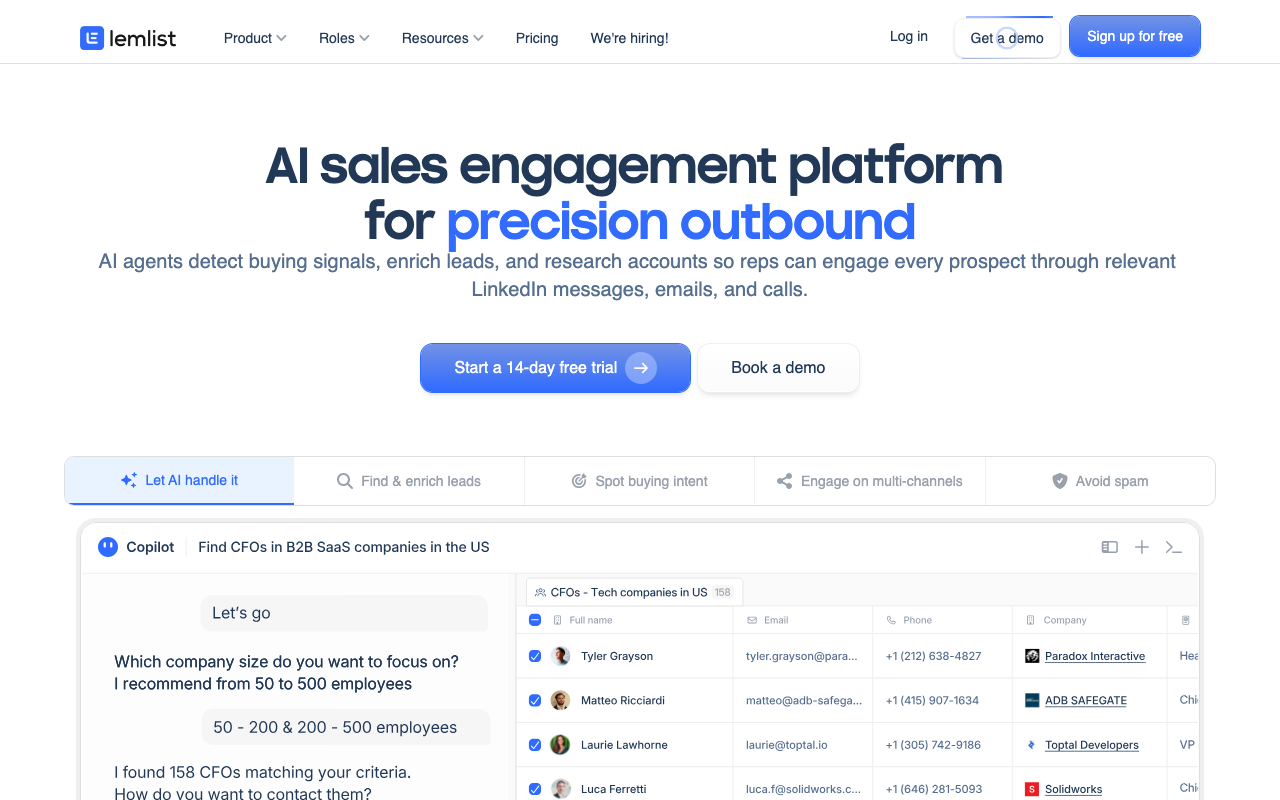
lemlist is an outbound sales engagement platform that bundles pieces most teams normally buy from four different vendors: a lead database, contact enrichment, multichannel sequencing and deliverability tooling. You can source prospects from a 650M+ lead database with filters, find and verify their emails and phone numbers, then run sequences across email, LinkedIn, cold calls, WhatsApp and SMS, with every reply landing in one unified inbox. AI agents (lemAgent) handle enrichment from LinkedIn profiles, websites and CRM data, and intent-signal agents flag and act on buying signals. The platform is SOC 2 certified.
In practice you build a lead list from lemlist's own database, a CSV upload, or the Chrome extension while browsing LinkedIn. You then construct a sequence that mixes email steps with LinkedIn profile visits, connection requests, messages, voice notes and feed engagement, plus calls through the built-in dialer, SMS and WhatsApp. LinkedIn actions run with smart limits and human-like delays, and a free LinkedIn account is enough to use them: Sales Navigator only widens the search filters rather than unlocking the automation.
Deliverability is handled inside the product rather than sold as a separate subscription. lemwarm warms your mailbox by exchanging mail with a network of roughly 10,000 users, and inbox rotation spreads sending across multiple domains and mailboxes. Data syncs to HubSpot, Salesforce, Attio and 500+ other tools, and there is a public API plus an MCP integration for AI assistants.
Billing has two layers, and this is the part to plan for. The subscription covers the platform, while enrichment is metered separately through rechargeable credits at 1 credit = $0.01. A verified email costs about 5 credits, a phone number 20, and buying-intent signals anywhere from 20 to 400+. Subscription pricing on annual billing is $55 per month for Email and $87 per month for Multichannel.
Where lemlist wins
- The stack is genuinely consolidated. Lead database, email finder and verifier, phone finder, sequencer, dialer and warm-up all sit in one subscription instead of four contracts and four logins.
- LinkedIn automation is native and complete. Profile visits, connection requests, messages, voice notes and feed engagement run inside the same sequence as email, with throttling and human-like delays, and they work on a free LinkedIn account.
- lemwarm and inbox rotation are included rather than upsold, so deliverability across multiple domains and mailboxes is handled without a separate warm-up tool.
- Contacts are unlimited on every plan, and emails and messages are unlimited from the Multichannel tier up, so list size does not drive cost.
- The integration surface is real. HubSpot, Salesforce, Attio and 500+ tools, plus a public API, developer access and an MCP server, backed by SOC 2 certification.
Where it falls short
- There is no free plan. The 14-day trial gives full Multichannel access without a card, but once it expires the account drops to read-only and you cannot launch campaigns.
- Two-layer pricing makes budgeting harder. The subscription does not include enrichment, and verified emails, phone numbers and intent signals all burn credits. Intent signals at 20 to 400+ credits each can make the real monthly bill difficult to forecast.
- The entry plan is email only. LinkedIn, SMS, WhatsApp and the dialer are absent from the $55 Email tier, so anyone who wants the multichannel promise starts at $87 per month.
- Governance sits behind Enterprise. Custom user roles and permissions, SSO and SAML, priority support and a dedicated account manager are all Enterprise-only.
- Advertised prices are annual rates. Monthly billing costs more (annual saves 20 percent, quarterly 10 percent), so the headline figure understates a month-to-month commitment.
Who should use lemlist
lemlist fits founder-led sales teams, SDR teams and RevOps groups running high-volume cold outbound who want prospecting, enrichment, email and LinkedIn in one place. The consolidation argument is strongest if you are currently paying for a data provider, a sequencer and a warm-up tool separately: folding those into one subscription simplifies both the stack and the finance conversation. It suits teams comfortable managing a credit budget and watching enrichment spend the way they would watch ad spend, since that is effectively what the second billing layer behaves like.
Skip it if you only need a simple email sequencer bolted onto a data provider you already trust, because you would be paying for a database and a dialer you will not touch. Skip it if a permanently free tier is a requirement. And skip it if SSO and granular role permissions are procurement blockers, since both sit behind the Enterprise plan and will turn a self-serve purchase into a sales negotiation.
Frequently Asked Questions
Does lemlist warm up emails?
Yes. lemwarm is included in every plan and warms new sending addresses by exchanging mail with a network of other inboxes. New inboxes need 2-4 weeks of warmup before sending high volume.
Can I personalize images?
Yes. Upload a template, mark dynamic fields, lemlist generates personalized images per prospect.
Is LinkedIn automation safe?
Lower risk than no-throttle bots, but not zero. Use a dedicated LinkedIn account when possible.
Does it integrate with Salesforce?
Yes. Two-way sync available.
Can I bring my own data?
Yes. CSV import for contact lists from any data source.