
The 8 Best Sales Enablement Tools in 2026

Key facts8 tools compared: Highspot, Seismic, Dock, Gong, HubSpot Sales Hub, Apollo, Mindtickle, Allego
- 8 tools compared: Highspot, Seismic, Dock, Gong, HubSpot Sales Hub, Apollo, Mindtickle, Allego
- Highspot (best for: Enterprise content + coaching): Quote only (~$700+/user/yr)
- Seismic (best for: Large enterprise content automation): From ~$32/user/mo, quote at scale
- Dock (best for: Mid-market deal rooms): Free; paid from $350/mo
- Gong (best for: Revenue teams, call coaching): $5K base + ~$1,600/user/yr
Most "sales enablement" buyers I talk to are really shopping for two different things at once: a place to store and serve sales content, and a way to make reps better at using it. The category has spent years smashing those into one platform, and in February 2026 the two biggest players, Highspot and Seismic, announced they're merging into a single ~$6B company. That tells you where this market is heading: fewer, bigger, more AI-heavy platforms.
That consolidation is good news and bad news. Good, because the survivors are genuinely powerful. Bad, because enterprise contracts now routinely run $45,000 to $100,000+ a year, and a lot of mid-market teams are paying for capability they'll never touch. So this guide splits the difference. If you run a large GTM org and content governance keeps you up at night, my top pick is Highspot. If you're a mid-market team that just wants buyers to engage and reps to close faster, look at Dock before you sign anything with a quote-only price tag.
This is for founders, RevOps leads, and sales managers picking a stack in 2026. I'll give you real pricing where it's published, the actual standout of each tool, and the catch nobody puts on the homepage.
Quick comparison
| Tool | Best for | Price | Standout |
|---|---|---|---|
| Highspot | Enterprise content + coaching | Quote only (~$700+/user/yr) | Nexus AI agents, content analytics |
| Seismic | Large enterprise content automation | From ~$32/user/mo, quote at scale | LiveDocs dynamic content assembly |
| Dock | Mid-market deal rooms | Free; paid from $350/mo | Digital sales rooms + mutual action plans |
| Gong | Revenue teams, call coaching | $5K base + ~$1,600/user/yr | Conversation intelligence |
| HubSpot Sales Hub | SMB to mid-market all-in-one | Free; Pro $90/seat/mo | CRM + enablement in one |
| Apollo | Outbound + data | Free; paid $49-$119/user/mo | 270M+ contact database |
| Mindtickle | Sales readiness + training | From ~$15/user/mo + setup | AI role-play, certification |
| Allego | Coaching-first enablement | Quote only | Video coaching + content in one app |

Highspot
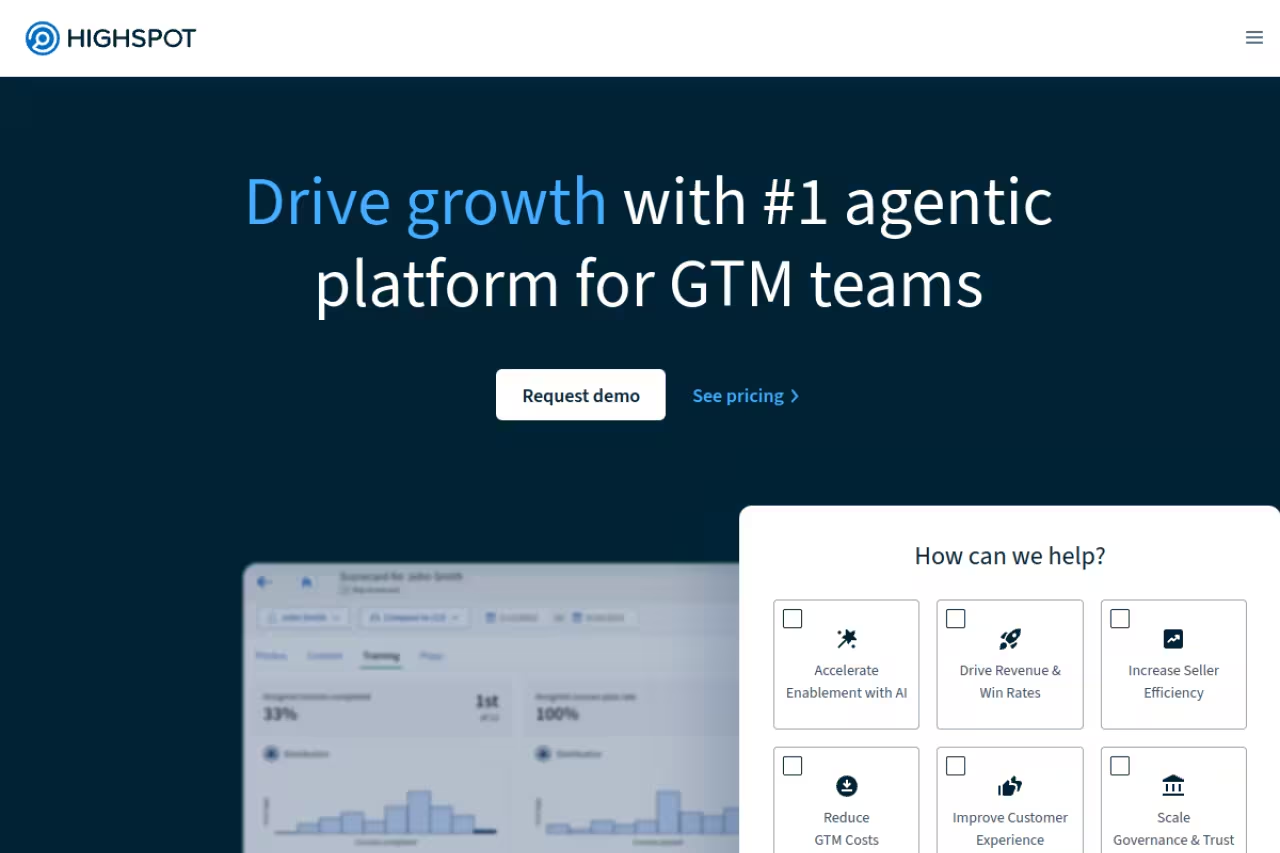
Highspot is the enablement platform that enterprise teams pick when content management and rep coaching are equally important and neither can be an afterthought. It now bills itself as "the agentic platform for GTM performance," which is marketing speak, but the substance underneath is real: a unified system for content, training, coaching, and buyer engagement, with analytics tying it all together.
Who it's best for: Sales orgs with 100+ reps and a marketing team producing more content than anyone can find. The content analytics are the best in the category. You can actually see which assets get used, which get opened by buyers, and which sit untouched.
The enterprise pick for sales orgs with 100+ reps and a marketing team producing more content than anyone can find, with the best content analytics in the category. It is expensive and quote-gated, and the pending Seismic merger makes the roadmap uncertain.
Highspot doesn't publish numbers. Based on Vendr procurement data, the content module starts around $700 per user per year, and enterprise contracts have landed near $91,000. Coaching and learning modules cost extra.
The standout: Nexus, Highspot's AI engine, powers agents like the Deal Agent (surfaces deal risk and next steps from buyer signals) and AI Role Play (reps practice pitches and get instant feedback). The role-play feature is the one I'd actually use weekly.
The catch: It's expensive and quote-gated, so you can't even sanity-check the budget without a sales call. And with the Seismic merger pending, you're buying into a product roadmap that's about to change. The two platforms will be supported independently for now, but "for now" is doing a lot of work in that sentence.
Seismic
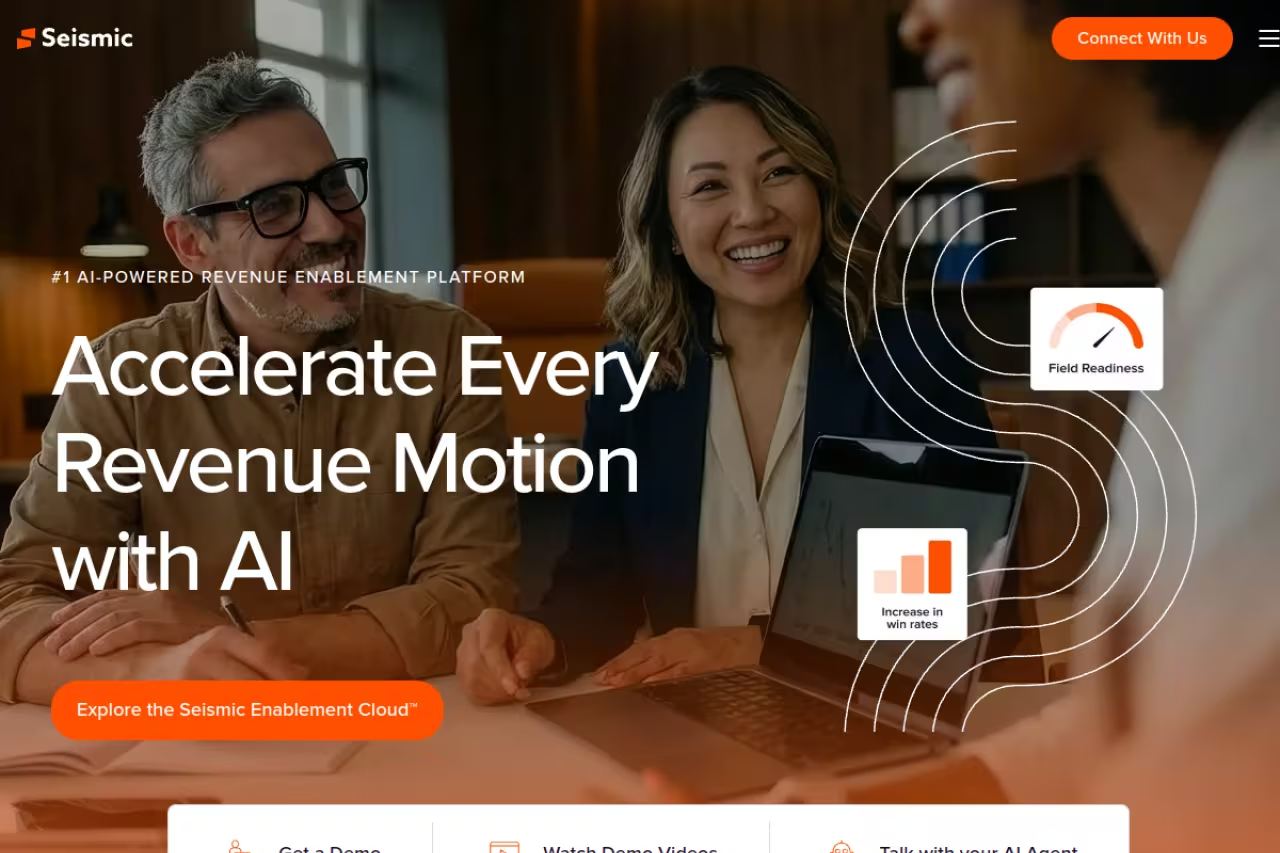
Seismic is Highspot's longtime rival and now its merger partner. Where Highspot leads on coaching integration, Seismic leads on content automation. If your problem is "we produce 200 versions of the same deck for different segments and reps are building them by hand," Seismic is the answer.
Who it's best for: Large enterprises in regulated or high-volume industries where personalized content at scale matters more than rep training. Financial services and pharma love it.
Choose Seismic if you are a large, regulated or high-volume enterprise where personalized content at scale matters more than rep training. LiveDocs saves real hours, but implementation takes months and smaller teams drown in configuration.
Seismic lists entry pricing around $32 per user per month, but real enterprise deployments are quote-only and land in the same $30 to $80 per user per month range as Highspot, often well into six figures annually once you add modules.
The standout: LiveDocs. It assembles dynamic, personalized content automatically, pulling the right data, disclaimers, and sections into a document based on the deal. For a rep prepping a pitch in a compliance-heavy field, that's hours saved per week.
The catch: It's heavy. Implementation takes months, and smaller teams drown in configuration they don't need. And like Highspot, the pending merger means you're partly betting on a future combined product, with Seismic CEO Rob Tarkoff leading the merged company.
Dock
Dock is the tool I recommend most to mid-market teams, because it solves the part of enablement buyers actually feel: the messy back-and-forth of a live deal. Instead of emailing PDFs and chasing signatures, reps spin up a single digital sales room per deal where the buyer finds everything in one link.
Who it's best for: B2B teams from seed-stage to mid-market who want buyer-facing deal rooms, mutual action plans, and onboarding portals without enterprise bloat or a six-figure contract.
A strong pick for B2B teams from seed-stage to mid-market that want buyer-facing deal rooms and mutual action plans without enterprise bloat. It is not a training or conversation-intelligence tool, but for its actual job the value is hard to beat.
There's a genuinely usable free plan for individuals and small teams. Paid plans start at $350/month for startups (5 users) and $1,000/month for growing companies, with additional seats at $50/user/month. Published pricing, no sales call required to see it.
The standout: The deal rooms double as mutual action plans, so the buyer and seller track next steps in the same space. Dock cites a 22% faster deal cycle across customers, and it connects to Salesforce and HubSpot to auto-create workspaces from CRM activity. The AI document generation (proposals, follow-ups from customer data) is a recent and useful addition.
The catch: It's a deal-room and content tool, not a training or conversation-intelligence platform. If you need call recording and coaching, you'll pair Dock with something like Gong. For its actual job, though, it's hard to beat on value.

Gong
Gong isn't a content library, it's a revenue intelligence platform, and it's on this list because coaching is half of enablement. Gong records and transcribes every sales call, then surfaces what's working, what's stalling, and which deals are at risk. For a sales manager who can't sit in on 40 calls a week, it's the closest thing to being everywhere at once.
Who it's best for: Revenue teams that want to improve rep performance through call insights and pipeline visibility rather than content management.
Pick Gong if you want to improve rep performance through call insights and pipeline visibility rather than content management. Its conversation intelligence is still the benchmark, but a mandatory platform fee and bundles make it overkill for a team of five reps.
Gong is quote-only and expensive. Expect a $5,000 base platform fee plus roughly $1,600 per user per year for the core plan (under 50 users). Bundled plans with Engage and Forecast push that to $2,880-$3,000 per user per year. Most contracts land between $40K and $300K+ depending on seats and modules. The platform fee makes simple seat math misleading, so budget carefully.
The standout: Conversation intelligence. Gong's call analysis is still the benchmark everyone else gets compared to, and the deal-risk warnings genuinely catch things reps miss.
The catch: The mandatory platform fee and the push toward expensive bundles mean Gong's effective per-user cost has climbed from about $160/month a couple of years ago to $200-$250/month now. It's powerful, but it's overkill for a team of five reps.
HubSpot Sales Hub
If you're earlier-stage and don't want to wire together five vendors, HubSpot Sales Hub bundles CRM, email tracking, deal pipelines, sequences, and meeting scheduling into one place. The enablement features are lighter than a dedicated platform, but the tight link between marketing content and sales activity is the payoff.
Who it's best for: SMB and lower mid-market teams that want one system for CRM and sales activity instead of a separate enablement vendor.
A sensible choice for SMB and lower mid-market teams that want one system for CRM and sales activity instead of a separate enablement vendor. Sequences and real reporting are locked behind Professional, and it will not match a specialist on content analytics.
There's a free CRM tier. Sales Hub Starter is $15/seat/month. The tier most teams actually need, Professional, is $90/seat/month billed annually (sequences, automation, and reporting are gated here), plus a one-time $1,500 onboarding fee.
The standout: Everything talks to everything. Because your content, sequences, and pipeline live in the same CRM, you skip the integration tax that bolt-on enablement tools charge in setup time.
The catch: Sequences and real reporting are locked behind Professional, so the Starter plan is thinner than it looks. And if you want deep content analytics or conversation intelligence, HubSpot won't match a specialist. For a primer on getting more out of it, see our guide to ChatGPT for sales.
If your team is spending half its day inside a CRM and an AI assistant, it's worth pressure-testing whether your stack is actually pulling its weight. That's the kind of audit a tool like Dupple X is built to help with.

Apollo
Apollo sits at the front of the funnel: a database of 270M+ contacts paired with outbound sequencing and basic deal management. It's enablement in the sense that it arms reps with the data and outreach tooling to start conversations in the first place.
Who it's best for: Outbound-heavy teams that need contact data, email finding, and multichannel sequences without paying ZoomInfo prices.
Suited to outbound-heavy teams that need contact data, email finding and sequences without paying ZoomInfo prices. The unified credit system is a budget trap, so treat the published price as a floor, not a ceiling.
Apollo has a free plan, though it cut the free tier from 10,000 to just 100 email credits per month in late 2025. Paid plans run $49 (Basic), $79 (Professional), and $119 (Organization) per user per month on annual billing. Heavy outbound teams often spend $150-$400/user/month once credit overages hit.
The standout: The data-plus-outreach combo. Most tools do one or the other. Apollo lets a rep find a prospect, verify the email, and drop them into a sequence without leaving the app.
The catch: The unified credit system is a budget trap. Sticker price and real spend diverge fast for active teams, and data accuracy, while decent, isn't flawless. Treat the published price as a floor, not a ceiling.
Mindtickle
Mindtickle is readiness-first. Where content platforms ask "can the rep find the deck," Mindtickle asks "can the rep actually sell." It measures whether training translates into behavior through AI role-play, certifications, and onboarding programs.
Who it's best for: Teams that onboard reps in cohorts and care about measurable ramp time, like fast-scaling sales orgs hiring in batches.
Readiness-first, for teams that onboard reps in cohorts and care about measurable ramp time. AI role-play scoring ties training to deal outcomes, but it is a learning platform you will run alongside something else, and the setup fee hurts small teams.
Quote-based, but entry-level learning packages start around $15 per user per month, with fuller enablement and AI capabilities costing more, plus a one-time implementation fee usually in the $3,000-$5,000 range. Volume and multi-year discounts are common.
The standout: AI-driven role-play and coaching that score reps on real selling scenarios, not multiple-choice quizzes. The data-first approach lets leaders tie training to deal outcomes, which most "training" tools can't prove.
The catch: It's a learning and readiness platform, not a content or deal-room tool, so you'll likely run it alongside something else. The setup fee and quote-only pricing also make it harder for small teams to test cheaply.

Allego
Allego takes the platform approach in one app: content management, agile learning, and conversation intelligence together. Its roots are in video coaching, and that's still where it shines. Reps record pitches, get peer and manager feedback, and learn in the flow of work.
Who it's best for: Coaching-led sales cultures that want video practice and content delivery in a single tool rather than stitching together a library and a separate coaching app.
A coaching-led choice for sales cultures that want video practice and content delivery in one tool. Pricing is not transparent and it trails Highspot and Seismic on content analytics, so skip it if content governance is your real problem.
Quote only, no public numbers. Plan on a sales call and a multi-seat commitment.
The standout: Video-based coaching is the core, not a bolt-on. If your enablement philosophy is "reps get better by practicing on camera and getting feedback," Allego is built around that loop.
The catch: No transparent pricing, and it's less dominant than Highspot or Seismic on pure content analytics. You're picking it for the coaching DNA, so if content governance is your real problem, look elsewhere.
How to choose
Skip the feature checklist. Start with the one problem that's actually costing you deals:
- Reps can't find or personalize content. This is the classic enablement problem. Highspot (best analytics) or Seismic (best automation) at the enterprise end. Dock if you're mid-market and want it without a six-figure contract.
- Reps aren't getting better. That's a coaching problem, not a content one. Gong for call insights, Mindtickle for structured readiness, Allego for video coaching.
- Buyers go dark mid-deal. You need digital sales rooms. Dock, full stop, especially with mutual action plans.
- You don't have enough conversations to enable. Front of funnel. Apollo for data and outreach. Pair it with our roundup of the best AI sales tools to round out the stack.
- You want one system, not five. HubSpot Sales Hub if you're SMB to mid-market and value integration over best-in-class depth.
One more rule: don't buy enterprise capability for a mid-market problem. The Highspot-Seismic merger is going to make the high end even bigger and pricier. Most teams under 50 reps get more value from Dock plus Gong than from a single quote-gated megaplatform they'll use 20% of.
If you want a faster way to vet and compare options across categories, our top tools directory is a good starting point.
FAQ
What is a sales enablement tool?
A sales enablement tool gives reps the content, training, and buyer-facing tools they need to sell more effectively. In practice that splits into a few jobs: serving and tracking sales content (Highspot, Seismic), coaching reps via call analysis or video (Gong, Allego, Mindtickle), and engaging buyers through deal rooms (Dock). Most teams need two of these, not all of them.
How much do sales enablement tools cost in 2026?
It ranges enormously. Mid-market tools like Dock start free and run $350-$1,000/month. HubSpot Sales Hub Professional is $90/seat/month. Enterprise platforms like Highspot and Seismic are quote-only and routinely cost $45,000 to $100,000+ per year. Gong adds a $5,000+ platform fee on top of roughly $1,600/user/year.
What's the difference between Highspot and Seismic?
Both are enterprise content and enablement platforms, and they announced a merger in February 2026. Historically, Highspot leads on rep coaching and content analytics, while Seismic leads on content automation (its LiveDocs feature assembles personalized documents automatically). After the merger, the combined company will operate as Seismic, though both products are supported independently for now.
Do small teams need a sales enablement platform?
Usually not a full enterprise one. A team under 25 reps is better served by a focused tool: Dock for deal rooms (free to start), HubSpot Sales Hub for an all-in-one CRM, or Apollo for outbound. Save the six-figure platforms for when you have a content governance problem that genuinely hurts.
Is Gong a sales enablement tool?
Gong is a revenue intelligence platform, not a content library, but it covers the coaching half of enablement. It records and analyzes sales calls to show what's working and flag at-risk deals. Many teams run Gong alongside a content tool like Dock or Highspot rather than as a replacement for one.
Which sales enablement tool has a free plan?
Dock, HubSpot, and Apollo all offer free tiers. Dock's free plan is the most useful for actual selling (digital sales rooms for individuals and small teams). HubSpot's free CRM is generous but gates sequences and reporting behind paid tiers. Apollo's free plan now caps you at 100 email credits per month, enough to evaluate, not enough to run campaigns.
Related guides
Some offers on this page may be paid placements or contain affiliate links.
