
Best Oil and Gas Accounting Software (2026)

Key facts8 tools compared: Pivoten, Quorum Software, W Energy, Enertia, PakEnergy, Pandell JV, Oracle…
- 8 tools compared: Pivoten, Quorum Software, W Energy, Enertia, PakEnergy, Pandell JV, Oracle NetSuite, GreaseBook
- Pivoten (best for: Small to mid-sized operators): From $695/mo, all modules
- Quorum Software (best for: Large operators, 500+ wells): Quote, six figures
- W Energy (best for: Multi-entity upstream + midstream): Quote (enterprise)
- Enertia (best for: Complex E&P workflows): Quote (enterprise)
Oil and gas accounting breaks normal accounting software. The minute you have a well with three working-interest partners, royalty owners on different decimal splits, severance taxes that change by state, and a joint interest bill due at month-end, QuickBooks stops being a tool and starts being a liability. I have watched a controller spend two weeks reconciling a revenue run a purpose-built system would have closed in an afternoon.
So this is not a generic accounting roundup. Every product here understands division orders, joint interest billing (JIB), revenue distribution to owners, and the suspense math that comes with title issues. The question is which one fits the size of your shop and the depth of your back office.
If you run a small to mid-sized operation and you want my short answer: start with Pivoten. It is cloud-based, it scales from one well to thousands, it has no multi-year contract, and at $695 a month with every module included it undercuts almost everyone. The enterprise crowd running thousands of wells with a full accounting team will land on Quorum or W Energy instead. Here is how the field actually shakes out.
Quick comparison
| Tool | Best for | Price | Standout |
|---|---|---|---|
| Pivoten | Small to mid-sized operators | From $695/mo, all modules | No contract, fast to start |
| Quorum Software | Large operators, 500+ wells | Quote, six figures | Absorbed OGSYS, deep upstream stack |
| W Energy | Multi-entity upstream + midstream | Quote (enterprise) | Modern cloud, field-to-finance |
| Enertia | Complex E&P workflows | Quote (enterprise) | 40+ years, deep configurability |
| PakEnergy | All sizes, land-heavy ops | Quote | Land management integration |
| Pandell JV | JV-focused, US and Canada | Quote, no upgrade fees | Real-time partner accounting |
| Oracle NetSuite | Growing mid-market | Quote (modular) | Full ERP breadth |
| GreaseBook | Field production capture | ~$15-40/well/mo | Mobile pumper app |
Pivoten: the best value for most independents

Pivoten calls itself software "developed by operators, for operators," and you feel that the first time you run a revenue distribution. It covers the full back office: JIB, revenue distribution, owner suspense, well plugging, house gas, direct deposit, positive pay, and core GL, AP, and AR. According to the company it now runs across 1,000+ companies managing 125,000 active wells and 250,000 mineral owners.
Who it's best for: Independent operators, family trusts, investment funds, and mineral owners who want real oil and gas accounting without an enterprise commitment. It scales from a single well up past 5,000.
A strong value pick for independent operators, trusts and mineral owners who want real oil and gas accounting from $695 per month with no multi-year contract. It is lean, not a sprawling ERP, so heavy midstream plant accounting or deep land configurability will outgrow it.
From $695 per month with all modules included, per Pivoten's own materials. No multi-year contract. You can run it cloud or on-premise, with US-based support.
The standout: Price-to-capability. You get the same JIB and revenue engine the big platforms charge six figures for, and you can leave whenever you want. For an operator with a few hundred wells, that pricing is hard to argue with.
The catch: It is purpose-built and lean, not a sprawling ERP. If you need heavy midstream plant accounting, pipeline allocations, or deep land-contract configurability, you will outgrow it. For pure upstream financials, that is rarely a problem.
Quorum Software: the enterprise standard
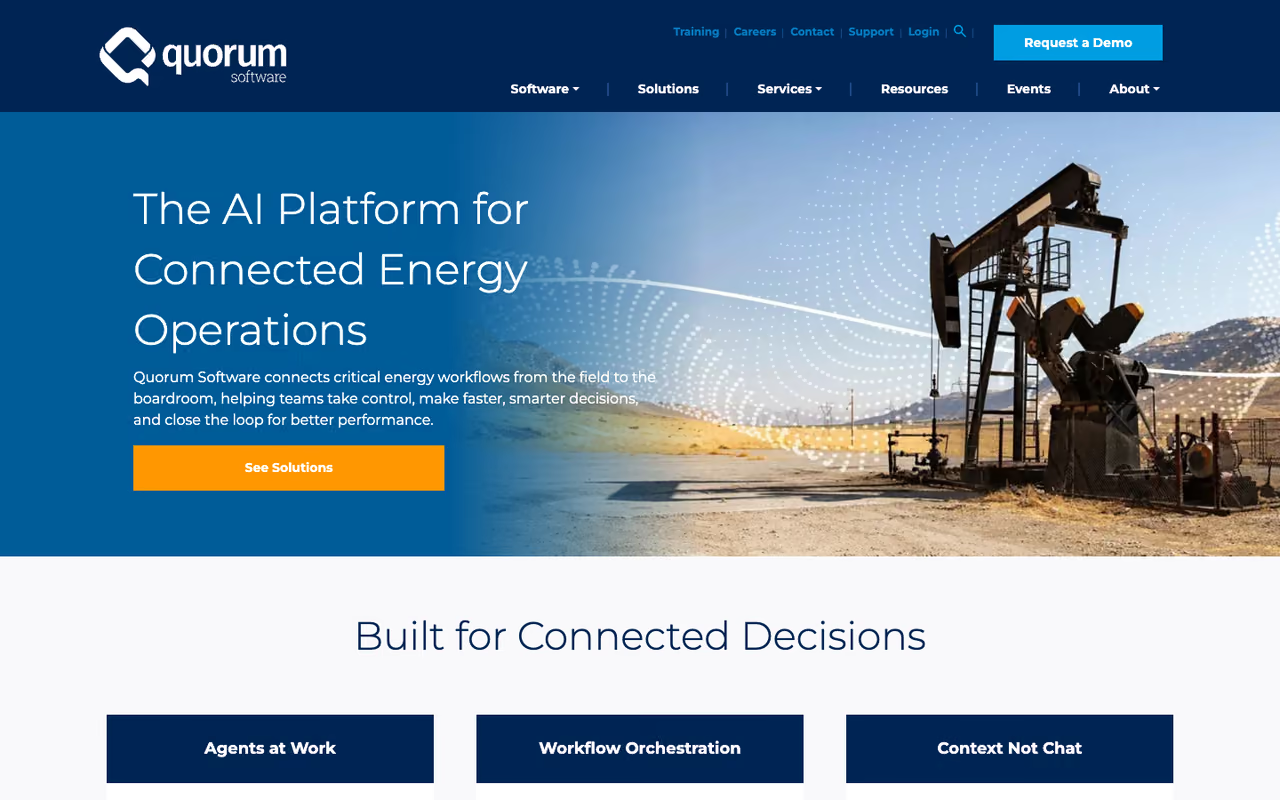
Quorum is what most large operators end up on, and it got larger by absorbing OGSYS, the long-running independent-focused accounting product. If you go looking for ogsys.com today it redirects straight to Quorum's On Demand accounting page. That tells you where the market consolidated.
Who it's best for: Operators running 500+ wells with a dedicated accounting team and IT support. Quorum's customer roster includes names like Tallgrass and Saturn Oil & Gas scaling from 200 to 40,000 BOE/D, which is the league this plays in.
The enterprise standard for operators running 500+ wells with a dedicated accounting team and IT support, with battle-tested JIB logic. Expect six-figure cost and long implementations, so it is overkill for an operator with 80 wells.
Quote-based, and realistically six figures once you factor implementation. This is not a tool you buy on a Tuesday afternoon.
The standout: Depth. The Upstream On Demand suite ties together well operations, land, accounting, and production in one cloud platform, and the OGSYS lineage means the JIB and disbursement logic is battle-tested across decades of independents.
The catch: Cost and complexity. Implementations run long, you need internal IT to support it, and for an operator with 80 wells it is overkill. The horsepower is real, but so is the overhead.
W Energy: the modern cloud platform
W Energy (formerly Waterfield Energy) is the one I point people to when they want enterprise capability without an interface that feels like 2004. Its Stream+ platform connects upstream and midstream from field to finance, covering accounting, land, production, and field service in one place. The DataView reporting layer gives you real-time financials instead of a month-end scramble.
Who it's best for: Multi-entity operators who run both upstream and midstream and want a single system across the two. The midstream side handles plant accounting and pipeline accounting, which most upstream-only tools cannot touch.
The pick for multi-entity operators running both upstream and midstream who want enterprise capability without a dated interface. A small single-basin operator will pay for unused capacity, and midstream features add complexity if you are upstream-only.
Enterprise quote-based. Like Quorum, expect a real implementation, not a self-serve signup.
The standout: The cloud experience. If you are choosing between W Energy and a legacy platform purely on usability, W Energy tends to win. Teams pick it up faster, which shortens the time before your accountants are actually productive.
Where it falls short: It is built for scale, so a small single-basin operator will pay for capacity they will not use. And midstream-grade features add complexity you do not need if you are upstream-only.
Enertia: for genuinely complex E&P
Enertia has focused on upstream oil and gas since 1983, and it shows. It is a single-vendor ERP covering accounting and financials, well production and operations, AFE management, land, contracts, mapping, and field data capture. Built on the Microsoft stack, it is the platform you reach for when your workflows are non-standard and you need to configure your way out of edge cases.
Who it's best for: Mid-cap independents with high invoice volume across thousands of wells, especially if your processes do not fit a template.
Reach for it when you are a mid-cap independent with high invoice volume and non-standard workflows that need configuring. It is heavy to implement, and for straightforward accounting it is more system than you need.
Enterprise quote-based. Plan for a heavier rollout than a cloud-native tool.
The catch: It is on the heavier side to implement, and the depth that helps complex shops becomes friction for simple ones. If your accounting is straightforward, this is more system than you need.
PakEnergy: when land management matters
PakEnergy, formerly WolfePak, pairs full upstream and midstream accounting with land management that is genuinely good. The land module lets teams input and relate agreements to assets far faster than typing them by hand, with automated renewal alerts, GIS mapping, and an owner-relations CRM. Accounting covers GL, AP, AR, bank rec, deposits, and 1099s with audit-ready workflows.
Who it's best for: Operators of any size whose pain is as much lease and obligation tracking as it is JIB. If lease expirations and rental due dates keep you up at night, the integrated land-to-accounting flow is the draw.
Choose it when lease and obligation tracking hurts as much as JIB, thanks to strong land management tied to accounting. As an established suite it carries weight, and smaller operators may find it more than pure financials need.
Quote-based.
The standout: Ownership data, lease obligations, and production results live in one system, so you stop reconciling across three.
The catch: As an established suite, it carries the weight of one. Smaller operators sometimes find it more than they need for pure financials.
Pandell JV: real-time joint venture accounting
Pandell JV is a cloud joint venture accounting system used by 500+ energy companies across Canada and the US. It processes partner transactions in real time, so you have a live view of net financial and operational data on any day of the month rather than waiting for close. Its grid technology lets you compile and export tailored reports quickly, and it links to back-office systems like BOLO, JDE, and EnergyLink.
Who it's best for: JV-heavy operators, especially those with Canadian operations, who want partner accounting that updates continuously.
The pick for JV-heavy operators, especially with Canadian operations, who want a live partner ledger instead of month-end surprises. It is JV-accounting-first, so a full operational ERP means integrating it with other systems.
Quote-based, and notably Pandell does not charge for software upgrades.
The standout: The real-time partner ledger. No more month-end surprises about where a JV balance actually sits.
Where it falls short: It is JV-accounting-first. If you need a full operational ERP spanning production and field ops, you will be integrating Pandell with other systems rather than running everything in one.
Oracle NetSuite: the ERP backbone
Oracle NetSuite is not built for oil and gas. I am including it because it solves a specific problem: you have outgrown QuickBooks, you are acquiring assets and entities, and you need real ERP breadth before you commit to an industry platform. One energy survey found 64% of retail oil and propane companies still run QuickBooks, and NetSuite is a common next step.
Who it's best for: Growing mid-market operators expanding into new regions or business lines who value multi-currency financials, procurement, and CRM in one system.
A stopgap when you have outgrown QuickBooks and need ERP breadth before committing to an industry platform. It has no native JIB, division orders or revenue distribution, so you end up maintaining two systems, and a purpose-built tool is better for pure upstream.
Modular quote-based, and it climbs with the modules you add.
The standout: Breadth. Accounting, inventory, procurement, and CRM connect without bolting on separate tools.
The catch: No native JIB, division orders, or revenue distribution. You will need an oil-and-gas add-on or integration to handle the industry-specific math, which means you are maintaining two systems. For pure upstream accounting, a purpose-built tool is the better call.
If you are also evaluating which AI and automation tools to layer on top of your accounting stack, our top tools directory and the best AI agents guide are useful next reads. And if your team is drowning in AI tool noise, Dupple X cuts through it with one weekly signal.
GreaseBook: production capture, not the books
GreaseBook is not accounting software, and I am listing it on purpose. It is the mobile pumper app that feeds your accounting system clean production data: tank levels, well tests, run tickets, and field notes captured on a phone instead of a paper sheet that gets lost in a truck. Pricing typically lands in the $15-40 per well per month range depending on source.
Who it's best for: Independent operators whose month-end pain starts in the field, not the office. Bad production data makes good accounting impossible, and this is where you fix that.
The catch: It will not do your JIB or cut owner checks. Pair it with Pivoten or one of the platforms above.
Not accounting software but a mobile pumper app that feeds clean production data into your books, for operators whose month-end pain starts in the field. It will not do your JIB or cut owner checks, so pair it with Pivoten or another platform.
How to choose
Forget feature checklists for a second and answer three questions.
How many wells and entities do you run? Under a few hundred wells, single basin, lean back office: Pivoten is almost always the right answer on price and speed. Above 500 wells with dedicated accounting and IT staff: you are in Quorum, W Energy, or Enertia territory, and the choice comes down to usability versus configurability.
Where does your pain actually live? If it is JIB and owner payments, any purpose-built tool here works. If it is lease obligations and land, weight toward PakEnergy. If it is joint ventures with partners, Pandell. If it is bad field data, fix that with GreaseBook first.
Are you upstream-only or upstream plus midstream? Plant and pipeline accounting narrows the field fast. W Energy and PakEnergy handle both; most upstream tools do not.
One rule worth repeating: do not run an oil and gas operation on generic accounting software past your first few wells. The states will not forgive a botched severance tax filing, and your working-interest partners will not forgive a wrong JIB. The right tool pays for itself the first clean month-end.
FAQ
What is the best oil and gas accounting software for small operators?
For most small to mid-sized operators, Pivoten is the best fit. It starts at $695 a month with every module included, requires no long-term contract, and handles JIB, revenue distribution, and owner suspense from a single well up past 5,000. It gives independents enterprise-grade accounting logic without the enterprise price tag or implementation timeline.
Can I use QuickBooks for oil and gas accounting?
You can for the first handful of wells, but it breaks down fast. QuickBooks has no concept of division orders, joint interest billing, revenue distribution by decimal interest, or severance tax by state. Surveys show many operators still run it, but most replace it once they add partners, royalty owners, or multiple states. Past that point a purpose-built tool saves far more than it costs.
What is joint interest billing (JIB) and why does it need special software?
JIB is how an operator bills working-interest partners for their share of well costs. It requires tracking each partner's decimal interest, allocating expenses correctly, and producing partner-ready statements every month. Generic accounting tools cannot model these ownership splits, so getting it wrong damages partner trust and creates disputes. Oil and gas accounting software automates the allocation and the statements.
Is cloud-based oil and gas accounting software better than on-premise?
For most operators today, yes. Cloud platforms like W Energy, Quorum On Demand, and Pandell give you real-time data, no server maintenance, and access from anywhere, which matters when your accountants and field teams are in different places. On-premise still makes sense for shops with strict data-residency rules or unreliable connectivity, and tools like Pivoten offer both.
How much does oil and gas accounting software cost?
It spans a wide range. Pivoten starts at $695 a month with all modules. Field production apps like GreaseBook run roughly $15-40 per well per month. Enterprise platforms like Quorum, W Energy, and Enertia are quote-based and frequently reach six figures once implementation is included. Your well count, entity structure, and whether you need midstream features drive the number.
Did Quorum acquire OGSYS?
OGSYS is now part of Quorum Software. The former ogsys.com domain redirects to Quorum's On Demand accounting page, and OGsys lives on as the accounting module inside Quorum's Upstream On Demand suite. If you used OGSYS as a standalone independent-focused platform, its capabilities continue under the Quorum umbrella.
Ready to stop manually scanning AI and automation news to keep your stack sharp? Try Dupple X and get the signal without the noise.
Related guides
Some offers on this page may be paid placements or contain affiliate links.
