
The 8 Best AI Visual Inspection Tools (2026)

Key facts8 tools compared: Landing AI (LandingLens), Cognex, Instrumental, Averroes, SwitchOn…
- 8 tools compared: Landing AI (LandingLens), Cognex, Instrumental, Averroes, SwitchOn DeepInspect, Roboflow, MVTec HALCON, Google Visual Inspection AI
- Landing AI (LandingLens) (best for: No-code teams, fast pilots): Free tier + custom enterprise
- Cognex (best for: Hardware-integrated factory lines): Quote-based (system + license)
- Instrumental (best for: Electronics NPI and assembly): Annual license, quote-based
- Averroes (best for: Few-shot, hardware-agnostic): Free trial + custom
A human inspector on a production line misses roughly 20 to 30 percent of defects after a few hours of staring at parts. That's not a knock on the inspector. It's biology. Attention drifts, lighting changes, and the hundredth widget looks exactly like the first. AI visual inspection exists to close that gap, and in 2026 the tools are finally good enough that a small quality team can stand one up in weeks instead of hiring a computer vision PhD.
The catch is that "AI visual inspection" now covers wildly different products. Some are no-code SaaS platforms you train by uploading photos. Some are embedded camera systems that run inference at the edge with zero cloud connection. Some are developer libraries that hand you the model and walk away. Picking the wrong category wastes a quarter and a budget cycle.
If you want the short answer: for most quality teams that don't have computer vision engineers on staff, Landing AI's LandingLens is the fastest path from "we have defects" to "we have a model catching them." If you're inspecting electronics during new product introduction, Instrumental is in a class of its own. And if you want hardware that just works on a fast line, Cognex remains the default. Below is how I'd choose between all eight, with real pricing and where each one falls short.
Quick comparison
| Tool | Best for | Price | Standout |
|---|---|---|---|
| Landing AI (LandingLens) | No-code teams, fast pilots | Free tier + custom enterprise | Few-image training, edge deploy |
| Cognex | Hardware-integrated factory lines | Quote-based (system + license) | In-Sight 3900, 25 MP at the edge |
| Instrumental | Electronics NPI and assembly | Annual license, quote-based | Finds unknown defects from 5 units |
| Averroes | Few-shot, hardware-agnostic | Free trial + custom | 20 to 40 images per defect class |
| SwitchOn DeepInspect | High-speed lines (1000+ PPM) | Quote-based | No-code SKU setup, 8 cameras |
| Roboflow | Developers building custom CV | Free + $79/mo Core | Full pipeline, YOLO/RF-DETR |
| MVTec HALCON | Vision engineers, classical + DL | License (perpetual/subscription) | GCAD anomaly detection |
| Google Visual Inspection AI | Cloud-native factories | Pay-as-you-go (GCP) | Managed, scales with GCP |

Landing AI (LandingLens)
Andrew Ng's company built LandingLens around a simple idea: most factories don't have thousands of labeled defect images, so the tool should work with dozens. You upload images, label good and bad regions in the browser, and the platform trains a model. The 2022 addition of LandingEdge lets you push that model to a device on the floor, so inference runs locally and feeds new data back to the cloud to keep improving.
Who it's best for: quality and process engineers without a data science team. The whole point is that you don't write code. Landing AI claims the labeling workflow cuts annotation time by up to 50 percent and reduces deployment time by up to 67 percent, which tracks with how guided the interface feels.
On pricing, there's a free Basic plan to learn the workflow, and Enterprise is custom-quoted. Credit-based usage can climb on high-volume lines, so model the cost against your real throughput before committing.
The catch: Landing AI has pivoted hard toward document extraction in the past year, and the homepage now leads with agentic document AI. LandingLens is still maintained and available, but it no longer feels like the company's center of gravity. If long-term roadmap investment matters to you, ask their team directly where visual inspection sits in 2026.
A good fit for quality engineers without a data science team, since you can train a model from dozens of images with no code. The company has pivoted toward document AI, so ask where visual inspection sits on its 2026 roadmap.

Cognex
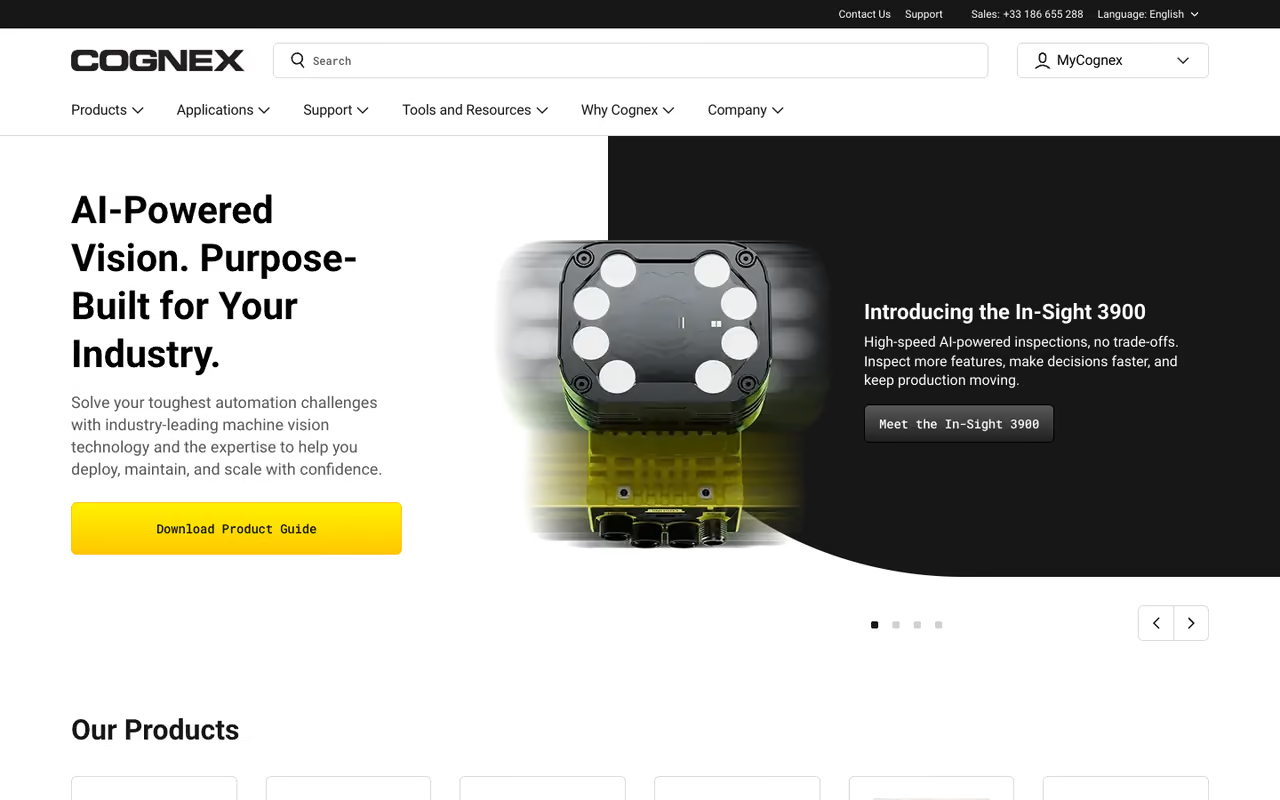
Cognex is the incumbent, and for good reason. The company did $994 million in 2025 revenue and added 9,000 new customer accounts, so when you buy Cognex you're buying a deployment playbook that's been run tens of thousands of times. Their AI sits inside the In-Sight line of smart cameras, blending "edge learning" (train on a handful of images, no GPU) with deep learning for harder, less predictable defects.
The headline product this year is the In-Sight 3900, announced May 5, 2026. It runs on Qualcomm Dragonwing silicon, handles up to 25 megapixels, processes inspections 4X faster than the previous generation, and runs PC-free at the edge. They also shipped the In-Sight 6900 on NVIDIA for the heaviest deep-learning jobs.
Who it's best for: teams that want the camera, the lighting, the software, and the support contract from one vendor on a fast line. This is hardware-first inspection.
The catch: pricing is quote-based and not cheap. A full In-Sight system plus software licensing runs into five figures per station, and you're committing to Cognex's ecosystem. For a startup doing low-volume inspection, that's overkill. It shines when uptime and line speed are worth real money.
The incumbent for fast lines where you want camera, lighting, software and support from a single vendor. It is hardware-first with quote-based pricing that runs into five figures per station, which is overkill for low-volume startups.
Instrumental
Instrumental was founded by two ex-Apple product design engineers, and it shows in the focus: electronics manufacturing, specifically the painful new product introduction phase where you're building the first few hundred units and every defect is a mystery. The platform pairs machine vision cameras with cloud software that stores every unit's image and test data for full traceability.
The differentiator is Discover AI, which surfaces defects you've never seen before using as few as five units. Most inspection tools need you to define what "bad" looks like first. Instrumental flips that: it flags anomalies in early builds before you even have a defect library. Their Solve AI claims to cut failure-analysis time by up to 90 percent, and the company reports a $50 billion telecom brand hit breakeven within a month of deploying it. Instrumental has raised over $80 million and now sits inside the Siemens Xcelerator catalog.
Who it's best for: hardware companies in NPI, EVT through DVT, who need to catch unknown-unknowns early.
The catch: it's narrow on purpose. If you're inspecting injection-molded parts or food packaging, this isn't your tool. Pricing is an annual license (monthly available for emergency ramps), quote-based, and you either bring your own equipment or rent Instrumental's stations.
Pick Instrumental if you build electronics hardware and need to catch unknown defects in the early NPI phase, using as few as five units. It is narrow on purpose, so skip it for molded parts or food packaging.
Averroes
Averroes is the scrappier no-code alternative, and its pitch is data efficiency. The platform trains on just 20 to 40 images per defect class and claims 99 percent-plus defect detection. It layers a WatchDog anomaly model on top of your supervised models, so it flags defects you never labeled, similar in spirit to Instrumental's Discover AI but pointed at a broader set of industries: semiconductors, solar, pharma, food and beverage, even oil and gas.
Who it's best for: teams that want few-shot training without locking into a hardware vendor. Averroes is hardware-agnostic and integrates with existing inspection rigs, with on-premise or cloud deployment.
A no-code, hardware-agnostic option that trains on just 20 to 40 images per defect class and flags unlabeled anomalies too. It is a younger, smaller vendor with unpublished pricing, so validate it on your hardest defect class during the trial.
Pricing isn't published. There's a free trial, and beyond that you're talking to sales for a custom quote. Reviews on Capterra skew positive on accuracy and the no-code workflow.
The catch: it's a smaller company than Cognex or Landing AI, so you're betting on a younger vendor. For some buyers that's a feature (more attentive support); for risk-averse enterprises it's a question mark. Validate it on your hardest defect class during the trial.
SwitchOn DeepInspect
SwitchOn's DeepInspect is purpose-built for speed. It runs AI inspection at 1000+ parts per minute, supports up to eight industrial cameras in one application, and handles surface defects, OCR/OCV, dimension checks, and assembly verification with up to 99.5 percent accuracy. As of April 2026 it's a validated entry in Intel's Edge AI Catalog, which is a useful trust signal for edge deployments.
Who it's best for: high-volume automotive and consumer-goods lines where parts fly past and you need to set up new SKUs without calling an engineer. DeepInspect trains on as few as 200 images and uses a no-code interface for new SKUs, and it integrates with Siemens, Delta, Omron, and Mitsubishi PLCs.
The catch: it's strongest in fast, repetitive, high-throughput contexts. If your inspection is low-volume or highly variable per unit, the throughput advantage doesn't pay off, and you'd do better with a more flexible platform. Pricing is quote-based.
Built for speed on high-volume automotive and consumer-goods lines, at 1000+ parts per minute with no-code setup for new SKUs. Throughput is the whole advantage, so low-volume or highly variable inspection is better served elsewhere.

Roboflow
Roboflow is the option for teams that want to build their own thing. It's a full computer vision pipeline: AI-assisted labeling, dataset management, training across architectures like YOLO and RF-DETR, and deployment to cloud or edge. Over a million engineers use it, including more than half the Fortune 100, and its open-source Inference server and Supervision library handle real-time video and multi-object tracking.
Who it's best for: developers and ML teams who want control. If you have someone who can write Python and you'd rather own the model than rent a black box, this is the most flexible pick on the list. It's also the natural landing spot for teams migrating off Amazon Lookout for Vision, which AWS discontinued on October 31, 2025.
The most flexible pick for developers and ML teams who would rather own the model than rent a black box, with a free plan and Core at $79/month billed annually. It is a build-it-yourself toolkit, so a quality manager wanting a pass/fail box should look elsewhere.
Pricing is transparent for once: a free Public plan with $60/month in credits, a Core plan at $79/month billed annually ($99 monthly), and custom Enterprise. That clarity is rare in this space.
The catch: this is a build-it-yourself toolkit, not a turnkey inspection appliance. You're responsible for camera integration, lighting, and the deployment hardware. Reviewers also flag that credits deplete faster than expected on large datasets. Great for engineers, wrong for a quality manager who just wants a box that says pass or fail.
If you're weighing build-versus-buy across your whole AI stack, our guides on the best AI agents and best AI for coding cover the developer-tooling side of that decision.
MVTec HALCON
MVTec makes HALCON, the machine vision library that's been the backbone of serious industrial vision for decades, plus MERLIC for no-code setups. This is engineer territory. HALCON gives you classical vision (matching, measurement, 3D) and modern deep learning in one toolbox, including anomaly detection that trains on a low number of "good" images only.
The 2026 releases are worth noting: HALCON 25.11 added Continual Learning so you can update a classifier with a few new images without it forgetting old classes, and MERLIC now ships Global Context Anomaly Detection (GCAD) that catches both local scratches and global problems like a missing or misaligned component in one pass. Starting April 2026, MVTec also simplified licensing to a single USB dongle across products.
Who it's best for: vision engineers and system integrators building bespoke inspection where you need both classical precision and AI flexibility.
The catch: there's a real learning curve and you need vision expertise to get value out of it. The no-code MERLIC softens that, but HALCON proper is a library, not an app. If nobody on your team knows what a region of interest is, start elsewhere.
Engineer territory: classical vision plus deep learning in one toolbox, for vision engineers and integrators building bespoke inspection. HALCON is a library rather than an app, so skip it if nobody on your team has vision expertise.
Google Cloud Visual Inspection AI
Google Cloud's Visual Inspection AI is the hyperscaler play, used by Renault, Foxconn, and Kyocera. It detects defects without forcing you to build training pipelines or tune hyperparameters by hand, and it lives inside GCP, so it scales with the rest of your cloud infrastructure.
Who it's best for: cloud-native manufacturers already standardized on Google Cloud who want managed inspection that ties into BigQuery, dataflow, and the rest of the stack. With Amazon Lookout for Vision gone, Google is now the main hyperscaler option for managed visual inspection.
The catch: you're tying inspection to a cloud vendor's roadmap, and managed AI services in this category have a history of getting sunset (see AWS). It also assumes reliable connectivity, which not every factory floor has. For air-gapped or latency-sensitive lines, an edge-first tool like Cognex or DeepInspect fits better.
The natural managed choice for manufacturers already standardized on Google Cloud, now the main hyperscaler option with Amazon's service gone. You tie inspection to one cloud vendor's roadmap and need reliable connectivity, so edge-first tools suit air-gapped lines better.
How to choose
Start with two questions, not a feature spreadsheet.
First: do you have engineers? If yes, Roboflow or HALCON give you control and lower long-run cost. If no, you want a no-code platform: Landing AI, Averroes, or SwitchOn.
Second: where does inspection happen? On a fast line with PLCs and tight latency, go edge-first with Cognex or DeepInspect, where the camera and inference live on the floor. For early-stage hardware builds where you're still discovering defects, Instrumental's unknown-defect detection is the unfair advantage. For cloud-native operations, Google's managed service slots in.
One rule that saves projects: run a real pilot on your single hardest defect class before signing anything. Vendor accuracy claims (99 percent, 99.5 percent) are measured on clean datasets. Your scratched, glare-prone, oddly-lit parts are the real test. Every tool here offers a trial or a paid pilot. Use it on the defect that actually keeps you up at night.
If your team is also evaluating AI tools for the rest of the operation, our top AI tools roundup and the Dupple X bundle are a faster way to compare than starting from a blank tab.
FAQ
What is the best AI visual inspection tool in 2026?
For no-code quality teams, Landing AI's LandingLens is the fastest to deploy. For hardware-integrated factory lines, Cognex is the safest default. For electronics during new product introduction, Instrumental leads on finding unknown defects. The "best" depends on whether you have engineers and where inspection physically happens.
Do AI visual inspection tools need a lot of training images?
Not anymore. Modern platforms train on far fewer images than older systems. Averroes works with 20 to 40 images per defect class, Cognex edge learning needs just a handful, and SwitchOn DeepInspect trains on as few as 200. Anomaly-detection approaches like MVTec HALCON's even train on "good" images only, then flag anything that deviates.
Is Amazon Lookout for Vision still available?
No. AWS discontinued Amazon Lookout for Vision on October 31, 2025, and stopped onboarding new customers in October 2024. Teams that relied on it have largely migrated to Roboflow, Google Cloud Visual Inspection AI, or a dedicated platform like Landing AI.
How much does AI visual inspection software cost?
It ranges widely. Roboflow is transparent at $79/month for its Core plan. Most industrial platforms (Cognex, Instrumental, SwitchOn, Averroes) are quote-based, and a full Cognex camera-plus-software station typically runs into five figures. No-code SaaS tools like Landing AI offer free tiers to start, with usage-based or custom enterprise pricing above that.
Can AI visual inspection run without an internet connection?
Yes, if you choose an edge-first tool. Cognex In-Sight systems and SwitchOn DeepInspect run inference locally on the factory floor with no cloud dependency. Landing AI's LandingEdge also deploys models to local devices. Cloud-managed options like Google Visual Inspection AI need connectivity, which makes them a worse fit for air-gapped lines.
How accurate is AI visual inspection compared to human inspectors?
Human inspectors typically miss 20 to 30 percent of defects over a shift due to fatigue. Leading AI inspection tools report 99 percent-plus detection accuracy on their benchmark datasets. The honest caveat: those numbers come from controlled tests, so validate any tool on your own hardest parts during a pilot before trusting the marketing figure.
Related guides
Some offers on this page may be paid placements or contain affiliate links.
