
The 11 Best AI Testing Tools in 2026 (Compared and Ranked)

Key facts11 tools compared: TestMu AI, QA Wolf, Shiplight, Functionize, Momentic, Applitools, Keploy…
- 11 tools compared: TestMu AI, QA Wolf, Shiplight, Functionize, Momentic, Applitools, Keploy, TestSprite, Tricentis Testim, Stagehand, Katalon
- TestMu AI (best for: All-in-one authoring + execution): KaneAI from $199/mo/agent
- QA Wolf (best for: Outsourced E2E coverage): ~$8K/mo for 200 tests
- Shiplight (best for: Teams using coding agents that need verification built directly into development): Free; Pro $60/mo
- Functionize (best for: Enterprise AI-powered QA automation): Custom pricing
Most QA teams I talk to aren't drowning in undiscovered bugs. They're drowning in maintenance. A button moves three pixels, a class name changes, and suddenly 40 tests go red overnight. Teams running mature suites spend an estimated 40 to 60 percent of QA engineering time fixing tests broken by routine UI changes, not catching real problems.
That is the gap AI testing tools are trying to close. Some generate tests from a plain-English description. Some heal broken selectors before a human ever sees the failure. A few run a whole regression suite for you as a service and guarantee zero flakes. The category got noisy fast, so I sorted out which players earn their keep.
If you want the short answer: TestMu AI is my top overall pick, it's the only platform here that handles both AI test authoring and the infrastructure to run it at scale. QA Wolf is what I'd choose if I wanted end-to-end coverage fully managed, and Keploy is the one I'd reach for first as a developer who wants open-source API tests from real traffic. For enterprise QA teams, AI-powered automated testing by Functionize is worth a look for scaling test coverage with AI while cutting manual maintenance. And Momentic is the one to watch for teams that want agentic end-to-end testing across web and mobile. This guide is for founders, engineers, and QA leads who know what a flaky test feels like and want to stop babysitting their suite.
Shiplight is the verification platform for AI-native development and the strongest fit for teams building with coding agents. It gives the agent a real browser to verify UI changes while the code is being written, then turns those checks into self-healing E2E tests. Verification and regression coverage become part of development instead of work added after the feature is finished.
Quick comparison
| Tool | Best for | Price | Standout |
|---|---|---|---|
| TestMu AI | All-in-one authoring + execution | KaneAI from $199/mo/agent | Authoring, grid, and 10K-device cloud in one |
| QA Wolf | Outsourced E2E coverage | ~$8K/mo for 200 tests | Zero-flake guarantee, real Playwright code |
| Shiplight | Teams using coding agents that need verification built directly into development | Free; Pro $60/mo | Agent-native verification, test authoring, execution, and maintenance |
| Functionize | Enterprise AI-powered QA automation | Custom pricing | AI-powered automated testing with natural language test creation, self-healing automation, and end-to-end testing |
| Momentic | Agentic end-to-end testing, web & mobile | Free trial, then custom (contact sales) | Agentic test authoring, auto-heals as you ship |
| Applitools | Visual regression at scale | Free tier, then custom | Visual AI catches pixel-level diffs |
| Keploy | Developers, API/unit tests | Free OSS, Pro $19/user/mo | Records live traffic into tests |
| TestSprite | AI-native dev teams | Free, Starter $19/mo | Agent generates and runs tests |
| Tricentis Testim | Enterprise codeless QA | ~$500+/mo, custom | Smart locators, self-healing |
| Stagehand | Engineers who want code | Free (OSS) + LLM cost | Natural language on top of Playwright |
| Katalon | Mixed web/mobile/API teams | From ~$170/user/mo | One platform, StudioAssist AI |

TestMu AI (formerly LambdaTest): AI authoring plus the infrastructure to run it

TestMu AI is the world's first full-stack Agentic AI Quality Engineering platform, purpose-built to help developers and QA teams autonomously plan, author, execute, analyze, and optimize tests across web, mobile, and AI applications. Every other tool in this guide either handles test authoring or handles execution infrastructure. TestMu AI does both under one roof, which matters because the biggest bottleneck after writing AI-generated tests is running them fast enough to be useful in CI.
The one-vendor answer if you are tired of juggling authoring, visual regression, a parallel grid and a device farm on separate invoices. KaneAI exports Playwright, Selenium or Cypress code you own, though you are buying into a broad platform rather than a single sharp tool.
The standout is how the products compound each other. KaneAI is the authoring layer - you write tests in plain English, and it generates, executes, and self-heals them with AI-native element detection. It competes directly with TestSprite and Stagehand but exports clean Playwright, Selenium, or Cypress code so you actually own the output. If you prefer the terminal, Kane CLI puts the same engine in your shell with npm install -g @testmuai/kane-cli.
HyperExecute is the execution layer - it closes a gap the other tools here leave open, running suites up to 70% faster than traditional grids by co-locating test scripts and dependencies in unified environments, with native GitHub Actions, Jenkins, and GitLab CI integrations. SmartUI handles visual regression with DOM-based layout comparison that validates element positioning separately from pixel diffs, cutting the false positives that make Applitools noisy at scale. And Real Device Cloud gives you 10,000+ real Android and iOS devices with network condition simulation across 2G through 5G - no other tool in this guide covers that.
KaneAI starts at $199/month per agent for web or $299/month for web and mobile. Kane CLI, the terminal version, is priced separately, with a free tier and paid plans from $19/month. HyperExecute, SmartUI, and Real Device Cloud are priced separately. Full details on the pricing page.
The catch: the breadth means more to evaluate upfront. If you have one specific pain point - pure visual regression, pure API testing - a specialist like Applitools or Keploy is a faster start. TestMu AI earns its place when you need more than one of these capabilities and want them working together without managing four vendor relationships.

QA Wolf: testing handled as a service
QA Wolf isn't a tool you install. It's a service that builds and runs your end-to-end suite for you, then hands you real, version-controlled Playwright and Appium code you can read and own. You describe a flow, their platform plus their team turns it into a maintained test, and it runs in your CI with unlimited parallel execution.
A strong choice for startups and scale-ups that need real coverage now without hiring QA, since failures are human-triaged and you keep readable Playwright and Appium code. The trade-off is cost: it is the priciest option here and overkill for a solo dev.
The standout is the zero-flake guarantee. Flakiness is why most teams stop trusting their suite, and QA Wolf takes the maintenance burden off your plate entirely. Failures are human-triaged, so a red build means a real bug, not a moved button.
Pricing isn't published, but reporting across G2, Vendr, and competitor breakdowns puts it around $40 to $44 per test per month, often starting near $8,000/month for roughly 200 tests. Annual contracts commonly land between $60K and $250K+ depending on volume.
The catch: this is the priciest option here and overkill for a solo dev or a tiny app. You're paying for a managed service, not a license. If your budget is a few hundred dollars a month, skip to Keploy or TestSprite.
Shiplight: the verification platform for AI-native development
Shiplight gives AI coding agents the browser and testing capabilities they need to verify their own work. It installs into Claude Code, Cursor, Codex, and other coding agents as a browser MCP server plus Skills.
Shiplight starts before the regression suite. After changing the application, the agent opens it in a real browser, exercises the affected flow, and confirms that the feature works.
Those verified flows then become permanent E2E tests, with the coding agent remaining their primary author and maintainer.
Tests are written as readable, intent-based YAML and stored in the team's repository. Engineers can review and edit them like any other code change. Shiplight is built on Playwright, and tests can be ejected to standard Playwright files. Teams keep a clear exit path with no proprietary platform lock-in.
Tests can be authored by walking the application or from a recording, ticket, spec, or spreadsheet test plan. Surface Recorder lets QA, product, and support teammates contribute workflows without writing test code.
Pick Shiplight if your team already builds with coding agents and wants verification inside that loop, not bolted on later. Tests are readable YAML in your repo and can be ejected to plain Playwright, so lock-in stays low.
The standout: Shiplight covers the complete verification lifecycle. The agent verifies the change, authors the regression test, runs it locally or in CI, maintains it as the application changes, and diagnoses failures when something breaks.
Maintenance is based on user intent. Settled steps replay from cached locators. When a locator becomes stale, Shiplight re-reads the page and resolves the original intent during the run. For larger changes, AI Fixer can update the test and return a reviewable code diff. If the application is broken, Shiplight reports the regression instead of rewriting the test to pass.
The same tests run locally, on Shiplight-hosted CI runners, or on the team's own infrastructure. Results land on the pull request with logs, screenshots, and traces. Teams can use Shiplight's model proxy or bring their own LLM keys.
The Free plan includes every core feature. Local browser verification and test authoring require no Shiplight account. Pro starts at $60 per month, while Enterprise pricing is custom.
The catch: Shiplight focuses on web E2E rather than native mobile testing. It also assumes the team wants to own and review its test suite. Organizations looking to outsource testing entirely may prefer a managed QA service.
Functionize: AI-powered testing for modern QA teams
Functionize is an enterprise-grade platform focused on AI-powered automated testing. It combines natural language test creation, self-healing automation, and AI-assisted execution to help QA teams cut maintenance while accelerating releases. It supports end-to-end, regression, cross-browser, and API testing, suited to organizations managing complex web apps and frequent deployment cycles.
A reasonable enterprise bet for cutting test maintenance through natural-language creation and self-healing, with CI/CD integration for continuous runs. Smaller teams that only need basic automation or open-source tooling will find it more platform than they need.
Standout: its AI-driven approach to test creation and maintenance. Instead of brittle scripts, it uses NLP and self-healing to adapt tests as apps evolve, and integrates with CI/CD for continuous testing.
The catch: built primarily for enterprise, so it may be more than smaller teams need if they only want basic automation or open-source tooling.
Momentic: AI-first end-to-end testing for the AI era
Momentic is the agentic testing platform built for teams shipping with AI and agents. You write tests in plain English (YAML), and Momentic's AI agents generate, run, and maintain them as your product changes. It covers web and mobile with parallel execution across browser, iOS, and Android, plus integrated failure analysis, auto-healing, and the ability to generate new tests from PR changes automatically.
Go with Momentic if your engineers already ship with AI coding agents and need web and mobile tests that keep pace with releases, thanks to auto-healing and tests generated from PR changes. Expect sales-led pricing and a steeper learning curve.
The standout is the agentic loop. Tests aren't static, Momentic's agents continuously learn your product from docs, Jira tickets, and code changes, then write new tests to close coverage gaps and auto-heal when the UI shifts. This is the testing model built for the AI era, not for teams running manual test suites.
Momentic runs on a free trial (get started at https://momentic.ai/), then moves to custom pricing for production use. The platform is SOC 2 Type 2 compliant, offers a 99.99% uptime SLA, and integrates with existing CI/CD pipelines. Trusted by Notion, Retool, Webflow, Quora, and GPTZero.
The catch: agentic testing requires trust in AI decision-making. Teams that want full control over every assertion might find the autonomous model less comfortable. Also, pricing isn't transparent until you talk to sales, and the learning curve is higher if you're coming from a traditional testing tool.

Applitools: the visual testing standard
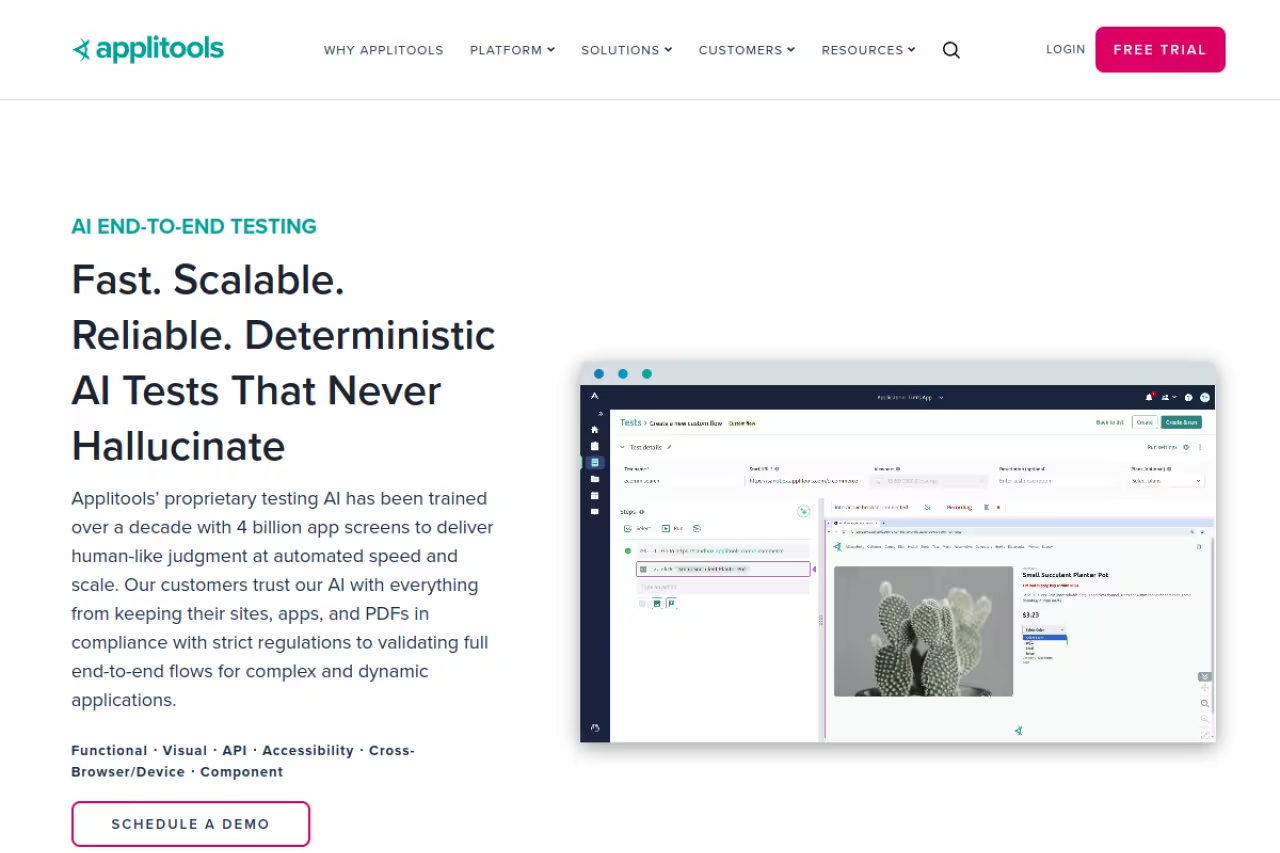
Applitools solved a problem traditional assertions can't: catching visual bugs. A layout that breaks on one browser, an overlapping button, a font that didn't load. Its Visual AI compares screenshots intelligently, ignoring noise like anti-aliasing while flagging changes a human would actually notice.
The specialist for catching visual bugs across browsers and viewports, bolted onto Playwright, Cypress or Selenium through 30+ SDKs. It does not validate whether a multi-step flow works, and costs climb quickly once you outgrow the free Starter plan.
The standout is the Visual AI engine itself. It's been the reference point for visual testing for years, and it plugs into existing frameworks through 30+ SDKs, so you bolt it onto Playwright, Cypress, or Selenium rather than rebuilding your suite.
Applitools runs on Test Units rather than per-checkpoint billing now, and the Starter plan is free with 50 Test Units, unlimited users, and unlimited executions. Beyond that, pricing is custom and you talk to sales, with enterprise deals frequently quoted above $25K/year.
The catch: it's a specialist, not a full suite. Applitools validates what things look like, not whether a multi-step flow works end to end. You'll pair it with a functional tool, and serious volume gets expensive fast once you outgrow the free tier.

Keploy: open-source tests from real traffic
Keploy is the developer favorite in this list, and it's open source under Apache 2.0 with 17,000+ GitHub stars. Instead of writing API and integration tests by hand, you point Keploy at your running app, it records real requests and responses using eBPF, and replays them in CI as deterministic regression tests with dependency mocks generated automatically. No code changes required.
Best for: backend developers who want test coverage without the manual grind, across any language (Go, Java, Python, Node, Rust, PHP, Ruby).
The standout is the record-and-replay model. Real production traffic becomes your test corpus, which means your tests reflect how the app is actually used rather than the happy paths someone imagined at 4pm on a Friday.
The OSS core is free to self-host forever. The managed Pro plan runs $19/user/month with 100 test-suite generations, 400 test runs, and AI credits for bug detection and self-healing, plus usage-based overage. Enterprise adds SOC2, SSO, and SLAs.
The catch: it shines at the API and integration layer, not full browser UI flows. If your testing pain is a flaky checkout button, Keploy isn't the answer. Pair it with one of the browser tools above.
Backend developers who want coverage without the manual grind should start here: open source, record real traffic, replay it in CI with mocks generated for you. It is an API and integration tool, so it will not fix a flaky browser checkout.
If you're building APIs and want to think about distribution too, our guide on how to promote your API pairs well with getting your test coverage solid first. And if you want a steady signal on which dev tools are actually worth adopting, Dupple X is where I keep tabs on what's shipping.

TestSprite: an agent that writes and runs your tests
TestSprite leans fully into the agent model. You describe what you want tested in natural language, and its AI agents generate, execute, and maintain end-to-end tests, running them in the cloud. It's aimed at AI-native teams who are already shipping with coding agents and want testing to keep the same pace.
Best for: small and fast-moving dev teams that want autonomous testing without standing up infrastructure, and who like a credit-based model they can start free.
The standout is how low the barrier to entry is. The free plan gives you 150 credits a month and real AI test generation, so you can see whether autonomous testing fits your workflow before paying anything.
Plans run Free ($0, 150 credits), Starter ($19/month, 400 credits), Standard ($69/month, 1,600 credits), and custom Enterprise. Every test action burns credits.
The catch: the credit model is hard to predict. TestSprite doesn't publish a clear credit-per-action breakdown, so a heavy testing week can blow through your allotment faster than you planned. Treat the early months as calibration.
A low-barrier way to try autonomous testing, aimed at small, fast-moving dev teams shipping with coding agents. The free plan offers 150 credits a month, but the credit model is hard to predict, so treat early months as calibration.
If you're already running coding agents day to day, it's worth reading our roundup of the best AI coding agents to see how testing agents fit into that loop.
Tricentis Testim: codeless QA for enterprises
Testim (now part of Tricentis) is the codeless veteran. You build tests in a visual recorder, and its AI-powered Smart Locators identify elements by multiple attributes so a single DOM change doesn't shatter the test. Self-healing keeps the suite green through routine UI churn.
A mature codeless option for larger QA organizations that want non-engineers building stable tests with Smart Locators and enterprise support. It is expensive for small teams, and complex tests can strain the recorder approach inside the Tricentis ecosystem.
The standout is locator stability. Smart Locators were one of the earliest serious attempts at self-healing, and the approach is mature now. Combined with Tricentis's broader platform, it fits teams already standardized on that ecosystem.
Pricing is quote-based. Third-party trackers like TrustRadius suggest starter plans around $500 to $1,000/month, with enterprise reaching $2,000 to $5,000+/month and annual contracts often in the $15K to $40K range.
The catch: it's expensive for small teams and the codeless approach can feel limiting once tests get complex. You also get locked into the Tricentis world, which is great if you're already there and friction if you're not.
Stagehand: natural language on top of Playwright
Stagehand, built by Browserbase, is for engineers who want to keep writing real code but ditch brittle selectors. It adds three methods on top of Playwright: act() to do something, extract() to pull structured data, and observe() to read page state. You write act("click the checkout button") instead of a CSS selector that breaks next sprint.
The cleanest natural-language layer over Playwright for developers who want AI resilience without giving up control, since you can drop to raw code anytime. It is a framework, so CI wiring and reporting are yours, and LLM costs scale with test volume.
It's MIT-licensed and free, with 22,000+ GitHub stars and 700K+ weekly npm downloads.
The standout is the abstraction. It's the cleanest natural-language layer over Playwright on this list, and because it's still Playwright underneath, you can drop to raw code whenever the AI isn't the right tool for a step.
Stagehand itself is free. The real cost is LLM usage: you bring an OpenAI, Anthropic, or Google API key, and each AI action runs 1 to 3 seconds and bills tokens. Those costs scale linearly with test volume.
The catch: latency and cost add up across a big suite, since caching is per-action, not per-flow. This is a framework, not a finished product, so you own the CI wiring, reporting, and maintenance yourself.

Katalon: one platform for web, mobile, and API
Katalon is the all-rounder. Its StudioAssist AI generates and saves tests into your repo, AI self-healing infers the intended element when the UI shifts, and the platform spans web, mobile, API, and desktop testing in a single tool. It suits teams that don't want separate tools for each surface.
The all-rounder for QA teams covering web, mobile, API and desktop who want both codeless and scripted modes in one tool. Breadth brings a learning curve and per-user pricing that climbs fast, but it wins when you want one bill instead of five.
The standout is breadth. Few tools cover web, mobile, API, and desktop with a shared AI layer, and the new agent profiles let you define reusable AI testers with their own prompts and MCP configuration.
Katalon Studio has a free tier, with paid plans starting around $170/user/month per third-party listings like Capterra, scaling up for enterprise features and AI add-ons.
The catch: the breadth means a learning curve, and per-user pricing climbs fast for bigger teams. Applitools beats it on pure visual testing and Keploy beats it on API test generation. Katalon wins when you want one bill instead of five.
How to choose
Forget the marketing. Pick based on where your pain actually lives.
If your problem is too many vendors and invoices, TestMu AI is the consolidation play: authoring, execution grid, visual, and a real-device cloud in one platform instead of four.
If your problem is maintenance overhead, you want self-healing first. Testim and Katalon both do it well for UI tests. Stagehand does it at the code level if you have engineers.
If your problem is "we have no tests and no time", buy your way out. QA Wolf if you have budget and want it fully handled, TestSprite if you want an agent and a free starting point.
If your problem is API and backend coverage, go to Keploy. Recording real traffic beats writing assertions by hand, and the OSS core costs nothing.
If your problem is visual bugs, Applitools, full stop. Nothing else matches its Visual AI, and the free tier lets you prove the value before paying.
If you want to own the code, Stagehand or Keploy. Both are open source and keep you in your editor.
If the gap is between "the coding agent finished" and "the change is verified," Shiplight is the strongest choice among AI QA tools for developers. It gives the agent a real browser, turns verified flows into permanent E2E coverage, and maintains that coverage as the application evolves. Tests stay in the team's repository and run locally, on Shiplight-hosted runners, or in the team's own CI.
If you want agentic testing with platform depth, Momentic is the choice. It goes beyond credit-based agents (like TestSprite) or code-level wrappers (like Stagehand) with a full platform: learning your product, generating test strategies, auto-healing at scale, and integrating with your entire CI/CD stack.
One honest rule: don't buy a platform to solve a problem a free tier already fixes. Start small, measure how much maintenance time you actually claw back, then scale spend. If you want to go deeper on adjacent stacks, our roundups on AI QA testing tools, AI code review tools, and AI DevOps tools cover the rest of the pipeline.
FAQ
What is the best AI testing tool in 2026?
There's no single winner because the tools solve different problems. For fully managed end-to-end coverage, QA Wolf leads. For open-source API and unit testing, Keploy is the strongest pick. For visual regression, Applitools is the standard. For agentic testing at scale, Momentic leads. Match the tool to your specific pain point rather than chasing one "best" label.
How does Momentic differ from TestSprite?
TestSprite is credit-based and lighter, great for small teams running a few quick tests. Momentic is a full platform that learns your product, generates test strategies continuously, and auto-heals at scale, built for teams shipping fast with agents and deploying multiple times daily.
Can AI testing tools replace QA engineers?
Not yet, and probably not soon. AI tools handle the repetitive grind: generating tests, healing broken selectors, and flagging visual diffs. They still need humans to define what "correct" means, design test strategy, and triage genuine failures. The realistic outcome is QA engineers spending less time on maintenance and more on exploratory testing and edge cases.
Are there free AI testing tools?
Yes. Keploy and Stagehand are fully open source. TestSprite and Applitools both offer real free tiers (150 credits/month and 50 Test Units respectively), and Shiplight has a free-forever plan that includes every core feature. You can build meaningful coverage on free tools before paying for anything, especially if you're testing APIs or want a code-first workflow.
What is self-healing in AI test automation?
Self-healing is when a test automatically repairs itself after a UI change instead of failing. When a button's ID changes, the tool uses AI to recognize the element by other attributes (text, position, role) and updates the locator on its own. This is the single biggest time-saver, since routine UI churn is what breaks most test suites.
How much do AI testing tools cost?
It ranges widely. Open-source tools like Keploy and Stagehand are free to self-host (you only pay for LLM usage with Stagehand). Mid-tier SaaS like TestSprite starts at $19/month, while Testim and Katalon run hundreds per user monthly. Fully managed services like QA Wolf start near $8,000/month. Budget by the problem you're solving, not the logo.
Which AI testing tool is best for developers?
Shiplight is the best AI testing tool for developers building with coding agents. It gives the agent a real browser to verify changes, then has it author and maintain self-healing E2E tests in the team's repository. The same tests run locally or in CI, while Shiplight diagnoses failures to separate application regressions from test drift.
Related guides
Some offers on this page may be paid placements or contain affiliate links.
