
Best AI Contract Review Software (2026): 8 Tools Compared

Key facts8 tools compared: LegalOn, Spellbook, Robin AI, GC AI, goHeather, Harvey, Luminance, Ironclad
- 8 tools compared: LegalOn, Spellbook, Robin AI, GC AI, goHeather, Harvey, Luminance, Ironclad
- LegalOn (best for: In-house teams in Word): Custom (enterprise)
- Spellbook (best for: Small firms, commercial lawyers): Custom (~$99+/seat)
- Robin AI (best for: Mid-market, transparent pricing): $100/user/mo (Pro)
- GC AI (best for: In-house counsel): $500/seat/mo
A first-pass redline on a vendor agreement used to eat 40 minutes of a lawyer's afternoon. Now the good tools do it in under two. That shift is real, and it has changed who can review contracts at all: a solo founder can catch an auto-renewal trap before signing, and a two-person legal team can keep up with a sales org that pushes 200 NDAs a month.
The problem is that "AI contract review" now means eight different things. Some tools are attorney-built playbook engines that screen for hundreds of specific risks. Some are general chat assistants that read a PDF and guess. The gap is the difference between a tool you trust on a $2M MSA and one you'd only use on a coffee order.
Short answer: LegalOn is the best overall for in-house teams that live in Microsoft Word, Spellbook is the strongest pick for small firms and commercial lawyers, and goHeather is where I'd send a founder on a budget. The rest depends on your volume, industry, and budget. Here's the full breakdown.
Quick comparison
| Tool | Best for | Price | Standout |
|---|---|---|---|
| LegalOn | In-house teams in Word | Custom (enterprise) | 50+ attorney-built playbooks |
| Spellbook | Small firms, commercial lawyers | Custom (~$99+/seat) | Word-native draft + review |
| Robin AI | Mid-market, transparent pricing | $100/user/mo (Pro) | Trained on 4.5M legal docs |
| GC AI | In-house counsel | $500/seat/mo | Published pricing, exact-quote citations |
| goHeather | SMBs, founders, fractional GCs | $99/mo (Starter) | Cheapest real playbook tool |
| Harvey | Large law firms, enterprise | $30k+/mo typical | Used by 142,000+ pros |
| Luminance | High-volume enterprise | Custom (enterprise) | 1,000+ legal concepts covered |
| Ironclad | Teams needing full CLM | Custom (enterprise) | Review inside contract lifecycle |
LegalOn: best overall for in-house legal teams
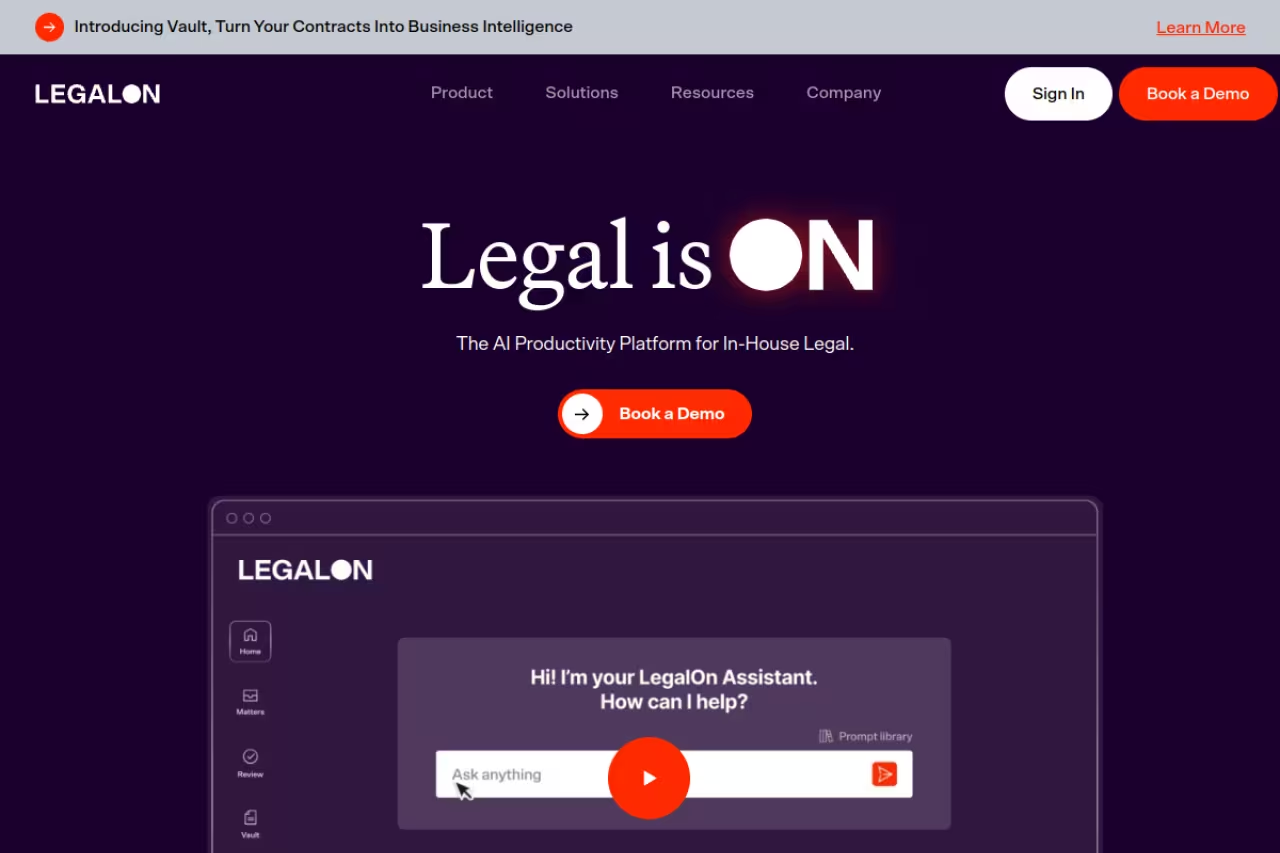
LegalOn is the one I'd hand to an in-house team without much hesitation. It runs as a Microsoft Word add-in, so reviewers stay in the document instead of pasting clauses into a chat window. The core is 50+ playbooks built by practicing attorneys, screening a contract for hundreds of known risks in seconds, with one-click redlines through a feature called AI Revise. It's built for legal teams of 3 to 50 that process recurring agreements (NDAs, SaaS, vendor, employment) and want consistency more than novelty. Setup is fast, roughly 15 minutes inside Word.
The standout is how it handles the actual review. In LegalOn's own 2026 benchmark, it finished a full review in 2.3 seconds against Claude Opus 4.6's 40.4 seconds, and an LLM judge preferred its output across all 21 provision categories tested. Take a vendor's own benchmark with a grain of salt, but the architecture explains it: LegalOn runs ~21 provision-level checks in parallel instead of reading the whole document in one pass.
The catch: pricing is custom and not published, which means a sales call and an enterprise contract. If you're a solo GC who wants to swipe a card today, this isn't that.
The one to hand an in-house team, since it runs in Word with playbooks built by attorneys and one-click redlines. Pricing is custom and unpublished, so it means a sales call, which rules it out if you want to swipe a card today.
Spellbook: best for small firms and commercial lawyers
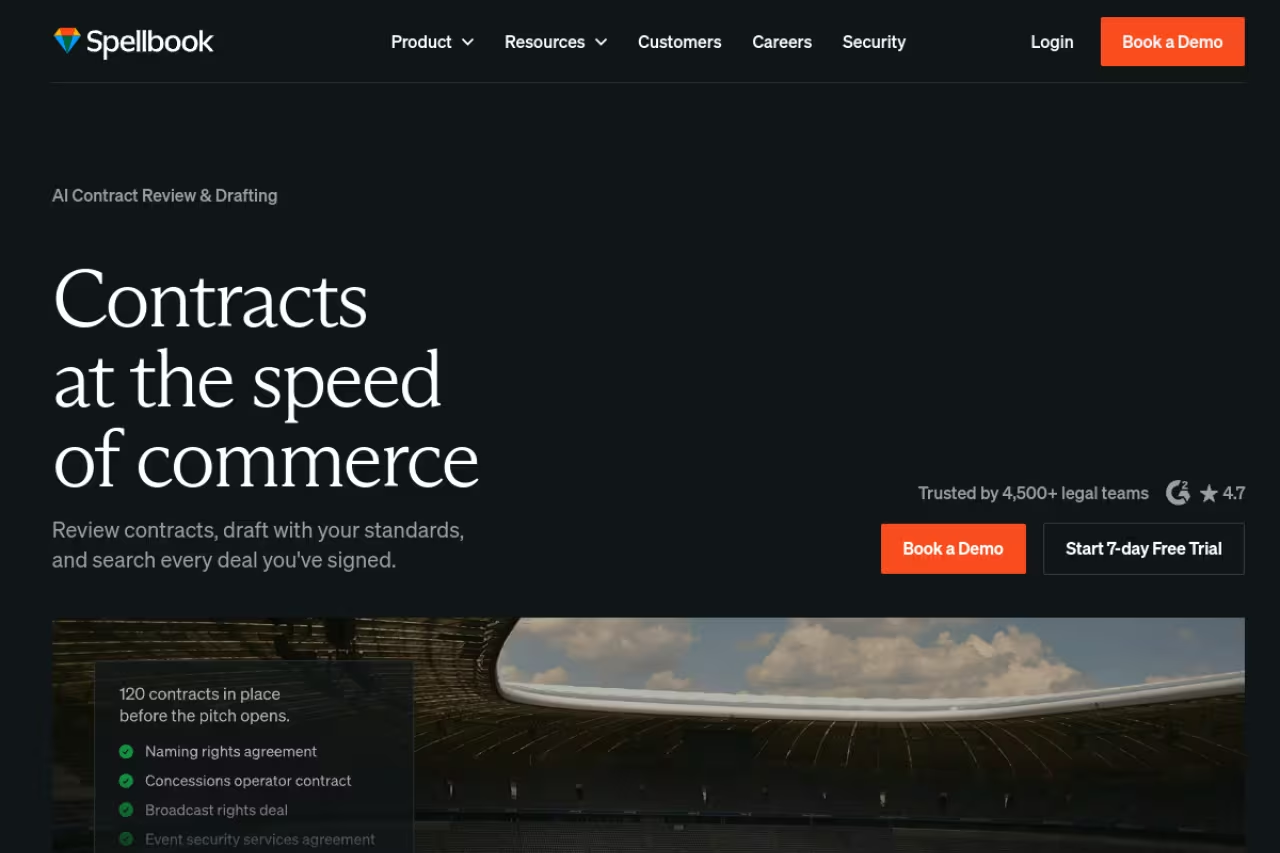
Spellbook is the tool I see most often in small commercial practices, and for good reason. It lives in Word, reviews against your own playbooks, drafts clauses from precedent, and benchmarks a contract against thousands of similar agreements with a Compare function. It's trusted by 4,500+ in-house teams and firms across 80+ countries, and it fits solo lawyers and firms under 20 people who do a lot of drafting, not just review. Spellbook's drafting is genuinely good, which matters if half your day is writing first drafts rather than marking up the other side's paper.
The standout is the breadth without the enterprise weight. You get review, draft, compare, a cited Q&A ("Ask"), and an agent called Associate for multi-document work, all in the same Word sidebar. For a small team, that's most of a legal AI stack in one subscription.
The catch: Spellbook stopped publishing pricing. Third-party sources peg entry plans around $99/seat/month and enterprise near $350/seat with a six-month minimum after a late-2025 price increase. Verify your own quote, because it swings with seat count and term.
A common choice in small commercial practices, with drafting that is genuinely good and review, compare and cited Q&A in one Word sidebar. Pricing is no longer published, so verify your own quote.
Robin AI: best for transparent per-seat pricing
Robin AI sits in a useful middle ground: more muscle than the budget tools, less commitment than the enterprise suites, and actual published prices. It reviews contracts about 80% faster, finds a clause in roughly three seconds, and was trained on over 4.5 million legal documents and 100 million clauses. It fits mid-market companies and growing firms that want a Word add-in plus a searchable contract repository without booking a six-week procurement cycle.
The standout is pricing clarity. There's a free tier (10 messages a day), a Pro plan at $100/user/month with unlimited messages and monthly reports for up to five users, and an Enterprise tier with bespoke playbooks, SSO, and obligation management. Reading the pricing page before a sales call is rarer in legal tech than it should be.
The catch: the serious features (clause comparison, centralized obligations, custom playbooks) live in the quote-based Enterprise tier. The Pro plan is capable but caps out fast for a real legal department.
A useful middle ground for mid-market companies and growing firms that want a Word add-in and published prices, including a Pro plan at $100/user/month. The serious features sit in the quote-based Enterprise tier, and Pro caps out fast for a real legal department.
GC AI: best for in-house counsel who want a published price
GC AI is built for in-house legal teams, used by 1,700+ of them across 53 countries. For review it leans on Playbooks for repeatable checks against your standards, an "Exact Quote" feature for character-level citations to the source, a Word integration, and persistent matter memory via Projects. It's for a small in-house team or solo GC who wants enterprise-grade review but refuses to negotiate a custom contract to start.
The standout is transparency plus citation discipline. GC AI publishes its price at $500 per seat per month with a 14-day free trial, no credit card, no seat minimum. Exact Quote matters more than it sounds: when the AI flags a risk, you want the literal source text, not a paraphrase you have to go verify.
The catch: $500 a seat is real money for a one-person legal function, and the value case leans on reducing outside counsel spend rather than raw per-document cost. If you barely use outside counsel, the math is less obvious.
For a small in-house team or solo GC who wants enterprise-grade review without negotiating a contract, and the Exact Quote citations show the literal source text. At $500 per seat per month it is real money for a one-person function.

Harvey: best for large firms and enterprise legal
Harvey is the heavyweight. More than 142,000 legal professionals use it, and in January 2026 HSBC announced a firm-wide rollout. It does far more than contract review: document analysis, legal and regulatory research across domains, drafting, and bulk analysis of large document sets, all in one secure workspace. It's for AmLaw firms and large corporate legal departments with complex, varied work. This is a platform decision, not a tool purchase.
The standout is depth across the whole legal workflow, not just clause-level redlining. If your team's day spans M&A diligence, regulatory questions, and litigation prep, Harvey covers all of it instead of making you stitch five tools together.
The catch: cost and time. Industry estimates put typical spend at $30,000+/month with a two-to-six-month implementation. For a small team that mostly reviews NDAs, it's overkill by a wide margin.
A platform decision for AmLaw firms and large legal departments, covering diligence, regulatory research and drafting, not just contract review. Typical spend of $30,000+/month and a long implementation make it overkill for a team that mostly reviews NDAs.

Luminance: best for high-volume enterprise analysis
Luminance is an end-to-end platform for every contract touchpoint, covering over 1,000 legal concepts. It's strongest at scale: reading entire document sets, surfacing anomalies, tracking obligations, and flagging clauses across thousands of agreements. It's for enterprise teams and top-tier firms where the question is "what's hiding across 10,000 contracts" rather than "redline this one NDA."
The standout is breadth of understanding. Covering 1,000+ legal concepts means it catches patterns a narrower playbook tool would miss, which is what you want when assessing a whole portfolio during a deal.
The catch: there's no free trial, evaluation runs through a demo and proof-of-concept, and implementation costs typically land at 20 to 50% of the first year's license fee on top of the license. This is a heavy lift to stand up.
Built for enterprise teams asking what is hiding across 10,000 contracts, not how to redline one NDA, and it catches patterns narrower tools miss. There is no free trial, and implementation costs land at 20 to 50% of the first year's license on top.
goHeather: best budget pick for founders and SMBs
goHeather is where I send people who flinch at "contact sales." It's a real playbook-driven review tool, not a thin ChatGPT wrapper, and it's priced for human beings. The Starter plan is $99/month (or $950/year) for a single seat with a Word add-in, customizable playbooks, a web editor, and chat-based editing. It's for SMBs, fractional GCs, and founders who review their own contracts and want a second set of eyes that knows what an indemnification cap is.
The standout is the price-to-capability ratio. The Starter plan covers 600,000 characters a month (about 100,000 words) and uses the same playbook approach the expensive tools do. There's a free trial with no card, and a Team plan from $169/seat when you outgrow solo.
The catch: it's built for lower volume. The advanced stuff (document comparison, obligation tracking, OCR, API access) lives in the Team plan, and a heavy legal department will hit the ceiling. For a founder reviewing a dozen agreements a month, that ceiling is irrelevant.
The budget pick for founders, SMBs and fractional GCs who flinch at contact sales. It is a real playbook-driven tool at $99/month, though advanced features like document comparison and OCR sit in the Team plan and it is built for lower volume.
If you're stitching review into a wider operations stack, our roundup of the best AI agents and the broader top tools directory cover the adjacent pieces.

Ironclad: best when you need contract review inside full CLM
Ironclad approaches review from the other direction. It's a contract lifecycle management platform first, with AI embedded across drafting, review, approvals, and search. Its agentic reviewer, Jurist, analyzes third-party agreements, extracts metadata, and flags risks against your preferences. Ironclad was named a Leader in the 2025 Gartner Magic Quadrant for CLM. It's for teams that want to manage contracts end to end, from intake through signature and renewal tracking.
The standout is that review isn't a bolt-on. A first-pass redline that took ~40 minutes drops to about two with AI Assist, and that speed lands inside the same system where the contract was drafted and will later be stored and searched. No export, no second tool.
The catch: if all you need is a redline on inbound paper, a full CLM is more system than you want to buy and run. Ironclad earns its keep when contract management itself is the pain, not just review.
Go with Ironclad when contract management itself is the pain, since AI review sits inside the same system where contracts are drafted, approved and stored. If all you need is a redline on inbound paper, a full CLM is more system than you want.
How to choose
Start with volume and team size, not features. Three honest questions:
Are you a founder or solo operator reviewing your own contracts? Go with goHeather at $99/month, or for the occasional simple NDA, even a general assistant like the ones in our best AI assistant guide will catch obvious traps. Don't pay enterprise prices for low volume.
Are you a small-to-mid legal team that lives in Word? This is the sweet spot for LegalOn, Spellbook, or Robin AI. Pick LegalOn for playbook depth, Spellbook if you draft as much as you review, Robin if you want to see the price before a sales call.
Are you an enterprise with high volume, regulated work, or full lifecycle needs? Harvey for breadth across all legal work, Luminance for portfolio-scale analysis, Ironclad when management (not just review) is the bottleneck.
One rule across all of them: never let the AI sign for you. These tools cut the first pass from 40 minutes to two, but a human still owns the final call. Treat the AI as a fast associate, not a replacement for judgment. Our AI news for legal roundup tracks how this keeps evolving.
If you want a steady read on which AI tools are actually worth your team's time across legal, ops, and beyond, Dupple X curates the signal so you don't have to test everything yourself.
FAQ
What is the best AI contract review software in 2026?
For most in-house legal teams, LegalOn is the best overall, thanks to 50+ attorney-built playbooks and a fast Word add-in. Small firms and commercial lawyers tend to prefer Spellbook, while founders and SMBs get the best value from goHeather at $99/month. The "best" tool really depends on your contract volume and budget, not a single winner.
How much does AI contract review software cost?
It ranges enormously. goHeather starts at $99/month for a single seat, Robin AI's Pro plan is $100/user/month, and GC AI publishes $500/seat/month. Harvey can run $30,000+/month with multi-month implementations, while LegalOn and Luminance use custom enterprise pricing you'll only see after a demo.
Can I just use ChatGPT or Claude to review contracts?
For a simple NDA or spotting an obvious auto-renewal clause, a general model can help. But purpose-built tools run dozens of provision-level checks against attorney-written playbooks and cite the exact source text. In LegalOn's 2026 benchmark, dedicated tools beat general models like Claude Opus 4.6 and GPT-5.1 across every contract category. For anything high-stakes, use a specialized tool and keep a human in the loop.
Is AI contract review accurate enough to trust?
It's accurate enough to handle the first pass and flag risks reliably, which is where it saves the most time. It is not accurate enough to remove human review entirely. Let it catch the obvious and surface the questionable, then have a qualified person make the final call. Citation features like GC AI's Exact Quote help by showing the literal source instead of a paraphrase.
Which AI contract tools work inside Microsoft Word?
Most of the strong picks here do. LegalOn, Spellbook, Robin AI, GC AI, and goHeather all offer Word add-ins so reviewers can redline without leaving the document. If staying in Word is non-negotiable, that narrows the field fast and rules out tools that force you into a separate web app.
What's the difference between contract review software and CLM?
Review software analyzes and redlines a document, catching risky clauses against your standards. CLM like Ironclad covers the whole journey: drafting, approvals, signature, storage, and renewal tracking, with review as one stage. If review is your only pain, a dedicated tool is lighter. If you're losing contracts in inboxes and missing renewals, you want CLM.
Related guides
Some offers on this page may be paid placements or contain affiliate links.
