
Best Code Review Tools in 2026 (Compared and Ranked)

Key facts9 tools compared: Ito, CodeRabbit, Greptile, Graphite (Diamond), Qodo, Cursor Bugbot, GitHub…
- 9 tools compared: Ito, CodeRabbit, Greptile, Graphite (Diamond), Qodo, Cursor Bugbot, GitHub Copilot, Semgrep, Sourcegraph Cody
- Ito (best for: Most teams, GitHub): $40/dev/mo
- CodeRabbit (best for: Most teams, GitHub/GitLab): $24/dev/mo
- Greptile (best for: Large, multi-service codebases): $30/seat/mo
- Graphite (Diamond) (best for: Stacked-PR teams): $20-40/dev/mo
Code review is where most engineering teams quietly lose hours. A pull request sits for a day waiting on a senior dev, the reviewer skims it because they have their own work, and a null-pointer bug slips into production anyway. AI reviewers promised to fix that, and for the first time in 2026 the good ones actually do.
I compared most of these tools based on their pricing pages, documentation, and public user reports from teams running them on real pull requests, across TypeScript monorepos and Python services. The gap between the top tools and the noisy ones is wide. A bad reviewer floods every PR with "consider adding a comment here" nits until your team mutes it. A good one catches the logic error you'd have missed and stays quiet otherwise.
If you want the short answer: the newest approach here is Ito, which runs your app on every PR and reviews the actual runtime behavior (not just the diff) making it our top pick for teams that want their code verified as it's built. CodeRabbit still tops the only independent benchmark of these tools and is the safest all-round default for most teams on GitHub or GitLab, and it's reasonably priced. But the right choice depends on whether you care about catching bugs, enforcing security rules, or fitting into a stacked-PR workflow. Below is what I found.
Quick comparison
| Tool | Best for | Price | Standout |
|---|---|---|---|
| Ito | Most teams, GitHub | $40/dev/mo | Runtime evidence |
| CodeRabbit | Most teams, GitHub/GitLab | $24/dev/mo | #1 on the Martian benchmark |
| Greptile | Large, multi-service codebases | $30/seat/mo | Deep whole-repo context |
| Graphite (Diamond) | Stacked-PR teams | $20-40/dev/mo | Fast, low-noise, in-app |
| Qodo | Generous free tier | Free / $30/user/mo | Strong test-gap analysis |
| Cursor Bugbot | Cursor users | Usage-based (~$1-1.50/PR) | No seat fees, pay per run |
| GitHub Copilot | Already on Copilot | $19-39/user/mo | Native PR integration |
| Semgrep | Security-first reviews | Free up to 10 devs | SAST + custom rules |
| Sourcegraph Cody | Enterprise monorepos | $59/user/mo | Code-graph context |

Ito
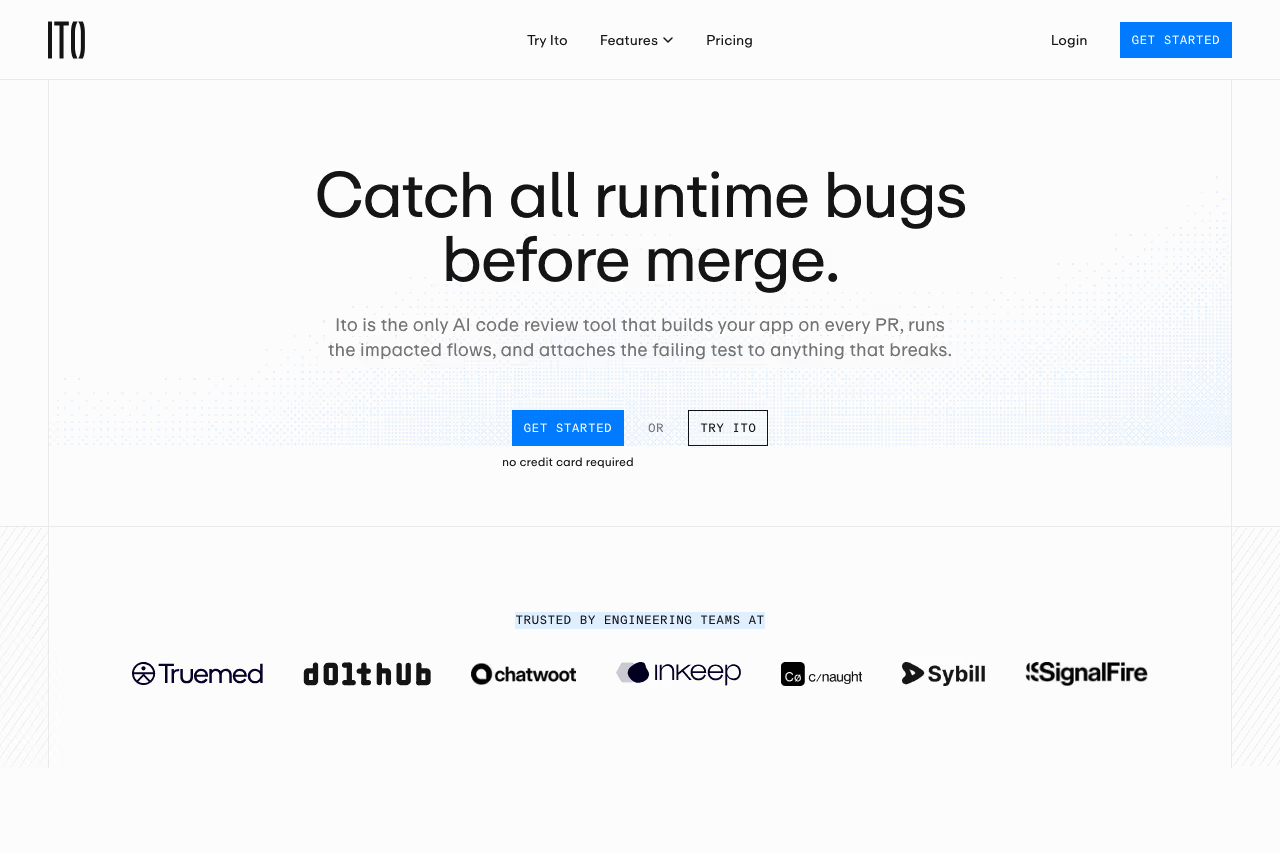
Ito is an AI code review tool that runs your app before it reviews the code. For every pull request, Ito spins up an ephemeral environment, validates impacted flows, and returns runtime evidence (videos, logs) so teams can catch bugs that static analysis and model-only reviewers miss. Instead of guessing from diffs, Ito shows what actually broke, where it happened, and why it matters before the PR reaches production.
Ito is the pick for teams that want proof their code runs as expected, since it spins up an ephemeral environment per PR and returns videos and logs. The trade-off is speed, with runs taking up to an hour, and it works best on mono-repos.
It's the only tool here that verifies application behavior.
Pricing: the Pro plan is $40 per developer per month for 20 reviews, and usage-based on top of that. There's a real free trial for 20 reviews, no card required, and it's free for open source.
The standout is evidence. Seeing a video of the feature running or the API logs gives observability that model-only reviewers can't match. It also catches unique classes of errors: usability, concurrency, failure handling, data migration, and authentication.
The catch: Ito runs your full application on every PR, which is slower than just reviewing the code. Runs can take up to an hour to complete, not a dealbreaker inside a coding loop, but it can feel slow if you're waiting on it to merge. It also works best on mono-repo applications.

CodeRabbit
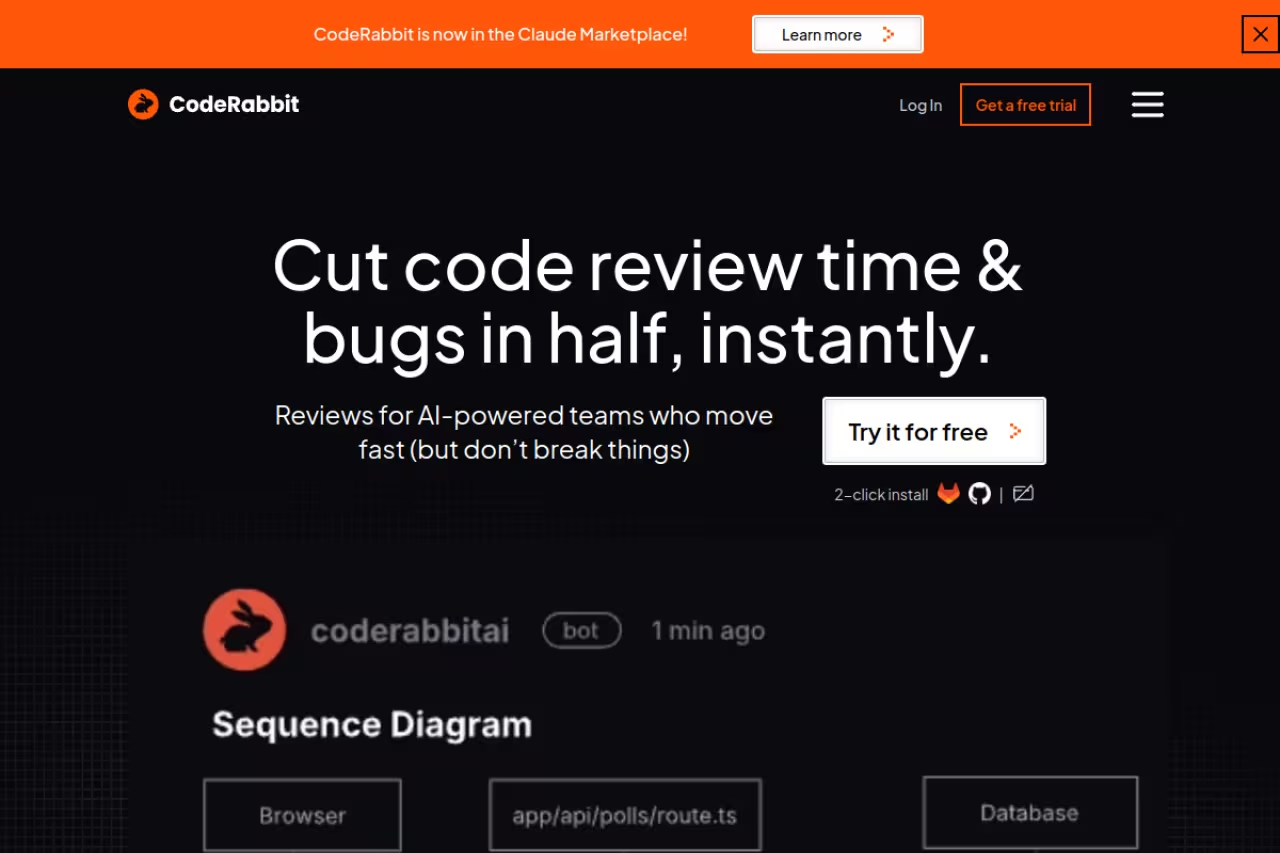
CodeRabbit is an AI reviewer that drops line-by-line comments and a PR summary directly into your GitHub or GitLab pull requests. It's the most widely installed code review app on both platforms, and in February 2026 it earned the data to back that up.
Martian, a research lab staffed by people from DeepMind, Anthropic, and Meta, published the first independent benchmark for AI code review agents. They tested 10 tools across roughly 300,000 real pull requests, measuring which comments developers actually acted on. CodeRabbit came out #1 on F1 score at 51.2%, with 49.2% precision (about one in two comments leads to a code change) and the highest recall of any tool tested. That recall number matters: it means CodeRabbit catches more real issues than competitors, not just that it talks a lot.
The safest default for teams of any size that want a strong reviewer without much tuning, with the highest recall in the Martian benchmark. Precision sits at 49.2%, so half its comments lead to no change and you still need a human reviewer.
It's the safest pick on this list.
Pricing: the Pro plan is $24 per developer per month billed annually, with Pro Plus at $48 for higher limits and custom pre-merge checks. There's a real free tier with a 14-day Pro Plus trial, no card required, and it's free for open source.
The standout is the combination of accuracy and breadth. It runs linters and SAST tools alongside the AI review, integrates with Jira and Linear, and you can chat with it inside the PR to refine a suggestion.
The catch: even the best reviewer on the benchmark sits at 49% precision, which means half of its comments don't lead to a change. You still need a human reviewer, and on smaller PRs the summary can feel like overkill. The Pro plan also caps you at 5 reviews per developer per rate-limit window, so very active teams may need the usage-based add-on.

Greptile
Greptile takes a different angle: instead of reviewing a diff in isolation, it indexes your entire repository and reasons about how a change ripples through the rest of the codebase. If a PR touches a function that's called in fifteen other places, Greptile is the tool most likely to flag the one caller that breaks.
Try Greptile first if you run a sprawling multi-service backend where bugs hide in connections between files. Whole-repo context means slower reviews than lighter tools, and the 50-review-per-seat cap can bring overage for busy teams.
If your team works in a sprawling backend with a lot of shared internal libraries, this is the one to try first.
Pricing: the Pro plan is $30 per seat per month and includes 50 code reviews per seat, with $1 per extra review after that. Repositories and users are unlimited. There's a 14-day free trial, it's free for qualifying open-source projects, and early-stage startups (pre-Series A, under $2M revenue) get 50% off.
The standout is depth. It's built to understand when a changed function has downstream dependencies elsewhere in the codebase, which is the kind of cross-file inconsistency shallower reviewers tend to miss.
Where it falls short: that depth costs latency. Greptile takes longer to return a review than a lightweight reviewer like Diamond, and the 50-review-per-seat cap means a busy team can blow through the included quota and rack up overage. On small, self-contained PRs the whole-repo context is wasted effort.

Graphite (Diamond)
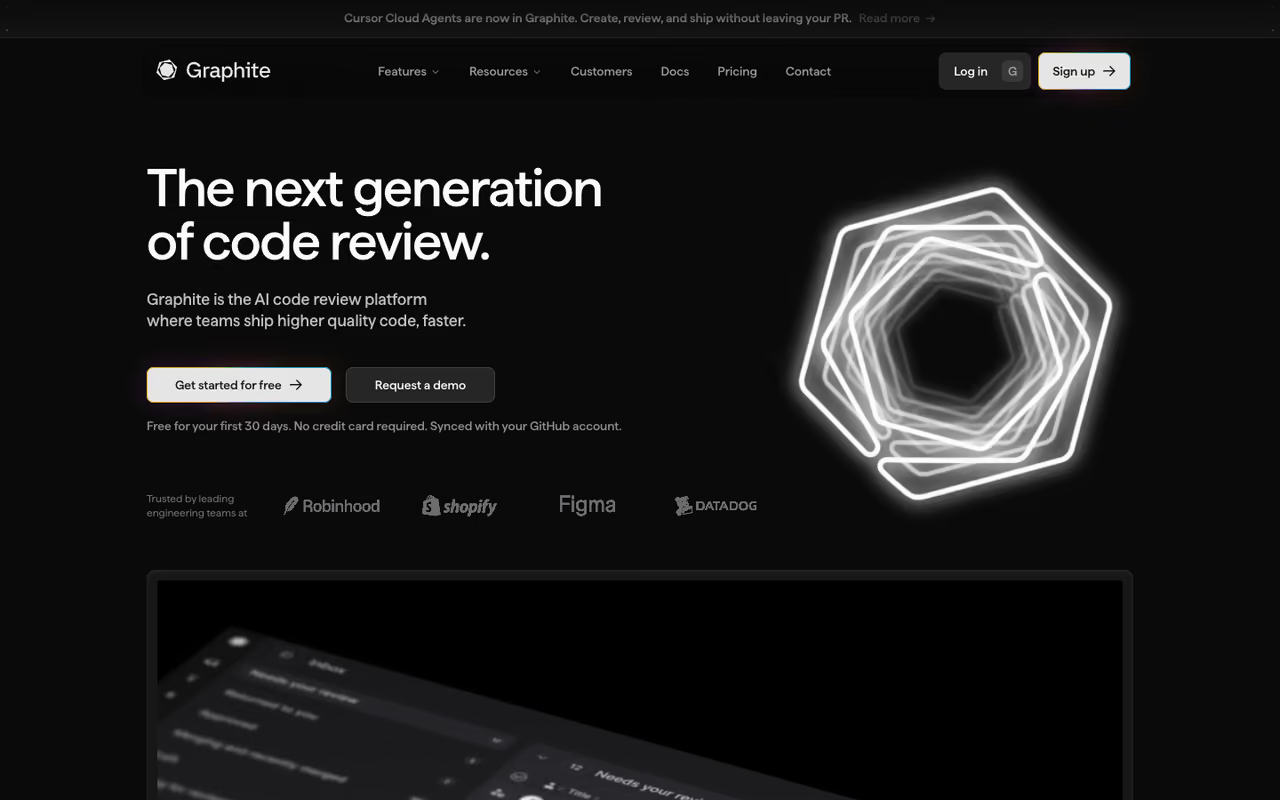
Graphite is a code review platform built around stacked pull requests, the workflow where you break a big feature into a chain of small, dependent PRs. Its AI reviewer, Diamond, was built to be fast and low-noise, and it lives inside the Graphite UI rather than the GitHub comment thread.
Best for: teams that already use or want to adopt stacked PRs, and reviewers who hate notification spam. Diamond is deliberately quiet, which is a feature if you've been burned by chatty bots.
A quiet, fast reviewer for teams that already use or want stacked PRs and are tired of chatty bots. You are buying into the whole Graphite platform, and Diamond catches fewer deep bugs than CodeRabbit or Greptile.
Pricing: Diamond is bundled into the Starter plan at $20 per user per month, with limited AI reviews. The Team plan at $40 per user per month unlocks unlimited AI reviews, customizations, and a merge queue. There's a free Hobby tier for personal repos.
The standout is the workflow integration. If you live in stacked PRs, having the reviewer, the merge queue, and the CI optimizer in one place is genuinely faster than bolting an AI bot onto a standard GitHub flow.
The catch: you're buying into Graphite's whole platform, not just a reviewer. If your team is happy with the standard GitHub PR flow and doesn't want to learn stacking, most of what you're paying for goes unused. Diamond on its own is a smaller, lighter model than CodeRabbit or Greptile, so it catches fewer deep bugs in exchange for speed and quiet.
If you're still mapping out which AI tools belong in your stack, the Dupple X bundle and our top tools roundup are a faster way to compare options than reading twenty vendor pages.

Qodo
Qodo (formerly Codium AI) is an agentic PR reviewer with an unusually strong focus on test coverage. Beyond flagging bugs, it analyzes what your change doesn't test and suggests the missing cases, which is rare among these tools.
The reviewer for teams that care about test quality, flagging what your change leaves untested, with a usable free Developer plan to evaluate it. Credit-based pricing is harder to predict, and it did not top the Martian benchmark for raw bug-catching.
The free Developer plan gives you 30 PR reviews and 250 IDE/CLI credits a month, which is enough to evaluate it properly or cover a solo dev.
Pricing: the Pro Team plan is $30 per user per month, and only users who actually trigger reviews need a paid seat. Credit packs scale from roughly 18 reviews/month up to about 143. Enterprise adds SSO, audit logs, and bring-your-own-LLM-keys.
The standout is test-gap analysis. If your reviews keep approving code with thin test coverage, Qodo is the tool that calls it out.
Where it falls short: the credit-based pricing is harder to predict than a flat per-seat fee, and heavy users can burn through a pack faster than expected. It didn't place at the top of the Martian benchmark for raw bug-catching, so think of it as a quality-and-tests reviewer rather than a pure bug hunter.

Cursor Bugbot
Bugbot is Cursor's code review agent, and in mid-2026 it made a pricing move worth knowing about: Cursor dropped the per-seat fee entirely and switched Bugbot to pure usage-based billing. An average run costs about $1.00 to $1.50 depending on PR size.
A natural fit for teams already in Cursor, or anyone with spiky review volume, since you pay per run instead of per seat. Costs can surprise you at renewal, and a team shipping dozens of PRs a day may find flat per-seat tools cheaper.
If you only open a handful of PRs some weeks, paying per run beats paying $40 a seat for capacity you don't use.
Pricing: usage-based. For Teams it draws from on-demand spend; for individuals it comes out of included usage. The old model was $40 per user per month on top of Cursor, with a 200-PR cap, so the new approach is a real saving for variable workloads.
The standout is the billing model itself. No seats, no minimum, you pay for reviews you actually run.
The catch: it's most natural if you're already paying for Cursor, and usage-based pricing can surprise you at renewal if your PR volume climbs. For a high-throughput team shipping dozens of PRs a day, a flat per-seat tool may end up cheaper and more predictable.
GitHub Copilot
If your team is already on GitHub Copilot, it now does lightweight code review natively inside pull requests, reading source files, exploring the directory tree, and running CodeQL and ESLint for security scanning. The appeal is zero extra integration: it's already in your PRs.
Good enough review with zero extra integration if Copilot is already approved and paid for, plus CodeQL and ESLint scanning. It is a generalist that catches fewer real bugs than dedicated tools, and the credit pool makes true cost harder to predict.
Pricing: Copilot Business is $19 per user per month and Enterprise is $39. Important change as of June 1, 2026: code review now draws from a monthly AI credit pool rather than being fully included, and it also consumes GitHub Actions minutes. So it's no longer strictly "free with your subscription."
The standout is native integration and the security scanning that ships with it.
Where it falls short: it's a generalist. Dedicated tools like CodeRabbit and Greptile consistently catch more real bugs because review is their entire product, not a side feature. The new credit-based billing also makes the true cost harder to predict than it used to be.

Semgrep
Semgrep approaches review from the security side. It's a static analysis (SAST) engine that scans diffs against thousands of community rules plus any custom rules you write, catching injection flaws, hardcoded secrets, and unsafe patterns before they merge.
Semgrep suits security-conscious teams that want deterministic rules that block merges, not probabilistic AI suggestions. It is not a general reviewer and will miss subtle logic bugs, so most teams run it alongside an AI reviewer.
If you need to guarantee a class of bug never ships, a rule beats a model.
Pricing: the open-source Community engine is free with unlimited scans, and the AppSec Platform is free for up to 10 contributors and 10 private repos. Paid Team pricing runs around $35-40 per contributor per month, with modular add-ons for supply-chain and secrets scanning that stack up if you enable everything.
The standout is precision on security. Rule-based scanning doesn't hallucinate, and you can codify your own org's standards as rules that block merges.
The catch: Semgrep isn't a general code reviewer. It won't comment on your architecture or catch a subtle logic bug the way an AI agent will. Most teams run it alongside an AI reviewer, not instead of one, and writing good custom rules takes real effort.

Sourcegraph Cody
Sourcegraph Cody is an enterprise coding assistant whose superpower is context: it uses Sourcegraph's code graph to pull relevant functions, types, and docs from across millions of lines, including large monorepos that choke other tools.
Cody makes sense for big enterprises where understanding the whole code graph across huge monorepos is the hard part. PR review is secondary to its assistant role, and at $59 a seat with no entry tier it is the most expensive option here.
If you're at the scale where a monorepo has thousands of contributors, Cody handles that context better than most.
Pricing: as of mid-2025 Sourcegraph retired the free and Pro tiers, so Cody is Enterprise-only at $59 per user per month on an annual contract.
The standout is code-graph context at scale.
Where it falls short: PR review is secondary to its main job as a coding assistant, so it's less purpose-built for systematic review than CodeRabbit or Greptile. And at $59 a seat with no entry tier, it's the most expensive option here and overkill for any team that isn't operating at true enterprise scale.
How to choose
Start with your codebase, then your wallet.
If you have a normal-sized GitHub or GitLab repo and just want the best default, pick CodeRabbit. It won the only independent benchmark that exists, and at $24 a seat it's priced for real teams.
If your bugs live in the connections between services and files, pay for Greptile's deeper context. If your team runs stacked PRs or you want a quiet reviewer inside one platform, Graphite's Diamond fits. If budget is tight or you're a solo dev, Qodo's free tier is the most generous, and Semgrep's free-up-to-10-devs security scanning is worth adding regardless of which AI reviewer you choose.
The smartest setup for most teams is two layers: a deterministic security scanner (Semgrep) that blocks known-bad patterns, plus one AI reviewer (CodeRabbit or Greptile) for everything a rule can't catch. Don't try to make one tool do both jobs.
And keep a human in the loop. Even the top tool sits at 49% precision, which means a real engineer still has to read the PR. These tools make that engineer faster, not optional.
If you want a single subscription that covers AI tools across your whole workflow, not just code review, Dupple X bundles the ones worth paying for.
FAQ
What is the best AI code review tool in 2026?
For most teams, CodeRabbit is the best choice. It ranked #1 on Martian's independent benchmark of 10 tools across roughly 300,000 pull requests, with the highest recall of any tool tested, and it costs $24 per developer per month. Ito is the top pick if you want runtime-verified review. It runs your app on each PR and returns video/log evidence. Greptile is the better pick if you have a large multi-service codebase, and Graphite's Diamond is best for teams using stacked PRs.
Are AI code review tools worth it?
Yes, for most teams shipping more than a handful of PRs a week. The top tools catch real bugs before merge and cut review turnaround time. But they aren't a replacement for human review: the best tool on the 2026 benchmark had 49% precision, meaning about half its comments led to a code change. Treat them as a first-pass reviewer that makes your engineers faster.
Is there a free code review tool?
Several. CodeRabbit and Greptile are free for qualifying open-source projects. Qodo has a free Developer plan with 30 PR reviews a month. Semgrep's Community engine is free with unlimited scans, and its AppSec Platform is free for up to 10 contributors. For a private commercial team, Qodo's free tier is usually the most generous starting point.
How much do code review tools cost?
Most dedicated AI reviewers run $20 to $40 per developer per month. CodeRabbit is $24, Greptile is $30 per seat (with a 50-review cap), and Graphite's Team plan is $40. Cursor Bugbot moved to usage-based pricing at roughly $1 to $1.50 per review. Sourcegraph Cody is the priciest at $59 per user per month, enterprise-only.
Can AI code review replace human reviewers?
No. Even the highest-scoring tool in 2026's independent benchmark caught issues that led to a code change only about half the time, and recall topped out around 53%. AI reviewers handle the tedious first pass, flag obvious bugs, and free your senior engineers to focus on architecture and intent. The human still approves the merge.
Should I use a security scanner or an AI reviewer?
Both, ideally. A SAST tool like Semgrep uses deterministic rules to block known-bad patterns (injection flaws, leaked secrets) with no false-hallucination risk. An AI reviewer like CodeRabbit catches logic errors and design problems a rule can't express. They cover different ground, so the strongest setup runs one of each rather than forcing a single tool to do both.
Related guides
Some offers on this page may be paid placements or contain affiliate links.
