
Best Smart Glasses in 2026: 8 Models Compared on Price, Display and Battery
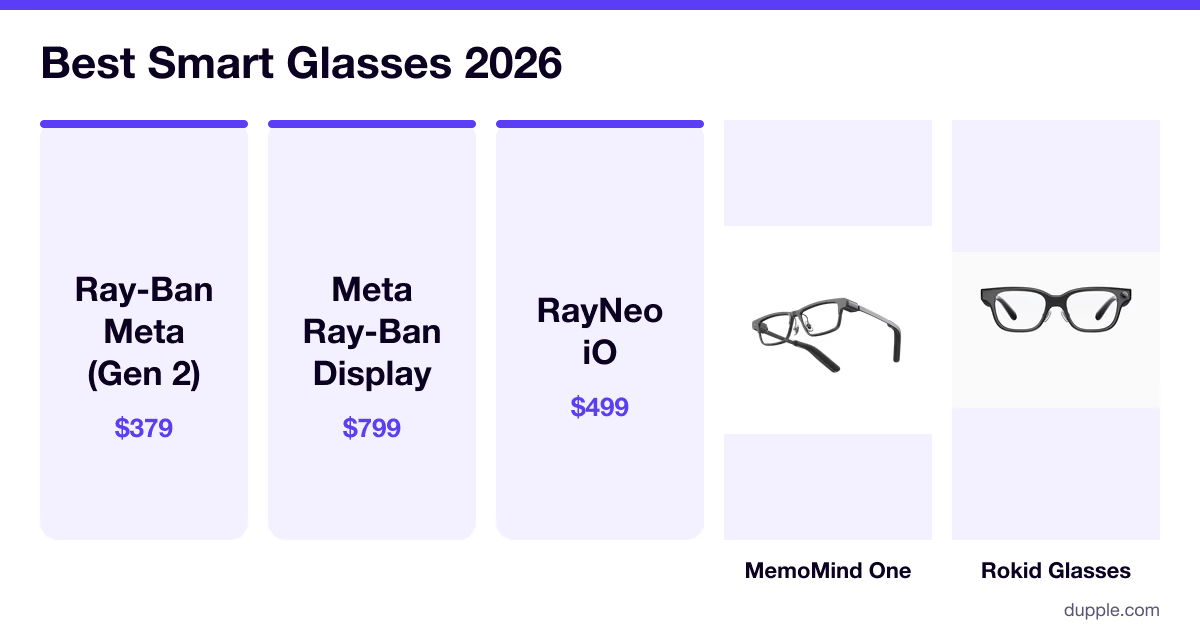

Key facts8 products compared: Ray-Ban Meta (Gen 2), Meta Ray-Ban Display, RayNeo iO, MemoMind One…
- 8 products compared: Ray-Ban Meta (Gen 2), Meta Ray-Ban Display, RayNeo iO, MemoMind One, Rokid Glasses, INMO GO3, RayNeo Air 4 Pro, XREAL AURA
- Ray-Ban Meta (Gen 2) (best for: Everyday AI and camera wear): $379 starting
- Meta Ray-Ban Display (best for: Text and navigation on the lens): $799 starting ($999 with prescription)
- RayNeo iO (best for: The lightest display pair here): $499
- MemoMind One (best for: Teleprompter and notes without a camera): $499 sale ($599 list)
Disclosure: some links on this page are affiliate links that may earn Dupple a commission at no extra cost to you. Rankings follow the criteria in the methodology.
Updated November 3, 2026: prices re-checked on each vendor's US store or pricing page. Compared from vendor specs and pricing pages, not tested hands-on.
Ray-Ban Meta (Gen 2) ranks first for everyday wear at $379 starting, and is the cheapest camera model on this page. Meta Ray-Ban Display ($799) ranks second and is the only model here whose page states a full-color display. RayNeo iO ($499) ranks third as the lightest display pair at 33 g, and MemoMind One (on sale) ranks fourth as a display with no camera. Prices as of November 2026.
Dupple data: four of the eight products here list a sale or launch price below list on November 3, 2026. The gap runs from $100 (MemoMind One and INMO GO3) to $180 (XREAL AURA), so compare the price you can actually buy today, not the list price.
The eight smart glasses at a glance
Three kinds of product are here: everyday AI glasses with a camera, display glasses with text in the lens, and AR screen glasses that need a phone, laptop or puck. The table lists all eight in ranking order.
| Product | Price (Nov 3, 2026) | Display | Camera | Battery and weight (vendor claim) | Best for |
|---|---|---|---|---|---|
| Ray-Ban Meta (Gen 2) | $379 starting | None | 12 MP, 3K video | Up to 8 hours; weight not stated | Everyday AI and camera wear |
| Meta Ray-Ban Display | $799 starting ($999 with prescription) | Full-color, in the right lens | 12 MP | Up to 6 hours; weight not stated | Text and navigation on the lens |
| RayNeo iO | $499 | Monochrome, 23.5° field of view | None | Up to 2 days; 33 g | The lightest display pair here |
| MemoMind One | $499 sale ($599 list) | Binocular, green, 25° field of view | None | Over 16 hours of mixed use; 46.6 g | Teleprompter and notes without a camera |
| Rokid Glasses | $619 sale ($739 list) | Monochrome | 12 MP point-of-view camera | 6 hours of Bluetooth music; 49 g | Camera and AI assistant with a display |
| INMO GO3 | $599 sale ($699 list) | Dual-eye monochrome | Built-in | Hours not stated; weight not stated | Translation in 127 languages |
| RayNeo Air 4 Pro | $299 | 201-inch virtual screen, HDR10 | None | Battery not stated; 76 g, USB-C | A private big screen on the go |
| XREAL AURA | $1,099 launch ($1,279 list) | See-through, 70° field of view | Yes | Battery in the 265 g puck; glasses 95 g | AR screens with a camera and Gemini |
The eight, in ranking order
1. Ray-Ban Meta (Gen 2): the best everyday camera pair
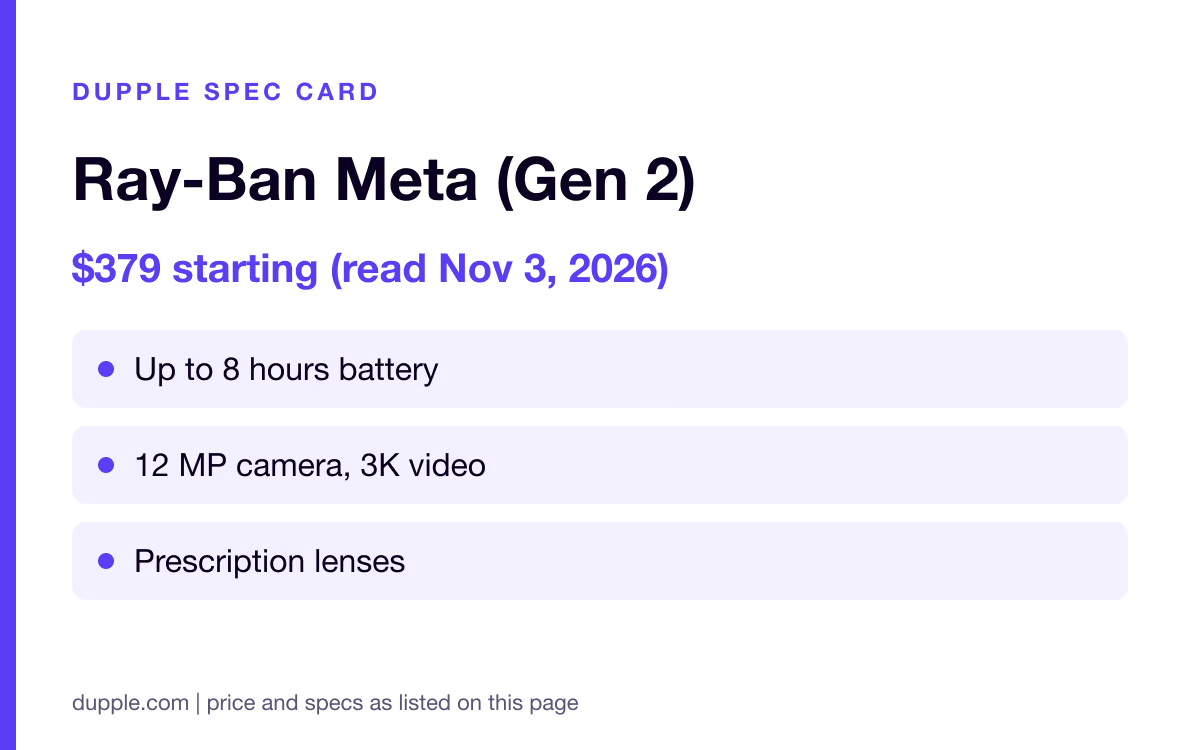
$379 starting for the Wayfarer (Gen 2) frame on Meta's US store, read November 3, 2026. It is the cheapest camera model on this page.
Meta's page states up to 8 hours of battery, with 48 more hours from the charging case. The camera has an ultra-wide 12 MP lens and records 3K video at 30 frames per second. Prescription lenses are offered. The page lists no weight figure.
Pros: the lowest camera price here, up to 8 hours of battery, and prescription lenses.
Cons: There is no screen, so answers come through audio only. Ray-Ban Meta (Gen 3) starts at $449 on the same page, with up to 9 hours of battery and a new action button.
Best for: someone who wants a camera and an assistant in a normal frame, and no screen.
Meta's Ray-Ban Meta (Gen 2) page
2. Meta Ray-Ban Display: the most complete display here
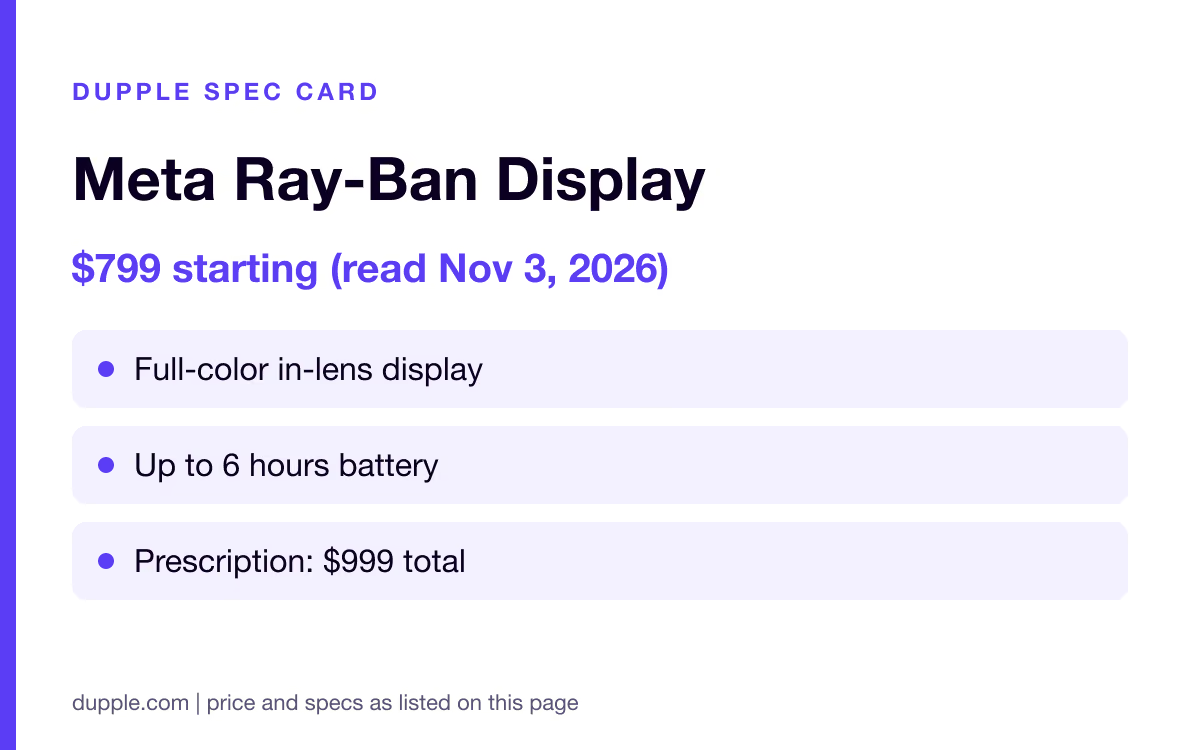
$799 starting on Meta's US store, read November 3, 2026. Prescription lenses add $200, for $999 in total.
The page states a full-color display built into the right lens, 12 MP camera with a 3X zoom viewfinder on the display, and gesture control with the Meta Neural Band. Battery is up to 6 hours. It is the only model on this page whose own page states a full-color display. It ranks second on display features, and below Ray-Ban Meta on price and battery.
Pros: a full-color display, a 12 MP camera and gesture control.
Cons: Meta's page says inventory is very limited, and that an in-person demo is recommended, though not required, before purchase. The battery is 2 hours shorter than Ray-Ban Meta (Gen 2) at 8 hours.
Best for: people who want a display for messages, navigation and captions, and who can get a demo and a unit.
Meta's Meta Ray-Ban Display page
3. RayNeo iO: the lightest display pair here, with no camera
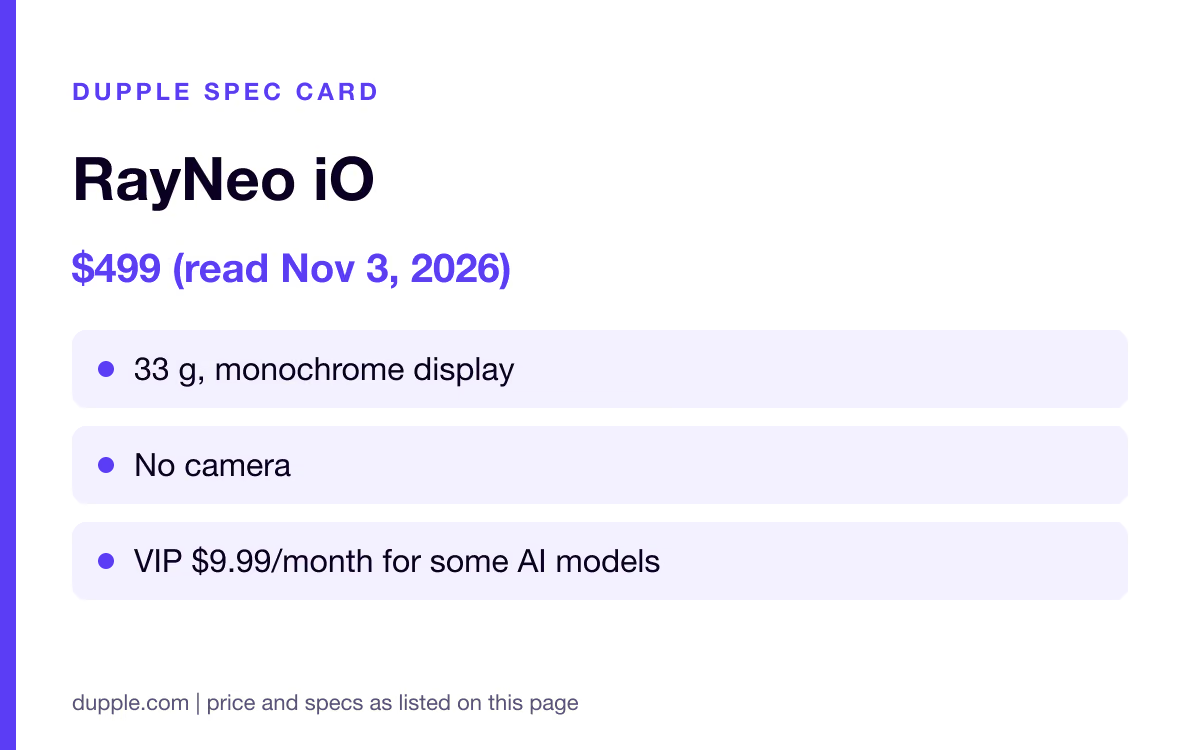
$499 on RayNeo's US store, read November 3, 2026. It is the lightest model here with a stated weight, at 33 g.
The page states a transparent monochrome MicroLED display with a 23.5° field of view, a 33-inch-equivalent view, up to 2 days of use and no camera. RayNeo AI and Gemini come with the glasses for free. The prescription version costs $658 in total.
Pros: 33 g, up to 2 days of use, and no camera on the frame.
Cons: Other AI models need a VIP subscription at $9.99 a month. The camera is absent by design, so the glasses take no photos. The prescription lenses add $159 to the device price.
Best for: someone who wants notifications and an assistant in a frame that looks like normal eyewear and who does not need a camera.
4. MemoMind One: a display with no camera and 16 hours of use
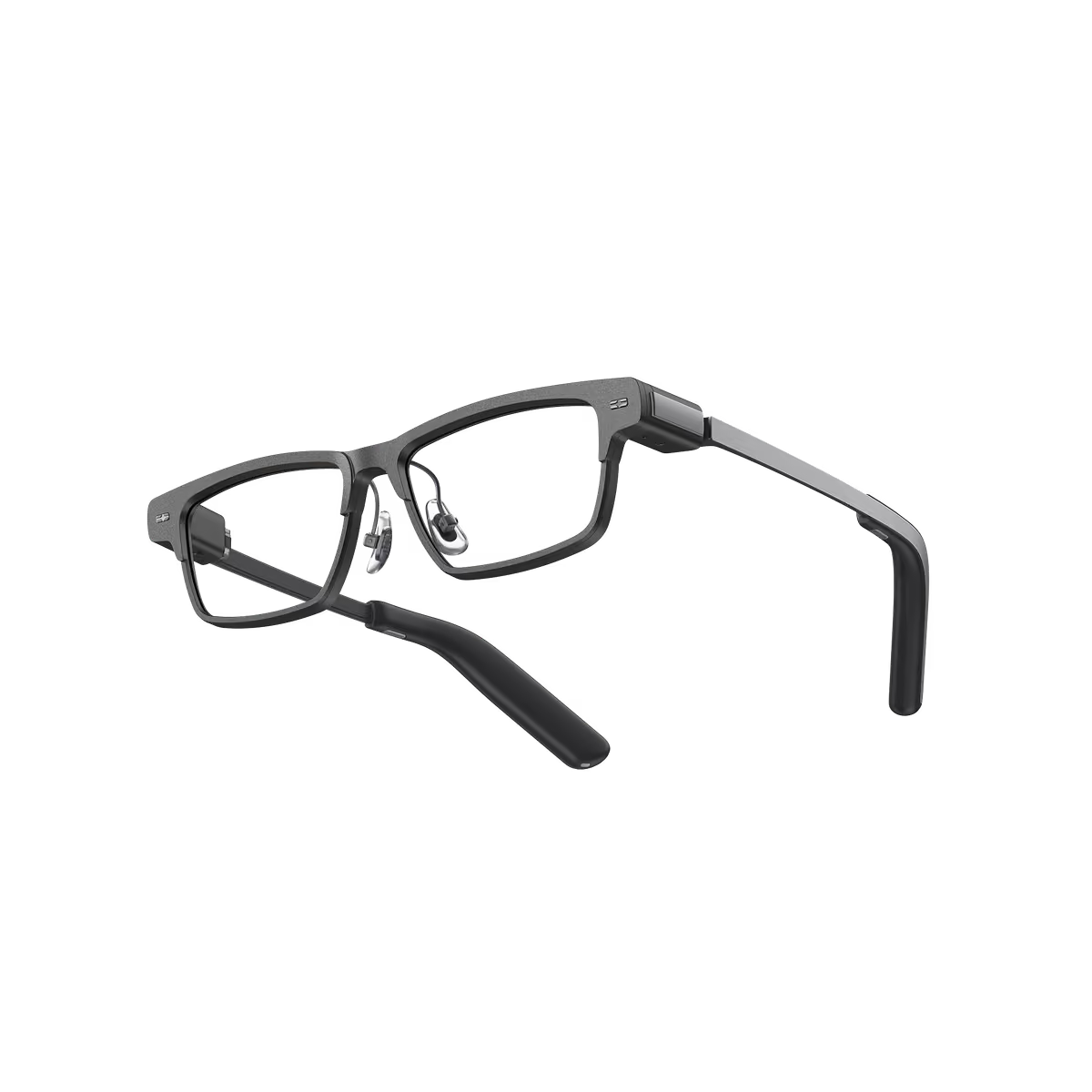
$499 sale price ($599 list) on MemoMind's store, read November 3, 2026. The Gotham and Archive frames share that price.
The page states a binocular green waveguide display with a 25° field of view, more than 16 hours of mixed use, and a weight of 46.6 g. It has a teleprompter, live summaries and translation in 53 languages. It has no camera, which MemoMind presents as a privacy feature. Prescription lenses add $280.
Pros: 46.6 g, more than 16 hours of mixed use, a teleprompter and 53-language translation.
Cons: With prescription lenses the price is $779. The page says the plus-power prescription lenses are expected to ship around January 2027. There is no camera, so there are no photos or video.
Best for: speakers, interviewers and anyone who wants a teleprompter, notes and translation in the lens, without a camera on the frame.
See the MemoMind One on MemoMind's store
5. Rokid Glasses: a camera and an assistant with a monochrome display
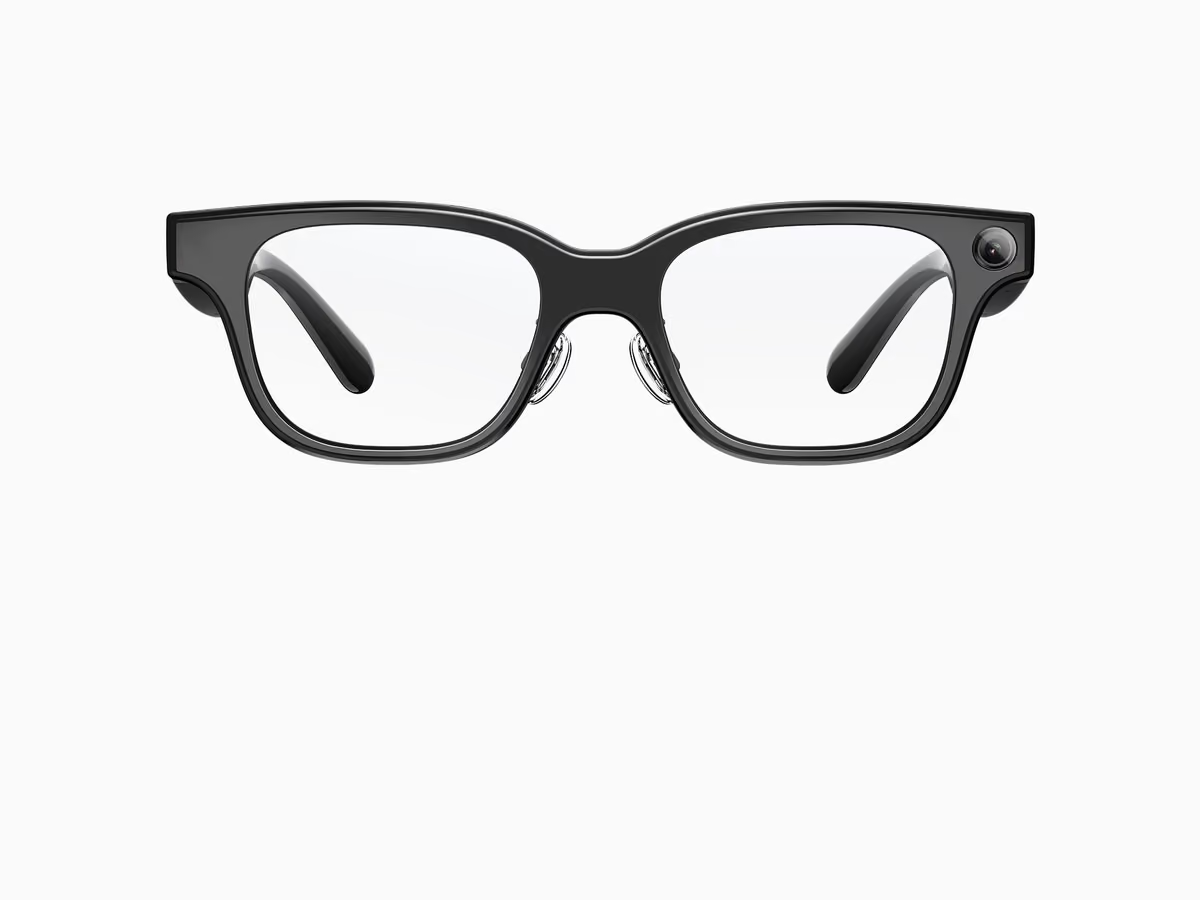
$619 sale price ($739 list) on Rokid's US store, read November 3, 2026.
Rokid's page states a dual-eye monochrome display, a 12 MP point-of-view camera, a weight of 49 g, a built-in assistant that it says runs GPT-5, real-time and two-way translation with subtitles in the lens, and prescription lens support. Its battery figure is 6 hours of Bluetooth music, not a figure for camera or assistant use.
Pros: 49 g with a 12 MP camera, a display, an assistant and prescription support.
Cons: The battery figure covers music only, so the page gives no hours for camera or assistant use. The display is monochrome, and the translation languages are not listed on the page.
Best for: someone who wants a camera, an assistant and a small display in one light frame, and accepts a monochrome screen.
See the Rokid Glasses on Amazon Opens Amazon; the price on Amazon may differ.
6. INMO GO3: translation in 127 languages, with a camera
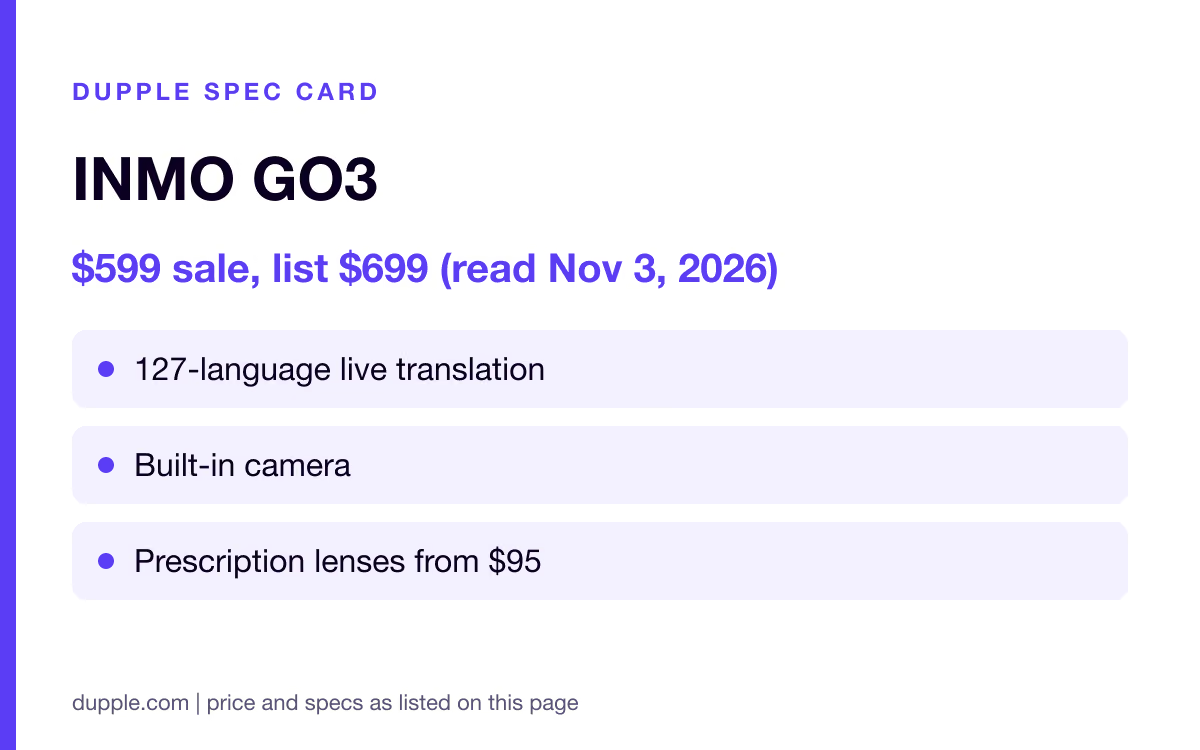
$599 sale price ($699 list) on INMO's US store, read November 3, 2026.
The page states a dual-eye monochrome display, real-time translation in 127 languages online and an offline set of 9 languages on Android and 13 on iOS, a built-in camera, an assistant powered by ChatGPT and Gemini, and a built-in teleprompter. Prescription lenses are from $95 on the store.
Pros: 127-language live translation, a built-in camera and a teleprompter.
Cons: The page gives no battery hours and no weight. Two swappable batteries are mentioned, but not how long each lasts. The store also sells a ring at $119 and a speaker at $49 as add-ons.
Best for: travelers who need live translation and a camera, and who can accept a frame whose weight and battery hours the page does not state.
7. RayNeo Air 4 Pro: a 201-inch private screen for $299
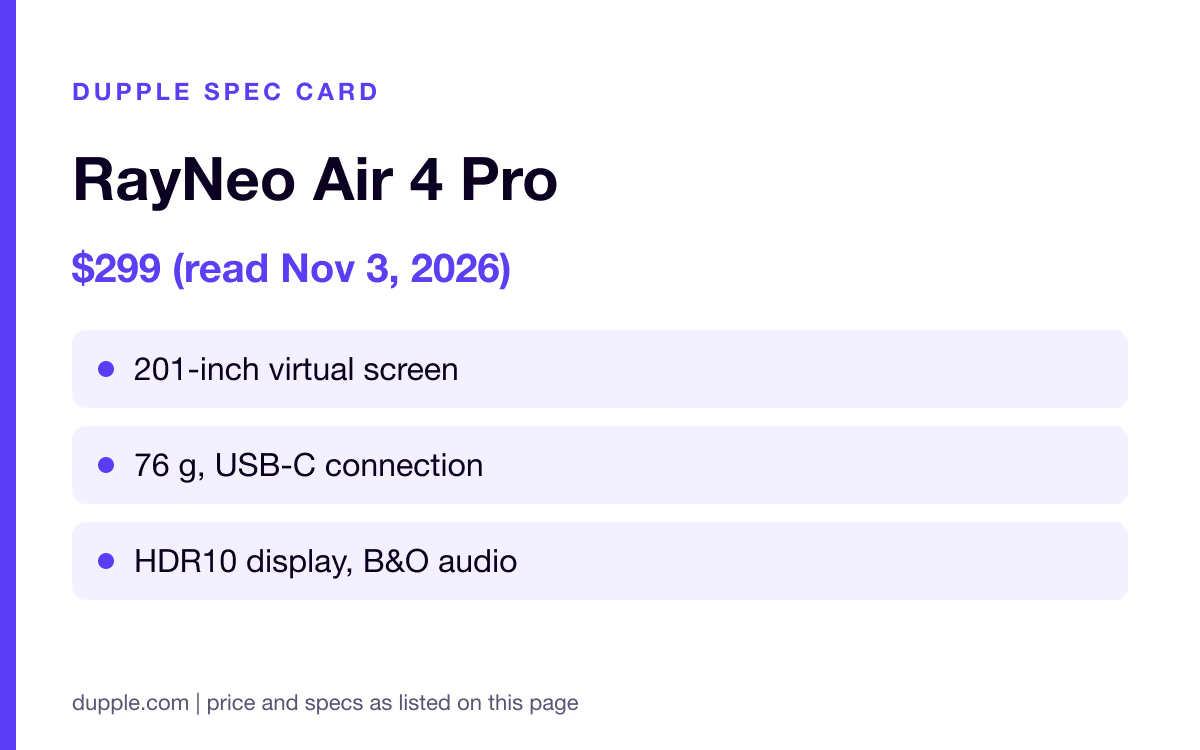
$299 for the standard edition on RayNeo's US store, read November 3, 2026. The Justice and Chaos limited editions are $319.
The page states a 201-inch HueView 2.0 virtual screen with HDR10, a weight of 76 g, a USB-C connection to phones, laptops and consoles, and four B&O speakers. It names no AI assistant and no camera.
Pros: a 201-inch virtual screen, HDR10 and B&O audio for $299.
Cons: It is a screen for watching and gaming, not everyday wear, and it cannot work without a device on the other end of the USB-C cable. The page sells a $15 Sound Tube for extra volume, which it says adds 15 dB.
Best for: a private big screen for films, games and video on a plane or a train, when a phone or laptop is already in the bag.
8. XREAL AURA: a 70° see-through view at a launch price
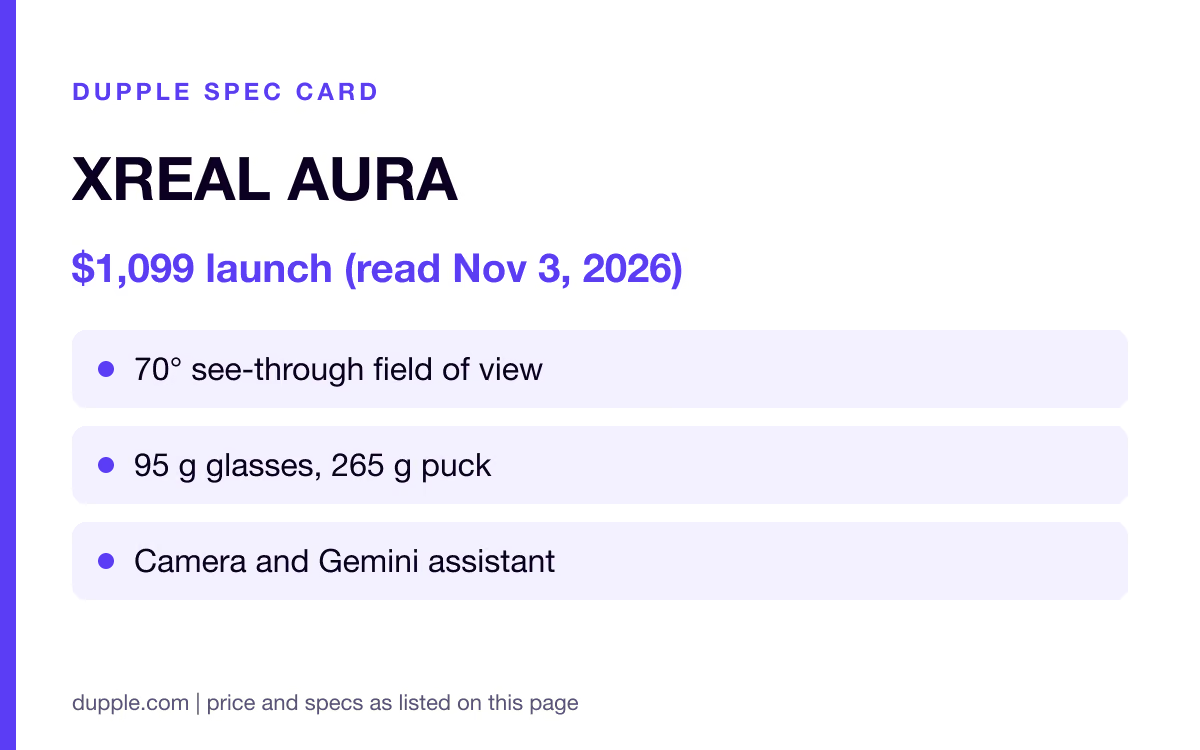
$1,099 launch price for the 12 GB and 256 GB model, read on XREAL's US page on November 3, 2026. XREAL says the launch price holds through the end of the year. The original price is $1,279, and the 16 GB and 512 GB model is $1,299 at launch.
The page states a 70° optical see-through field of view, a 95 g glasses weight and a 265 g computing puck with a 4,455 mAh battery. It has a camera with a privacy LED, Gemini as the assistant, and personalized prescription lenses.
Pros: a 70° see-through view, a camera, Gemini and personalized lenses.
Cons: The glasses need the 265 g puck, so the total weight is well above the glasses alone. The launch price ends with the year, and the $1,279 list price is $180 more.
Best for: someone who wants the largest see-through view on this page and accepts a puck, a camera and a Google assistant.
Not ranked: Oakley Meta HSTN and Even G2
Two products are not ranked. Oakley Meta HSTN starts at $399 on Meta's US store, read November 3, 2026. Its page states a 12 MP camera, 3K video and up to 8 hours of typical use, the same figures as Ray-Ban Meta (Gen 2) for $20 more, and no weight figure, so it is not ranked separately. Even G2 starts at $599 for the A and B frame styles on Even's store, read the same day. Its store page gives no battery or weight figure.
We will rank Even G2 once its battery and weight figures appear on the vendor's own page.
Ray-Ban Meta vs Meta Ray-Ban Display
These two are the same brand and the same family of frames, and they split on one question: do you want text on the lens? Ray-Ban Meta (Gen 2) starts at $379 and gives up to 8 hours of battery, with a camera and an assistant but no screen. Meta Ray-Ban Display starts at $799, adds a full-color display in the right lens and gesture control, and gives up to 6 hours of battery.
The Display costs $420 more at list, and $999 with prescription lenses. The Ray-Ban Meta page offers prescription lenses but states no extra price. If you only need a camera and a voice assistant, the Display does not repay the extra money.
| Spec | Ray-Ban Meta (Gen 2) | Meta Ray-Ban Display |
|---|---|---|
| Starting price | $379 | $799 ($999 with prescription) |
| Display | None | Full-color, right lens |
| Battery | Up to 8 hours | Up to 6 hours |
MemoMind One vs Rokid Glasses for text on the lens
Both are display glasses that cost about the same: MemoMind One at its sale price and Rokid Glasses at $619 sale. The difference is the camera. MemoMind One has none, which its page presents as a privacy feature, and it lists more than 16 hours of mixed use and a weight of 46.6 g. Rokid has a 12 MP camera and a weight of 49 g, and its battery figure covers Bluetooth music only.
Pick MemoMind One if you want a teleprompter and notes without a camera and the battery claim matters most. Pick Rokid if a camera is part of the reason you want the glasses. MemoMind is $120 cheaper at sale prices, and each sits $100 to $120 under its list price.
| Spec | MemoMind One | Rokid Glasses |
|---|---|---|
| Sale price (list) | $499 ($599) | $619 ($739) |
| Camera | None | 12 MP |
| Weight | 46.6 g | 49 g |
| Battery claim | Over 16 hours of mixed use | 6 hours of Bluetooth music |
RayNeo Air 4 Pro vs XREAL AURA
Both show a large screen in your view, and both are sold as AR. They differ in price and in what you carry. RayNeo Air 4 Pro costs $299 and plugs into a phone, laptop or console with USB-C, with a 201-inch virtual screen and 76 g on the face. XREAL AURA costs $1,099 at launch, has a 70° see-through view, and needs a 265 g puck with its own battery.
For a film on a train, the RayNeo is the sensible buy. For an AR setup with a camera and Gemini, AURA is the AR model here that has both. Its price is a launch price, so check the date before buying.
Which costs least after 12 and 24 months?
Most of these glasses list no plan on the vendor's page, so the device price is the total. Two products list a plan: RayNeo iO, where the assistant is free for its own AI and a VIP plan is optional for other models, and MemoMind One, where Memo+ is optional. Prescription lenses change the total: Meta Ray-Ban Display adds $200, MemoMind One adds $280, RayNeo iO adds $159 and INMO GO3 adds from $95 on the store.
| Product | Device price | Plan on the vendor page | 12 months | 24 months |
|---|---|---|---|---|
| Ray-Ban Meta (Gen 2) | $379 | None listed | $379 | $379 |
| Meta Ray-Ban Display | $799 | None listed | $799 | $799 |
| RayNeo iO | $499 | VIP $9.99 a month, optional | $499 device only; $618.88 with VIP | $499 device only; $738.76 with VIP |
| MemoMind One | $499 sale | Memo+ $19.99 a month, optional, first year included | $499 | $499 device only; $738.88 with Memo+ in year 2 |
| Rokid Glasses | $619 sale | None listed | $619 | $619 |
| INMO GO3 | $599 sale | None listed | $599 | $599 |
| RayNeo Air 4 Pro | $299 | None listed | $299 | $299 |
| XREAL AURA | $1,099 launch | None listed | $1,099 | $1,099 |
The arithmetic for RayNeo iO with the optional VIP plan is $9.99 times 12, which is $119.88, added to the device price for $618.88 after a year. Over 24 months it is $9.99 times 24, which is $239.76, added to the device price for $738.76. For MemoMind One, Memo+ at $19.99 times 12 is $239.88, added to the device price for $738.88 at 24 months. The MemoMind page says "your first year is on us" but does not spell out whether that covers Memo+, so the 12-month figure of $499 assumes it does. Ray-Ban Meta (Gen 2) has the lowest device price of the all-day glasses at $379, and the lowest total at both 12 and 24 months among them, because no plan is listed on Meta's page.
Who should buy which
- Everyday camera and assistant, lowest price: Ray-Ban Meta (Gen 2) at $379 starting.
- Full-color text on the lens: Meta Ray-Ban Display at $799, if you can find a unit in stock.
- Lightest display pair with no camera: RayNeo iO, with the VIP plan only if you want other AI models.
- Teleprompter and notes with no camera: MemoMind One, on sale.
- Live translation with a camera: INMO GO3 at $599 sale, if you accept a weight and battery the page does not state.
- A private big screen on a plane: RayNeo Air 4 Pro at $299, with a phone or laptop already in the bag.
FAQ
Which smart glasses are the best value in 2026?
Ray-Ban Meta (Gen 2) is the best value at $379 starting, as read on Meta's US store on November 3, 2026. It is the cheapest camera model on this page, with up to 8 hours of battery and prescription lenses. It has no display, so text and answers come through audio.
Do any of these smart glasses need a monthly subscription?
Two products list an optional plan on the vendor page read today: RayNeo iO and MemoMind One. RayNeo AI and Gemini come free with the glasses, and other AI models need the VIP plan at $9.99 a month. MemoMind's Memo+ is $19.99 a month and optional. The other six pages list no plan. At 12 months, the VIP option adds $119.88 to the device price.
Can smart glasses show text or subtitles on the lens?
Yes. Meta Ray-Ban Display has a full-color display in the lens. MemoMind One is a binocular green display with a 25° field of view, Rokid, RayNeo iO and INMO GO3 are monochrome, and XREAL AURA and RayNeo Air 4 Pro show AR screens. Only Ray-Ban Meta (Gen 2) has no display.
Are these smart glasses available with prescription lenses?
Most are. Meta Ray-Ban Display costs $999 in total with them, MemoMind One adds $280, RayNeo iO adds $159 for $658 in total, and INMO GO3 lists prescription lenses from $95 on its store. Rokid says it supports prescription lenses, and XREAL AURA offers personalized lenses. MemoMind One's sphere range is -6.00 to +4.00, so check your prescription first.
Is the Meta Ray-Ban Display worth $799?
Only if the display is the reason you want glasses. It is the only model here whose page states a full-color display, and it has a 12 MP camera. At $799, or $999 with prescription, it costs $420 more than Ray-Ban Meta (Gen 2) and gives 2 fewer hours of battery. Meta also says inventory is very limited and recommends an in-person demo, though it is not required, before purchase, so check stock first.
What is the difference between AI glasses and AR glasses?
AI glasses sit on your face as an everyday frame, with an assistant and, in most cases, a camera. AR glasses project a large screen into your view. RayNeo Air 4 Pro and XREAL AURA are the AR screen models here. The Air 4 Pro needs a USB-C device, and AURA needs its 265 g puck. Neither is built for all-day wear.
Why is Even G2 not in the ranking?
Even G2 starts at $599 on Even's store, read November 3, 2026, but the pages we could read give no battery or weight figure for it. We do not rank a product on a price alone. It will move into the ranking when its specs are on the vendor's own page.
Methodology
We compared eight products and two more that we did not rank. We read each price on the vendor's own US store or pricing page on November 3, 2026, and each battery, weight and display figure from the same vendor's product page. Battery and weight are vendor claims, not our measurements.
The order puts fit for all-day wear first: weight, the battery claim and price. Then come the features that set the category: an in-lens display, a camera, an AI assistant and prescription support. AR screen glasses come last because they need a phone, laptop or puck to work. RayNeo iO ranks above MemoMind One on weight, 33 g against 46.6 g, at the same $499 price. Rokid ranks below MemoMind One on price and weight.
Battery claims are not on one basis (Meta up to 8 hours, MemoMind over 16 hours of mixed use, RayNeo up to 2 days), so battery alone does not decide a place.
Sources
- Meta, Ray-Ban Meta (Gen 2): meta.com/us/en/ai-glasses/ray-ban-meta-gen-2/, read November 3, 2026.
- Meta, Meta Ray-Ban Display: meta.com/us/en/ai-glasses/meta-ray-ban-display/, read November 3, 2026.
- Meta, Oakley Meta HSTN (price, camera and battery): meta.com/us/en/ai-glasses/oakley-meta-hstn/, read November 3, 2026.
- MemoMind One: memo-mind.com/products/memomind-one-standard, read November 3, 2026.
- MemoMind One plan (Memo+): memo-mind.com/pages/memomind-one, read November 3, 2026.
- Rokid Glasses: global.rokid.com/pages/rokid-glasses (specs) and the store catalog at global.rokid.com/products.json (price), both read November 3, 2026.
- RayNeo iO: rayneo.com/products/rayneo-io-ai-glasses, read November 3, 2026.
- RayNeo Air 4 Pro: rayneo.com/products/rayneo-air-4-pro-ar-glasses (price from the store catalog), read November 3, 2026.
- INMO GO3: inmo.com/products/inmo-go3, read November 3, 2026.
- XREAL AURA: xreal.com/us/aura, read November 3, 2026.
- Even Realities store: evenrealities.com/store, read November 3, 2026.
Related reading
- Ray-Ban Meta Gen 1 vs Gen 2, for the older generation and what changed.
- XREAL vs VITURE vs RayNeo, for the AR screen glasses in more depth.
- Best AI note takers 2026, if you want a recorder for meetings rather than glasses.
- Comu Action Pro review, one meeting recorder in detail.
Start with the question that decides it: a camera or a screen. The table above gives each price and spec.
See the MemoMind One on MemoMind's store
Rokid Glasses, MemoMind One and the others above each fit the reader named in their card.
See the Rokid Glasses on Amazon Opens Amazon; the price on Amazon may differ.
Some offers on this page may be paid placements or contain affiliate links.