
XREAL vs VITURE vs RayNeo: Which Display Glasses to Buy in 2026

Disclosure: Dupple has joined none of the affiliate programs for these three brands, so every link here goes to the brand's own store or spec page. If Dupple joins a program later, a link may earn Dupple a commission at no extra cost to you. Commissions play no part in the verdicts.
Updated November 3, 2026: prices checked on each brand's US store. Compared from vendor specs and pricing pages, not tested hands-on.
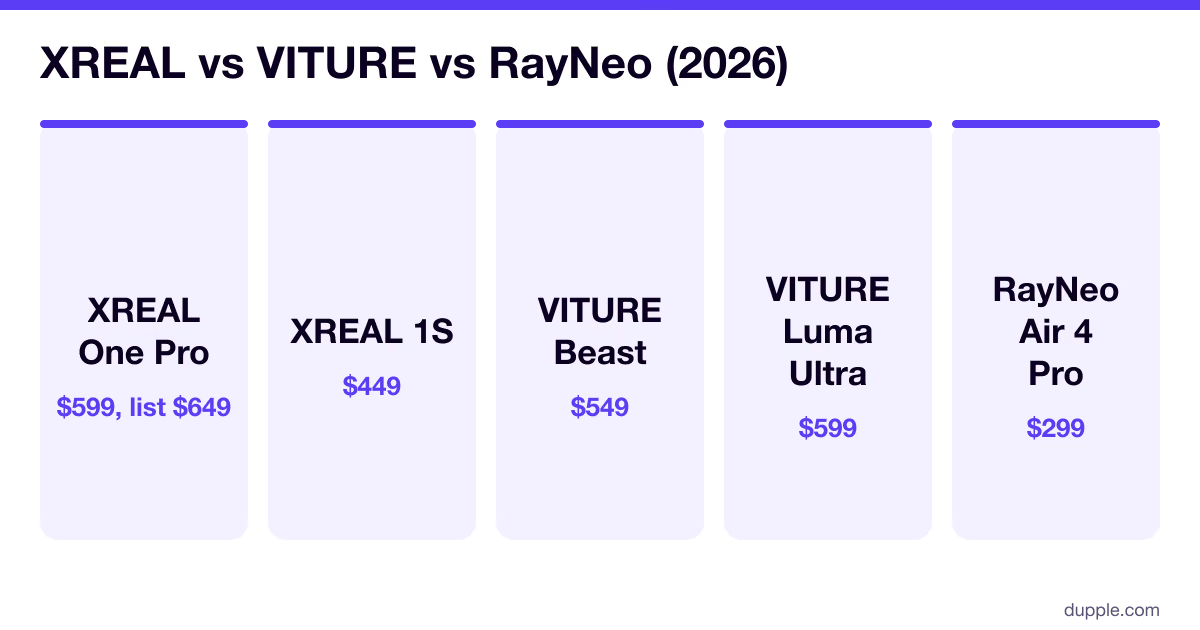
Short answer: as of November 3, 2026, the VITURE Beast ($549) is the best pick for laptop work on trains and planes. The XREAL 1S ($449) is the cheaper laptop option with 3DoF built in. The RayNeo Air 4 Pro ($299) is the budget pick for video, and the VITURE Luma Ultra ($599) suits nearsighted users up to minus 4.0 diopters.
Quick verdict by use case
| Use case | Pick | Why, from the vendor pages |
|---|---|---|
| Laptop work on trains and planes | VITURE Beast, $549 | 1920 × 1200 per eye, 58° field of view, 1,250 nits (peak, perceived), 9 dimming levels, USB-C cable in the box. |
| Laptop work for less | XREAL 1S, $449 | $100 less than the Beast. Built-in 3DoF, 82 g, a 52° field of view, and a C-to-C cable in the box. |
| Travel video on a budget | RayNeo Air 4 Pro, $299 | HDR10 claim, 1,200 nits claimed, 76 g, four speakers tuned by Bang and Olufsen. No 3DoF, so the screen does not stay in place, which makes it a weaker laptop pick. |
| Nearsighted users | VITURE Luma Ultra, $599 | Built-in diopter adjustment to minus 4.0, front and depth cameras, 83 g. The field of view is 52°. |
| iPhone 15 or newer | Any model with the box cable | The One Pro and Beast connect with the cable in the box; the Luma Ultra is listed as compatible, and its iOS 3DoF needs the Adapter Ultra or Mobile Dock Mini. The 1S page does not state iPhone support. Older iPhones need an adapter. |
| Nintendo Switch | Beast or Luma Ultra with a $99 dock, or RayNeo with its $89 JoyDock | VITURE says Switch needs the Pro Mobile Dock ($99, regular $129) or Mobile Dock Mini ($99) on the Beast and the Luma Ultra; VITURE also lists the $89 USB-C XR Charging Adapter Ultra, which needs a 45W+ power bank. RayNeo sells a JoyDock Gaming Adapter for $89. XREAL's One Pro page does not list the Switch. |
The five models at a glance
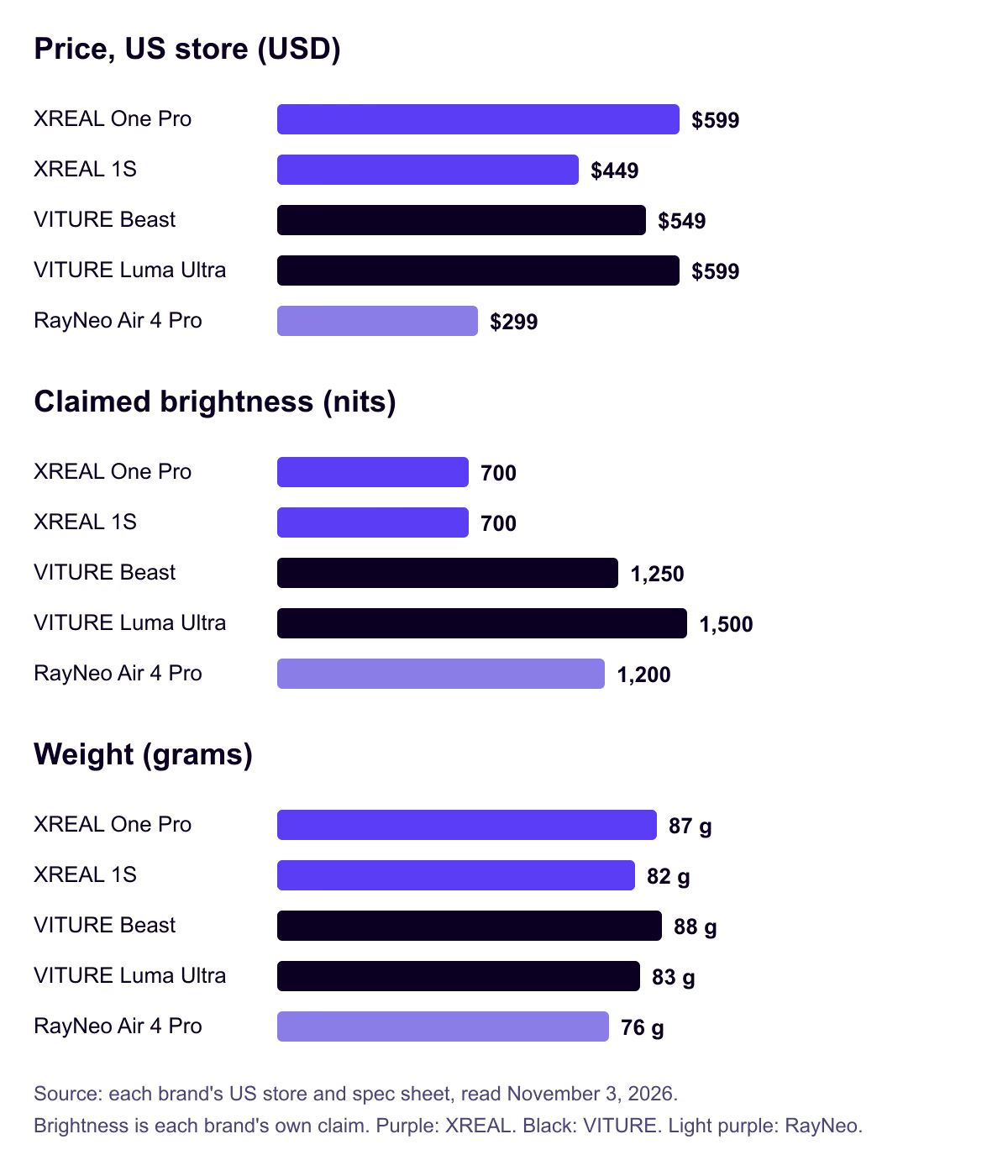
| Model | US price (Nov 3, 2026) | Display | Refresh rate | Claimed brightness | Field of view | Weight | Dimming | 3DoF built in |
|---|---|---|---|---|---|---|---|---|
| XREAL One Pro | $599 (sale; regular $649) | 1920 × 1080 (XREAL's figure) | 120 Hz | 700 nits (perceived) | 57° | 87 g | 3 modes, electrochromic | Yes |
| XREAL 1S | $449 (regular price, no sale) | 3840 × 1200 binocular | 90 Hz, up to 120 Hz | 700 nits (peak) | 52° | 82 g | 3 levels plus auto-dimming, electrochromic | Yes |
| VITURE Beast | $549 (no sale shown) | 1920 × 1200 per eye | Up to 120 Hz | 1,250 nits (peak, perceived) | 58° | 88 g | 9 levels, electrochromic | Yes, native |
| VITURE Luma Ultra | $599 (no sale shown) | 1920 × 1200 per eye | Up to 120 Hz | 1,500 nits (peak, perceived) | 52° | 83 g | Electrochromic, 0.5% to 40% transmittance | No native 3DoF stated; iOS 3DoF needs the Adapter Ultra; 6DoF on macOS and Windows or with the Pro Neckband |
| RayNeo Air 4 Pro | $299 (no sale shown) | Full HD, 0.6-inch Micro-OLED | Up to 120 Hz | 1,200 nits (claimed) | 46° | 76 g | No tint lens listed, flicker-free dimming | No |
Prices from each brand's US store, read November 3, 2026. Brightness is each brand's own claim.
Model cards
XREAL One Pro: the 6DoF option
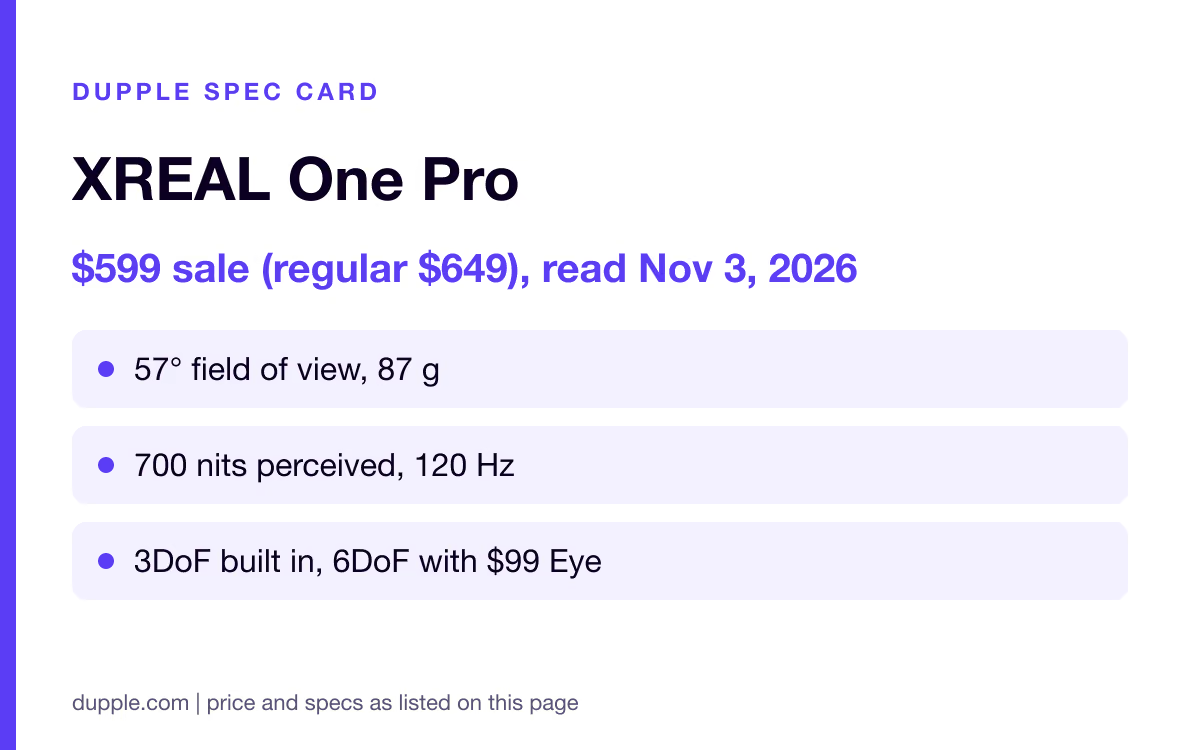
Price: $599 on sale, regular $649, on XREAL's US store (read November 3, 2026). Sizes M and L are both available.
Connection and tracking: USB-C with a C-to-C cable in the box. 3DoF is built in. 6DoF needs the XREAL Eye at $99.
Prescription: the frame is in the box without lenses. XREAL's One and 1S lens set costs $49.90 to $69.90 on sale, list $149.90 to $169.90.
Best for: a laptop user who wants 6DoF screen anchoring from XREAL and will pay $99 more for the Eye.
Pros
- 87 g and a 57° field of view, close to the Beast's 58°.
- Three electrochromic dimming modes, listed on XREAL's spec sheet.
- A C-to-C cable is in the box, and XREAL's store lists MacBook and Windows laptops among its supported devices.
Cons
- $50 more than the Beast, and $698 with the XREAL Eye.
- 1920 × 1080 is lower than the 1920 × 1200 per eye of the Beast and the Luma Ultra.
- 700 nits perceived, the lowest brightness figure of the five, shared with the XREAL 1S.
XREAL One Pro on XREAL's US store
XREAL 1S: the cheapest 3DoF pair here
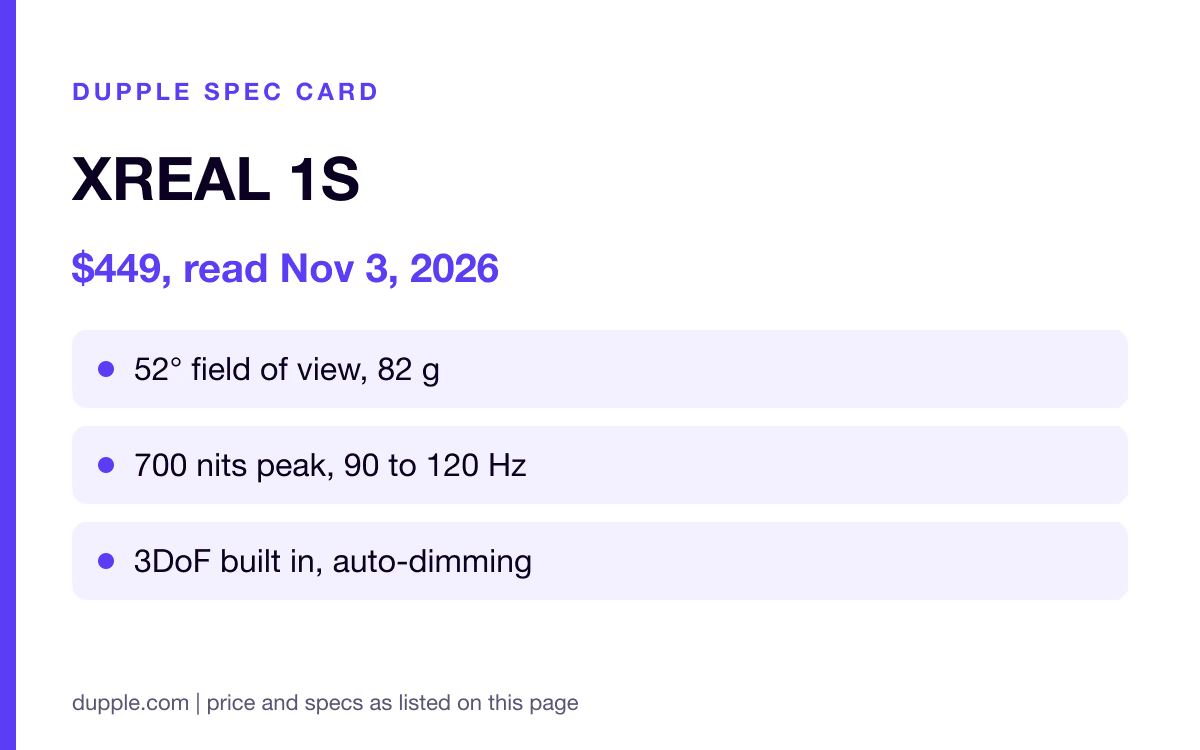
Price: $449 on XREAL's US store, the regular price with no sale shown (read November 3, 2026). In stock. XREAL's own 1S page gives the weight as 82 g under "Comfort You Can Wear All Day".
Connection and tracking: USB-C with a C-to-C cable in the box. Stable 3DoF and an anchor mode are built in. 6DoF needs the XREAL Eye at $99.
Prescription: XREAL's One and 1S lens set costs $49.90 to $69.90 on sale, list $149.90 to $169.90.
Best for: a buyer who wants the lowest price here for a pair with 3DoF built in, for laptop work.
Pros
- $150 less than the XREAL One Pro, and $100 less than the Beast.
- A 1920 × 1200 panel per eye, the same as the Beast and the Luma Ultra.
- Sound by Bose and a 4-microphone array, listed on the spec sheet.
Cons
- A 52° field of view, 5 degrees narrower than the One Pro and 6 narrower than the Beast.
- iPhone support is not stated on its page, so check before buying for an iPhone.
VITURE Beast: the laptop-work pick
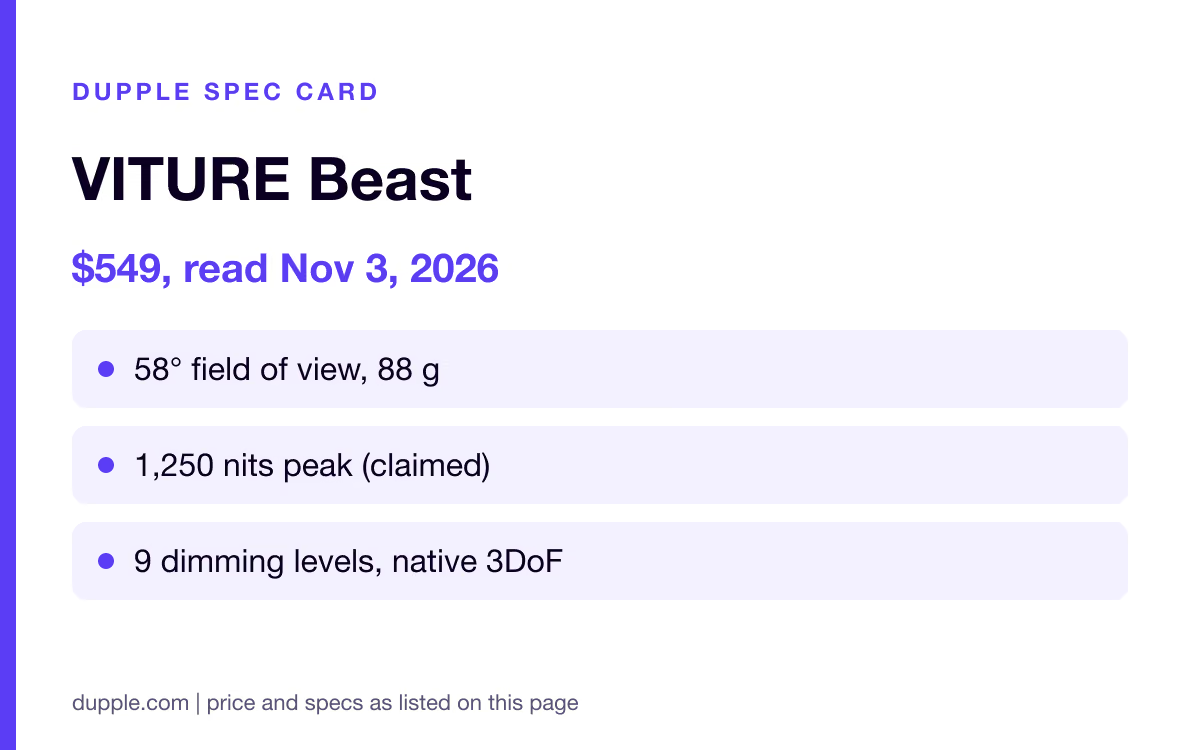
Price: $549 on viture.com, with no sale price shown (read November 3, 2026). In stock.
Connection and tracking: USB-C with the included cable. Native 3DoF is built in. VITURE's Ecosystem Support table lists 6DoF as "In Future Plans".
Prescription: a prescription frame is in the box. VITURE sells lenses for it from $79 to $145.
Best for: a Mac or Windows laptop user who wants the widest screen of the five and the most dimming control, at $549.
Pros
- A 58° field of view, the widest of the five, and 1,250 nits (peak, perceived) as claimed.
- Nine dimming levels, the most of any model here that states a level count.
- Native 3DoF and a USB-C connection that needs only the cable in the box.
Cons
- 6DoF is "In Future Plans", not live.
- VITURE's spec list suggests wearing it 3 to 4 hours at a time.
- 88 g, the heaviest of the five, and lenses start at $79 on top of the frame.
VITURE Luma Ultra: for nearsighted users up to minus 4.0
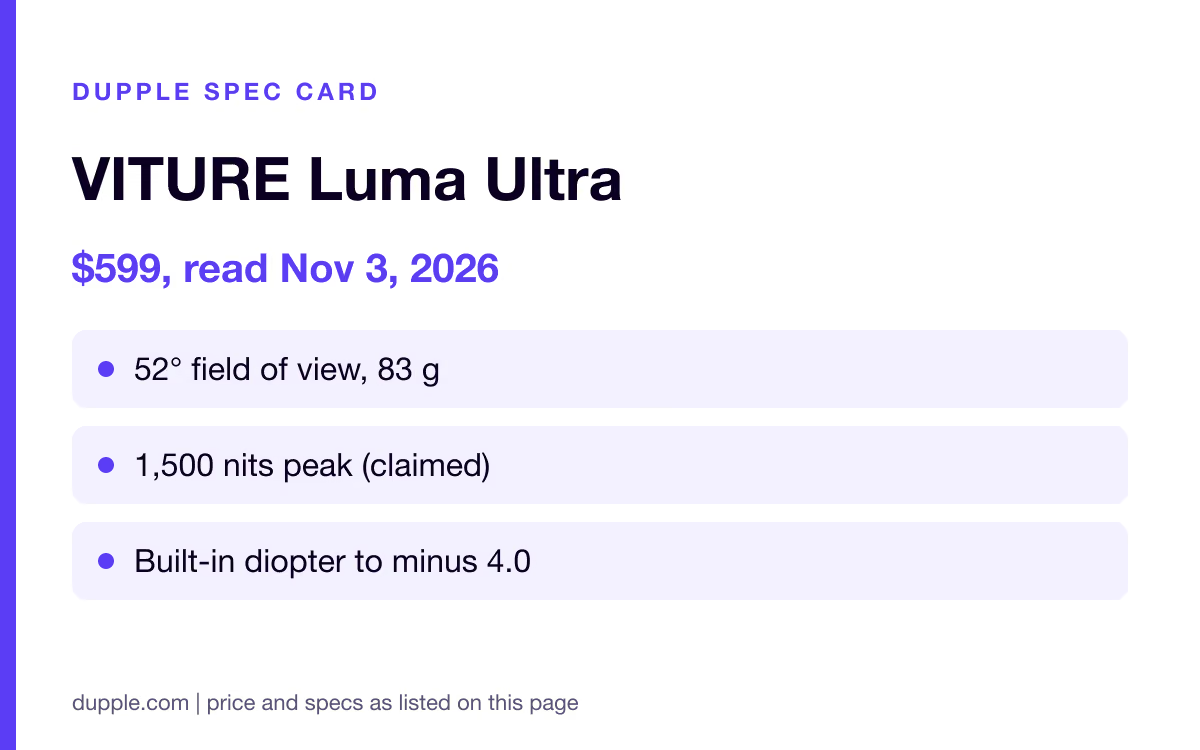
Price: $599 on viture.com, with no sale price shown (read November 3, 2026). In stock.
Diopter and cameras: built-in diopter adjustment to minus 4.0. A front RGB camera and dual depth cameras provide the hardware for 6DoF.
Connection: a magnetic connector at the glasses end, with a USB-C to magnetic cable in the box. No built-in battery: it draws power from the connected device (VITURE FAQ).
Best for: a nearsighted laptop user who wants no lens cost up to minus 4.0.
Pros
- 1,500 nits (peak, perceived) as claimed, the highest of the five.
- Built-in diopter adjustment to minus 4.0, so many nearsighted users skip lens costs.
- 83 g, third lightest of the five.
Cons
- A 52° field of view, 6 degrees narrower than the Beast.
- Its FAQ says 6DoF is not supported in the SpaceWalker app on iOS or Android.
- Full gesture control needs the VITURE Pro Neckband, which is $328 against a list price of $399.
VITURE Luma Ultra on viture.com
RayNeo Air 4 Pro: the budget pick for video, with HDR10
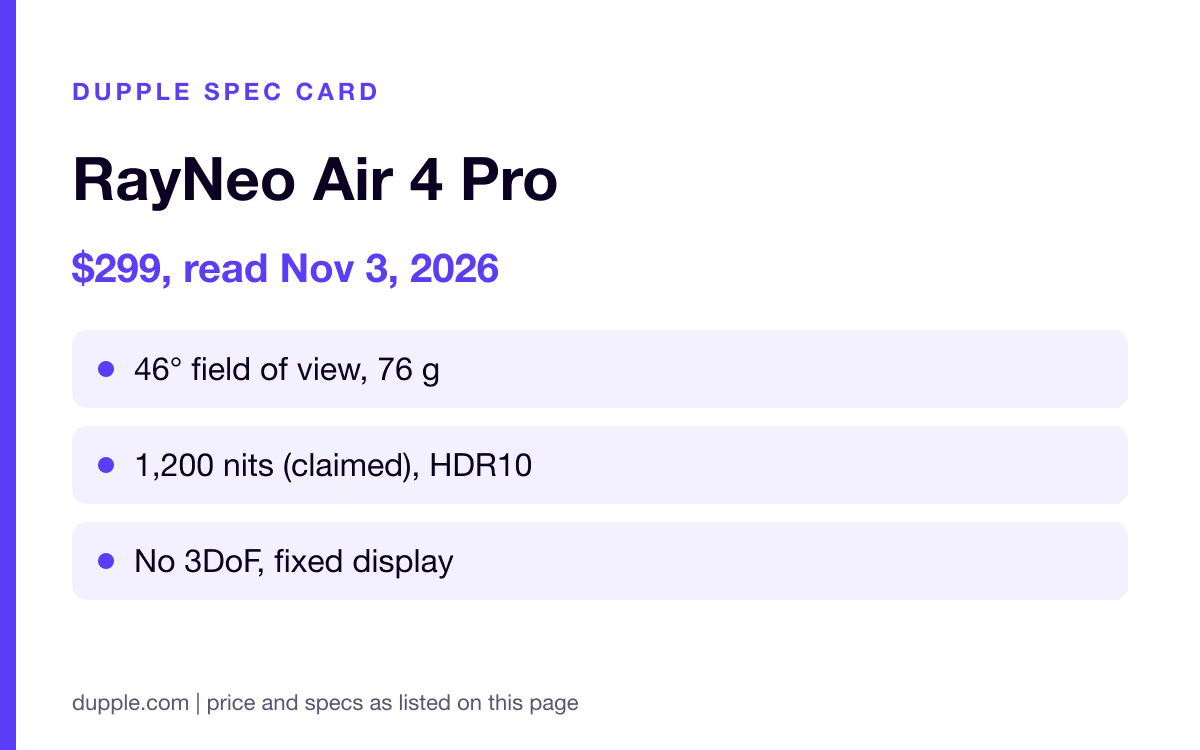
Price: $299 on rayneo.com, Standard Edition, in stock (read November 3, 2026). Its cart preview shows an estimated shipping date of November 4 to 6. No sale is shown on the page today.
Tracking: no 3DoF. Its FAQ says: "No. Air 4 Pro uses a fixed display rather than 3DoF spatial anchoring."
Power and prescription: no built-in battery, so it draws power from the connected device (RayNeo FAQ). It is prescription-ready through the partner Lensology, price not read.
Best for: a budget buyer who wants HDR video and the lightest frame here. Not the pick for laptop work, because the screen does not anchor in place.
Pros
- $299, the lowest price of the five, and 76 g, the lightest with a stated weight.
- The only one that names HDR10 (VITURE lists HDR as supported), with four speakers tuned by Bang and Olufsen.
Cons
- A 46° field of view, the narrowest of the five.
- No 3DoF, and no tint lens is listed: its dimming is flicker-free.
RayNeo Air 4 Pro on rayneo.com
XREAL One Pro vs VITURE Beast
The One Pro costs $50 more than the Beast, and $99 more again with the XREAL Eye for 6DoF. Its field of view is one degree narrower, 57 against 58. The Beast claims 1,250 nits peak, against the One Pro's 700 nits perceived. The Beast's panel is 1920 × 1200 per eye, against 1920 × 1080, with nine dimming levels against three. The One Pro gives 6DoF today with the Eye, while the Beast lists 6DoF as "In Future Plans". The two weigh 87 g and 88 g.
| Spec | XREAL One Pro | VITURE Beast |
|---|---|---|
| US price | $599 (sale; regular $649) | $549 |
| Display per eye | 1920 × 1080 | 1920 × 1200 |
| Claimed brightness | 700 nits (perceived) | 1,250 nits (peak, perceived) |
Verdict: the Beast for laptop work and video, and the One Pro only if 6DoF matters now and you accept $698 with the Eye.
RayNeo Air 4 Pro vs XREAL One Pro
The RayNeo costs $300 less than the One Pro on sale. It weighs 76 g against 87 g and claims 1,200 nits with HDR10, where the One Pro pages we read name no HDR format. The One Pro has a wider 57° field of view against 46°, and three electrochromic dimming modes against flicker-free dimming with no tint lens. The One Pro also has 3DoF built in, which the RayNeo lacks.
| Spec | RayNeo Air 4 Pro | XREAL One Pro |
|---|---|---|
| US price | $299 | $599 (sale; regular $649) |
| Field of view | 46° | 57° |
| Weight and head tracking | 76 g, no 3DoF | 87 g, 3DoF built in |
Verdict: the RayNeo for price and HDR video, the One Pro for laptop work that needs the screen to stay in place.
VITURE Beast vs Luma Ultra
The Luma Ultra costs $50 more than the Beast, and claims 1,500 nits peak, against the Beast's 1,250. The Beast's screen is wider, 58° against 52°. The Ultra has a built-in diopter range to minus 4.0 and camera hardware for 6DoF, which its FAQ says is not supported in SpaceWalker on iOS or Android but works with SpaceWalker on macOS and Windows and with the Pro Neckband. The Beast has no built-in diopter adjustment, but its prescription frame is in the box, with lenses from $79. The Ultra weighs 83 g against the Beast's 88 g, and its connector is magnetic, while the Beast uses USB-C.
| Spec | VITURE Beast | VITURE Luma Ultra |
|---|---|---|
| US price | $549 | $599 |
| Field of view | 58° | 52° |
| Built-in diopter | None, frame in the box | Minus 4.0 |
Verdict: the Beast for the wider screen, the Ultra for nearsighted users whose prescription sits within its diopter range.
XREAL 1S vs One Pro
The 1S costs $150 less than the One Pro on sale. Its field of view is 52 degrees against the One Pro's 57. Both claim 700 nits, the 1S as peak and the One Pro as perceived. The 1S display is 3840 × 1200 binocular, which is 1920 × 1200 per eye, against the One Pro's 1920 × 1080. The 1S weighs 82 g on XREAL's 1S page, against 87 g for the One Pro.
| Spec | XREAL 1S | XREAL One Pro |
|---|---|---|
| US price | $449 (regular price, no sale) | $599 (sale; regular $649) |
| Field of view | 52° | 57° |
| Weight | 82 g | 87 g |
Verdict: the 1S if $150 and a narrower screen are fine, the One Pro for the wider view.
What does each setup cost in total?
The vendor pages we read list no subscription for these five models, so each total is a one-time price. The table adds what each user needs on top of the glasses. Prices are from each brand's US store, read November 3, 2026.
| Glasses | Glasses price | Laptop (USB-C) adds | iPhone adds | Switch adds | Prescription lenses |
|---|---|---|---|---|---|
| XREAL One Pro | $599 (sale) | $0, C-to-C cable in the box | $0 on iPhone 15 or newer; from $199 for the Beam Pro on older iPhones | Not on XREAL's supported list | From $49.90 on sale, list $149.90 |
| XREAL 1S | $449 | $0, C-to-C cable in the box | Not stated on the 1S page | Not stated on the 1S page | From $49.90 on sale, list $149.90 (One and 1S lens set) |
| VITURE Beast | $549 | $0, included cable | $0 to plug in; about $89 more for the full iOS mode (iPhone Pack Ultra $638 minus $549) | $99 dock (Pro Mobile Dock, regular $129, or Mobile Dock Mini); VITURE also lists the $89 USB-C XR Charging Adapter Ultra, which needs a 45W+ power bank | From $79, up to $145 |
| VITURE Luma Ultra | $599 | $0, USB-C to magnetic cable in the box | Listed as compatible; iOS 3DoF needs the Adapter Ultra or Mobile Dock Mini (price not read) | $99 dock (Mobile Dock Mini or Pro Mobile Dock), per its Ecosystem Support table; VITURE also lists the $89 USB-C XR Charging Adapter Ultra, which needs a 45W+ power bank | Built-in diopter to minus 4.0 |
| RayNeo Air 4 Pro | $299 | Data cable in the box (RayNeo unpacking list) | USB-C iPhone listed as compatible; $64 HDMI adapter for Lightning iPhones | $89 JoyDock Gaming Adapter; for a Switch 2, RayNeo sells a $15 bracket that lets the JoyDock hold it | Lensology partner, price not read |
Dupple data: computed from vendor prices on November 3, 2026.
Glasses alone cost from $299 for the RayNeo to the top of the range. With prescription lenses, the One Pro costs from $648.90, the 1S from $498.90, and the Beast from $628, up to $694. Adding the XREAL Eye for 6DoF brings the One Pro to $698. A Switch user pays $648 with the Beast and its $99 dock, $698 with the Luma Ultra and its dock, and $388 with the RayNeo and its $89 JoyDock ($403 for a Switch 2 with the $15 bracket; RayNeo also lists an Air 4 Pro + JoyDock bundle at $349). An iPhone 14 or older on the One Pro adds the Beam Pro, from $199, for $798 or more.
FAQ
Can you use these as a laptop monitor, and how many screens do you get?
Yes. All five show a laptop's screen as a large virtual display over USB-C or an adapter. VITURE's Beast page lists 2-screen and 3-screen layouts. How many windows you can use depends on your laptop and software.
Do they work with an iPhone?
Yes, on a USB-C iPhone with video output. XREAL's One Pro page lists iPhone 15, 16 and 17. VITURE's Beast page excludes the iPhone 16e, iPhone 17e and iPhone Air. Older iPhones need an adapter, such as RayNeo's $64 HDMI adapter or XREAL's Beam Pro, from $199.
Do they come with prescription lenses?
No model ships with lenses. The XREAL One Pro and the VITURE Beast include a prescription frame. Lenses for the One Pro cost from $49.90 on sale (list $149.90), and for the Beast from $79. The VITURE Luma Ultra has a built-in diopter adjustment to minus 4.0. XREAL lists its One and 1S lens set at $49.90 to $69.90 on sale (list $149.90 to $169.90), and RayNeo's lens price was not read.
Do they have a battery?
The RayNeo Air 4 Pro and the VITURE Luma Ultra have no built-in battery, and both draw power from the connected device, according to their own FAQs. XREAL and VITURE's Beast do not state a battery. VITURE's Beast and Luma Ultra pages suggest wearing them 3 to 4 hours at a time.
Which one is brightest?
On the claimed figures, the Luma Ultra leads at 1,500 nits (peak, perceived), then the Beast at 1,250 (peak, perceived) and the RayNeo at 1,200. XREAL gives the One Pro 700 nits perceived and the 1S 700 nits peak. These are vendor claims, not a like-for-like test.
Which one is lightest?
The RayNeo Air 4 Pro is lightest at 76 g, then the XREAL 1S at 82 g (XREAL's 1S page), the Luma Ultra at 83 g, the One Pro at 87 g and the Beast at 88 g.
Is there a discount code?
Dupple holds no discount code for these brands. On November 3, 2026, RayNeo's product page showed no sale, and its cart total was $299.00, so this page uses that price.
Methodology
We compared five models: the XREAL One Pro and 1S, the VITURE Beast and Luma Ultra, and the RayNeo Air 4 Pro. Prices and specs come from each brand's own US store and spec pages, read on November 3, 2026, with the US market set where the store offers one. Brightness figures are the brands' claims. None of the five was tested hands-on for this page. The table lists models by brand, not by rank. The verdicts pick a winner for each use case, and no payout or commission figure enters them. Sale prices change, so check the store before you buy.
Sources
- XREAL One Pro, XREAL US store (read November 3, 2026)
- XREAL 1S, XREAL US store (read November 3, 2026)
- XREAL 1S, xreal.com (82 g weight) (read November 3, 2026)
- XREAL One series spec sheet, tutorials.xreal.com (read November 3, 2026)
- XREAL One Pro prescription lenses, XREAL US store (read November 3, 2026)
- XREAL One/1S prescription lenses, XREAL US store (read November 3, 2026)
- XREAL Eye, XREAL US store (read November 3, 2026)
- XREAL Beam Pro, XREAL US store (read November 3, 2026)
- VITURE Beast XR Glasses, viture.com (read November 3, 2026)
- VITURE Luma Ultra XR Glasses, viture.com (read November 3, 2026)
- VITURE Beast prescription lens frame with lenses, viture.com (read November 3, 2026)
- VITURE Pro Mobile Dock, viture.com (read November 3, 2026)
- VITURE Mobile Dock Mini, viture.com (read November 3, 2026)
- VITURE Beast USB-C iPhone Pack Ultra, viture.com (read November 3, 2026)
- VITURE Pro Neckband, viture.com (read November 3, 2026)
- RayNeo Air 4 Pro AR Glasses, rayneo.com, with accessory list (read November 3, 2026)
Related reading
Some offers on this page may be paid placements or contain affiliate links.