
Last updated: March 2026
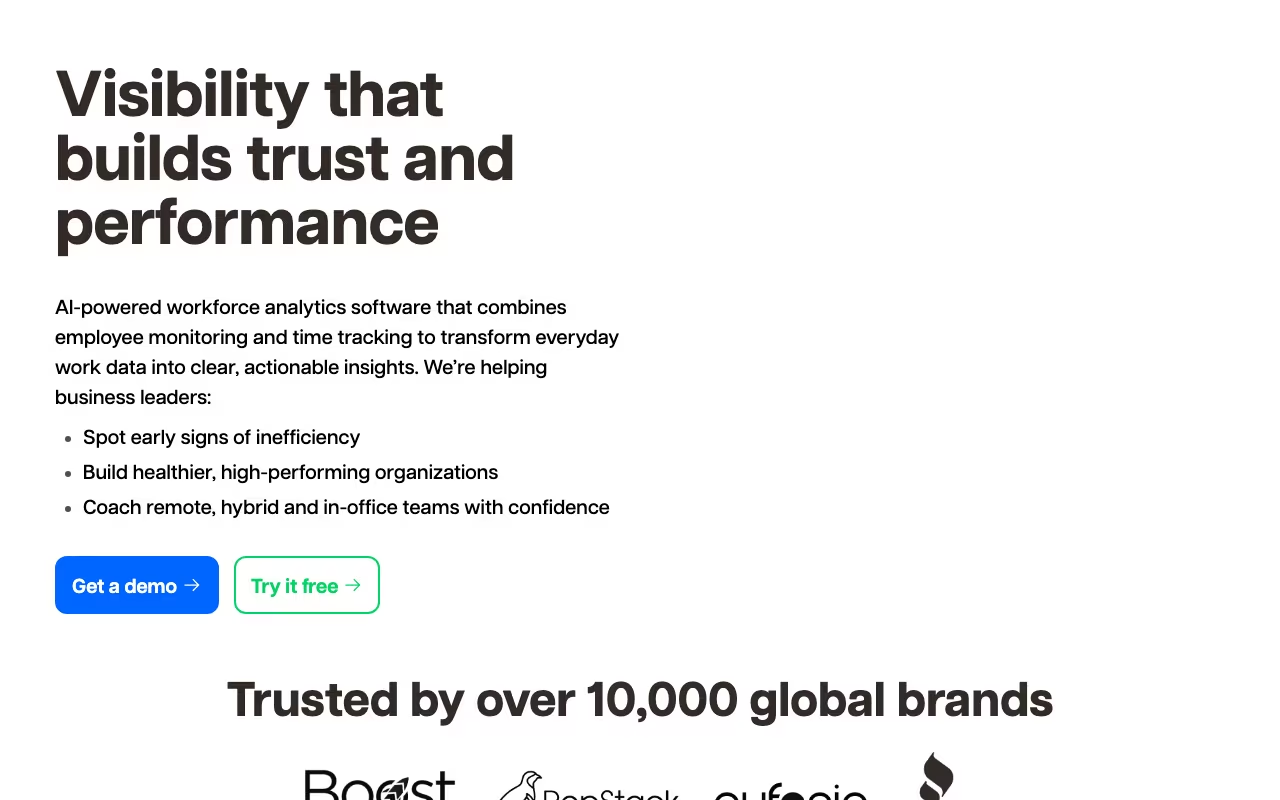
Let's be honest about what Time Doctor is: employee monitoring software. Whether that's a good thing depends entirely on how you use it. Deployed as a Big Brother tool, it kills morale. Deployed transparently as a mutual productivity tool, it can genuinely help remote teams stay accountable without constant check-ins.
Time Doctor tracks what employees do during work hours: time on tasks, which apps and websites they use, optional screenshots at random intervals. Employees see their own data, can pause tracking for breaks, and can delete screenshots containing sensitive information. The transparency is the selling point. Unlike covert monitoring tools, everyone knows the rules.
Try Time Doctor Free for 14 DaysWhat Gets Tracked (and What Doesn't)
The desktop app runs in the background and logs time automatically. No manual timesheets. It categorizes app and website usage as productive, unproductive, or neutral based on your team's settings (YouTube might be unproductive for your accounting team but productive for your video editor).
Optional screenshot capture takes random screenshots at configurable intervals. Employees can delete any screenshot before it syncs if it contains personal information. Managers see that a deletion happened but not the content. This is a reasonable privacy compromise.
Productivity analytics go beyond raw time tracking. Time Doctor shows patterns: which apps get the most hours, when deep focus happens vs. constant task-switching, and how individual productivity compares to team averages. The Premium plan adds AI-powered benchmarks that compare your team's patterns to industry norms.
Payroll, Projects, and Integrations
For agencies billing clients by the hour, Time Doctor connects tracked time directly to invoicing. For companies with hourly workers, it integrates with payroll providers (Gusto, ADP) to calculate payments from tracked hours. This eliminates the "I worked 40 hours" vs. "the system says 32" disputes.
Project and task tracking syncs with Asana, Trello, Jira, and other PM tools. You don't rebuild your task structure inside Time Doctor; it pulls from what you already use.
What Time Doctor Costs
Basic ($8/user/month): Time tracking, screenshots, basic reporting. Covers the essentials.
Standard ($14/user/month): Adds payroll integration, project budgets, detailed analytics. Most popular tier.
Premium ($20/user/month): VIP support, executive dashboard, client login portal, AI-powered workforce analytics (Benchmarks AI), meeting insights.
14-day free trial, no credit card. Annual billing saves roughly 15%. For a 10-person remote team on Standard, that's $140/month. Not cheap for a tracking tool, but cheaper than the lost productivity it's supposed to recover.
See Time Doctor PlansThe Honest Trade-offs
- Accountability without micromanaging: Managers get visibility into how time is spent without hovering over shoulders. Useful for remote teams and client billing
- Self-awareness for employees: Many people are surprised by their own data. Seeing that you spent 3 hours in Slack yesterday is a wake-up call no manager needs to deliver
- Accurate client billing: Agencies and consultants get proof-of-work reports that clients actually trust
- Monitoring always has a morale cost: Even transparent monitoring signals distrust. Some high-performers will resent it regardless of implementation
- Desktop app required: Everyone needs to install software. IT overhead increases with team size
- Screenshots feel invasive: Even with employee controls, random screenshots create anxiety for some people. Consider carefully whether you actually need this feature
- Measures presence, not output: 8 hours of tracked "productive" time doesn't mean 8 hours of good work. The best employees sometimes produce their best work in 4 focused hours
Time Doctor vs Hubstaff vs Toggl Track
Hubstaff is the most direct competitor with nearly identical features. Hubstaff has stronger GPS tracking for field teams; Time Doctor has deeper productivity analytics. Pricing is similar. Try both during free trials and pick the interface you prefer.
Toggl Track takes the opposite philosophy: simple time tracking without screenshots, app monitoring, or productivity scores. Better for trust-based environments where teams track their own time voluntarily. If your goal is self-awareness rather than accountability, Toggl is the better choice.
Clockify offers free time tracking with basic features. No monitoring capabilities, but it costs nothing. Good starting point if you're not sure you need the full monitoring stack.
Frequently Asked Questions
Can employees pause or stop tracking?
Yes. Employees can pause tracking for breaks, personal calls, or any reason. Paused time is logged but not monitored. They can also stop tracking entirely at the end of their workday.
Does it work offline?
Yes. Tracking continues offline and syncs when connectivity returns. Mobile apps for iOS and Android also support on-the-go tracking.
Time Doctor is a powerful tool with a clear purpose. If you manage remote teams, bill clients by the hour, or need accurate time records for hourly workers, it delivers. The key is deploying it openly: explain why you're using it, give employees access to their own data, and use it to have productive conversations rather than punitive ones. The tool itself is neutral. How you implement it determines whether it helps or hurts.
Start Your Free Time Doctor Trial