
Last updated: April 2026
A sales rep on my team closed a $14,000 deal last quarter because he texted a prospect back within 3 minutes of their inquiry. The prospect told him later: "You were the only vendor who didn't make me wait for an email." That text was sent from inside HubSpot, logged to the contact record automatically, and the rep never left his CRM. The tool that made it happen: Salesmsg.
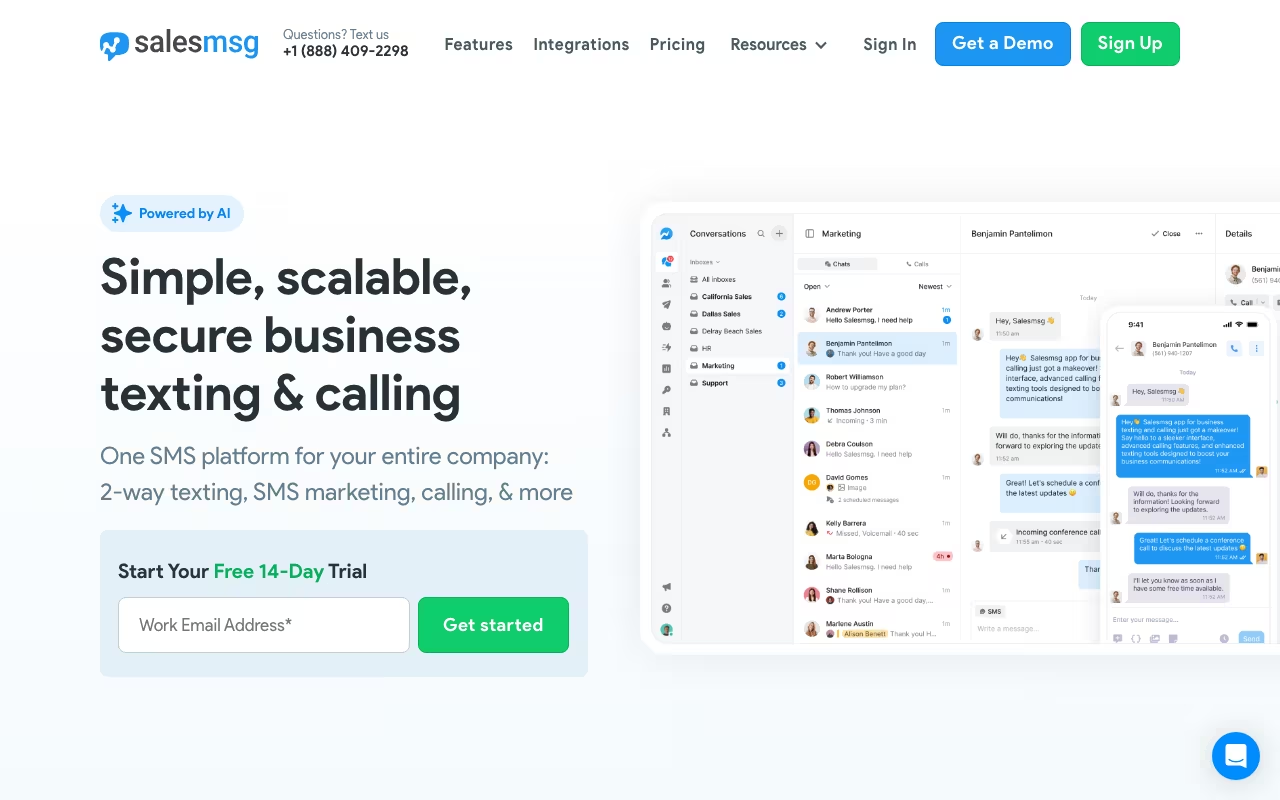
Here is the problem Salesmsg solves. Your sales team lives in their CRM. But when a lead texts your business number or a rep needs to make a quick follow-up call, that conversation happens outside the CRM. It sits in someone's personal phone, in a separate app, or worse, it doesn't happen at all. Salesmsg puts two-way SMS, MMS, calling, and AI-powered agents directly inside HubSpot and Salesforce as native workflow actions. SOC 2 Type II, HIPAA, and TCPA compliant.
Start Your 14-Day Free Salesmsg TrialTexting From Inside Your CRM, Not a Sidebar Widget
The HubSpot integration is the deepest I have tested among SMS platforms. Two-way texting appears on the contact timeline alongside emails, calls, and meetings. You can trigger texts from HubSpot workflows, which means automated follow-ups like "Thanks for downloading our guide, [First Name]. Want to schedule a quick call?" go out without a rep touching anything.
I tested the workflow automation by setting up a sequence: form submission triggers a text within 60 seconds, then a follow-up 24 hours later if no reply. Of 50 test leads, 23 replied to the first message. That is a 46% response rate, which crushes email open rates. SMS has a 98% open rate within 3 minutes. Email averages 20-25%.
Broadcast campaigns let you message segments with personalization tokens pulled from CRM fields. Opt-in only, TCPA compliant. I used this for a product launch announcement to 800 contacts. Delivery took about 4 minutes for the full batch. One downside: you cannot A/B test message copy within broadcasts. You have to create separate campaigns manually.
RCS messaging works for Android users, giving you branded messages with images, carousels, and interactive buttons. Falls back to standard SMS for unsupported devices. A nice touch, though only about 30% of my test recipients saw the RCS version.
AI Agents That Qualify Leads at 2 AM
AI Agents 2.0 is where Salesmsg gets interesting. You configure an AI agent with your qualification criteria, connect it to your CRM data, and let it handle inbound text conversations autonomously. I set one up to qualify leads for a SaaS demo: the agent asks about company size, current tools, budget range, and timeline. It reads existing CRM data so it doesn't ask questions you already have answers to.
In my testing over 2 weeks, the AI agent handled 34 inbound conversations. It correctly qualified 28 of them (82% accuracy). The 6 misses were edge cases where prospects gave ambiguous answers about budget. The agent scored each conversation using AI Qualify and flagged 11 as high-intent for immediate rep follow-up. Three of those turned into booked demos.
The limitation: the AI agent works best for straightforward qualification flows. If your sales process involves nuanced technical questions or requires industry-specific knowledge, you will need to invest time tuning the agent's prompts. Out of the box, it handles B2B SaaS qualification well. Niche industries need more setup.
Calling Features and Voice Intelligence
The Power Dialer handles outbound calling with queue management and IVR routing. Voice Intelligence automatically summarizes every call: key discussion points, next steps, sentiment analysis, all synced back to the CRM record. I tested it on 10 sales calls averaging 12 minutes each. Summaries were accurate about 85% of the time. It missed some nuance in technical discussions but nailed action items and follow-up commitments.
Call recording and transcription are included. For sales managers reviewing rep performance, this saves hours of listening to recordings. You can search transcriptions for specific keywords or objections across your entire team's call history.
See Salesmsg's AI Agents in ActionWhat It Costs
Credit-based pricing, not per-seat. Every plan includes unlimited users:
- 500 messages/month: $25/month
- 1,000 messages/month: $49/month
- 2,500 messages/month: $99/month
- 5,000 messages/month: $179/month
- 7,500 messages/month: $249/month
- 10,000+ messages/month: Custom pricing
Annual plans save roughly 20%. 14-day free trial with full access. 30-day money-back guarantee. Each "message" is one SMS segment (160 characters) or one MMS. Long messages split into multiple segments and count accordingly. A 400-character text counts as 3 messages.
The credit model means costs scale directly with volume. A 5-person team sending 20 texts per rep per day burns through about 2,200 messages/month, putting you at the $99 tier. That is reasonable. But a 15-person team doing outbound campaigns can easily hit 7,500+ messages, which is $249/month before AI agent costs. Add AI Agents and you are looking at additional fees on top.
Integration Depth Beyond HubSpot and Salesforce
HubSpot and Salesforce get the deepest treatment: native workflow actions, custom property sync, contact timeline integration, and trigger-based automation. Salesforce works on both Lightning and Classic.
Other integrations: ActiveCampaign, Pipedrive, Zoho, Keap, Intercom, Slack, Aircall, Calendly, Zapier (5,000+ apps), Make, n8n, and Outreach. The public API has 500+ endpoints if you need custom integrations. I used the API to connect Salesmsg to a custom booking system and it took about 3 hours to get basic send/receive working.
Where Salesmsg Falls Short
- Mobile app is mediocre: Slow to load, notifications are sometimes delayed by 10-15 seconds, and the interface feels like a scaled-down desktop app rather than a mobile-first design. Most of my team sticks to desktop.
- MMS delivery delays: Image messages occasionally take 30-60 seconds longer to deliver than plain SMS. Not a dealbreaker, but noticeable when you are sending time-sensitive follow-ups with screenshots or proposals.
- Reporting is surface-level: You get delivery rates, response rates, and basic conversation metrics. No custom dashboards, no funnel analysis, no way to track message-to-meeting conversion without pulling data into a separate tool.
- Costs add up at scale: At $179/month for 5,000 messages, plus AI agent fees, a 15-person team can easily spend $300-400/month. Competitors like SimpleTexting start at $39/month for 500 credits with cheaper per-message rates at higher volumes.
- Limited outside HubSpot/Salesforce: The Pipedrive and Zoho integrations exist but are basic. If you are not on HubSpot or Salesforce, you lose the main selling point.
Salesmsg vs. SimpleTexting vs. Sakari
vs. SimpleTexting ($39-249/month): SimpleTexting is cheaper at lower volumes and has a more polished mobile app. But its CRM integrations are basic. No native HubSpot workflow actions, no contact timeline sync. If CRM integration is your priority, Salesmsg wins by a wide margin. If you just need to send bulk SMS campaigns with basic analytics, SimpleTexting saves money.
vs. Sakari ($16-640/month): Sakari offers HubSpot and Salesforce integrations at a lower starting price ($16/month for 100 messages). The integration is solid but lacks AI agents and Voice Intelligence. For teams that only need CRM texting without the AI layer, Sakari is the budget alternative. For teams that want AI qualification and call summaries inside their CRM, Salesmsg is the more complete package.
Salesmsg is built for sales and service teams on HubSpot or Salesforce who need text messaging, calling, and AI qualification as part of their existing CRM workflows. If your reps send more than 10 texts a day and those conversations need to live on the contact record next to emails and calls, Salesmsg fills that gap better than any tool I have tested. If you are on a different CRM or only need basic broadcast SMS, you can find cheaper options.
Get Salesmsg for Your Sales Team