
AI Phone Agents for Businesses That Miss Too Many Calls
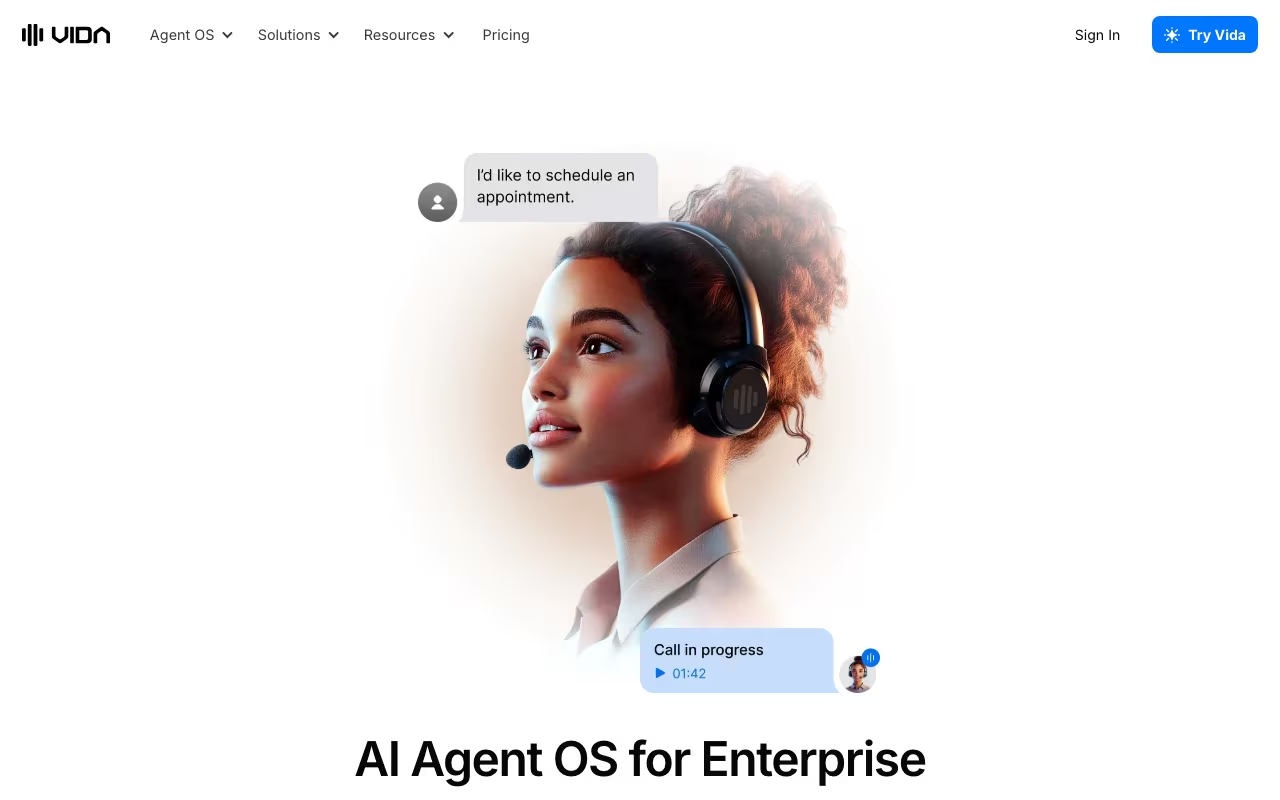
Vida is an AI phone agent platform that answers calls, qualifies leads, schedules appointments, and handles FAQ responses across voice, SMS, email, and web chat. Think of it as a virtual receptionist that works 24/7, speaks 10+ languages, and never puts anyone on hold. The San Francisco-based company raised a $4 million Series A in November 2025 and claims to have powered over 100 million customer interactions across tens of thousands of deployed agents.
The core pitch is straightforward: small businesses and professional services firms miss 20-40% of incoming calls. Each missed call is a lost customer. Vida's AI answers every call instantly, collects the caller's information, qualifies whether they're a good lead, books appointments directly into your calendar, and sends you a summary. The system runs on multiple large language models simultaneously, selecting the best one for each interaction type, so you don't have to think about model management.
Set Up Your AI Phone Agent with Vida Get started →What the Platform Actually Does
The no-code agent builder lets you configure your AI receptionist with pre-built templates for industries like healthcare, automotive, legal, and real estate. You define how the agent should greet callers, what questions to ask, when to escalate, and what information to collect. The setup process takes 15-30 minutes for a basic agent. More complex workflows with conditional routing take longer but don't require any technical skills.
Beyond answering inbound calls, Vida handles outbound campaigns via voice, SMS, and email. You upload a contact list, define the message sequence, and the AI makes calls or sends texts on your behalf. The platform claims 80% faster resolution times compared to human-handled calls, averaging 1 minute 14 seconds versus roughly 6 minutes for a human agent. Custom voice cloning lets you create a branded voice for your agent rather than using generic AI voices.
Integrations connect through Zapier (7,000+ apps), plus native connections to Google Calendar, SIP trunking providers, and select CRM platforms. HIPAA compliance, SOC 2 Type II certification, and STIR/SHAKEN call authentication make Vida viable for regulated industries like healthcare where data handling matters.
Pricing Reality Check
This is where Vida gets interesting and potentially problematic. Vida's pricing page no longer lists plans or rates. Each build is quoted after scoping, and the only published figure is a pilot that starts at $1,500, credited toward your first month in production.
Older sources reference monthly plan tiers that no longer appear on Vida's pricing page. With a $1,500 pilot before production, Vida is priced for businesses where missed calls cost hundreds of dollars each, meaning medical practices, law firms, and service contractors. A solo freelancer answering 10 calls a week doesn't need a $1,500 pilot for an AI receptionist.
Overage rates add up too: roughly $0.15 per minute of voice, $0.09-0.10 per text, and $5/month per additional local number. Spam calls cost you money, since the system charges per minute regardless of whether the caller is a real lead or a robocall.
See Vida's AI Phone Agent Pricing See plans →Vida publishes no list prices; plans are quoted by sales, per the Vida pricing page (checked September 2026).
The Trust Problem
Vida's biggest weakness isn't the product itself. It's the near-total absence of independent reviews. The platform has no presence on G2, no reviews on Capterra, and only 3 ratings on the App Store. Vida's own website claims "5-star rating, 1,000 reviews" but this isn't verifiable on any major independent platform. For a product handling your business phone calls, something that directly impacts revenue and customer relationships, that lack of third-party validation is a significant concern.
The other notable gap is no human escalation. Vida is purely AI. If a caller has a complex issue that the AI can't handle, there's no option to route to a live agent. Competitors like Smith.ai offer hybrid AI-plus-human models where the AI handles routine calls and a real person steps in for anything complicated. Calendar integration is limited to Google Calendar only, which rules out teams using Outlook or Calendly natively.
Who Should Consider This
Vida makes financial sense for service businesses where each missed call represents $200+ in potential revenue. A dental practice, plumbing company, or law firm that misses 5 calls per day is leaving $1,000+ on the table daily. Once in production, Vida pays for itself if it captures even 2-3 additional clients per month. For businesses with lower call volumes or lower per-customer value, cheaper alternatives like My AI Front Desk or Goodcall offer similar AI receptionist features at lower price points. And if you want the safety net of human backup, Smith.ai's hybrid approach is worth the premium.
Try Vida's AI Receptionist for Your Business Get started →How Vida works
Vida positions itself as an "AI Agent Operating System" for creating, deploying, managing and reselling AI agents that handle business communications and operations. The agents answer, qualify, schedule, route and follow up on inbound contact across voice calls, SMS, email, web chat and web calls, and they can also run outbound voice, chat and email. Beyond conversation, the agents perform work: CRM hygiene (lead scoring, tagging, deduplication), payment requests, document generation and report building, browser control to navigate web apps and submit forms, and multi-step conditional operations.
You build agents in a no-code Agent Builder, optionally starting from agent templates. Vida frames the rollout as a staged pilot rather than self-serve signup: a 20 to 30 minute discovery call, scoping and a proof of concept in 1 to 2 business days, agent build and pilot in 2 to 10 business days, then production.
Telephony has three routes. You take a dedicated Vida Number (an AI-powered phone line), you forward your existing number, or you register your own SIP trunk. Agents then connect outward through native connectors for Google Workspace, Microsoft 365, GitHub, Trello, Google Calendar, X Search, X-Time and Athena Health, plus Zapier, webhooks for pulling dynamic data from your backend, and a developer API. The platform also advertises MCP-ready and OpenClaw-compatible agents, multi-language support, and white-label resale.
Where Vida wins
- Genuinely omnichannel rather than voice-only. Phone, SMS, email, web chat and web calls all run through the same agent, inbound and outbound.
- Telephony flexibility that many voice-agent tools lack. A provisioned Vida number, call forwarding from your existing line, or SIP registration against your own system.
- The compliance posture is unusually concrete for this category. SOC 2 Type II, HIPAA with a signed BAA, and STIR/SHAKEN plus TCR registration for call attestation and A2P messaging.
- Agents can act, not just talk. Browser control to fill and submit forms, payment requests, document and report generation, CRM deduplication and lead scoring, and webhook lookups into backend systems.
- Viable for resellers. White-label plus a developer API and agent templates make it workable for agencies selling agents under their own brand.
Where it falls short
- No published pricing at all. The pricing page lists no plans, rates or included minutes. The only number disclosed is a proof of concept that "starts at $1,500", credited toward your first month in production.
- Sales-gated onboarding. There is no free tier or self-serve trial on offer, only a discovery call and a paid pilot, so evaluation costs money and 2 to 10 business days of build time.
- The native connector list is short and idiosyncratic. Google Workspace, Microsoft 365, GitHub, Trello, Google Calendar, X Search, X-Time and Athena Health. There is no named CRM connector (no Salesforce, no HubSpot) despite CRM hygiene being a headline feature, so most CRM work routes through Zapier, webhooks or the API.
- Vertical depth is narrow. Athena Health is the single named healthcare integration, and there are no named integrations for e-commerce, legal, home services or the other common voice-agent verticals.
- Some claims stay vague. Marketing terms like "OpenClaw compatible" and "MCP Ready" appear without specifics on the site about what is actually supported.
Who should use Vida
Vida suits mid-market and regulated businesses that want a done-with-you AI receptionist and operations agent across phone, text and email, and that can absorb a paid pilot. Healthcare is the clearest fit given HIPAA with a BAA and the Athena Health integration. It also works for agencies that want a white-label agent platform with API access underneath it.
Skip it if you want to try before you buy, if you need transparent per-minute pricing to model your unit economics, or if you depend on deep native CRM integration rather than routing that work through Zapier and webhooks.