
What Is Vibe?
Vibe is the connected TV (CTV) advertising platform that lets SMBs run streaming TV ads on Hulu, Roku, Tubi, Pluto TV, and other streaming services. Founded to democratize TV advertising, Vibe offers self-serve campaign management with budgets starting at $50/day, opening CTV to businesses that previously could not access premium streaming inventory.
The pitch is "TV ads for small businesses." Programmatic CTV used to require enterprise contracts with DSPs costing thousands monthly. Vibe simplified the buying experience: pick your geography, demographics, and time of day; upload a 15- or 30-second ad; set daily budget; launch. The platform handles inventory access, frequency capping, and optimization.
The product targets DTC brands, local services businesses, and regional advertisers. National brand campaigns work but enterprise advertisers typically use bigger DSPs (The Trade Desk, DV360).
Try Vibe Get started →How Vibe Works
Sign up and create your first campaign. Define targeting: country, state, metro area, demographics, content categories, time of day. Vibe matches your settings to available CTV inventory across its supply network.
Upload your video ad. If you do not have one, Vibe's creator tool helps build a basic ad from product imagery, stock footage, and templates. Quality varies; brands serious about CTV typically hire a video production team but the tool covers MVPs.
Set daily budget (minimum $50/day) and campaign duration. Vibe optimizes delivery within your settings, spreading impressions across the day rather than burning budget in one hour.
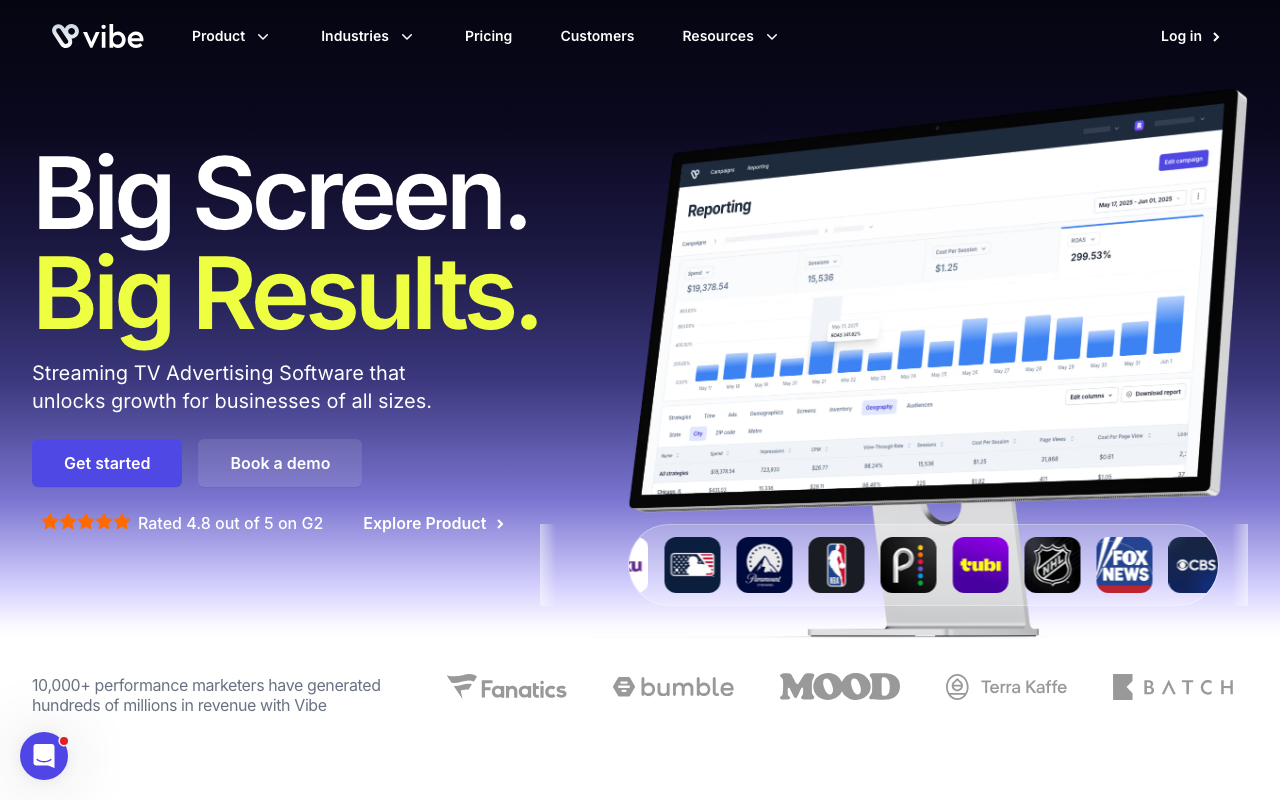
Track performance through the dashboard. Impressions, completed views, click-through rates, and (with pixel integration) website visits or conversions tied to the campaign. Attribution to website conversions is approximate; CTV attribution is harder than display attribution.
Pause, adjust, or expand campaigns daily. Vibe's self-serve model means changes apply immediately rather than requiring traffickers or account managers.
Vibe Pricing in 2026
Pay-as-you-go for ad spend. No monthly platform fee on entry tiers.
Minimum daily budget: $50.
Platform fee: percentage of ad spend, typically 15-20%.
Custom creative production: optional add-on for businesses without existing video.
For a typical SMB campaign at $100/day for 30 days, total spend is $3,000 plus Vibe's platform fee. Compared to running similar inventory through an agency or enterprise DSP, Vibe's transparent self-serve model is cheaper for low-volume spend.
See Vibe Pricing See plans →Where Vibe Wins
- Self-serve CTV: rare for advertisers spending under $10K/month.
- Low budget minimums: $50/day vs $5K-$10K monthly minimums on enterprise DSPs.
- Premium inventory access: Hulu, Roku, Tubi inventory accessible to SMBs.
- Quick setup: campaigns live within hours.
- No long-term commitments: pay only when you spend.
Where It Falls Short
- Inventory limited vs enterprise DSPs: scale of impressions and depth of targeting smaller than DV360.
- Attribution approximate: CTV-to-web attribution challenges affect everyone in the category.
- Creative quality matters: bad CTV ads waste budget. Most SMBs need production help.
- Less optimization sophistication: simpler bidding logic than enterprise platforms.
Vibe vs MNTN vs Tatari vs AdRoll CTV
Marketing tools, published pricing
| Tool | Pricing | Model |
|---|---|---|
| TheTop | $99/mo (lowest published recurring price) | Subscription |
| Hopp for Business | $9/mo (lowest published recurring price) | Subscription |
| POWR | $9.99/mo (lowest published recurring price) | Subscription |
| Roster | $500/mo (lowest published recurring price) | Subscription |
| Recomaze AI | $99/mo (lowest published recurring price) | Subscription |
MNTN is the closest mid-market competitor. Stronger optimization, similar pricing.
Tatari targets DTC brands with strong attribution methodology. More expensive, more analytical depth.
AdRoll CTV bundles with broader retargeting platform. Better for brands already using AdRoll.
Roku Ads direct buying is an alternative for inventory-specific campaigns.
Who Should Use Vibe
SMBs testing CTV: low risk, transparent pricing.
Local services businesses: brand awareness in specific metros.
DTC brands diversifying from Meta/Google: CTV reaches audiences that ad blocker prevent reaching on web.
Skip it if: you spend $50K+/month on ads (enterprise DSPs more efficient), need precision attribution (CTV is approximate), or have no video creative budget (bad ads waste spend).
How Vibe works
Vibe Inc. sells what it calls a contextual AI workspace: hardware that captures meetings, plus software that turns them into searchable organizational memory. The hardware line has four pieces: the Vibe Board S1 and S1 Pro smart whiteboards (55 inch and 75 inch), the Vibe Bot in-room AI conference device, and the Vibe Dot portable recorder. All of them feed the Vibe Memory Engine, which transcribes, summarizes, identifies speakers, extracts action items and answers questions about past decisions. The company claims 40,000+ customers across corporate, education and professional services.
In practice you buy a device and pair it with a per-seat software plan. The Board S1 is Chrome-based and the S1 Pro is Windows-based, so each runs the conferencing and app stack native to its operating system. The Bot is a room capture device and the Dot is a recorder you carry between meetings.
On the software side there are three tiers, and the levers that change are transcription minutes, memory retention window and AI Credits. Starter is $0 per seat per month with 300 transcription minutes, speaker identification, action-item extraction and basic AI summaries, but only 7 days of retention. Pro is $9 per seat per month billed annually ($108 a year) for 1,200 minutes, 12-month retention, workflow integrations (Slack, Jira, Linear, cloud drives) and custom summary templates. Max is $29 per seat per month ($348 a year) for unlimited transcription, permanent retention, Salesforce and HubSpot integration, company-branded live decks and advanced workspace admin controls. Two caveats from the site itself: software subscriptions are not sold standalone right now, and Bot support for the Pro and Max tiers is dated July 2026.
Where Vibe wins
- The free tier is real. Starter costs nothing per seat and still includes 300 transcription minutes, speaker identification, action-item extraction and basic AI summaries.
- Paid tiers are cheap for this category. $9 per seat per month annually for 1,200 minutes and 12-month retention undercuts most standalone AI meeting tools.
- Retention is an explicit product feature. 7 days, 12 months, or permanent, stated per tier, rather than an unstated backend policy you discover later.
- Three capture surfaces, one memory layer. A room display, a conference puck and a pocket recorder all write into the same searchable store.
- The integration list is concrete. Slack, Jira, Linear and cloud drives at Pro; Salesforce and HubSpot at Max. Named products, not vague claims about connecting to your stack.
Where it falls short
- Hardware is the entry ticket and it is expensive. Board S1 is $3,699, S1 Pro is $5,699, Vibe Bot is $1,599, Vibe Dot is $199 on pre-order, and the pricing page states there are no standalone software subscriptions currently available.
- The two boards run different operating systems. Chrome on the S1, Windows on the S1 Pro, so the app and conferencing experience is not the same product across the line, and the choice is locked in at purchase.
- Parts of the lineup have not shipped. The Dot is still pre-order, and Bot support for the Pro and Max software tiers is dated July 2026.
- The free tier undercuts the pitch. Starter keeps memory for 7 days, which makes it useless for the thing the product is sold on: recalling past decisions. The value only appears once you pay.
- CRM is gated to the top tier. Salesforce and HubSpot integration requires the $29 Max plan, and Team or Enterprise plans require contacting sales with no published price.
- Conferencing compatibility is unstated. The site does not say which video platforms are certified on the boards, so Zoom, Teams and Meet support has to be confirmed with sales.
Who should use Vibe
Vibe makes sense for teams that are already buying meeting-room display or conferencing hardware. If a board or a room device is going in the budget anyway, getting transcription and searchable meeting memory bundled at $9 or $29 per seat is a good deal, and permanent retention at the Max tier is the kind of feature most note-takers charge more for.
Skip it if you only want software. Vibe currently ties subscriptions to a hardware purchase, and a software-only note-taker will be cheaper, faster to roll out, and platform-agnostic. If you do buy, decide the Chrome versus Windows question carefully, since that choice cannot be changed after purchase, and confirm your conferencing platform is supported before ordering.
Frequently Asked Questions
How do I create an ad?
Upload your existing video, or use Vibe's creator to build basic ads from imagery and stock footage.
What length should ads be?
15- or 30-second ads. 30 seconds is standard for most CTV inventory.
Can I track conversions?
Yes via pixel integration on your website. Attribution is approximate due to CTV measurement challenges.
Which streaming services are available?
Hulu, Roku, Tubi, Pluto TV, Samsung Plus, and many others through the supply network.
Is there a minimum commitment?
No. Pay only when you spend; pause anytime.