
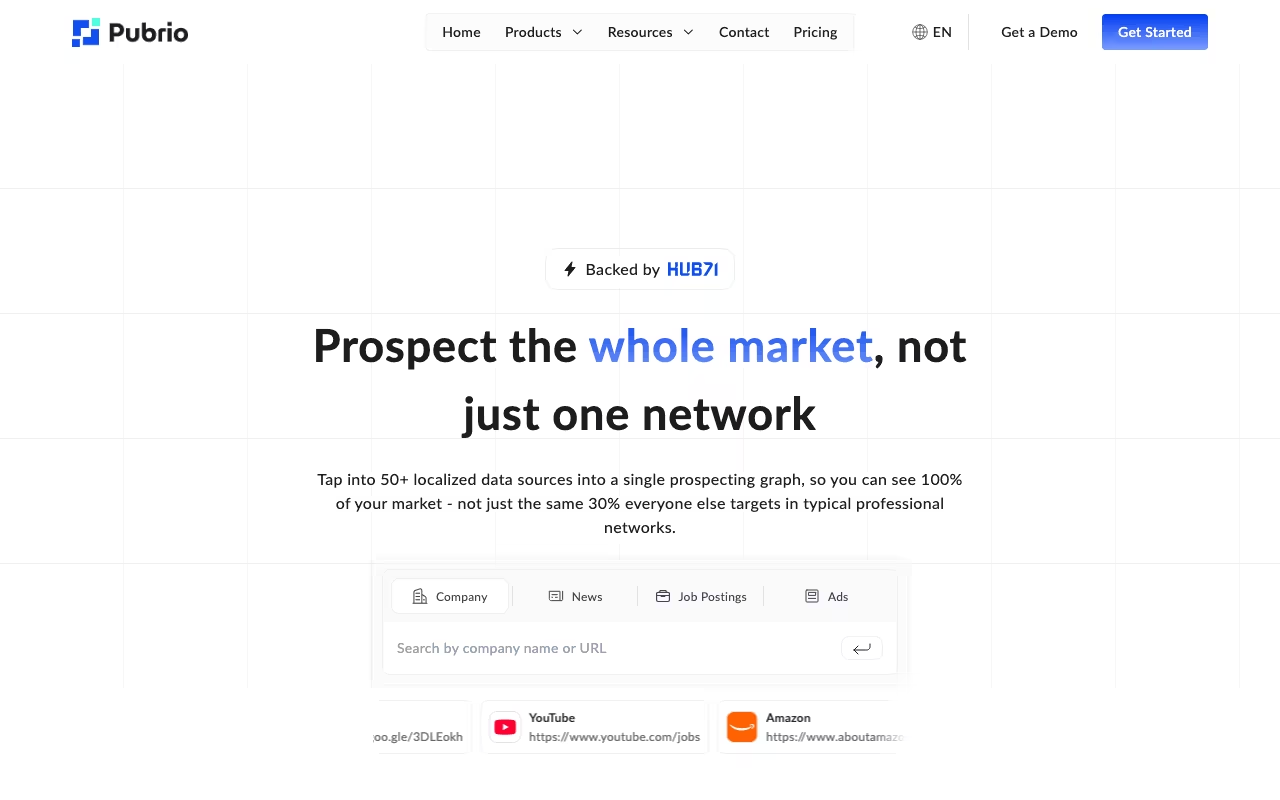
What is Pubrio?
B2B intent data and lead generation platform for sales teams to find in-market buyers.
Pubrio is aimed at sales teams that want to spend less time on admin work and more time actually closing deals. It handles the repetitive parts of the sales process so your reps can focus on conversations that move the needle.
How We Evaluated Pubrio
We looked at Pubrio on five things: pipeline management, lead scoring, outreach automation, CRM integration, and forecasting accuracy. Same checklist we use for every sales tool in the directory, so the comparisons are like for like.
That meant using the product, testing the features that matter most for sales work, reading the docs, and checking whether pricing is upfront or hidden behind a sales call. We also compared it against Demodesk and Capsule CRM to see where it stands.
Key Features
What Pubrio actually gives you:
- Team Collaboration: Built-in collaboration tools for real-time teamwork
- Contact & Lead Management: Organize contacts and track leads through your pipeline
- Lead Management: Capture, score, and route leads efficiently
- Outreach Automation: Automate follow-ups and outreach sequences
Pricing
Pubrio publishes its pricing: there is a free plan, then Startup at US$99 and Corporate at US$199 per user per month billed annually.
To give you a rough sense of the market, comparable sales tools like Demodesk and Capsule CRM charge in the range of custom pricing to custom pricing/mo, which should help you calibrate expectations.
Prices checked on the Pubrio pricing page in September 2026. Plans and limits change, so confirm before you buy.
Pros and Cons
What we like
- This is a tool built specifically for sales, which means the features are tailored to real use cases in this space rather than being generic functionality that sort of applies
- The pipeline view keeps your reps focused on moving deals forward instead of spending half their day navigating the tool itself, which is a trap a lot of CRMs fall into
- It focuses on doing one thing well rather than trying to be a Swiss Army knife, which usually means the core features get more development attention and polish than they would in an all-in-one platform
What could be better
- The tool only works if your reps actually log their activity consistently, and adoption is often the hardest part of rolling out any sales tool
- Larger organizations with complex requirements may find that some of the advanced features they expect from enterprise software are missing or underdeveloped
Pubrio Alternatives
If Pubrio isn't the right fit, here are the closest competitors worth looking at:
| Tool | What it does | Pricing |
|---|---|---|
| Demodesk | Demodesk is a business tool available at demodesk.com. Sign up to see pricing, features... | From $50/mo |
| Capsule CRM | Capsule and Transpond is a business tool available at transpond.io. Sign up to see pric... | From $18/mo |
| Lusha | Lusha is a business tool available at lusha.com. Sign up to see pricing, features, and ... | From $36/mo |
| Salesflare | Salesflare is a business tool available at salesflare.com. Sign up to see pricing, feat... | From $35/mo |
We track hundreds of sales tools in our tools directory. Worth browsing if none of these match what you need.
Who It's For (and Who It's Not)
Good fit: Pubrio makes the most sense for sales teams and SDRs who spend most of their day inside their pipeline and need fast access to deal data, follow-up reminders, and lead context without switching between five different tabs. If that sounds like your situation, it's worth at least testing it out.
Skip it if: you close a handful of deals a month through personal relationships and word of mouth. At that volume, a well-maintained spreadsheet genuinely works fine. In that case, you might want to look at Demodesk as a lighter-weight option.
Bottom Line
Does its core job well. Worth the investment if sales is central to your daily work. If you only need it occasionally, look at a simpler option.
In short: Pubrio is a strong choice for sales teams and SDRs who spend most of their day inside their pipeline and need fast access to deal data. you close a handful of deals a month through personal relationships and word of mouth.
Try PubrioHow Pubrio works
Pubrio is a B2B market-intelligence and prospecting platform built around one specific question: has a company just started expanding into a new market? It watches a claimed 800M+ companies and 560M+ contacts assembled from 50+ local data sources, and surfaces 16 named signal types including new hires, executive moves, office openings, legal-entity registrations, funding, partnerships, ad campaigns, press mentions, events, product launches, tech-stack additions, capital investment, cloud infrastructure, IP filings, and licenses. The pitch is timing: Pubrio claims to see a market entry roughly a quarter before press coverage does, and every signal ships with dated evidence and source attribution.
The product is a set of modules rather than a single screen. Search filters companies and people by firmographics plus intent. The Movement Map is a visual view of expansion flows across 228 markets, filterable by stage (Exploring, Committing, Expanding, Scaling). Monitors are the core automation, with Sequences for outreach, Sheets for CRM and spreadsheet enrichment, Ronna AI, and a paid Manual Data Research service alongside.
Configuring a Monitor replaces what would otherwise be polling code. You pick a detection mode: Signal First scans broadly for a signal type and then filters by company attributes, while Company First watches a named list of accounts. You then set combined filters such as "500+ employees hiring for AI roles", and optionally stack people-enrichment layers to resolve contacts by role, department, or management level. Delivery goes out by webhook (JSON with custom headers), by email (white-label available), or straight into a Sequence that auto-enrolls the matched contacts. Frequency runs from real-time (frequency_minute set to 0) through 15-minute intervals to a daily digest. Routing also targets Salesforce, where it creates or updates accounts, and n8n. Billing is consumption-based across four separate credit types: trigger credits, company-enrichment credits, people-search credits per layer, and redemption credits for each contact actually retrieved.
Where Pubrio wins
- Non-English source coverage is the real differentiator. The platform reads signals in local languages (Japanese, Portuguese, and Korean are the examples given), so it catches registrations and hires that English-only databases miss.
- Monitors remove the usual build work. One configuration replaces polling loops, cron jobs, and chained API calls, and the enrichment plus contact resolution happens inside the same trigger.
- Signals carry dated evidence and source attribution rather than an opaque score, so a rep can see exactly why an account surfaced.
- Both detection modes are covered. Signal First gives inbound-style discovery across the whole database, Company First watches named accounts, which suits prospecting and ABM respectively.
- Real-time delivery is the default, and webhook payloads are plain JSON with custom headers, so it drops into an existing stack without a middleware layer.
Where it falls short
- Pricing is effectively opaque. The pricing page renders only the tier names (Free, Startup, Corporate, Organization) and a 20% annual-discount note. No dollar figures or credit allowances are readable without signing up or contacting the company.
- Four separate credit meters (trigger, company enrichment, people search per layer, contact redemption) make cost forecasting hard. Stacking enrichment layers multiplies spend in ways that are not obvious at config time.
- Native routing destinations are thin: Salesforce, email, n8n, and generic webhooks. No native HubSpot, Pipedrive, or Slack destination is listed, so anything else needs the webhook plus your own glue.
- The Movement Map is capped at 18 flows on screen at once, and the free tools show deliberately limited scope compared with the paid platform.
- Headline coverage numbers stand alone. The 800M companies and 560M contacts figures come with no stated accuracy, bounce, or freshness guarantee beyond "daily refresh".
Who should use Pubrio
Pubrio fits outbound and GTM teams selling into international or multi-region markets, where a company registering an entity or opening an office in your territory is the buying trigger. The local-language sourcing makes it genuinely useful for APAC, LATAM, and European coverage that Apollo or ZoomInfo handle poorly, and the Monitor plus Sequence combination means the signal can turn into an enrolled contact without a human in the middle.
Skip it if you sell to a single domestic market on plain firmographics. You would be paying a signals premium for what is, in that use case, a contact database, and cheaper tools do that job better. Also skip it if you need a budget number before booking a sales call, because the site will not give you one, and the four-meter credit model means even a quoted number requires modelling before you can trust it.