
The Best B2B Lead Generation Channels in 2026 (Compared and Ranked)

Key facts8 channels compared: Cold email + data (Apollo), Data enrichment (Clay), LinkedIn outbound…
- 8 channels compared: Cold email + data (Apollo), Data enrichment (Clay), LinkedIn outbound (Sales Navigator), Website visitor ID (RB2B), Cold email at volume (Instantly), SEO and GEO content, Webinars and events, Paid search (Google Ads)
- Cold email + data (Apollo) (best for: SMB to mid-market outbound): Free, then $49/seat/mo
- Data enrichment (Clay) (best for: Technical GTM teams, signal-based outreach): $185/mo (Launch)
- LinkedIn outbound (Sales Navigator) (best for: $10k+ ACV, named-account selling): ~$99/mo per seat
- Website visitor ID (RB2B) (best for: Warm inbound capture, US traffic): Free, then ~$149/mo
Most "best B2B lead generation channels" lists are written by people who have never run a pipeline. They rank channels by how impressive they sound, not by how many qualified meetings they actually book. So you get a tidy list with "influencer marketing" at number three and zero context on cost, ramp time, or who it works for.
I've spent the last few years covering outbound and inbound tools for B2B software, and the honest truth is that no single channel wins. What wins is matching a channel to your deal size, your sales cycle, and how your buyers actually decide. A $400 ACV product and a $40k ACV product should not be using the same playbook, and most teams burn months learning that the hard way.
This guide ranks the channels that consistently produce pipeline in 2026, with the real tools and current pricing for each. If you want the short version: for most teams under a few million in ARR, the combination that works is intent-led outbound (website visitor identification plus targeted cold email) layered on top of SEO that compounds. That's where I'd start. Below is the full breakdown so you can pick the right mix for your situation.
Quick comparison
| Channel | Best for | Entry price | Standout |
|---|---|---|---|
| Cold email + data (Apollo) | SMB to mid-market outbound | Free, then $49/seat/mo | All-in-one database + sequencer |
| Data enrichment (Clay) | Technical GTM teams, signal-based outreach | $185/mo (Launch) | Waterfall enrichment + AI research |
| LinkedIn outbound (Sales Navigator) | $10k+ ACV, named-account selling | ~$99/mo per seat | Best person-level targeting |
| Website visitor ID (RB2B) | Warm inbound capture, US traffic | Free, then ~$149/mo | Person-level de-anonymization |
| Cold email at volume (Instantly) | High-volume outbound, agencies | $30/mo (Growth) | Unlimited inboxes + warmup |
| SEO and GEO content | Long sales cycles, compounding inbound | Mostly time + tooling | Lowest cost per lead over time |
| Webinars and events | High-ticket, education-heavy sales | Free to run | Warmest leads of any channel |
| Paid search (Google Ads) | High-intent, ready-to-buy demand | Variable CPC | Captures bottom-of-funnel intent |
Cold email and contact data with Apollo
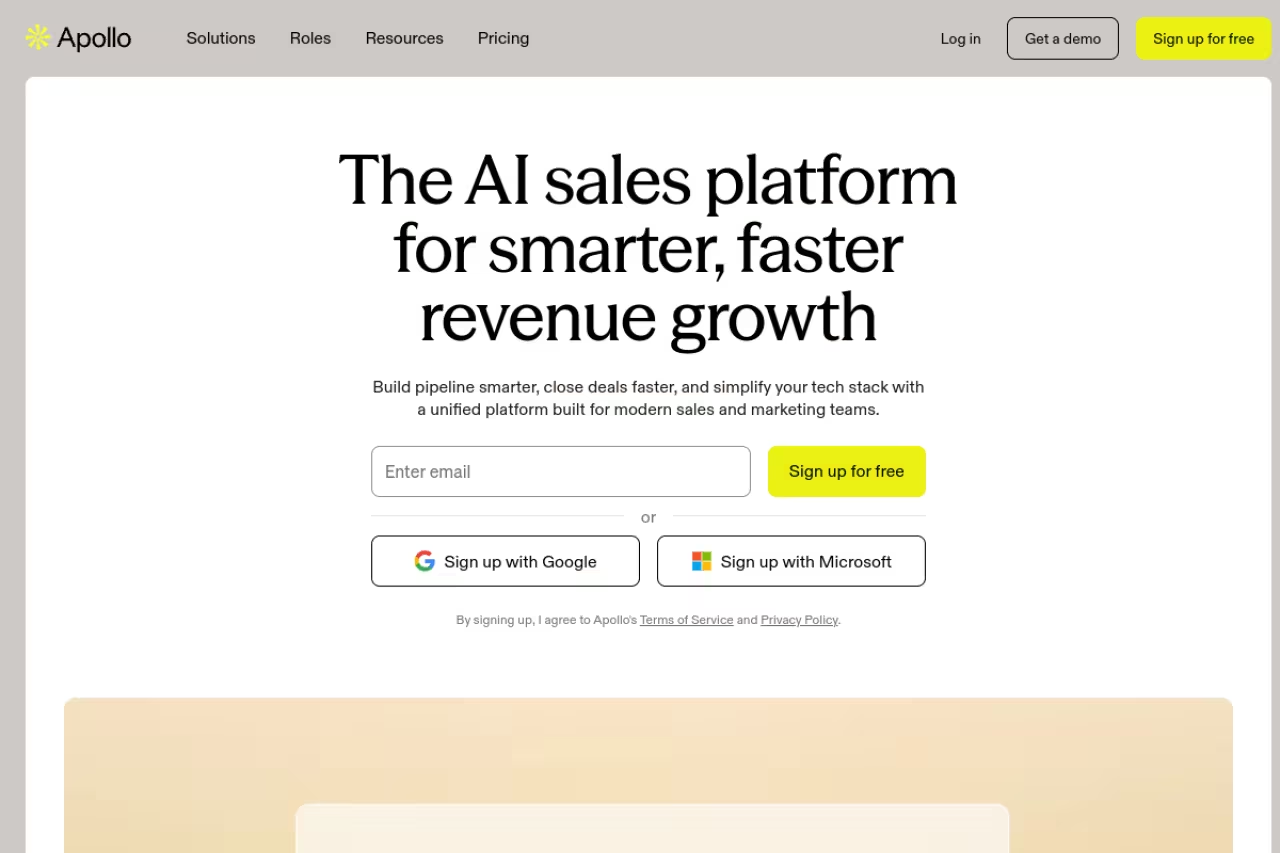
Apollo is the default starting point for most outbound teams, and for good reason: it bundles a 270M+ contact database, email and phone enrichment, and a sequencer into one tool. You build a list, verify contacts, and run multi-step sequences without stitching three subscriptions together.
Who it's best for: SMB and mid-market teams that want to start outbound fast without a complicated data stack. If you're a founder running your first outbound motion, this is the lowest-friction entry point.
The default starting point for SMB and mid-market teams, and the lowest-friction entry for a founder's first outbound motion. Apollo bundles data and sequencing in one tool, but accuracy varies by region and real spend can reach $150 to $400 per user.
Pricing is genuinely accessible. There's a free plan with 100 credits a month, then Basic at $49 per seat/mo, Professional at $79, and Organization at $119 (billed annually, three-seat minimum on Organization). Extra credits run about $0.20 each once you exhaust your allocation.
The standout is the all-in-one design. For under $100 a seat you get data and a sending engine that would otherwise be two separate vendors.
The catch: data accuracy varies by region and seniority. Apollo's coverage on US mid-level contacts is solid, but I've seen bounce rates climb on European data and senior executives. Active outbound teams also report real monthly spend of $150 to $400 per user once credit overages kick in, so the sticker price is not the full story. Always verify a sample before you blast a list.
Data enrichment and signals with Clay
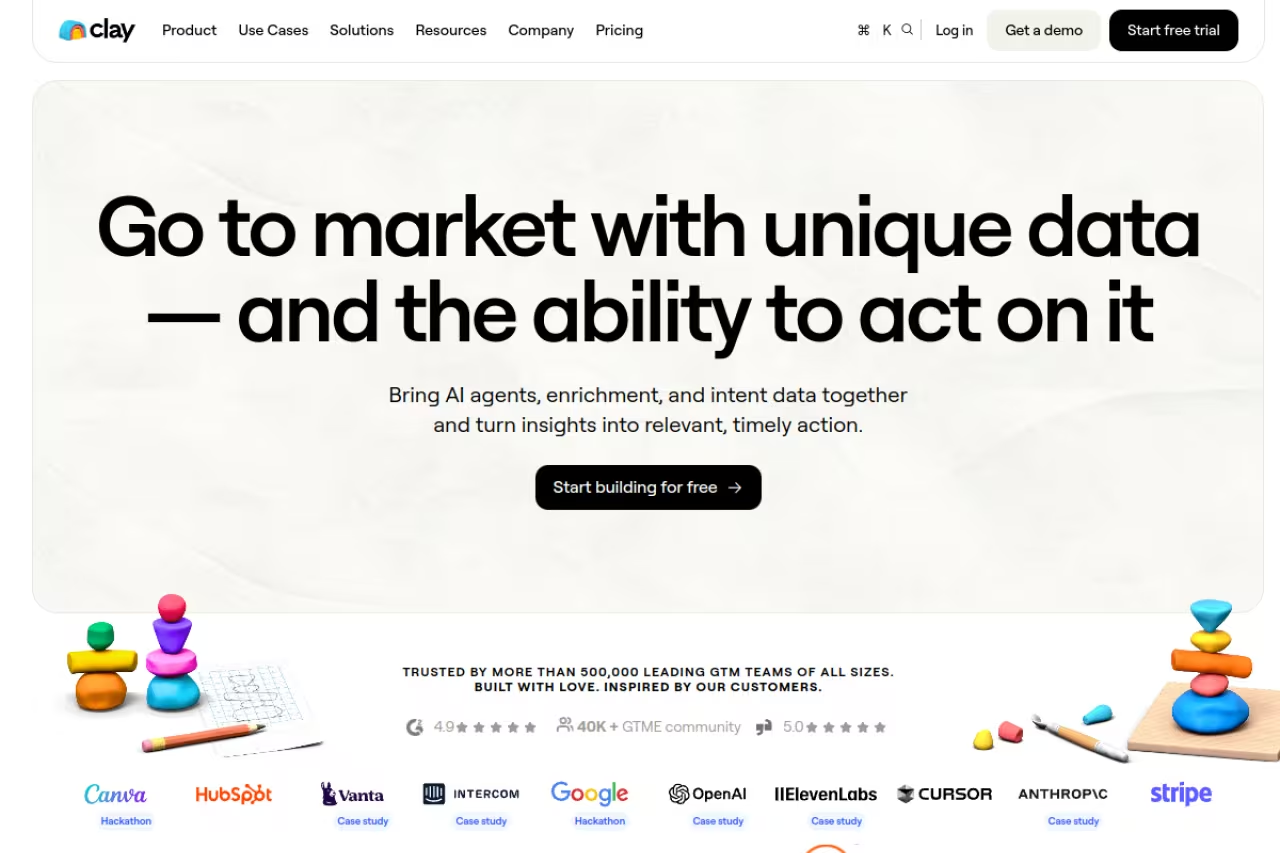
Clay is what your GTM team graduates to when "find the email" is no longer the hard part. It's a spreadsheet-style enrichment platform that chains dozens of data providers together (waterfall enrichment), runs AI research on each prospect, and triggers outreach off signals like job changes, funding rounds, or hiring spikes.
Who it's best for: technical, RevOps-minded teams that want to personalize at scale and act on intent signals instead of spraying the same template at 5,000 people.
Clay restructured its pricing in March 2026. The old Starter, Explorer and Pro tiers were replaced by Launch at $185/mo and Growth at $495/mo, with a free tier giving 100 data credits and 500 actions monthly. Growth unlocks CRM sync, HTTP API, and web intent data that used to require the $800 Pro plan.
The standout is depth. Nothing else lets you build a list, enrich it from ten sources, write a custom opener with AI, and push it to your sequencer in one table.
Clay is where a technical, RevOps-minded team graduates once personalizing at scale and acting on signals matters more than finding emails. It has a real learning curve and credits vanish fast, so start with Apollo and move over later.
Where it falls short: Clay has a real learning curve, and credits disappear faster than you expect. Teams running integrated campaigns often land at $495 to $800 a month for Clay alone, before the sequencer and CRM. It's overkill if you're sending 200 emails a month. Start with Apollo, move to Clay when personalization becomes your bottleneck. For a wider look at where Clay fits, see our roundup of the best AI lead generation tools.
LinkedIn outbound with Sales Navigator
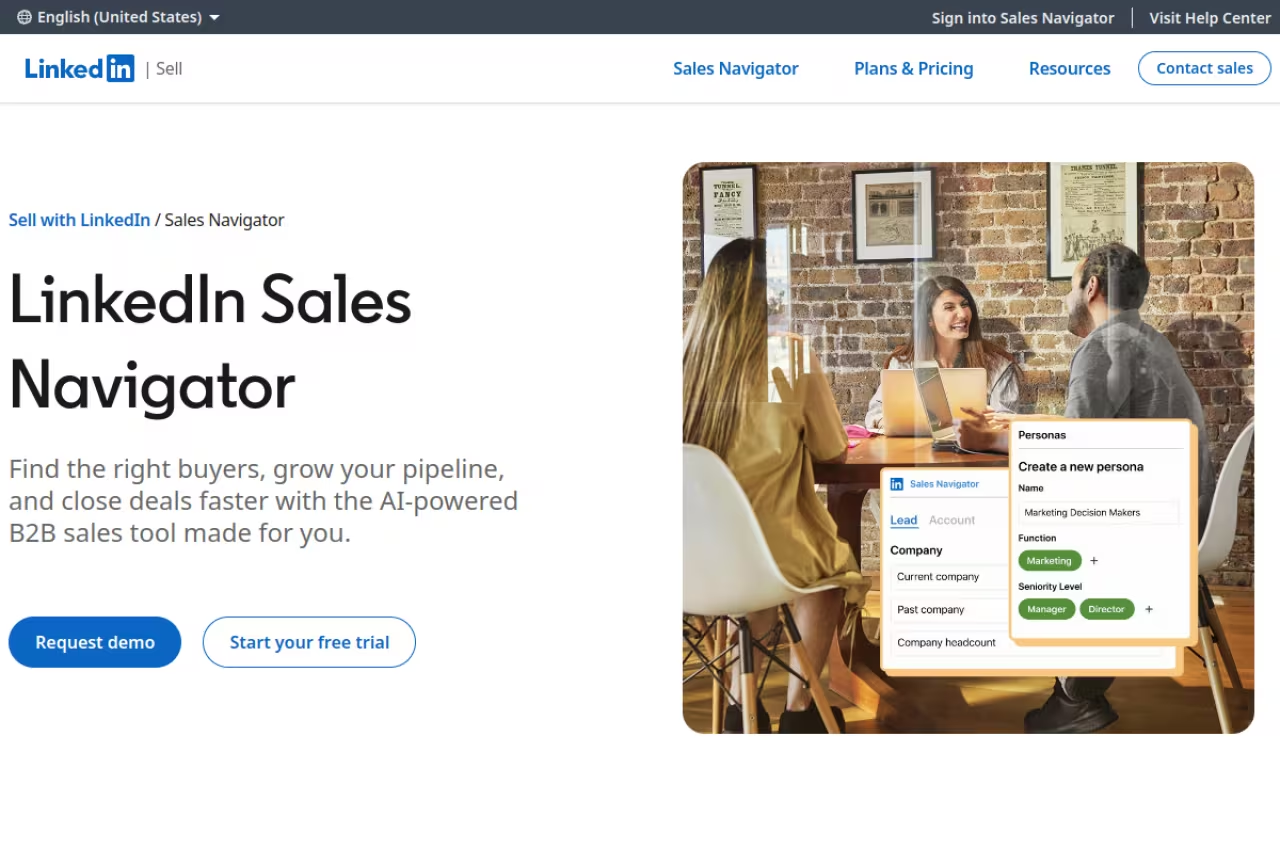
LinkedIn Sales Navigator is the channel I'd reach for first when the deal is big and the buyer is specific. It's the best person-level targeting on the market: filter by title, seniority, company headcount, recent job changes, and dozens of other firmographic and behavioral signals, then warm prospects up through real interaction before you ever pitch.
Who it's best for: high-ticket B2B ($10k+ ACV) where you're selling to named accounts and a handful of decision makers, not a broad list.
The Core plan runs about $99 per month per seat (roughly $90 billed annually, listed at $119.99 month-to-month). That's per seat, so a five-person sales team is a real budget line.
The standout is relationship-driven selling. LinkedIn outbound built on genuine engagement converts far better for complex deals than any cold email, because the buyer already half-knows you by the time you ask for time.
The catch: it doesn't scale through brute force. LinkedIn caps connection requests and messages, and the moment you automate aggressively you risk a restriction. This is a quality channel, not a volume one. It also pairs best with consistent content, which is a separate time investment.
The first channel to reach for in high-ticket B2B ($10k+ ACV) with named accounts and a handful of decision makers. Sales Navigator targets individuals better than anything else, but LinkedIn caps outreach, so it is a quality channel, not a volume one.
Website visitor identification with RB2B
Here's the channel most teams sleep on: the prospects already visiting your site. The vast majority leave without filling out a form, and visitor identification tools resolve who they were so you can follow up while intent is hot.
RB2B pioneered person-level identification for US traffic, pushing a named LinkedIn profile to your Slack the moment someone hits your pricing page. That's a warm signal you can act on the same day, and leads followed up within 24 hours convert several times better than cold ones.
Who it's best for: early-stage teams (under ~$3M ARR) that want to validate intent-based outreach before committing to a full platform. RB2B dropped its free plan and now starts around $149/mo, with Warmly as the natural step up (around $700/mo) once you want AI chat, buying-committee data, and automated outbound on top.
The standout is speed-to-lead on already-warm traffic. You're not finding new prospects; you're catching the ones who found you.
Where it falls short: match rates are US-heavy. RB2B resolves 60 to 75% of US traffic but only 10 to 25% globally, so if your audience is international, expect thinner data. A recent Gartner-led accuracy audit also found match quality varies widely between vendors, so test before you trust the numbers any tool advertises.
RB2B suits early-stage teams that want to validate intent-based outreach by catching prospects already visiting their site. Match rates are US-heavy, falling to 10 to 25% globally, and accuracy varies by vendor, so test before trusting it.
If you're spending money to drive traffic to your site, capturing the people who already showed up is the highest-ROI channel on this list. It's the cheapest pipeline you'll ever build. If your funnel starts with a free utility or content offer, our guides on interactive lead magnet examples and the free tool marketing strategy pair well with this.

High-volume cold email with Instantly
When outbound is a numbers game (low ACV, large addressable market), you need infrastructure built for volume and deliverability, not a CRM bolt-on. Instantly is the tool I see most often in that seat.
Who it's best for: agencies and teams sending thousands of emails a month who need many sending inboxes and a warmup network to keep them out of spam.
Instantly is modular. Outreach starts at $30/mo (Growth) for 5,000 emails, scaling to $77.60 (Hypergrowth, 25,000) and $286 (Light Speed, 500,000). The lead database and CRM are separate subscriptions, so a full setup (outreach + leads + CRM) starts around $124/mo.
The standout is unlimited connected inboxes on every tier plus a built-in warmup network. For deliverability at scale, that combination is hard to beat at the price.
Instantly is the tool for agencies and teams sending thousands of emails a month, with unlimited connected inboxes and a built-in warmup network. Volume without domain hygiene and list quality just torches your sender reputation.
The catch: cold email infrastructure is only as good as your domain hygiene and list quality. Volume without deliverability discipline just torches your sender reputation. Before you scale sends, read our breakdown of cold email deliverability in 2026, because that's where most volume outbound quietly dies.
Building outbound is a grind, and the operators who get it right stay current on the tools, signals, and tactics. That's exactly what we cover in Dupple X. If you'd rather skip the research treadmill, start a yearly trial and get the playbooks without the trial-and-error.
SEO and GEO content
Outbound buys you pipeline this month. SEO buys you pipeline for years. Content that ranks for the problems your buyers search keeps generating leads long after you publish, at a cost per lead that drops every month it stays live.
What's changed in 2026 is GEO (generative engine optimization). Buyers increasingly start in ChatGPT, Perplexity, and Google's AI overviews, not the classic ten blue links. Content now has to be structured to be cited by those engines, which means clear answers, real data, and schema, not keyword stuffing.
Who it's best for: businesses with longer sales cycles where buyers research heavily before talking to sales. If your average deal takes three months to close, content is doing work the whole time.
There's no subscription "price" beyond your time and a few tools (an SEO suite, a writer or two). The standout is compounding economics: the article you publish today can still book demos in 2028.
The long game for businesses with long sales cycles and heavily researching buyers: content compounds, and a post published today can still book demos years later. It is slow, six to twelve months before meaningful volume, so skip it if you need pipeline next week.
The catch: it's slow. Expect six to twelve months before SEO produces meaningful volume, and it rewards consistency over bursts. It's the wrong channel if you need pipeline next week. For the playbook, see our B2B tech lead generation guide.
Webinars and live events
Webinars produce the warmest leads of any channel on this list, full stop. Someone who gives you 45 minutes of attention is far closer to buying than someone who clicked an ad. The trade-off is that they're labor-intensive and don't scale on their own.
Who it's best for: high-ticket, education-heavy sales where buyers need to understand a category before they'll commit. Security, fintech, and developer tooling all do well here.
Webinars produce the warmest leads here, ideal for high-ticket, education-heavy sales like security, fintech and developer tooling. They are labor-intensive and only work if you already have an email list, social following or paid distribution to fill seats.
Cost is mostly your time plus a webinar platform. The standout is qualification: attendees self-select by topic, so the leads arrive pre-segmented and genuinely interested.
The catch: a webinar with no audience is just you talking to yourself. This channel only works if you already have an email list, a social following, or paid distribution to fill seats. Pair it with the channels above rather than treating it as a cold-start engine.
Paid search with Google Ads
When someone types "best [your category] software" into Google, they're telling you they're ready to buy. Paid search captures that bottom-of-funnel intent instantly, which is why it earns a spot despite rising costs.
Who it's best for: products with clear, high-intent search demand and enough margin to absorb competitive CPCs. If nobody searches for what you sell, this channel can't help you.
Paid search captures bottom-of-funnel intent at the exact moment buyers look, so use it where search demand is clear and margins absorb competitive CPCs. Crowded B2B keywords are expensive, and a sloppy landing page wastes every click.
Cost is entirely variable and depends on your category's competition. The standout is intent: no other paid channel reaches buyers at the exact moment they're looking.
The catch: B2B keywords in crowded categories are expensive, and a sloppy landing page wastes every click. Treat it as a way to capture existing demand, not create it, and make sure your conversion path is tight before you spend.
How to choose your channels
Don't try to run all eight. Pick based on three variables:
Deal size. Under ~$5k ACV, lean on volume channels: cold email (Apollo or Instantly) and SEO. Above ~$10k ACV, shift to relationship channels: LinkedIn outbound, webinars, and account-based plays. The economics only work one way.
Sales cycle. Short cycles reward channels that capture existing intent fast (visitor ID, paid search). Long cycles reward channels that nurture over time (content, webinars, email).
Time to pipeline. Need leads this month? Outbound and paid. Building a durable engine? SEO and content. Most healthy pipelines run one fast channel and one compounding channel in parallel.
If I were starting from zero today with a typical B2B software product, I'd run RB2B on the website, Apollo for outbound, and SEO content in the background. Three channels, two of them under $200 a month, covering warm inbound, proactive outbound, and long-term compounding. Add LinkedIn and webinars as your ACV climbs. For more on filtering for quality over volume, our guide to qualified leads for B2B SaaS goes deeper, and the best AI tools for sales prospecting covers the layer on top.
FAQ
What is the best B2B lead generation channel in 2026?
There isn't one universal best channel. For most teams under a few million in ARR, the strongest combination is website visitor identification (to capture warm inbound) plus targeted cold email (proactive outbound), with SEO content compounding underneath. Match the channel to your deal size and sales cycle rather than chasing whatever's trendy.
How much should B2B lead generation cost?
It varies wildly by channel. You can start outbound for under $200 a month with tools like Apollo ($49/seat) and RB2B ($149/mo). Volume cold email via Instantly starts at $30/mo. The expensive channels are paid search (variable CPC) and full platforms like Clay ($185 to $800/mo) or Warmly ($700/mo). Start cheap, prove the channel works, then scale spend.
Is cold email still effective for B2B in 2026?
Yes, but only with discipline. Cold email works when your list is well-targeted, your domains are warmed up, and your deliverability hygiene is tight. The teams getting blocked are the ones blasting generic templates from cold domains. Personalization (often via Clay) and deliverability setup matter more than raw volume now.
What's the difference between Apollo and Clay?
Apollo is an all-in-one prospecting tool: contact database plus sequencer, ideal for getting outbound running fast. Clay is a data enrichment and signal platform that chains many data sources together and personalizes at scale, but it doesn't send for you. Most teams start on Apollo and add Clay when deep personalization becomes the bottleneck.
How fast can a new channel produce leads?
Outbound and paid search can produce leads within days to weeks. Website visitor identification produces warm leads almost immediately if you already have traffic. SEO and content are slow, typically six to twelve months before meaningful volume, but cheapest per lead long term. Run one fast channel and one slow channel at the same time.
Do I need a full sales stack to start?
No. A founder can start with one data-and-sending tool (Apollo's free or $49 tier) and a visitor ID tool on the website. Add a CRM and enrichment layer once you have consistent volume and need to manage follow-up systematically. Buying a heavy stack before you have process is a common and expensive mistake.
Related guides
Some offers on this page may be paid placements or contain affiliate links.
Across our whole catalogue the median is $24 a month and 33% of tools advertise a free tier. Figures are the lowest recurring monthly price quoted in our own review of each tool, read on 2026-08-19. Full method and every category.
