What Polymarket Actually Is
Polymarket is a prediction market where people buy and sell shares tied to the outcome of real-world events, from elections and interest-rate decisions to sports results and crypto price levels. Each share settles at either $1.00 or $0.00 once the event is decided, so the price you pay along the way (say $0.53) reads directly as the market's estimate of a 53% probability. Instead of a sportsbook setting odds against you, you trade peer to peer with other participants on an open order book.
It runs on the Polygon blockchain and uses pUSD, an ERC-20 stablecoin backed one-to-one by USDC, as its collateral and settlement currency. That structure lets anyone with a wallet fund an account, take a position, and exit before resolution without asking a house for permission. Traders outside the United States use polymarket.com, while US residents trade on the separately regulated polymarket.us exchange.
Try Polymarket Get started →A Live, Tradable Probability for Almost Anything
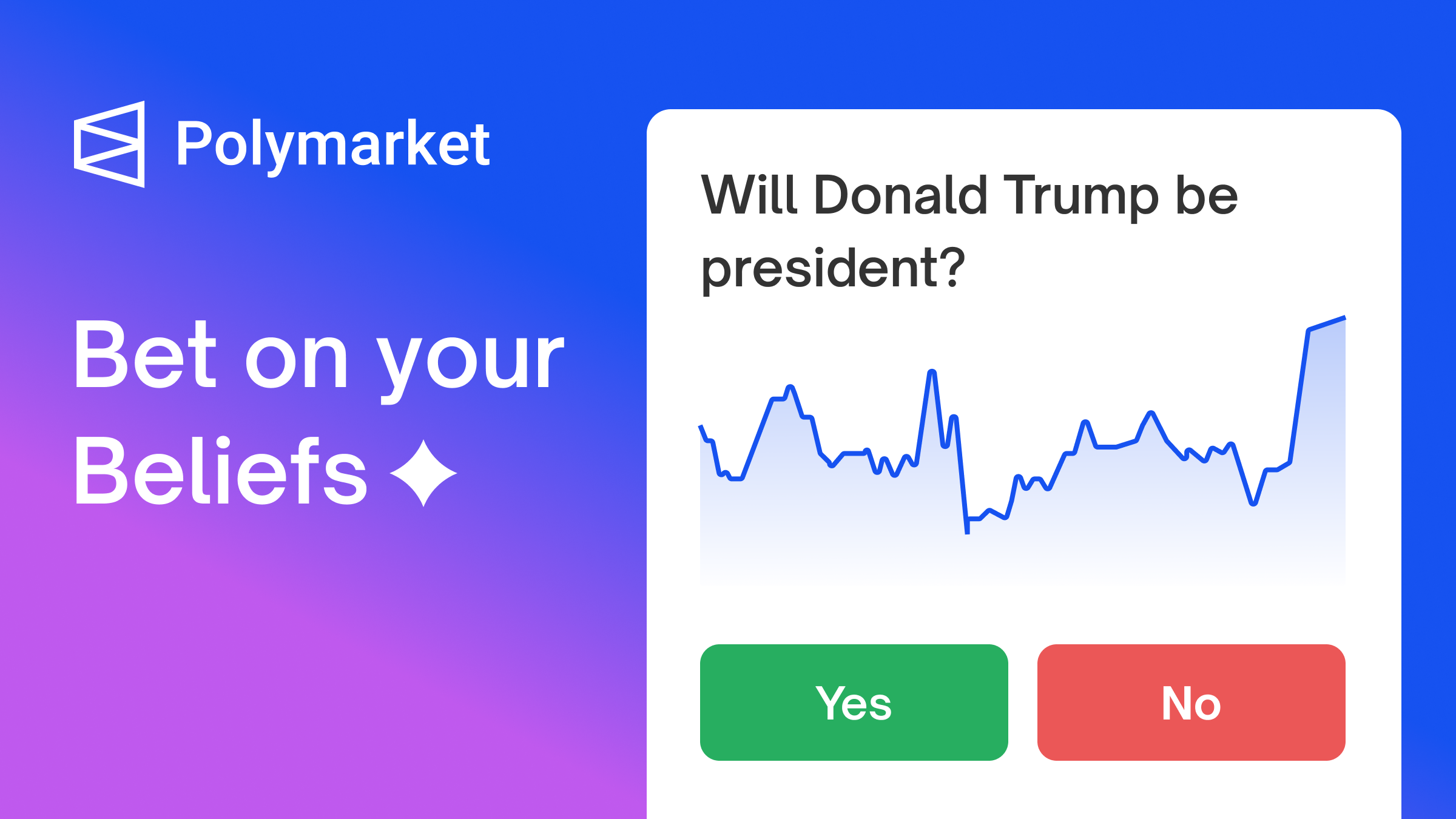
The feature that defines Polymarket is that it converts an open question about the future into an asset you can price and trade in real time. Every market is built from a $1 pUSD deposit that mints one Yes share and one No share. Because the two must add up to $1.00, the price of the Yes share is the market's live probability of the event happening. When new information lands, prices move within seconds, and a market trading at 71 cents on Yes is telling you the crowd now sees a 71% chance.
Orders are matched on a central limit order book (CLOB), so you are trading against other participants rather than a bookmaker. You can enter with a market order, set a limit order at the exact price you want, and close a position at any point before the event resolves rather than waiting for the outcome. Many questions are a simple Yes or No, but Polymarket also runs multi-outcome markets (for example, several candidates in one race), each priced as its own share so the field reflects a full distribution of probabilities rather than a single line.
What Else It Does
Thousands of markets across many categories
Polymarket lists active markets across politics, economics, finance, crypto, sports, tech, culture, weather, and world events, with new questions added constantly as news breaks. Depth ranges from long-horizon markets like the 2028 US presidential race, which has carried more than $1 billion in volume, down to fast markets that resolve in five minutes on where Bitcoin trades next. High-profile events attract deep liquidity, with individual markets such as a Federal Reserve rate decision drawing millions of dollars in trading.
Self-custody wallets and USDC-backed collateral
Funds live in a wallet you control rather than a company-held balance. New accounts receive a deposit wallet, and existing Safe or proxy wallet users can keep their current setup. Collateral is pUSD, a stablecoin backed one-to-one by USDC and enforced through smart contracts, so the value of your balance does not swing with crypto volatility. Deposits arrive as USDC on Polygon, which keeps transaction costs low and settlement fast compared with trading directly on Ethereum.
Resolution through the UMA optimistic oracle
Markets do not settle on Polymarket's say-so. Outcomes are resolved by the UMA optimistic oracle, where a proposer submits the result with a bond and a challenge window lets anyone dispute it. If a result is contested, UMA token holders vote to decide it, and the winning side redeems each share for $1 pUSD. This on-chain, adversarial process is designed to keep resolution neutral, though it also means edge-case or ambiguously worded markets can take longer to finalize.
Live odds, news, and portfolio tracking
Each market page pairs current prices and probability charts with related news articles, the order book, and a comment thread, so you can see both the number and the context behind it. A portfolio view tracks your open positions, cost basis, and profit or loss, and public leaderboards surface the largest and most active traders. The result feels closer to a trading terminal for real-world events than to a betting slip.
Pricing
Pricing checked against Polymarket's own site. Plans and limits change, so confirm before you buy.
Polymarket has no subscription and no charge to create an account or fund a wallet. The cost of using it comes from trading fees and blockchain network fees, not a monthly plan. Makers who post limit orders pay 0% and can earn a rebate worth 20% of the taker fees their orders help fill. Takers who cross the spread pay a fee that varies by category on the international platform, currently ranging from 0.75% on sports up to 1.80% on crypto, with geopolitics markets free of taker fees. The US-regulated polymarket.us exchange uses a simpler flat schedule: a 0.30% taker fee with a 0.20% maker rebate.
Deposits and withdrawals carry no platform fee. You pay only network gas, which is a fraction of a cent for moving USDC on Polygon and can rise to a few dollars or more if you bridge funds to Ethereum during congestion.
- Account and deposits: free to join, no subscription, self-custodied wallet.
- Maker orders: 0% fee, plus a rebate of 20% of related taker fees.
- Taker fees (international): roughly 0.75% to 1.80% by category, geopolitics free.
- US exchange (polymarket.us): flat 0.30% taker fee with a 0.20% maker rebate.
Who It Is For
Polymarket fits people who follow news, politics, sports, or crypto closely and want to put a defined-risk position behind a view, with the maximum loss capped at what they paid per share. It rewards traders who are comfortable with self-custody wallets and stablecoins, and who value being able to exit a position early rather than holding to resolution. Analysts, journalists, and researchers also lean on it as a real-time gauge of crowd expectations, since the prices double as a probability feed that updates faster than most polls or forecasts.
It is a weaker fit for anyone who wants a casual, fiat-only tap-to-bet app, or who is uncomfortable managing crypto. US users should note they are directed to the regulated polymarket.us exchange, and everyone should treat positions as speculative and only commit money they can afford to lose. Availability also depends on the rules in your jurisdiction.
Is Polymarket free to use?
There is no subscription or account fee, and posting limit orders as a maker costs 0%. You pay a taker fee when you cross the spread, which ranges by category on the international platform and is a flat 0.30% on the US exchange, plus small network gas fees for deposits and withdrawals.
How do Polymarket prices work?
Each share pays $1.00 if the outcome happens and $0.00 if it does not, so a price of $0.60 reflects a 60% implied probability. Prices move as traders buy and sell on the order book, and you can sell a position back at any time before the market resolves.
What currency does Polymarket use?
Markets are collateralized in pUSD, a stablecoin backed one-to-one by USDC, and the platform runs on the Polygon network. You deposit USDC into a wallet you control rather than handing funds to a house account.
How are Polymarket markets resolved?
Resolution runs through the UMA optimistic oracle. A proposer submits the outcome with a bond, a challenge period allows disputes, and contested results are decided by UMA token holder votes before winning shares redeem for $1 each.
Can I use Polymarket in the United States?
US residents cannot trade on polymarket.com and are directed to polymarket.us, a separately regulated exchange with its own flat fee schedule. Access elsewhere depends on local rules, so check what applies in your jurisdiction before funding an account.