What Is Leadfeeder?
Leadfeeder (now part of Dealfront) is the B2B website visitor identification platform that reveals which companies are visiting your site even when individual visitors do not fill out forms. Founded in 2012 in Helsinki, Leadfeeder serves over 60,000 B2B teams with company-level visitor data, intent signals, and CRM integration.
The pitch is anonymous traffic intelligence. Most B2B visitors browse before converting. Leadfeeder identifies the companies behind those visits, shows what pages they viewed and for how long, and pushes qualifying accounts to sales. Sales teams reach out to interested accounts before competitors do.
The technology matches IP addresses to company records using IP-to-company databases plus traffic pattern analysis. Coverage is strongest for office-based traffic in North America and Western Europe. Identification rates typically run 30-60% of total B2B traffic depending on industry and geography.
Try Leadfeeder Free Get started →How Leadfeeder Works
Install the tracking script on your website. Leadfeeder identifies visiting companies and shows them in the dashboard with detailed visit data: pages viewed, time on site, repeat visits, traffic source, and a calculated lead score based on engagement signals.
Visitor companies enrich with firmographic data: industry, employee count, revenue range, location, key contacts. For each visiting company, Leadfeeder can suggest sales contacts who match common decision-maker profiles (CMOs at SaaS companies, VPs of HR at enterprises, etc.).
Filters and feeds organize visitor traffic for sales workflows. Build a feed for "Enterprise companies in fintech who visited the pricing page twice" and assign to your enterprise SDR. Other feeds route mid-market visitors to inside sales or marketing for nurture campaigns.
CRM integration pushes companies to Salesforce, HubSpot, Pipedrive, and others. New visits create accounts; existing accounts get visit history logged. Sales reps see in their CRM that an account visited the site recently with what content they engaged.
Slack and email alerts notify teams when high-value accounts visit. Set rules like "If a company with 500+ employees visits the demo page, post to #sales-hot in Slack."
Leadfeeder Pricing in 2026
Free: 7-day visitor view, basic features, up to 100 identified companies. Trial-grade.
Paid: From €99/month annually, scaling by the number of unique identified companies per month. Higher tiers (€299-€799+/month) include more identified companies, longer history, advanced filters, and team features.
Dealfront acquired Leadfeeder in 2022 and now bundles it with Dealfront's broader sales intelligence platform (contact data, account scoring, intent signals). Pricing for the bundled product runs higher than standalone Leadfeeder.
See Leadfeeder Plans See plans →Where Leadfeeder Wins
- Established product: 12+ years of iteration on the identification algorithm.
- CRM integration depth: native Salesforce, HubSpot, Pipedrive, and Zapier.
- Lead scoring: configurable rules surface highest-intent companies.
- Slack and email alerts: real-time notifications for hot accounts.
- Privacy-aware: company-level identification (not person-level) keeps GDPR posture clean.
Where It Falls Short
- Identifies companies, not people: tells you what company visited, not which person. Person-level products (RB2B) do this for US visitors but with GDPR implications.
- Identification rate varies: home-office traffic, mobile traffic, and traffic from small companies often identifies poorly.
- Pricing climbs fast: high-volume sites pay significant monthly fees for identified company quotas.
- Some accuracy issues: occasional misattributions, especially for shared IP ranges.
Leadfeeder vs RB2B vs ZoomInfo WebSights vs VektorOS
RB2B identifies individual people visiting (US-only). More aggressive on identification, more GDPR risk for non-US use.
ZoomInfo WebSights bundles with ZoomInfo's broader sales intelligence. Better if you already use ZoomInfo for contact data.
VektorOS is the AI-focused alternative with scoring and outreach automation.
Albacross and Lead Forensics are similar European competitors.
Who Should Use Leadfeeder
B2B SaaS marketing teams with content-driven inbound: identify which target accounts engage with content before they fill out a form.
Account-based marketing programs: track target account engagement across the website.
Sales teams in EU with GDPR concerns: company-level identification clean from a compliance standpoint.
Skip it if: your traffic is mostly consumer or mobile (identification rate too low), you need person-level US identification (use RB2B), or you only have low traffic volumes (not worth the subscription).
How Leadfeeder works
Leadfeeder is B2B website visitor identification. It tells you which companies visited your site, which pages they looked at and how engaged they were, without any of those visitors filling in a form. It matches visitor IP addresses against a company database the vendor sizes at 60M companies and 400M verified contacts, and claims identification of up to 45% of the companies in your traffic. Beyond identification, it now also sells audience building (define an ICP with 100+ filters and push it to paid, organic and ABM channels), campaign attribution, and contact-level enrichment with intent signals.
You paste a tracking script on your site, a step the vendor claims takes about four minutes. From there the core unit of work is the feed: a saved filter over incoming visits, built from 50+ behavioural and firmographic criteria such as pages viewed (a pricing-page feed is their canonical example), visit duration, traffic source, industry, company size and location. Feeds fire real-time notifications to email or Slack, and qualified companies sync automatically to your CRM.
Integrations named on the site are Salesforce, HubSpot, Pipedrive, Zoho, Microsoft Dynamics, Looker Studio, Gong, Zapier and Slack. On paid tiers you can drill from a company into a contact database with emails, phone numbers and LinkedIn profiles, filterable by role and seniority. Tracking is company-level by default for GDPR reasons, and individual-level tracking only kicks in once a visitor self-identifies through a form or an email integration.
Where Leadfeeder wins
- Identification with no form fill, and the site is unusually candid that the IP-to-company database turns over about 20% monthly, an honest acknowledgement that this data decays and has to be maintained.
- The free Lite plan is free forever rather than a trial, and notably includes unlimited users, so a whole sales team can look at the data.
- Feeds plus Slack and email alerts make it a live prompt for salespeople rather than a report someone has to remember to open.
- CRM coverage is broad for the category: Salesforce, HubSpot, Pipedrive, Zoho and Microsoft Dynamics are all named, with Zapier covering the rest.
- Contact-level enrichment sits in the same product (email, phone, LinkedIn, filterable by seniority), so you are not buying a separate data vendor just to action the accounts.
- Company-level-by-default tracking is a defensible GDPR posture for European sellers.
Where it falls short
- The free Lite plan is close to a demo: the last 100 companies per month and only 7 days of visitor history, so no trend analysis and no chance of catching a slow-moving account.
- The real product starts at €79/mo (annual) for Discover, and the features most buyers actually want sit higher: verified contact enrichment and intent filtering need Discover, AI list enrichment and CRM automation need Activate at €369/mo annual (€527 monthly), and unlimited identification plus automatic CRM enrichment need Scale at €599/mo.
- Scale is annual-billing only, so there is no low-commitment way to test the top tier.
- Pricing scales on two axes at once, identified companies per month and enrichment or activation credits, which makes forecasting the bill harder than a flat seat price.
- IP-based identification structurally misses consumer ISPs, VPNs and much home and mobile traffic. The vendor's own 45% figure is a ceiling, not a typical result.
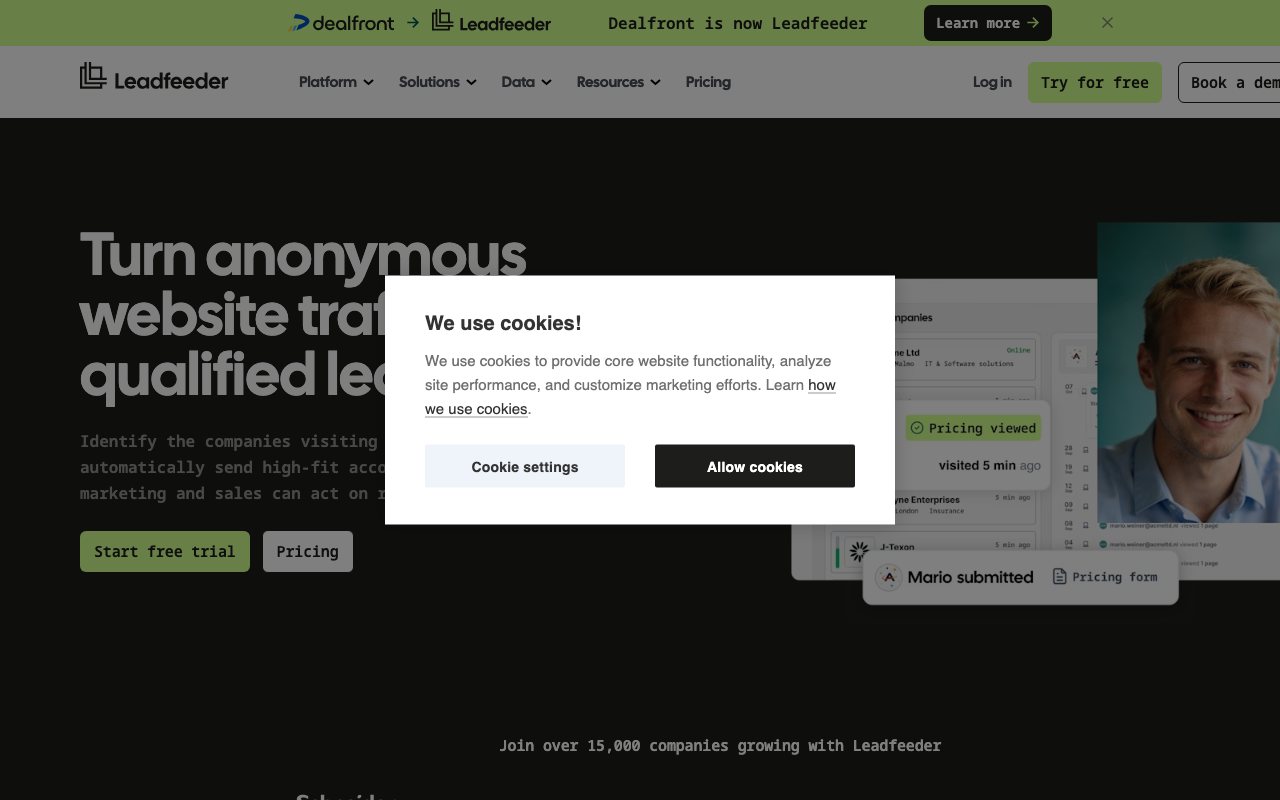
- Brand instability is a genuine buyer risk. Leadfeeder merged with Echobot in 2022, became Dealfront in April 2023, then consolidated back to the Leadfeeder name in 2025-26. Documentation, contracts and third-party integrations may still carry the Dealfront name.
Who should use Leadfeeder
B2B teams with meaningful, non-consumer website traffic and a defined ICP, where a salesperson will actually act on a pricing-page alert the same day. It suits mid-market and enterprise sellers with long cycles and a CRM already in place, and European sellers who need the company-level GDPR posture.
Skip it if your traffic is B2C or heavily mobile, because IP matching will barely fire. Skip it too if you have too little traffic to fill a feed, or if nobody is staffed to work the alerts, in which case you are paying €79-599 a month for a dashboard nobody opens.
Frequently Asked Questions
Is Leadfeeder GDPR compliant?
For company-level identification, yes. Person-level data is not collected.
What is the identification rate?
Varies by industry and geography. B2B SaaS sites typically see 30-60% of traffic identified to a company.
Does it work with HubSpot?
Yes, native bidirectional integration.
How accurate is the company identification?
High for unique IP addresses from corporate offices. Less reliable for ISP traffic, mobile, and shared IPs.
Can I export visiting companies to CSV?
Yes on paid plans.